The Coldest Girl in Coldtown – Holly Black

Thank goodness for Holly Black — she’s put the bite back into vampire fiction.coldest  If you’ve been playing the home game, you’ll know that Stephenie Meyer pretty much took fangs and sex out of the vampire equation with her hugely popular Twilight series.  I didn’t hate the first book, but it went downhill fast afterwards. I loved The Coldest Girl in Coldtown. The prose sparkles, but the vampires don’t, so it’s win-win for lovers of vampire fiction.

Tana woke lying in a bathtub.

It doesn’t take very long for Tana and the reader to realize that something just isn’t right. Tana had been attending a sundown party and had locked herself in the bathroom to avoid her ex boyfriend, Aidan. Exiting the bathroom the morning after, Tana is aware of the quiet.

She’d been to plenty [of sundown parties], and the mornings were always full of shouting and showers, boiling coffee and trying to hack together breakfast from a couple of eggs and scraps of toast.

What Tana finds instead, as she moves through the house which smells of spilled beer and “something metallic and charnel-sweet,” are the bodies of her classmates “their bodies pale and cold, their eyes staring like rows of dolls in a shop window.”  And we’re only on page five, people!

The Coldest Girl in Coldtown takes the best parts of standard vampire mythology and ups the ante. The vampires in this book are rock stars, revered and coveted.  Black builds a mythology that is believable. Patient zero in Black’s world is Caspar Morales, a vampire who decided that he wouldn’t kill his victims, he’d infect them instead. Essentially, you’re bitten by a vampire, you’re infected, or Cold.

If one of the people who’d gone Cold drank human blood, the infection mutated. It killed the host and then raised them back up again, Colder than before. Cold through and through, forever and ever.

Pretty soon, the government has no choice but to barricade the infected people (and the wannabes) in places called Coldtowns. People who suspect that they are infected must,  by law, turn themselves in. And once you’re in a Coldtown, there’s no getting out.

As Tana comes to terms with the fact that her friends are dead, she discovers that Aidan is, in fact, not. He’s been bungee corded to a bed and chained beside him is a vampire boy, a boy who “must have been handsome when he was alive and was handsome still, although made monstrous by his pallor and her awareness of what he was.”

This is Gavriel. He is everything a vampire should be: dangerous, cunning, tortured and impossible to resist. (Okay, maybe I am just a little bit fixated on my personal notion of a vampire here, but Gavriel ticks all the vampire ticky boxes for me. )

The Coldest Girl in Coldtown is so good. Tana is smart and resourceful and brave. The book builds a world that is believable and terrifying. It is a world that just is. The book isn’t scary, but it is definitely a page-turner. The descriptions of vampirism are bloody and sensual (without being over-the-top, so there’s nothing sexually graphic).

I raced to the end, concerned for all the characters and their fates.  Should there be a sequel?  Black had this to say on her website:

Coldest Girl in Coldtown was written as a stand-alone. That said, I know what happens next, and maybe someday you will too. Right now, as with Curse Workers, I’m happy with where I left everyone. I’m sure they’ll be fine. Right?

I’m good with that.

Highly recommended.

Through the Woods – Emily Carroll

throughwoodsJust in time for Hallowe’en comes Canadian author Emily Carroll’s book, Through the Woods, a collection of chilling short stories. The stories would be quite enough on their own, but Carroll ups the ante with amazing art work. As far as graphic literature goes, Through the Woods goes to eleven. (Yes, yes I did just use a Spinal Tap reference.)

There are five stories in Carroll’s collection and each one of the stories feels vaguely old-fashioned. The monsters that live on these pages have been around for a very long time.

In the first story “Our Neighbor’s House,” Mary is left in charge of her two younger sisters, Beth and Hannah, while her father goes off to hunt. Their father tells them “I’ll be gone for three days…but if I’m not back by sunset on the third day, pack some food, dress up warm, and travel to our neighbor’s house.” When their father fails to return, things go from bad to worse in short order.

In the final story, “The Nesting Place, ” Bell, short for Mabel,  spends her school holidays with her older brother, Clarence, and his wife, Rebecca, at their isolated country house. Bell is a solitary child and she takes little interest in socializing with her brother. The only other person at the house is the housekeeper who warns Bell not to venture into the woods because she could easily become lost as Rebecca once had, “found three days later at the bottom of a cave…three days all alone in the dark drinking water out of a fetid pool to stay alive.” Rebecca, as Bell is soon to find out, has been deeply changed by that experience. And not in a good way.

woods

The stories between the first and last are every bit as unsettling. Dreams and teeth and blood and beasts loom large in this collection.Carroll’s illustrations are saturated with primary colours: blood-red moons and sapphire blue rivers. I don’t know much about art, but Through the Woods is a beautiful book to look at – if slightly macabre.

See more of Carroll’s work at her website.


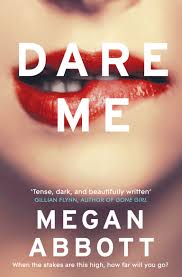
Dare Me – Megan Abbott

daremeWe have cheerleaders at the high school where I teach, but they’re sure as hell not like the cheerleaders in Megan Abbott’s compelling YA novel, Dare Me. These girls are vicious.

Addy Hanlon is the  narrator of this sordid tale.

There I am, Addy Hanlon, sixteen years old, hair like a long taffy pull and skin tight as a rubber band. I am on the gym floor, my girl Beth beside me, our cherried smiles and spray-tanned legs, ponytails bobbing in sync.

Her ‘girl’ is Beth Cassidy, an acerbic teen who spits out insults like bullets. Beth and Addy have been besties since they were young enough to “hang on the monkey bars, hooking [their] legs round each other.” Now they rule their school, part of a cheer squad that makes boys go weak in the knees and girls run for cover when they swagger down the hall, an impenetrable mass of venom.

Ages fourteen to eighteen, a girl needs something to kill all that time, that endless itchy waiting, every hour, every day for something – anything – to happen.

The social order of things is thrown into disarray, though, when the squad gets a new coach.

The New Coach. Did she look at us that first week and see past the glossed hair and shiny legs, our glittered brow bones and girl bravado? See past all the that to everything beneath, all our miseries, the way we all hated ourselves but much more everyone else? Could she see past all that to something else, something quivering and real, something poised to be transformed, turned out, made? See that she could make us, stick her hands in our glitter-gritted insides and build us into magnificent teen gladiators.

Colette French is demanding. On the second day she “takes a piece of Emily’s flab in her fingers” and tells her to “fix it.” The girls discover they can’t fluster her, that she is already bored with their nonsense. Then, Coach dismisses Beth as captain, saying that she doesn’t “see any need for a captain.”

Addy knows Beth’s response, when it comes, will change everything, and it does.

Dare Me is a riveting look at the world of girls on the cusp of adulthood and the woman who allows them a glimpse of what waits for them on the other side. There are no parents here, no sane adults to pull back the reins. Even Coach, who seems dazzling and perfect to the cheerleaders, is soon revealed as damaged and flawed. Addy is particularly taken with Coach and as their relationship morphs into something more intimate, Addy realizes she’s been “waiting forever, my palm raised. Waiting for someone to take my girl body and turn it out.”

I can’t express how  terrific this book is. The writing is dazzling; it was like a mouth full of pop-rocks, you know that candy that fizzes in your mouth? Watching Addy try to navigate her sixteenth year, despite the fact that the world of cheer-leading is totally alien to me, was a thing of horrible beauty.

Highly recommended.

The Lantern – Deborah Lawrenson

lantern If you’ve ever been to Provence, I suspect you’ll recognize the lush and aromatic landscape Deborah Lawrenson describes in her novel The Lantern. I’ve never been, but after reading this gothic romance, I’d love to go.

…the lavender fields, sugar-dusted biscuits, wild-flowers in meadows, the wind’s plainsong in the trees, the cloisters of silver-flicking olives, the garden still warm at midnight

The Lantern is two stories in one, stories that share Les Genevriers, an abandoned house in southern France. In one story we meet Benedicte, the youngest of three children who grows up in the house back when it was a working farm. In the other we meet Dom and an unnamed narrator, who is affectionately called ‘Eve,’ who have recently purchased Les Genevries with a view to restoring it to its former glory.

Eve is a twenty-something translator who meets Dom, a forty-something composer, in Switzerland, in a maze – which is prescient, as her life suddenly becomes a tangle of wrong turns and dead ends. She is instantly smitten with him and he seems to return the affection. When they return to London, Eve says “I tried to play it cool. So did he. But we both knew.” Their whirlwind romance eventually takes them to France and Les Genevries.

That summer, the house and its surroundings became ours. Or, rather, his house; our life there together, a time reduced in my memory to separate images and impressions: mirabelles – the tart ornage plums like incandescent bulbs strung in forest-green leaves; a zinc-topped table under a vine canopy; the budding grapes; the basket on the table, a large bowl; tomatoes ribbed and plump as harem cushions; thick sheets and lace secondhand from the market, and expensive new bed covers that look as old as the rest; lemon sun in the morning pouring through open windows; our scent in the linen sheets. Stars, the great sweep of the Milky Way making a dome overhead. I have never seen such bright stars, before or since.

Sounds romantic, eh? But it’s also isolated and when Dom starts to behave strangely and Eve starts to smell things and see things that aren’t actually there, The Lantern  crosses over into gothic territory. There’s also, as it turns out, an ex-wife whom Dom doesn’t want to talk about and a real estate agent in the local town who does. The plot thickens.

Then there’s Benedicte. She lives her whole life at Les Genevries. Her story, and that of her blind sister Marthe and malevolent brother, Pierre, weave throughout Eve’s narrative and make up some of the “many stories about the place.” As an old woman living in Les Genevries, Benedicte becomes convinced that she is being haunted. She sees her brother, Pierre, “standing, waiting expectantly in front of the hearth, silent, as if his intention was perfectly clear.” And then he is gone. Benedicte has never believed in ghosts, but it is hard to deny that Les Genevries is full of spirits.

Lawrenson does a fabulous job of weaving together the stories of Eve and Benedicte, their connection to Les Genevries and of making Provence jump off the page. The novel is creepy, clever and compelling and a lot of fun to read.

Highly recommended.

Life After Life – Kate Atkinson

life-after-life-“What if we had the chance to do it again and again, until we finally did get it right? Wouldn’t that be wonderful,” says Teddy to his big sister, Ursula, the unusual main character of Kate Atkinson’s even more unusual novel Life After Life.

Ursula is born  in February, 1910. She dies and is born again. And again. Attempting to piece these multiple lives into any sort of coherent order is damn near impossible so I suggest you don’t even try. It’s far easier to just be with Ursula as she is born, grows up and then grows up again, each time encountering different possibilities based on life’s many variables. The reader is dropped into Ursula’s life at different points, just as she seems to be. Ursula hits the ground running, and eventually – with a little bit of attention paid –  so does the reader.

Ursula is a fine character with which to spend your time. She was “born with winter already in her bones” and when winter comes around again she “recognized it from the first time around.” It is through her eyes we see her parents: her perfect and beloved father, Hugh and her slightly snippy mother, Sylvie. When she is born she already has two older siblings, Maurice and Pamela, and then her arrival is followed by Teddy and James. The siblings and their parents live at Fox Corner, an English estate. Her lives and deaths flow almost seamlessly together, darkness falls and she is no more until she is again – still with the same family, still Ursula.

I don’t pretend to understand the novel’s finer points (it would take at least another reading), but I can say this: Life After Life clocks in at almost 500 pages and it was a joy to read. Sometimes Ursula makes choices which are ultimately detrimental to her well-being. One bad decision tips the balance and causes her life to spin out of control.  It’s only human to wonder how things might have been different if only… Other times her life is better, but not perfect. People suffer and die. World War I and then II upset the status quo.

There is a part of Ursula’s conscious that recognizes that her life seems to be on repeat. Her mother tells her it’s déjà vu, “a trick of the mind.” Dr. Kellet introduces her to the word “reincarnation” when she is just ten. But explanations are not necessary for Ursula or the reader. And although not every version of her life is a joy to read about, each one is as compelling as the next. Perhaps Ursula knows instinctively that ” If there’s no great glorious end to all this, if nothing we do matters… , then all that matters is what we do. ‘Cause that’s all there is. What we do. Now. Today. ” (Thanks for that quote, Joss Whedon! From the Angel episode “Epiphany.”)

It might be interesting to consider that Atkinson is also playing with the notion of novelist as God. Of course a novelist really does have the opportunity to make anything they want to happen to their characters happen. They don’t however, under normal circumstances, make every scenario occur in the same novel. If this was an experiment for Atkinson, it paid off in spades. The writing is beautiful. Ursula is everything you’d want in a protagonist; the minor characters are compelling and each and every one of Ursula’s lives offers something of value to careful readers.

Highly recommended.

My Ideal Bookshelf – Thessaly La Force & Jane Mount

myidealbookshelf1_grande My son gave My Ideal Bookshelf to me for my birthday back in May.  It’s one of those books that is both a pleasure to read and a pleasure to look at. The premise was to ask 100 plus people (writers, designers, chefs, artists, photographers) about their ideal bookshelf.  In other words:

Select a small shelf of books that represent you – the books that have changed your life, that have made you who you are today, your favourite favourites. You begin, perhaps, by walking over to your bookshelf and skimming the spines on the top shelf. You pull down a handful that you remember loving; you grab a couple that you read over and over again. Some you know just by the colour of their dust jackets. One is in tatters – it was passed down by your mother – and it’s dog-eared and carefully held together by tape and tenderness. The closer you look, the trickier the task turns out to be.

You got that right. But before I talk about what I did with My Ideal Bookshelf let me just point out how much fun this book was to read. Although I don’t know everyone whose bookshelves were included, it didn’t matter. If you are a book lover, you are naturally drawn to other people’s bookshelves. You know it’s true. If I am in someone’s house, their bookshelves take precedence over anything else. I must snoop. It’s futile to resist the siren call of the books.

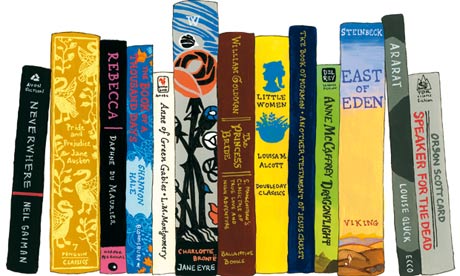
I read My Ideal Bookshelf cover-to-cover. Each person’s shelf is artistically recreated by Jane Mount. For example, this is Stephanie Meyer’s shelf:

meyer

Each shelf is accompanied by a personal reflection. Meyer offers this insight into her choices:

These books contain threads of what I like to write about: the way people interact, how we relate to one another when life is beautiful and horrible. But these books are greater than anything I could ever aspire to create.

None of the commentaries explain the person’s entire collection, but each  offers a glimpse into that person’s reading life.  For example, book designer Coralie Bickford-Smith says “The written word means so much to me. If I design a cover that gets people to pick up a book, then I’ve done my job. I want the younger generation to fall in love with books like Jane Eyre again.”  Interior designer Tom Delavan offers this: “Books are the very best kind of decoration, really. There are two types of books, the ones you read and the ones you have on your coffee table. Both make a space feel like home – you spend time with them, they have meaning for you, and they actually look good, too.” Writer Dave Eggers says “These are the books that crushed me, changed me when I first read them, and to which I have returned many times since, always finding more in them.”

Book lovers always have something to talk about. Always. My Ideal Bookshelf is like a beautiful conversation. With pictures.

I liked the book so much that I thought it would be really cool to ask my students to build their own ideal bookshelves and then write an essay to talk about their reading lives.  There’s a handy template at the back of the book (and it’s also available on their blog). As the school year winds down, this is a great way to have students reflect on the books they’re read – not only during their time with me, but for as long as they’ve been reading. We just got started on Friday, but it was so much fun to walk around and see what had made students’ lists. (When I saw that my Turkish exchange student had Donna Tartt’s The Secret History on her list – we both shared a moment of squealing delight.)

I wanted to take up the challenge, too. I’m going to cheat, though, and do a YA bookshelf and another bookshelf – although there may be some cross-over titles. I am no artist, but here’s what I came up with.

idealbookshelfya

It wasn’t easy to come up with these titles…and I left off a dozen more…so I am looking at this like it’s a snapshot of my YA reading life…including both books that I  read when I was a teenager and younger  (Jane Eyre, A Little Princess, A Tree Grows in Brooklyn, That Was Then, This Is Now and Anne Frank: The Diary of a Young Girl all fall into that category. I read them between 35-40 years ago!) and more recent reads. The thing they all have in common is that I loved them and the characters that inhabit the pages have stuck with me.

My Ideal Bookshelf would make an excellent gift for any book lovers on your list.

I’d love to hear about your ideal bookshelf!

The Raft – S. A. Bodeen

raftRobie, the fifteen-year-old protagonist of S.A. Bodeen’s YA novel The Raft has been back and forth between Hawaii and the island of Midway dozens of times. She lives there with her research scientists parents, but when the novel opens she’s visiting her aunt in Honolulu. When her aunt is unexpectedly called to work on the mainland, Robie isn’t bothered about being alone. She’s used to it and knows how to look after herself.

Looking after yourself on 2.4 square miles of island, as it turns out, is different from looking after yourself in downtown Honolulu. Unfortunately Robie gets accosted on the street one evening — nothing serious — but it spooks her and she decides to take the cargo plane home. Unfortunately, phone and Internet service is spotty on the island and so Robie isn’t able to let her parents know she is coming home. Even more unexpectedly, the plane hits bad weather and goes down. Only Robie and the co-pilot, Max, survive.

This novel is terrific. Like, couldn’t-put-it-down terrific. Robie is resilient and smart and is able to cope with her circumstances better than people twice her age. The raft she floats in leaks, there are sharks in the water — and not much else. It’s impossible to imagine that Robie will make it, but she does.

I don’t want to say too much about the things Robie endures. Once you start reading The Raft you’ll find out pretty quickly because you won’t be able to stop turning the pages. I should also mention that Bodeen slips some compelling stuff about ocean and bird life, conservation and pollution into the mix and it all feels necessary and organic. Robie is at home in this environment and knows “more about ocean fish and seabirds than most post-graduate researchers.” It’s a good thing, too.

Bodeen’s prose is straightforward and Robie’s voice is authentic. In a moment of prescience she remarks: “Lately it seemed there were a lot more days when my life felt less  like luck and way more like suck.”

I’m not one for survival stories, really, but I enjoyed Robie’s tremendously.

Highly recommended.


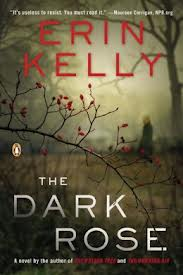
The Dark Rose – Erin Kelly

darkroseSO ANNOYED! I had an awesome review of this book written and when I posted it all that posted was what is below between the **…and I am tired and never going to be able to recreate what I had written and I could SCREAM.

So, briefly:

39-year-old Louisa and 19-year-old Paul are both working on the restoration of a ruined Elizabethan garden in Kelstice, a small town northwest of London. She’s hiding out – as she has done for the past twenty years or so – because she’s still obsessed with the guy she was in love with when she was 18. Paul’s hiding out because his best friend, Daniel, will soon be on trial for murder and he’s the star witness for the prosecution.

Paul’s had a traumatic childhood. He lost his father in a rather traumatic and gory accident which he witnessed. Then he started to get picked on in school and Daniel became his saviour.  He’s really a decent guy who just made some stupid choices because of his loyalty to Daniel.

**It’s also impossible not to relate to Louisa – at least I could relate to her. She falls madly in love with Adam Glasslake, lead singer of the band Glasslake and the more distant and unattainable he is, the more she wants him. What 18-year-old hasn’t been on that roller coaster ride?

After they make love for the first time and after Adam falls asleep, Louisa

…inhaled the thick oily skin between his shoulder blades where he smelled most like himself. If you could distill and bottle the essence of a human being, if you could crush skin like petals , then she would do this with Adam Glasslake. The vetiver scent was faint now, but his neck still bore the visible traces of the oil he had anointed himself with earlier. It was a faint dark green. Below this, on his clavicle, she had marked him for herself, a vivid red circle, half kiss, half bite. She felt intensely female and powerful, like a witch.

Louisa and Adam’s relationship is rocky at best and ends badly and years later she still gives in to a ritual that requires liquor and a few tatty mementos.   The first time she sees Paul she is so overcome that she felt that “the strength of her longing had finally called him [Adam] into being, that she had conjured his spirit.” She is so overcome she “would have smashed through the glass walls of the greenhouse to get away from him.”

When Louisa and Adam’s separate but equally compelling lives intersect, things don’t turn out at all like you might expect. And I mean that in a good way. Kelly does an admirable job making both Louisa and Paul into characters that you actually kind of root for thus elevating The Dark Rose  from run-of-the-mill thriller to literary page-turner.

The Dark Rose is my first encounter with Erin Kelly, but I will certainly be reading more of her work.**

More Than This – Patrick Ness

morethanthis“Here is the boy, drowning” is the opening line of Patrick Ness’s confounding, riveting, philosophical and profoundly moving YA novel More Than This. If you are a regular visitor to The Ludic Reader then you know that I am a Ness fan. I have huge love for his novels A Monster Calls, The Knife of Never Letting Go, The Ask and the Answer and Monsters of Men.

More Than This was my pick for book club and we gathered on Feb 18th to discuss the novel over dinner. The discussion was rich with differing viewpoints; the dinner itself was only moderately successful. My book club – despite the fact that three of its members, myself included, are teachers – doesn’t normally choose YA fiction. The only other book we’ve chosen from the YA canon was Marcus Zusak’s amazing novel, The Book Thief. In any case, as I was reading I had a feeling that my choice might not float everyone’s boat. Even I had trouble wrapping my head around Ness’s ‘big picture.’

More Than This is the story of a boy who, in the novel’s riveting opening, drowns. And then he finds himself, well, not dead.

He seems to be lying on a concrete path that runs through the front yard of a house, stretching from the sidewalk to a front door behind him.

The house is not his own.

And there’s more wrong than that.

For 163 pages, Seth (as the boy eventually remembers) is alone in a post-apocalyptic town in England. This is, as it turns out, the town where he grew up before he moved to America. Bits and pieces of his story come back to him when he dreams. For example, he remembers something horrible happening to his younger brother, Owen, something for which his mother never forgave him. He remembers Gudmund,  a boy for whom he has more than friendly affection. He remembers his other friends, H and Monica. As his previous life filters back to him in dreams, he tries to survive in this new wasteland.

And then he meets Regine and Thomasz. And the Driver, a creepy faceless virtually indestructible being whose sole purpose seems to be to try to catch the three teenagers. And how can there be just them? What has happened to the world?

One member of book club was certain that Seth was suffering from a psychotic break and while her argument is certainly plausible, I am happier taking Seth’s dilemma at face value. I think it’s a more interesting book if we believe in what he sees and experiences. Otherwise, it just feels like Bobby Ewing in the shower.

But believing what Seth does also proves problematic. I’ll admit: I was often confused. But that didn’t negate my love of Seth or his new friends. And, ultimately, I think More Than This has interesting things to say about the myopic lens through which teenagers view their lives. As Seth’s past and present converge, he starts to understand how his story, the story of his life, is unknowable, but that “whatever is forever certain is that there’s always more.”

The last couple of pages of More Than This are outstanding. Some members of my group felt that the novel was 150 pages too long, but I disagree. I think the novel packs a terrific punch and Seth’s journey from self-centered adolescence to manhood is memorable and magnificent.

I continue to be filled with admiration for Ness and look forward to talking about this novel with my students. But make no mistake – this novel has lots to offer thoughtful readers of any age.

Highly recommended.

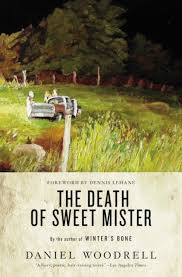
The Death of Sweet Mister – Daniel Woodrell

sweetmisterThe Death of Sweet Mister is grim and virtually unputdownable.

Woodrell’s novel is set in 1960s Ozarks. I don’t know anything about the Ozarks but Wikipedia tells me that “It covers much of the southern half of  Missouri and an extensive portion of northwestern and north central Arkansas. The region also extends westward into northeastern Oklahoma and extreme southeastern  Kansas.”

Morris “Shug” Atkins is thirteen and lives with his mother Glenda and her boyfriend, Red. “The idea that Red was my dad,” says Shug “was the official idea we all lived behind, but I wouldn’t guess that any of us believed it to be an idea you could show proof of or wanted to.”

Red is an ex-con, a mean snake of a man who drinks and does drugs and abuses both Shug and his mother.

…Red was near only the height I was at that age, but a man. He had the muscles of a man and all those prowling hungers and meanesses…

Their lives are just about as miserable as you might imagine them to be.

The three of them live in a house that “looked like it had been painted with jumbo crayons by a kid with wild hands who enjoyed bright colours but lost interest fast”  in the middle of a graveyard. In exchange for their dwelling, Shug maintains the cemetery – mowing and the like.  Red contributes to the family’s meagre existence by sending Shug off to break into houses and steal pharmaceuticals. You know it’s only going to be a matter of time before Shug gets caught.

Shug’s mother, Glenda, is the sort of woman who will never “get too plain or too heavy. Her eyes were of that awful blue blueness that generally attaches to things seen at a distance.” She copes with Red’s nastiness by drinking rum and cola, her special “tea”.

None of the characters in The Death of Sweet Mister seem to hold out much hope for a brighter future, but then into the narrative drives Jimmy Vin Pearce. His shiny green T-Bird and his flashy clothes seem to signal hope, like maybe Glenda and Shug might be able to escape the smallness and meaness of their lives. But one day Shug comes home to find blood had “whirled and whirled in the kitchen.”

I loved the language of Woodrell’s book. I loved Shug’s voice. I felt tremendous sympathy for him. He is a product of his environment and so it’s not particularly surprising how his story concludes. Doesn’t make it any less sad, though.

Highly recommended.