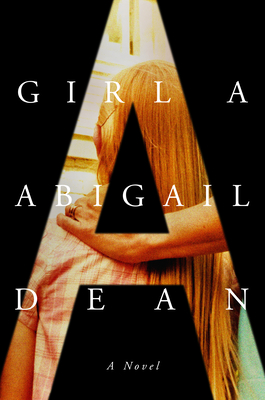
At just fifteen, Lex Gracie escapes her family home on Moor Woods Road, flags down a car and thus rescues her siblings from what is soon dubbed by the press as the “House of Horrors”. She is named Girl A to keep her identity secret from the world. Her siblings, Ethan, Evie, Gabriel, Delilah and Noah, are similarly named.
Now, years later, Lex, a lawyer based in NYC, is off to the prison where her mother has just died. Lex has been named executor of the estate, which is comprised of the house and a little bit of money. Lex feels the right thing to do is to build a community centre where the house stands, but in order to do that she needs her siblings to sign off. Abigail Dean’s accomplished debut Girl A traces Lex’s journey through the trauma of her past as she locates and visits with her siblings in an effort to secure their signatures.
Wisely, Dean chooses to leave much of what happens in the house to the reader’s imagination. It’s more than enough, trust me.
Sometimes, in my head, I visit our little room. There were two single beds, pressed into opposite corners, as far away from each other as they could be. My bed and Evie’s bed. A bare bulb hung between them and twitched at footsteps in the hallway outside. It was usually dull. but sometimes, if Father decided, it was left on for days. He had sealed a flattened cardboard box against the window, intending to control time, but a dim, brown light seeped through and granted us our days and nights.
The disintegration of the Gracie family doesn’t happen all at once, although the father, Charlie, is definitely volatile. As he becomes more and more evangelical – even going so far as to start his own church – he becomes more rigid and violent. Lex and Evie finds solace in a hidden book of Greek myths and school is a safe place until Charlie forbids them to go. Lex’s mother shrinks into the background, often disappearing for days into her bedroom to care for the newest baby.
Lex unspools the story of her childhood as she visits with each of her siblings, all adopted into different families after the rescue. Thus, this is a story about the aftermath of trauma as much as it is about the trauma itself. What becomes of these children makes for compelling reading.
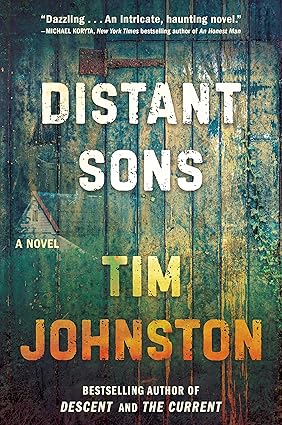
It was on page 32 of Tim Johnston’s latest novel Distant Sons when I realized that I recognized his main character, Sean Courtland. It wasn’t his name; it was a passing reference to “the high pines of the Rockies, the summer she was eighteen, a track star floating up the mountain on pink Nikes while he, age fifteen, fell increasingly behind on the bike.” Wait a minute! I know that scenario. I raced for my copy of Descent and sure enough there he was. Cool, I thought. I LOVED Descent and I loved Sean, so I was happy to spend more time with him. Then, a while later, when we are introduced to Dan Young, I had the same niggle in the back of my head. Again, it wasn’t the name, it was the fact that he had a twin brother named Marky. Wait a minute! I ran for my copy of The Current. Yep. Tim Johnston is cannibalizing his previous novels and, oh, what a feast it is.
First of all, you don’t need to know anything about Descent or The Current to understand the plot of Distant Sons. This is not the sort of novel where the reader loses out if they are not familiar with the backstories. That said, I highly recommend both of those novels. Descent, in particular, blew me away and made Johnston an auto buy author for me. Nevertheless, you will not suffer for not having read these books before reading this one because Distant Sons isn’t really a sequel.
It’s ten years past the events of Descent (not totally sure what that means for the timeline of The Current.) Sean Courtland, now 26, has landed in small town Wisconsin and isn’t able to go much farther because his car has broken down. He finds a job doing some carpentry work for Marion Deveraux, an elderly reclusive oddball. The townspeople have long been suspicious of Devereaux because of three boys who’d gone missing thirty-odd years ago.
Not long after he arrives in town, he finds himself in trouble with the local police for getting into a bar fight, where he was defending the honour of local waitress Denise Givens against jack off Blaine Mattis. Then, he crosses paths with Dan Young, who has also run into some of his own bad luck with a vehicle. Sean offers him some work because, as luck would have it, Dan has plumbing experience and the job at Devereaux’s needs plumbing work done.
These are the main characters in Johnston’s story. Their intertwining lives, the stuff of chance, has a profound impact on each of them. As much as I loved Sean when I first met him, I love him just as much – or more – in this book. I feel as though he has been punishing himself for a decade and I wanted him to be able to let the past go and find something good to hold on to. His new relationships with Dan, Denise and Denise’s father are thoughtful and it is refreshing to see male relationships in particular that are not merely posturing. Sean’s interactions with other people errs on the side of kindness always. Although Dan and Sean are reluctant to reveal too much about themselves, I felt as though I was watching an authentic relationship unfold.
There is a mystery at the core of this novel, and Johnston certainly has a few surprises in store for the reader, but this is a novel about people – some of whom who are just trying to do the right thing. Slow burn, for sure, but 100% worth the effort. I gasped. I teared up. I loved every second of this book.
If you haven’t ever read this author, I beg you to give him a try. He’s fantastic.
I had no real expectations going into Andrew O’Hagan’s 2020 novel Mayflies, but even if I had know what I was getting myself into, my reading experience would have exceeded all of them.
The novel opens in 1986 and the narrator, James, and his best friend, Tully, are just finished secondary school. They live in Glasgow and things aren’t easy for them. James’ father “wandered off in search of himself” and his mother “decided that the life of a single mother was not for her, and flitted to Arran.” He spends a lot of time at Tully’s house.
James admires Tully.
Other guys were funny and brilliant and better at this and that, but Tully loved you. He had the leader thing, when he was young, the guts of the classic frontman, and if any of us got together we instantly wanted to know where he was.
The first part of the novel focuses on one weekend when James, Tully and some of their other friends, travel down to Manchester to a music festival. It’s a weekend of total debauchery, as you might imagine when a group of young lads get together. I was in my 20s in the 1980s – and big into British music because I had a boyfriend from England – and so I loved all the pop culture references. The bands playing the festival included Orchestral Maneuvers in the Dark (which they trash, but which I recall liking) and The Smith (whom I didn’t appreciate then, but do now).
What we had that day was our story. We didn’t have the other bit, the future, and we had no way of knowing what that would be like. Perhaps it would change our memory of all this, or perhaps it would draw from it, nobody knew. But I’m sure I felt the story of that hall and how we reached it would never vanish.
Tully and James also quote movies back and forth at each other and engage in the silly banter you might expect from boys their age, but they also talk meaningfully about James’ missing parents, Tully’s strained relationship with his father, and the politics of the day. Theirs is a true and profound relationship, which makes the second part of this novel even more poignant.
Flash forward to 2017, when James receives a call from Tully. I’ll leave it at that. The second half of the book is a love letter to the friendship and shared memories between the two men and it is utterly beautiful. In fact, I found the whole book just, well, truly heartbreaking.
They say you know nothing at eighteen. But there are things you know at eighteen that you will never know again. Morrissey would lose his youth, and not just his youth, but the gusto that took him across the stage with a banner saying ‘The Queen Is Dead’ is a thing of permanence. We didn’t know it at the time, but it was also, for all of us, a tender goodbye, and we would never be those people again.
For anyone who has more behind them than ahead of them, this book will certainly speak to the person you were, the memories and the people you shared the journey with. But even for a young person, this book will surely resonate. I found it deeply moving and cried on more than one occasion.
Chris Whitaker’s novel We Begin at the Endis one of the best books I’ve read in the last few years and so when I heard that he had a new book coming out I purchased it as soon as it was available. (Sadly, it’s a flimsy paperback with a stupid unremovable “Read with Jenna” sticker on it. ) Not only did I race out to purchase All the Colors of the Dark, but I started reading it almost immediately. The weather cooperated, too; I got a rainy Saturday with nothing much to do and so I didn’t stop reading until just after 2 a.m. when I turned the final page (595 of them!)
Patch and Saint meet as kids. They’re both outsiders in their small town of Monta Clare, Missouri. Patch lives with his single mother, Ivy, who has barely been able to keep it together; Saint lives with her grandmother, Norma. Their friendship sustains them for many years and is the central relationship in the novel.
At the beginning of the story, Patch rescues another local girl, Misty, from a man who clearly intends to do her harm. He has admired Misty from afar and when he encounters them in the woods, he recognizes that something is not right.
Patch desperately looked around for anyone at all. Anyone who could handle this, who could ease the responsibility, the acute burden of seeing a girl in trouble.
He has no choice but to act, and he does, and it changes the trajectory of his life.
When Patch disappears, Saint lets nothing stand in her way until she finds him. But he is not the same person he was and as the details of what happened to him emerge, it also reveals a dogged determination to get to the truth.
I can’t say any more than that.
This is an epic story because it takes place over many years. It is also a story that moves swiftly. There’s a lot of dialogue in this story and so despite its length it almost begs to be read in one sitting. I think Whitaker’s super power is his characters. I loved Saint and Patch, who are revealed to us through their actions and their dialogue. But they are not the only characters to love. There’s Chief Nix, Norma and Sammy, too. I felt like I knew and cared for each and every one of them.
There’s not a lot of exposition here. (Honestly, this would make a terrific series and given the author’s connection to Jordy Moblo, I’ve got my fingers crossed.) But there is a compelling mystery and some heart-stopping moments. In fact, there’s a lot going on in this book and while the conclusion wasn’t as punch-you-in-the-gut as We Begin at the End, I finished feeling very satisfied. And as a person who generally falls asleep relatively early, the fact that I had to stay awake – in fact, couldn’t fall asleep even after I finished – to find out what happened to these people I had fallen in love with should tell you everything you need to know about All the Colors of the Dark.
Amy Jo Burns’ debut novel Shiner is my first five-star read of the year. It is the story of Wren Bird who lives with her parents Briar and Ruby in West Virginia outside of the aptly named no-where town of Trap. Wren tells us
The story of a snake handler’s daughter began when I’d just turned fifteen. I knew little then of the outside world my father kept from me. Ours is an oral civilization, I used to hear him say, and it’s dying. He blamed coal, he blamed heroin. He never blamed himself.
Briar is a preacher. As a young man, so the story goes, he’d been struck by lightning, causing one of his irises to go milky white and apparently giving him the power to heal and handle venomous snakes.
My father obeyed the rituals of snake-handling law, which meant he pretended we still lived in the 1940s instead of the age of the internet and all the things people did on their cell phones that I couldn’t understand. […] Daily my father lifted his serpents to the sky and uttered a prayer in tongues that no one could interpret.
Wren has never known any other life. Briar has kept her and her mother isolated on the “mountain’s western ridge.” Their only visitor is Ivy, Ruby’s childhood best friend, and her sons. When they visit, Briar hides in his snake shed because “He couldn’t bear to share my mother mother with anyone – not with Ivy, not even with me.”
A terrible accident sets off a summer of discovery for Wren and it is a breathtaking journey, where secrets are revealed and new relationships are forged.
There are so many things to admire about Shiner, not the least of which is the writing. But you can have great writing that is somehow distancing and impedes the plot. I loved the way this book was written, but I also loved the characters, particularly Wren and Flynn, the local ‘shiner’ (someone who makes moonshine) who is connected to Wren in a meaningful way, although she doesn’t know it.
Shiner is about the way “mountain men steered their own stories, and women were their oars.” It’s about finding your voice and making choices. It is about family. I loved every single second of it.
Jonah, 16, and Simon, 14, have left their home and are heading to Arizona to find their older brother, Matt, whom they hope will have returned from the Vietnam War and will be waiting for them. They’ve got nothing but the clothes on their backs, a crumpled ten dollar bill, Matt’s letters to Jonah, Jonah’s notebook, and a loaded pistol.
The brothers are at odds with each other, but that’s because Jonah is trying to honour Matt’s wishes that he look after Simon and Simon clearly doesn’t want to be looked after. They have a brother’s code though and it turns out, they’re going to need it.
When the1940 black Lincoln Cabriolet passes them, Jonah knew “It was as out of place in the dessert as a sailboat would have been, and it was the kind of car you knew had to carry stories with it, but I had no intention of finding out what those stories told.”
The driver, Mitch, and his passenger, Lilly, stop for the boys and thus begins their nightmare.
I felt like I was being swept along by something that had already gone too far. I knew I didn’t like Mitch from the moment I saw him, but there was something about that girl…
From the moment the boys get in the car, it is clear that Mitch is nuts. (Well, readers will know that from the book’s very first page.) The novel is almost unbearably suspenseful as we are swept along across the desert. Is Lilly Mitch’s girlfriend? Prisoner? Is she manipulating Mitch or the boys? I was so concerned for their safety.
Interspersed with their “adventure”, we read Matt’s letters to Jonah, which are filled with the horrors he is experiencing in Vietnam, a notoriously brutal and unforgiving conflict.
Andrew Smith has written a compelling, brutal, nail-biting story about survival, brothers and the horrors to be found at war and right here at home. I loved it.
Raymond Green and his best friend Simon Blackburn aren’t really part of the in crowd at their Connecticut high school. In fact, they’re not really part of any crowd at all. Ray is a history nerd and Simon’s “not really a nerd at all. […] His nerdiest attribute would have to be his love of vampire fiction.” Ray and Simon have been best friends since middle school and their lives have been pretty closed off from the rest of the world that is until Jane Doe moves to their hometown from Brooklyn.
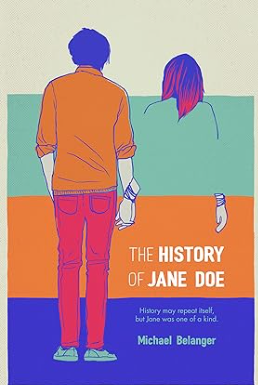
Michael Belanger’s debut YA novel The History of Jane Doe is Ray’s story of his junior year and how Jane’s arrival changes his life forever.
…I should tell you that everything I am about to write is true. It’s not one of those made-up stories that has morals and plot devices and well-crafted metaphors. History doesn’t have room for all that. Facts are facts, whether you like them or not. I’m only changing one name: hers. It just didn’t feel right to use her real name, so I’m calling her Jane, as in Jane Doe.
Ray’s story focuses on the “Before” and “After” and it won’t be difficult for readers to figure out the event to which the “After” is referring. The joy in this story comes from the characters themselves. Watching Ray try to connect with Jane because he’d “always operated under the assumption that the less [he] spoke, the better” when it came to talking to girls is a delight. In fact, across the board the dialogue in this book is terrific. I often laughed out loud or snickered. The book is reminiscent of John Green’s Paper Towns and Looking for Alaska – and I mean that as a compliment.
This is also a book that tackles some pretty weighty subjects including mental health issues and depression, the breakdown of a family (Ray’s father has buggered off to Florida) and social isolation. Anyone who has ever experienced life’s trials would certainly recognize themselves in these pages.
I loved spending time with these characters and highly recommend this book.
From a vantage point some time in the future, Thea Atwell looks back at the year she was fifteen in Anton DiSclafani’s debut novel The Yonahlossee Riding Camp for Girls. It is only with this hindsight that Thea is able to make sense of the events which led up to her parents banishing her to North Carolina. She has only ever known her home in rural Florida, where her father is the only doctor for miles and the family’s wealth is buoyed by citrus. There, she and her twin brother Sam spend their days doing exactly what they want: for Thea this means riding her horse, Sasi; for Sam it means examining the natural world. The outside world consists of her aunt and uncle and her two-years-older cousin, Georgie, but they live in Gainesville.
Thea hints at the reasons why she has been sent away. She says early on that her parents were sending her to Yonahlossee so they “wouldn’t have to see me.” When she thinks of home she “wanted to weep, but I would not let myself. I had wept enough for a lifetime. Two lifetimes. Three.”
It doesn’t take her long to settle in to life at Yonahlossee, partly because one of the camp’s more popular girls, Sissy, befriends her and partly because Thea is an exceptional horsewoman. Life here is so different from life back home and the people back home seem to have forgotten her; her parents take turns writing and she hears nothing from Sam, once her closest companion.
The novel moves seamlessly between days at Yonahlossee and the days leading up to the “event” which caused her exile. In the meantime, she begins to understand her power when begins a relationship with an adult at the camp.
One of the students in my Young Adult Literature class read this book and called it “disgusting.” I wholeheartedly disagree. This is a coming-of-age story featuring a young woman trying to figure out what society and her parents expect from her and what she wants for herself. The fact that the novel is set in 1930 makes this all the more problematic. Thea has been sheltered by her parents’ money, but out in the world she comes to understand that everyone has not lived as she has. She is often selfish and petty, but she is also smart and free-spirited. Does she make some bad choices? Certainly. Are her choices “disgusting”? Certainly not.
At Yonahlossee I learned the lesson I had started to teach myself at home: my life was mine. And I had to lay claim to it.
It’s 2020, the scary beginning of Covid, when Ann Patchett’s latest novel Tom Lake opens. Lara and her husband, Joe, and their three adult daughters Emily, Maisie, and Nell are hunkered down on the family’s Michigan cherry farm. The girls have asked Lara to tell them the story of how she came to date Peter Duke, a famous actor. Emily, the eldest and the child who intends to stay on the farm, has long believed that Peter Duke is her father and it has caused quite a bit of friction between her and her mother over the years.
Lara’s story really begins when, in high school, she and her best friend, Veronica, are roped into helping at a community theatre casting call for a production of Thornton Wilder’s Pulitzer Prize winning play Our Town. Although she was really only there to take the names of those who’d come to audition, Lara ends up auditioning herself and lands the part of Emily, a role which is to change her life. Later, at college, she plays the part again and as she remarks “Luck was everything.” A Hollywood producer, there to see his niece in the role of Mrs. Gibbs, is enamoured with Lara’s portrayal of Emily and thinks she’d be perfect for a movie he’s casting. That opportunity leads her to Tom Lake, a summer stock theatre in Michigan where she will reprise the role of Emily for a third time. This is also where she meets Peter Duke, or, as everyone calls him: Duke. He’s playing Mr. Webb, Emily’s father, even though he is only four years older. Everyone could see that he was destined for greater things, though.
This is a story about falling in love with Peter Duke who wasn’t famous at all. It’s about falling so wildly in love with him – the way one will at twenty-four – that it felt like jumping off a roof at midnight. There was no way to foresee the mess it would become in the end, nor did it occur to me to care.
Almost from the moment that they meet, Lara and Duke are a couple and their summer together is one that changes the course of Lara’s life. Lara’s daughters think they know (most of) the story, but she parcels out the narrative, editing and obfuscating because “There was always going to be a part of the story that [she] didn’t tell Joe or the girls.”
Honestly, I will read anything Patchett writes. Even if I didn’t know anything about Our Town, I would have loved this story of a mother and her daughters, of first love and the devastation it can leave in its wake, of friendships and marriage, of family. But because I am very familiar with Wilder’s play, which is really about some of the very same things Patchett writes about, I found this book extra meaningful. Wilder once said that his play was about finding “a value above all price for the smallest events in our daily life.” Much of the action of Patchett’s novel takes place on the family cherry farm where mother and daughters spend their days picking fruit. In the evenings, they share dinner, conversation, and movies. Covid made the circumstances perfect for this sort of thing because where were you going to go and what else were you going to do?
Tom Lake is a quiet novel but that is not to say that you won’t be swept along by these characters and their story. Like Lara’s daughters, I wanted to know what became of Peter Duke and there were some other surprises in this novel, too.
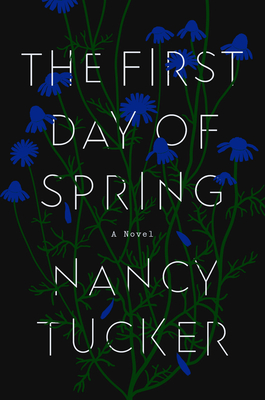
The opening line Nancy Tucker’s debut The First Day of Spring is a corker.
I killed a little boy today.
That’s eight-year-old Chrissie speaking. Yep – you heard that right; Chrissie is eight. She lives an impoverished life with her mother, but beyond being poor, her mother is emotionally distant and Chrissie is mostly left to fend for herself. Her clothes are never clean; she often wets the bed and there is never anything to eat at her house “even though the whole point of a kitchen was to have food in it.”
Chrissie survives because of free school dinners and by hanging around at her best friend Linda’s house at tea time, even though she is fairly certain Linda’s mother doesn’t really like her. In fact, no one seems to like Chrissie very much; she’s bossy, often kicks people who talk back to her, and brags and lies in equal measure.
After she kills the little boy, Chrissie has a “belly-fizzing feeling [like when she] remembered a delicious secret, like sherbet exploding in [her] guts.” Somehow the secret sustains her and provides opportunities for her to receive the attention she so desperately craves. Besides, Chrissie is fairly certain the little boy will come back from the dead: Jesus did and so does her father, who disappears and reappears at random intervals.
The novel also features an adult Chrissie, now going by the name Julia. She and her young daughter, Molly, live by a strict set of rules.
…back to the apartment at three forty-five, […] a snack at four, […] read the reading book at four-thirty, […] watched Blue Peter at five, […] had tea at five-thirty.
Julie’s life is structured because bad things happen “when [she] stopped concentrating.”
Julia has already had to move and change her name once because people are not kind when they find out who she is and what she has done. When she starts getting phone calls, she thinks her life is going to be upended again. And when Molly accidentally breaks her wrist, Julia is sure that the authorities are going to take her daughter away from her. That sends her on a journey back into her past.
The First Day of Spring is suspenseful, heart-breaking and hopeful, and I highly recommend it.




 The Ludic Reader