The Blue Castle – L.M. Montgomery

I haven’t read a Lucy Maud Montgomery book for probably 50 years – and, sadly, that’s not an exaggeration. Of course, like many Canadian women, I read and fell in love with Anne of Green Gables when I was a kid, but I haven’t ever revisited Anne’s island. The Blue Castle is the only novel Montgomery wrote which is not set in her beloved Prince Edward Island, and it’s only one of two adult novels she wrote.
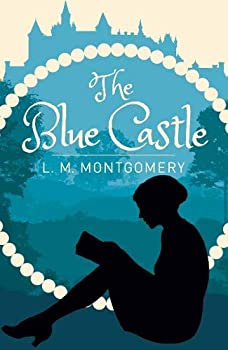
Valancy Stirling lives with her widowed mother and Cousin Stickles in Deerwood, Ontario. Her life is joyless, and her mother, cousin and extended family are overbearing and critical. Every day is like the day before, and there is no hope that anything will ever change. What stings most of all is that “she had never had a chance to be anything but an old maid. No man had ever desired her.”

There is one bright spot in Valancy’s life and that is her “Blue Castle”.

Valancy had lived spiritually in the Blue Castle ever since she could remember. She had been a very tiny child when she found herself possessed of it. Always, when she shut her eyes, she could see it plainly, with its turrets and banners on the pine-clad mountain height, wrapped in its faint, blue loveliness, against the skies of a fair and unknown land. Everything wonderful and beautiful was in that castle.

A trip to the doctor changes everything for Valancy. Suddenly she stops allowing her family to bully her and their reaction to her spirited responses is quite comical. She packs her bags and moves out to Old Abel Gay’s, the local handyman and town drunk, whose daughter, Cissy, a former classmate of Valancy’s, is dying. No one can quote believe it. They think she’s gone quite mad. But Abel is kind to her and Valancy finds a friend in Cissy. Suddenly the whole world opens up to Valancy, and truthfully, almost 100 years after The Blue Castle was published, her journey to independence is a delight.

If, like me, you haven’t read Montgomery in forever, I highly recommend this one. It’s charming, it’s funny, it’s sweet and, in many ways, Valancy is a modern heroine. I loved my time with her.
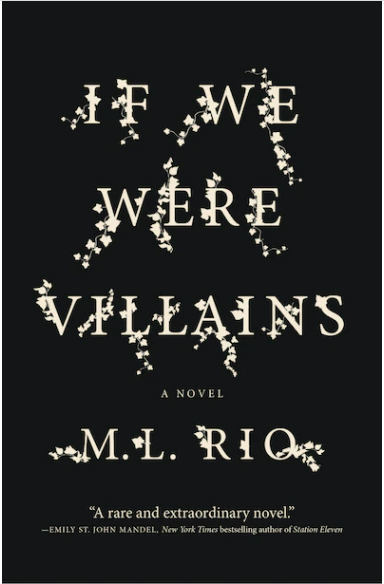
If We Were Villains – M.L. Rio

I would put M.L. Rio’s 2017 debut If We Were Villains in the ‘dark academia’ category. For me, that’s a book about students in a sort of gothic university setting where dark deeds are done. Donna Tartt probably deserves the credit for writing the quintessential novel in this milieu, The Secret History, a book I read when it first came out and intend to re-read this summer because I recommend it all the time, but have very little memory of the book’s details.

When If We Were Villains begins, Oliver Marks is just being released after spending ten years in prison. He makes a deal with Joseph Colborne, the detective who arrested him but never really believed he was guilty, to finally tell the story of what really happened at Dellecher Classical Conservatory in Broadwater, Illinois, where Oliver had been one of the seniors in the acting department.

There were seven of us then, seven bright young things with wide precious futures ahead of us, though we saw no further than the books in front of our faces. We were always surrounded by books and words and poetry. all the fierce passions of the world bound in leather and vellum.

Dellecher is a weird, isolated school – kind of a given in books of this type. The seven main characters live together in “what was whimsically called the Castle.” They are as eclectic a bunch as you’d expect acting students to be; almost every type you could imagine is represented. They are serious ‘actors’ and at Dellecher, the only playwright they ever study is Shakespeare. Indeed, the seven of them often converse with each other using only words written by the Bard. A Shakespeare scholar might be able to parse the significance of the lines that are spoken; I felt lucky to merely recognize some of them.

Oliver unspools the story of what happened at Dellecher and, in doing so, reveals the dark underbelly of friendship, jealousy, violence, and love that simmers beneath the surface of this close-knit (proximity, not affection necessarily) troupe of players. I can’t say they were a particularly likeable group, but I guess that doesn’t really matter. They’re actors, and by definition we can’t really know who they are beneath the stage make-up. That works in the novel’s favour, really, because when the crime for which Oliver is later incarcerated is committed, the players (let’s call them that instead of friends) have to put on the greatest performance of their lives.

I enjoyed this novel, but I wouldn’t call it a page-turner. It requires something of its readers: attention must be paid. It is structured in five acts, the ending is ambiguous (although I have my suspicions) and, like any great play, it gave me a lot to think about.

Well worth your time.

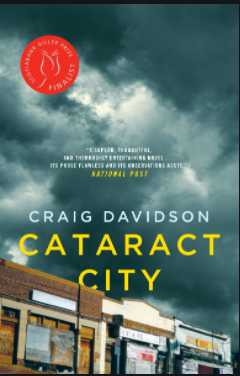
Cataract City – Craig Davidson

Although I can’t say the subject matter of Canadian writer Craig Davidson’s Giller-nominated novel Cataract City was necessarily my thing (boys lost in the woods, greyhound racing, dog fights, bare knuckled fist fighting, etc), I found myself sinking whole heartedly into this story of two best friends: Owen Stucky and Duncan Digs. I think it’s because Davidson (who also writes horror novels under the name Nick Cutter, the only one of which I’ve read is The Troop) is such an excellent writer and his stories are so filled with nostalgia and melancholy and hope that it’s impossible not to really care about his characters even though their shenanigans might not be the usual fare for a woman in her late middle age.

Craig and Duncan live in Cataract City (aka Niagara Falls), a city which they seem to love and loathe in equal measure. When the novel opens, Duncan is just getting out of the Kingston Penitentiary after serving 2912 nights. Of those nights, Duncan tells us, “two were the longest: the first and the last.” When he gets back to his parents’ house, he pries up a loose floorboard in his bedroom closet and from the cavity under the floor, takes out an old cigar box, filled with the treasures of his youth. The mementos spark his memories and the novel begins its meandering narrative, told in the voices of both Duncan and his childhood friend, Owen.

As described by the boys, Cataract City is a place where dreams go to die. Owen says “If you grew up in Cataract City and earned a university degree, chances are you left town. If you grew up in Cataract City and managed to finish high school, chances are you took a job at the dry docks, Redpath Sugar, the General Motors plant in St. Catherines or the Bisk.” Both the boys’ fathers work at the Bisk, the Nabisco plant, and their “dads carried the smell of their lines home with them.”

The city of your birth was the softest trap imaginable. So soft you didn’t even feel how badly you were snared – how could it be a trap when you knew its every spring and tooth?

Duncan and Owen meet when they are ten; even though they “both lived on Rickard Street and went to the same school” they had never spoken to each other. When another boy tackles Owen one day in the playground, Duncan comes to his rescue and the two boys bond over their shared love of wrestling. It’s wrestling that gets the boys into their first scrape.

Cataract City bounces back and forth between then and now, changing narrators effortlessly. Although the boys take different roads in life (Owen becomes a cop after a knee injury squashes his chances to play professional basketball and Duncan, well, he ends up in jail), the two never stop caring for each other. The melancholic nostalgic seeps into Davidson’s story and it’s hard not to be reminded of days gone by when even the characters long to

be kids again, just for a while. Revoke for just one day our breaking bodies and tortured minds. I would have given anything to spend one more day as we once had, even if it was one of those piss-away afternoons reading comic books in Owen’s basement while the rain clicked in the downspout like marbles.

I loved the journey these two take, some of it literal, some figurative. I loved the insights into friendship and family and love and memory. I loved all the references to Canadian things (The Beachcombers and Rowdy Roddy Piper). I loved the struggle to figure out what it all means in the end.

An instant in time, measurable in seconds, that acts as the hinge for everything you’ve ever done. Everything feeds into that moment: your backlog of experience and behaviours determine how you enter that moment and how you’ll walk away from it afterwards. Every way you’ve ever been hurt, every grievance nursed, every secret fear, those moments where you’ve stood up or stepped down and all the love in your body – it all matters when you reach the Point. It is all brought to bear.

The only other Davidson novel I’ve read is The Saturday Night Ghost Club and I really loved it. I will make a concerted effort to read his other work, for sure. Highly recommended.

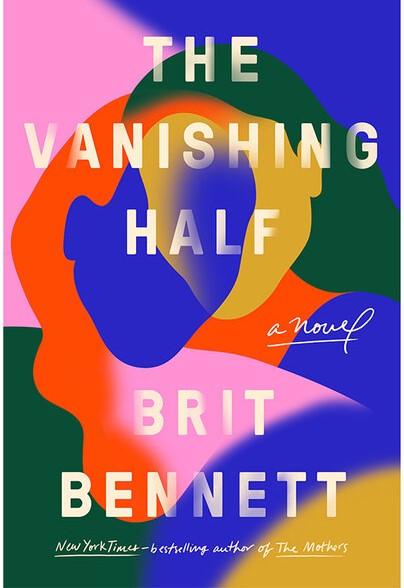
The Vanishing Half – Brit Bennett

Brit Bennett’s novel The Vanishing Half tells the story of twin sisters Desiree and Stella Vignes, who run away from their small-town home at sixteen. Mallard, Louisiana is “more idea than place.” Founded in 1848 by a man “who would never be accepted as white but refused to be treated like Negroes”, Mallard seems to pride itself on breeding generations who are “lighter than the one before.” That’s how one of the twins is able, and makes the decision, to pass as white, and thus enters a world that, in the mid 1950s, she wouldn’t normally be allowed to inhabit.

At first the sisters head to New Orleans, where they hope they will be able to fulfill their dreams which had been “trapped by [Mallard’s] smallness.” Stella, the practical one, is studious and dreams of a bigger life. Desiree “imagined herself escaping into the city and becoming an actress.” But then, one day, Stella disappears. It will be many years before the sisters see each other again.

The Vanishing Half begins when Desiree and her young daughter, Jude, arrive back in Mallard fourteen years after she and Stella first ran away. It’s big news in a small town because nobody left Mallard and “nobody married dark”, but Desiree had done both. From here, the novel reaches back to tell the story of the girls’ initial disappearance, their separation and then what becomes of their lives.

Stella’s story is vastly different than her sister’s. She meets Blake Sanders, and marries him and they move to California, where they have a daughter called Kennedy. It isn’t until a black family moves onto their cul de sac that Stella’s past starts to resurface and we begin to see how much she has buried. Blake doesn’t know she’s black. Kennedy doesn’t know her mother has a sister. She passes as white and she lives as white and it seems to make her life both easier and harder.

It isn’t until Jude decides to attend college in Los Angeles and, by chance, sees Stella at an event where she is working as a catering waitress, that the sisters’ stories merge. Fascinated with her violet-eyed, blonde cousin Kennedy, Jude tries to put her mother’s story back together.

I really enjoyed this book. It was easy to read; the characters were interesting and complicated, and although I guess I didn’t really understand Stella’s motivation for keeping her past a secret, for denying she had a twin, I guess the truth of the matter is that we can never really understand someone until we walk in their shoes. I loved Desiree’s childhood sweetheart, Early Jones, who comes back into her life when he is hired by Desiree’s abusive ex-husband to find her. I loved Jude and her boyfriend, Reese.

Families are complicated and the families in Bennett’s novel are no different. Everyone keeps secrets, some more damaging than others. Stella’s secret, of course, is the biggest of all. Stella’s husband, for example, seems to love her unconditionally, but he doesn’t really know her. Stella’s relationship with Kennedy is, especially as Kennedy gets older, tense, but how could it be anything but? Kennedy has questions; Stella has no answers she’s willing to give.

I didn’t finish Bennett’s novel The Mothers, but I have no qualms about recommending this one to readers.

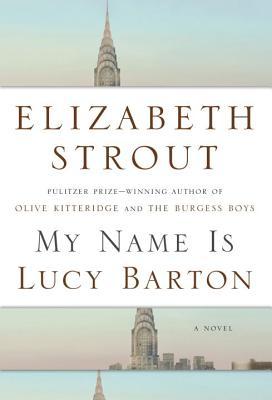
My Name is Lucy Barton – Elizabeth Strout

Lucy Barton is recovering from surgery in a New York City hospital with a view of the Chrysler Building. She’d gone into the hospital to have her appendix removed and ended up staying for nine weeks, fighting an infection that nobody seemed able to identify. During her time in the hospital, her mother comes to stay for a few days and as the two women sit together, parts of Lucy’s childhood float to the surface. This is the premise of Elizabeth Strout’s novel My Name if Lucy Barton. Last year I read Olive Kitteridge, a book which had been languishing on my tbr shelf for years. I loved it. I really enjoyed this book, too. It’s a quiet book and as the story moved along, it seemed to build in intensity.

Lucy and her mother have a strained relationship; in fact, they have not spoken in several years, but when she shows up at Lucy’s bedside “using my pet name, which I had not heard in ages, [it] made me feel warm and liquid-filled, as though all my tension had been a solid thing, and now was not.”

For five days, Lucy’s mother sits with her and the two talk of the past, a past which hadn’t been necessarily kind to them.

We were oddities, our family, even in that tiny rural town of Amgash, Illinois, where there were other homes that were run-down and lacking fresh paint or shutters or gardens, no beauty for the eye to rest on. […] We were told on the playground by other children, “Your family stinks,” and they’d run off pinching their noses with their fingers; my sister was told by her second-grade teacher – in front of the class – that being poor was no excuse for having dirt behind the ears, no one was too poor to buy a bar of soap.

Lucy gets out, though. A teacher recognizes Lucy’s love of reading and provides her with lots of books to read. The books make Lucy feel “less alone. This is my point. And I thought: I will write and people will not feel so alone!” Despite her insecurities, Lucy takes herself, her studies and her writing very seriously and earns herself a full-ride scholarship to college. This is the beginning of Lucy’s journey of self-discovery and also the beginning of her exile from her family. It is only her mother’s arrival at her bedside which makes her re-examine her roots and she is telling this story from many years in the future when she actually has the perspective necessary to understand.

As Lucy and her mother share stories about the people of Amgash, Lucy also looks more closely at her memories of her family and her own strengths and weaknesses as a person. These observations are the heart and soul of Strout’s novel.

It interests me how we find ways to feel superior to another person, another group of people. It happens everywhere, and all the time. Whatever we call it, I think it’s the lowest part of who we are, this need to find someone else to put down.

I think My Name is Lucy Barton is a book that would benefit from a second read. It really asks the reader to look closely at their own lives, their harsh judgments of others, their estrangements, the second-chances we’re offered and often stupidly refuse. When Lucy and her husband divorce, Lucy’s adult daughter tells her “when you write a novel you get to rewrite it, but when you live with someone for twenty years, that is the novel, and you can never write that novel with anyone again!”

I think this is a novel that is deceptive, now that I’ve tried to capture my thoughts about it here. Quiet, yes, but powerful in the way that it examines one woman’s story. And that’s what we all have, our own stories.

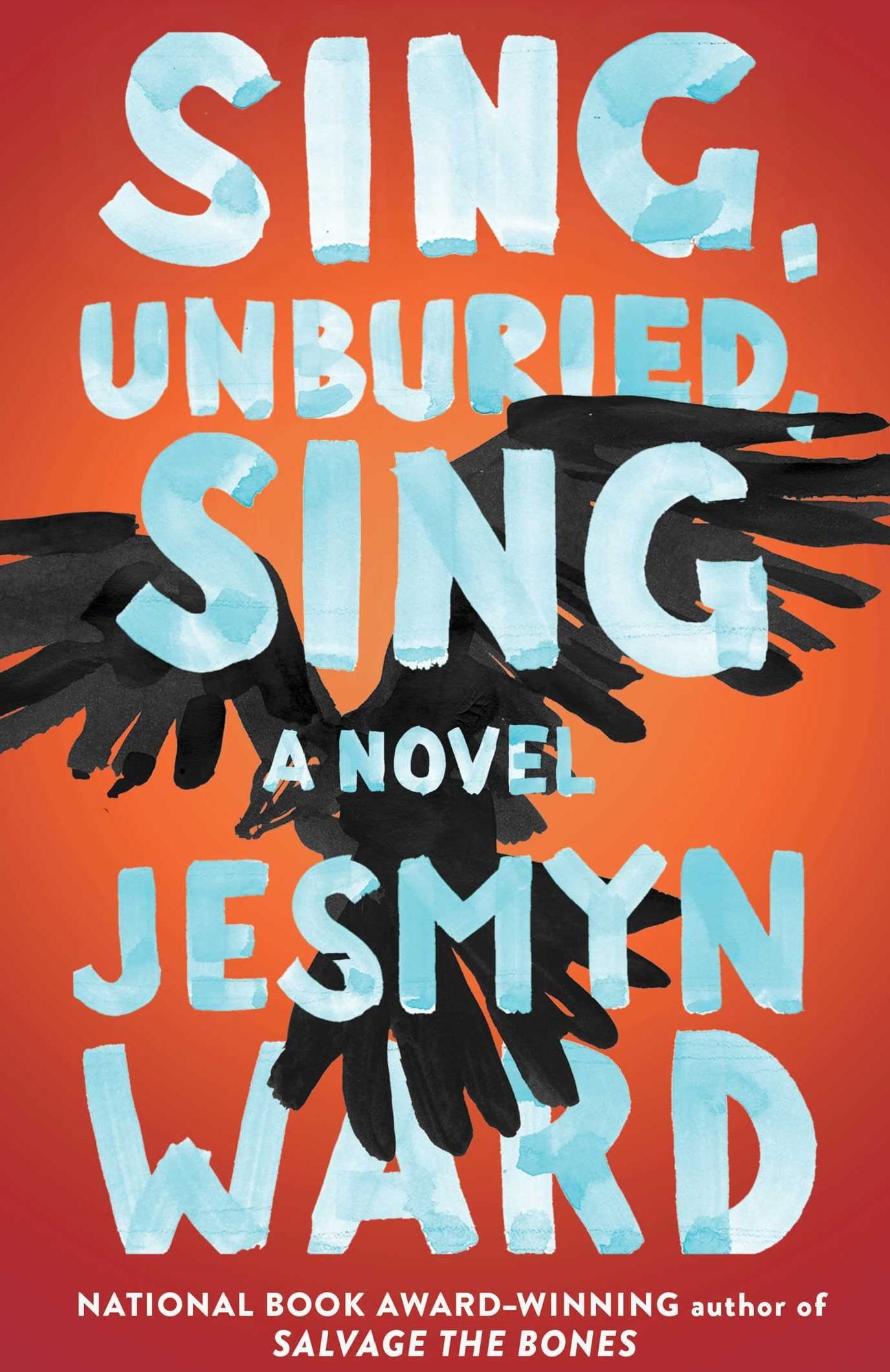
Sing, Unburied, Sing – Jesmyn Ward

Jesmyn Ward’s 2017 award-winning novel Sing, Unburied, Sing is the kind of book you can’t really put down once you pick it up. Partly it’s because the real action takes place over a very short amount of time and is so nerve-wracking I just couldn’t bear to stop reading, and partly it’s because the narrators in the book, Jojo and his mother, Leonie, and Richie, a boy who died years before the action of the story, are just too compelling to turn away from.

Jojo lives with his mother, his little sister, Kayla, and his maternal grandparents, Pop and Mam, in rural Mississippi. It’s Jojo’s thirteenth birthday when the novel begins, and Jojo’s first task of the day is to help his grandfather slaughter a goat for his birthday barbecue. Jojo says “I like to think I know what death is. I like to think that it’s something I could look at straight.” Oh, he’ll be looking at it straight, all right, and so will the reader. Ward doesn’t shy away of any of the details and so you’ll know pretty much from that opening scene that violence is part of the deal in this book.

This family has its share of troubles. Mam is currently bedridden, ravaged by cancer; Leonie is addicted to drugs; Michael, Jojo’s white father is currently in prison. Jojo depends on himself and his grandfather, who is loving albeit taciturn. Pop demonstrates his affection for Jojo by telling him stories, stories about his childhood and stories about his own incarceration.

Sometimes he’ll tell me the same story three, even four times. Hearing him tell them makes me feel like his voice is a hand he’s reached out to me, like he’s rubbing my back and I can duck whatever makes me feel like I’ll never be able to stand as tall as Pop, never be as sure.

Jojo’s main concern is Kayla, who is only three. He no longer depends on his mother and, in fact, thinks of her as Leonie. “It was a new thing, to look at her rubbing hands and her crooked teeth in her chattering mouth and not hear Mama in my head….”

When Michael is due to be released from prison, Leonie decides that she should make the journey to the prison to pick him up. She also thinks it would be a great idea to bring Jojo and Kayla, and her co-worker, a white woman named Misty whose boyfriend, Bishop, is also serving time. It’s hot, Kayla is almost immediately car sick, and the whole journey just seems fraught with danger.

Both Leonie and Jojo see ghosts. Literally. Leonie sees the ghost of her brother, Given, who was killed in a hunting accident fifteen years ago. Given was, by all accounts, destined for greatness: a talented athlete, popular and well-liked. Jojo sees Richie, a young boy who was incarcerated with Pop. In some ways Richie and Given are a manifestation of the guilt carried by those still living, but at the very least they are indicative of the way we are shaped by our pasts. Can we blame Leonie’s vices on the loss of her brother? Can we, at least, empathize with her? I’m not sure I did, she was just so negligent, but I was wholly invested in Jojo and found it impossible not to worry about him the entire time.

Sing, Unburied, Sing tackles the prickly topic of racism, too. Michael’s parents are make-no-bones-about-it racists. Leonie has talked to them exactly four times and is well aware that Michael’s father, Big Joseph (after whom Jojo is named) would rather “hang up in my face […] than speak to me, the nigger his son had babies with.” When a white cop pulls them over, my heart was in my throat the whole time. This is a story that carries the weight of hundreds of years of racism on its shoulders. My white privilege, I know, makes me blind to it.

This is a must-read book.

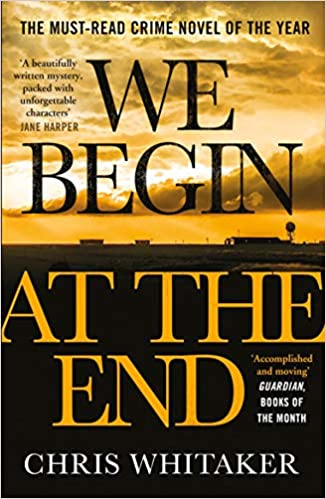
We Begin at the End – Chris Whitaker

Chris Whitaker’s novel We Begin at the End was all over my Twitter feed and the praise was copious, so I did what any booklover does, I ordered the book. Regular readers will know that having possession of a book doesn’t necessarily mean it’s going to land on my bedside table (which is where my currently-reading books live), but this one called to me. I needed to know what all the fuss was about. I needed to know if it was deserving of the fuss.

Hell, yeah.

Whitaker’s mystery/coming-of-age/noir novel concerns the fates of a whole cast of characters. It starts in the past as the town of Cape Haven, California, including Walk and his best friend Vincent King, are out looking for the body of Sissy Radley, younger sister of Vincent’s girlfriend, Star. Flash forward thirty years: Vincent’s been languishing in prison, Walk is now the town sheriff, and Star’s the messed-up mom of 13-year-old Duchess and 5-year-old, Robin.

Walk has made it his mission to look out for Star and her kids. Star’s a bit of a hot mess. She and her kids live in poverty, and Star spends a lot of time self-medicating with booze and pills. Duchess thinks part of her mom’s difficulty stems from what happened to Sissy all those years ago. “Duchess had got the bones of the story over the years, from Star when she slurred it, from the archive at the library in Salinas.”

When Vincent is released from jail he returns to Cape Haven and sets about restoring his family home, which just happens to be on a prime piece of waterfront. Dickie Darke, the local badass and sometime consort of Star, wants Vincent’s land badly, but Vincent isn’t interested in selling. He mostly just wants to be left alone. Vincent’s freedom is short lived though, and he’s soon back in jail for another crime, and this crime is the mystery which threads itself through the novel. Vincent insists on Martha May, another childhood friend and Walk’s old girlfriend, to represent him even though she’s not a criminal lawyer. That brings Martha back into Walk’s orbit after a long absence.

There are lots of surprises in Whitaker’s novel and some of the best ones are saved for the end, but it isn’t really the mystery that kept me turning the pages, it’s the characters.

Walk is loyal and dogged, and he’s spent his whole life in Cape Haven, where he knows everyone, Cape Haven is a quiet coastal town and he’s never even really had occasion to draw his gun. Vincent is taciturn and patient. Star is a hot mess. Even Dickie Dark is complicated. Minor characters, Milton, the town butcher and head of the local neighbourhood watch, Cuddy, the guard at the prison where Vincent has spent the last thirty years of his life, and Hal, the children’s grandfather, are compelling. But it’s Duchess who draws you in

If Duchess is perhaps a tad too precocious, she’s to be forgiven. She’s been dealt a rotten hand. And when circumstances land her and Robin in Montana with the grandfather they don’t know, her life is upended again. It takes every ounce of energy she has to rein herself in, and she’s really only willing to do that for her little brother. She doesn’t let people get close; it takes patience and perseverance to get past her defenses. Luckily, there are people in her life willing to keep trying. I loved her. She reminded me of Turtle, the protagonist of Gabriel Tallent’s stellar debut My Absolute Darling. This is a compliment, trust me.

There are a lot of moving pieces in Whitaker’s novel, and a lot of characters, too. There has been some criticism of his prose and the short hand he uses. I don’t read westerns and while much of this novel feels like a western, I chalked Duchess’s odd vernacular up to bravado: “I am the outlaw Duchess Day Radley” she tells more than one adversary. Perhaps odd coming from a kid from California, but not necessarily from a smart kid looking to build a protective shield around herself and those she loves. As for the novel’s prose, once I settled into Whitaker’s world, the writing just seemed spare. I think it suited the story, laid it bare.

This is a great book on so many levels. Read it for the mystery. Read it for the characters. Read it for the gut punch at the end. But read it!

Girl Crazy – Russell Smith

Justin, the protagonist of Russell Smith’s novel Girl Crazy, is a 32-year-old community college instructor fresh from a break-up with his long-time girlfriend Genevieve. Justin knows it is “a little weird that they kept making plans to see each other and pretending to be friends so soon after the breakup.”

One day, Justin meets Jenna near a payphone. She’s dressed in yoga gear that leaves little to the imagination and Justin is smitten…or aroused…or something. Jenna, it turns out, is in need of medical attention and Justin has a friend who’s a resident at a local hospital. This chance encounter leads Justin into a life that is totally unfamiliar to him.

Although Justin has a grown-up job, it doesn’t take him long to start behaving like an adolescent. That’s the main thing that stood out to me: Justin is immature. But then, I also acted like a crazy person at around that time in my life, or perhaps just a few short years before then, so I shouldn’t be so quick to judge. Perhaps he only seems super young and ridiculous to me because he is half my age.

Once he and Jenna hook up, it’s like a fuse has been lit. Justin is fueled by lust and manipulated into behaving in ways I can’t imagine are in character for him pre-Jenna. I kept wondering why he was doing such crazy things: casually hanging out with criminals, buying drugs via the Internet, seeking out underground card games. But then, I did some stupid things when I was young, usually because there was a boy involved.

It’s interesting to see this world through a guy’s eyes, actually and Justin sees everything through sex. Women are reduced to the sum of their sexiest parts: “a stripe of her belly was visible”, “her lips were so full they looked swollen”, “her thong, rising like a tattoo from between her muscles.” Smith describes sex without romance, but that doesn’t mean it’s not well-written. But it’s also not erotica. But I don’t think this is a love story, either.

Justin is obsessed with Jenna and he wants to save her from herself. Jenna, however, is not interested in being saved. I don’t think she misrepresents herself; I think Justin is thinking with his dick.

I don’t know how I feel about Girl Crazy. I don’t think I am the target audience, but I had zero trouble turning the pages. I would definitely read more by this Canadian writer.

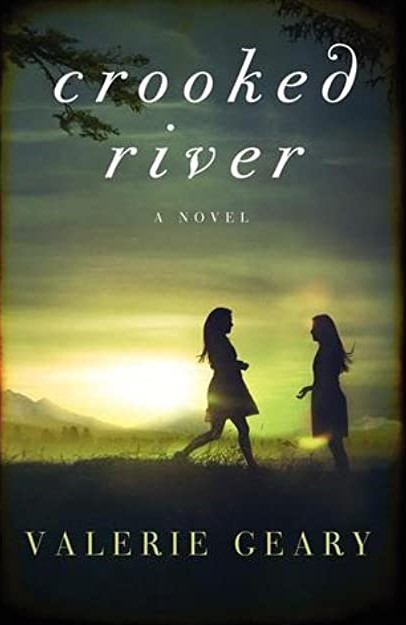
Crooked River – Valerie Geary

Fifteen-year-old Sam and her younger sister, Ollie, 10, have come to live with their father, Bear, in a teepee in a meadow in Oregon. Bear’s eccentric, sure, but he’s not crazy. One day he left his home, his wife and kids, in Eugene, and just didn’t come back. Sam’s been spending summers with her father since she was seven and she’s come to appreciate the quiet of both the place and her father.

…there was no electricity, only the sun. No plumbing, only the river and a barrel to catch the rain. No roof over our heads to blot out the stars, no television to drown out the bird and cricket songs, so asphalt to burn the soles of our feet. Most kids would probably hate a place like this, but to me it was home.

This is Ollie’s first summer; she’d previously gone to summer camp instead of going to Bear’s, but now there is no choice: the sisters’ mother has died suddenly.

When Valerie Geary’s beautiful novel Crooked River begins, the girls are down by the river and they find a “woman floating facedown in an eddy where Crooked River made a slow bend north.” They try to pull her to shore, but the current takes her. Sam is certain Bear will know what to do, but when they get back to the tent they find something that starts a chain reaction of discoveries, coincidences, and bad decisions. Before the girls can even make sense of what’s happening, their father is arrested for murder.

It is mostly down to Sam to tell this story because Ollie has elected to stop talking. “I was trying to be patient” Sam says, “but her silence was finally starting to wear me thin.” Ollie may not talk to anyone else, but she does commune with ghosts. The night is made of them, she says. “I see. I see things no one else does. I see them there and wish I didn’t. I want to tell and can’t.”

The sisters know their father is innocent, and Sam is desperate to prove it. Part of what makes Crooked River so great is the mystery, but what I really loved about the book is its sense of place. From the meadow’s hidden delights, to the beehives Bear tends, everything in Geary’s novel is written with a true appreciation for their inherent beauty. The mystery part, though, kicks into high gear in the novel’s last third and it’s a thrill ride.

This is also a book about family, grief and growing up. And if you think that’s all too much to cram into one book, then you don’t know Geary’s prodigious gifts as a novelist. There’s a beating heart at the center of this book and a crooked river runs through it.

Highly recommended.

White Ivy – Susie Yang

My first book of 2021 is White Ivy which was marketed as a coming-of-age thriller of sorts with plot twists that “will leave readers breathless” (according to Library Journal, at least). It concerns the fate of Ivy Lin, born in China, but left behind when her parents move to America. Then, “when Ivy turned five, Nan and Shen Lin had finally saved enough money to send for the daughter.” She joins her parents and baby brother, Austin, in Massachusetts.

Ivy is “average and nondescript” and grows up dreaming of about looking different.

Ivy’s only source of vanity was her eyes. They were pleasingly round, symmetrically situated, cocoa brown in color, with crescent corners dipped in like the ends of a stuffed dumpling. Her grandmother had trimmed her lashes when she was a baby to “stimulate growth,” and it seemed to have worked, for now she was blessed with a flurry of thick, black lashes

You know what they say about eyes being the windows to the soul, right? I’m not gong to go so far as to say that Ivy is soulless, only that she never seems quite sure about what she wants and even when she is, she seems to think that the only way to get it is through cheating. She’s a narcissist and given her early childhood, it’s no wonder.

Ivy Lin was a thief but you would never know it to look at her. Maybe that was the problem. No one ever suspected – and that made her reckless.

What does Ivy steal? Little things at first, things her strict immigrant parents don’t want her to have: tampons, cassette tapes, a walkman. Then she tries to steal her way into another life, a life inhabited by the object of her teenage desire: Gideon Speyer. For just one moment, when she is invited to Gideon’s birthday party at his “handsome glass and stone manor”, Ivy imagines what it might be like to belong. It’s a short-lived dream because when her parents find out that she lied to them to attend the party, they humiliate her by picking her up, send her to China for the summer and then move to New Jersey. It’s not until many years later that Ivy crosses paths with Gideon once again.

White Ivy is a strange book. I read it in a couple of sittings, but I never really felt as though I understood Ivy’s motivation. Does she lie out of habit? What is it about Gideon that she desires, really? They have zero chemistry. And then there’s Roux, a childhood friend who resurfaces right around the time Ivy’s relationship with Gideon is going to next level (aka meet – or in this case, re-meet – the parents).

Roux is rough around the edges. He cares little what anyone thinks of him. He’s made something of himself, although whether or not his success is strictly legal is up for debate. In many ways, he would make a much better partner for Ivy, but he’s not the waspish dream. He does complicate Ivy’s life, and then he offers an ultimatum which pushes the novel into thriller-esque territory.

I am not really sure how I feel about this book. I didn’t hate it. I didn’t love it. I wouldn’t call it a coming-of-age novel because there is no moment of epiphany for Ivy. It’s not a thriller. It’s definitely character driven and Ivy isn’t necessarily a character you will warm to. Not that that matters. Did I want her to succeed? ::shrugs:: I felt sort of as if there were some missed opportunities in this novel, but it wasn’t a waste of reading time.