Room – Emma Donoghue

Today I am five. I was four last night going to sleep in Wardrobe, but when I woke up in Bed in the dark I am changed to five abracadabra. Before that I was three, then two, then one, then zero. “Was I minus numbers?”

Jack is the narrator of Emma Donoghue’s stunning novel, Room. (Yes, I am late to the bandwagon; everyone and their dog was talking about this book when it first came out. But you all know I buy more books than it will ever be possible for me to read, right?)

From the book’s opening scene until I closed the novel a few hours later I was totally mesmerized by Jack and his Ma and the eleven by eleven world they lived in, their ‘Room.’  Jack and Ma live in this Room because of Old Nick, a predator who kidnapped Ma when she was 19 and has held her captive for seven years. Room is a prison, but it’s also the only home Jack has ever known. He doesn’t understand Outside, but he’s curious and  Ma knows that time is running out. They must find a way to escape.

Jack is a mesmerizing character and although it was risky to allow the story be told entirely through him, it’s a risk that pays off.  His worldview is so naive. He has no real concept of time (his sixth birthday will happen next week, his birthday cake takes hours and hours to make) and he believes that the people in TV “are made just of colors.”  His world is structured: sleep, eat, exercise, watch TV, read. His only playmate is his mother, but even through his innocent eyes he can see that Ma is struggling. Sometimes she spends entire days “Gone.” Sometimes she displays emotions Jack is unable to understand.

What wakes me up is a noise over and over. Ma’s not in bed. There’s a bit of light, the air’s still icy. I look over the edge, she’s in the middle of Floor going thump thump thump with her hand. “What did Floor do?”

Ma stops, she puffs out a long breath. “I need to hit something,” she says, but I don’t want to break anything.”

“Why not?”

“Actually, I’d love to break something. I’d love to break everything.”

“I don’t like her like this. “What’s for breakfast?”

Room is a remarkable achievement. It reads like a thriller; I couldn’t turn the pages fast enough. But it is also a beautiful testament to the power of love. What wouldn’t Ma do for Jack? Even more amazing, is what Jack is willing and able to do for Ma. I’ll be thinking about this book for a long time.

Highly recommended.

Rape: A Love Story – Joyce Carol Oates

Joyce Carol Oates wastes no time cutting to the chase in her novella, Rape: A Love Story.

After she was gang – raped, kicked and beaten and left to die on the floor of the filthy boathouse at Rocky Point Park. After she was dragged into the boathouse by the five drunken guys – unless there were six, or seven – and her twelve-year-old daughter with her screaming Let us go! Don’t hurt us! Please don’t hurt us!

Teena  Maguire and her 12-year-old daughter, Bethie, leave a July 4th party after midnight and cut through Rocky Point Park.  They take a short-cut through the woods and encounter the group of drunken men, many of whom are known to Teena from around her Niagara Falls neighbourhood.

Although Bethie is beaten, she manages to escape and hide under a boat. She listens as her mother is raped and savagely beaten and left for dead. The reader is not spared from the horror of this crime, but Oates — skillful writer that she is — never crosses the line into gratuitous.

Bethie manages to attract the attention of a police officer and it happens to be Officer Dromoor, a man who knows Teena because of an encounter they’d had one night at a local bar. Dromoor is a good man– a married father-to-be with a finely attuned sense of justice.

Teena survives the attack, but her life is forever altered. Rape: A Love Story sets about examining the ways in which this horrific incident changes her and Bethie and Dromoor and even three of the perpetrators and their families. It asks questions like was Teena dressed inappropriately and thus ‘asking for it’? Oates doesn’t offer any answers, though.

I have a love/hate relationship with Oates. There’s no denying her considerable talent, but sometimes I find her hard work. It’s not style over substance — although, no question she has some stylistic tics which take some getting used to. In Rape, she employs second person narrative (always a risky choice, imho, although clearly well-handled here), choppy sentences, and a narrative that jumps around. But, let’s face it, she’s Joyce Carol Oates.

I always want to like her more than I actually do.

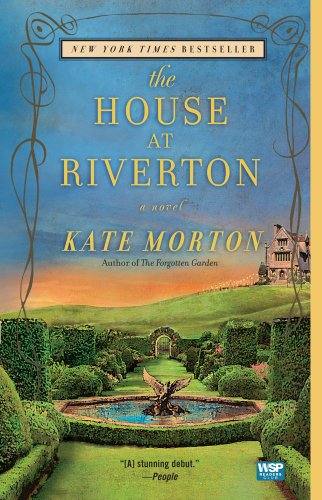
The House at Riverton – Kate Morton

I’m sure many of you have already read Kate Morton’s debut novel, The House at Riverton, but I only just finished it yesterday afternoon. If you haven’t already found a book to while away the dog day’s of summer, might I suggest you run to your bookstore immediately and purchase this one. Whew. What a read!

Grace Bradley is fourteen years old when she comes to Riverton House to work. Her mother had also worked at the sprawling Essex manor house, but had to leave under mysterious circumstances.  It is through Grace that we learn of Riverton and its inhabitants.

I have been thinking about the day I started at Riverton. I can see it clearly. The intervening years concertina and it is June 1914. I am fourteen again: naive, gauche. terrified, following Nancy up flight after flight of scrubbed elm stairs. Her skirt swishes efficiently with every step, each swish an indictment of my own inexperience.

The story, though, starts in the present. Grace is an old woman now. Her husband is dead; her daughter is in her sixties and her beloved grandson, Marcus, has been missing for several weeks. When a filmmaker from America writes to ask if Grace would consult on a film she’s making about a tragedy at Riverton, Grace is pulled back into her memories.

Fans of Downton Abbey will be able to picture Grace’s life perfectly: the servants downstairs, their dedication to service, their hierarchy. But Grace is more concerned with the Hartford siblings: David, Hannah and Emmeline. Over the years she becomes particularly close to Hannah and  when Hannah marries, she is whisked off to London to live.

The House at Riverton is about an aristocratic family in decline. Set between the two great wars, characters go off to their deaths, or come home damaged. The Roaring Twenties usher in an era of shifting sensibilities. Morton does a spectacular job of evoking a time and place. It’s easy to sympathize with the female characters who yearn for  a different life and although criticism has been leveled at Grace for choosing service over personal happiness, I believe I understand her choice.

Because Grace is looking back, the reader knows early on that some tragedy has befallen the Hartford family. That alone would be enough to turn the pages. But the novel takes its time arriving at its conclusion. Perhaps some readers found the novel slow and the prose over-written; I know it took me a while to settle into the story.

However, when I left Grace, 468 pages later, it was with great sadness because even though this is the story of Riverton, Grace’s own story is inextricably linked.

So Much Pretty – Cara Hoffman

I rarely pick up a book randomly anymore, but So Much Pretty was calling my name. Not only was it calling my name, it actually jumped the pile instead of languishing on my bookshelf for months and months. Still, despite the endless glowing praise I had a hard time settling into the book. Perhaps it was the time of year I started to read it — late June, when school is busy. I took the book with me on a family holiday and while the kids were swimming, I sat on a beautiful screened porch and lost myself in Cara Hoffman’s small-town drama.

Told from multiple perspectives, So Much Pretty flips over the small town of Haeden, NY and exposes its creepy underbelly. When the body of a missing teenager, Wendy White, is discovered in Tern Woods, it kick starts an examination of several lives particularly Flynn, the brittle newspaper reporter and  Claire and Gene and their daughter, Alice, transplants from NYC. The book also includes police reports and interviews. In this way, the book is difficult to navigate at first. It really deserves to be read in one sitting because once I made time for it, it really wouldn’t let me go.

Although there is a horrific crime at the center of this book, the real crime has more to do with the ways in which people are often complicit.  Parents misreading their children; neighbours turning away from each other; individuals looking for the spotlight. The story unfolds at a leisurely pace, making sure the reader understands all the players and their connections, but I feel like I missed a lot of clues — no, not even clues — signs that things were not quite right in Haeden because my mind was occupied trying to figure out how Alice was connected to Wendy. I got it horribly wrong, btw.

There are questions to be answered here, but Hoffman’s  feelings are opaque. She masterfully navigates all the pieces, but I never got the preachy feeling I often get with, say, a Jodi Picoult novel. The bulk of what happens to Wendy is left to the reader’s imagination, and her fate is far worse because of it. This would be a fantastic book club pick because of the inherent opportunities  for discussion. So, while it took me a bit to get into, I ended up loving So Much Pretty. Its copious praise is well-deserved.

The Sense of an Ending – Julian Barnes

I didn’t get a chance to write my thoughts about Julian Barnes’ Booker Prize winning novella, The Sense of an Ending, back when I actually finished it – which was in June.  The book deserves a much more thoughtful review than I am likely to give it here.

Narrated by Tony Webster, a divorced father with a grown daughter, The Sense of an Ending is a meditation on youth and the ways in which our memories are often skewed by our desire to remember ourselves differently from how we actually were.

“We live in time – it holds us and moulds us – but I’ve never felt I understood it very well,” Tony says. He also tells the reader that he is “not very interested in his schooldays, and don’t feel any nostalgia for them. But school is where it all began…”

It is at school that Tony and his friends meet Adrian Finn, “a tall, shy boy who initially kept his eyes down and his mind to himself.” Adrian is bright, clearly smarter than Tony and his friends – or perhaps just more thoughtful, more willing to question the subjects (particularly history) that he is being taught.

History is the certainty produced at the point where the imperfections of memory meet the inadequacies of documentation.

At the end of school, the four boys go their separate ways.  Tony  meets a girl, Veronica Ford, and it is this relationship which sets  the story in motion. Things with Veronica end badly and when she ends up dating Adrian, Tony is hurt and angry.

How this threesome plays out makes up the bulk of the story, but it isn’t a traditional love triangle. This is really a story about who we were, who we become and how we alter our memories to accommodate our own version of ourselves.

The Sense of an Ending is one of those books which would certainly benefit from repeat readings – and trust me, it wouldn’t be a hardship. Barnes’ prose is precise and devastating. The book reads like a mystery and in a way it is – we are often mysteries to ourselves and it is only when our memories are challenged that we see the person we have been.

The Slap – Christos Tsiolkas

If you are not easily offended, The Slap is one hell of a book. I just now randomly opened it and counted half a dozen raunchy references to sex and another half dozen expletives. Tsiolkas throws around the ‘c’ word like he’s talking about making a cup of tea. Yet, The Slap is a very human story, albeit one filled with polarizing characters.

At our book club discussion, our moderator (that’s the person who chooses the book) asked us to write the name of the most reprehensible character on a slip of paper. Then she asked us to name the most sympathetic character. She wanted our thoughts on paper before we began talking and were swayed by opposing opinions. Then we began to discuss the book, the premise of which is simple enough. A group of disparate characters gather at the Melbourne home of Hector and Aisha for a barbeque. Hector is a gorgeous Greek man and Aisha is from India and owns her own veterinary clinic. They have a couple young kids. There are cousins and parents and friends and co-workers in attendance. One of the guests slaps the face of four-year-old, Hugo, who was going to — so the slapper thought — bash his son with a cricket bat. Hugo’s parents press charges.

But The Slap isn’t really a book about what becomes of Hugo and his parents or how the trial plays out. Tsiolkas drops in and out of the lives of various characters (one at a time a la Jodi Picoult only WAY more sophisticated and profane), giving us snapshots of their lives and insight into their feelings about the slap. We don’t hear from every character at the bbq and, interestingly enough, some of the characters we do hear from seem like unusual choices. The beauty of the book, though, is that we do get to know the characters well, feeling empathy, admiration and repulsion in equal measure – sometimes all at once for the same character.

The Slap, as another member of our group pointed out, is quite unlike anything else our group has ever read…and that’s saying something considering we’ve been meeting for 13 years. It isn’t just the language — which takes some getting used to even for someone like me who has been known to drop the occasional ‘f-bomb.’ Several of us agreed that we had a visceral reaction to the book and the characters: hard drinking, racist, violent, irreverent and funny drug users – the whole lot.  The Slap is thrumming with energy. It is almost impossible to put down.

Tsiolkas has important things to say about love, though – not just the love between a man and a woman, but the love between friends,  and parents and children.

This, finally, was love. This was its shape and essence, once the lust and ecstasy and danger and adventure had gone. Love, at its core, was negotiation, the surrender of two individuals to the messy, banal, domestic realities of sharing a life together. In this way, in love, she could secure a familiar happiness.

The Slap is an excellent novel.

Major Pettigrew’s Last Stand – Helen Simonson

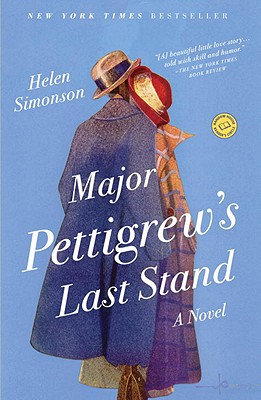
Helen Simonson’s debut novel Major Pettigrew’s Last Stand is the next best thing to spending a holiday in the English countryside. When we meet the title character, Major Ernest Pettigrew (retired), he’s just received the news that his younger brother, Bertie, has died. He’s trying, rather unsuccessfully, to cope with the news when Mrs. Ali, proprietress of the local village shop, appears at his door to collect the paper money. She takes note of his unsteady appearance and  offers to make him a cup of tea. Thus begins their relationship.

Mrs. Ali was, he half suspected, an educated woman, a person of culture. Nancy had been such a rare person, too, fond of her books and of little chamber concerts in village churches. But she had left him alone to endure the blunt tweedy concerns of the other women of their acquaintance. Women who talked horses and raffles at the hunt hall and who delighted in clucking over which unreliable young mother from the council cottages had messed up  arrangements for this week’s play group at the Village Hall. Mrs. Ali was more like Nancy. She was a butterfly to their scuffle of pigeons. He acknowledged a notion that he might wish to see Mrs. Ali again outside of the shop, and wondered whether this might be proof that he was not as ossified as his sixty-eight years, and the limited opportunities of village life, might suggest.

Major Pettigrew’s Last Stand is one of those little gems of a novel – beautifully written, with characters so remarkably authentic they seem to jump off the page. Pettigrew is a widower and Mrs. Ali, too, has lost a spouse. They are drawn together because of a shared love of Kipling, but they live in a small town – everysmalltown, really, where everyone knows your name and your business – and not everyone would have them together. Although Mrs. Ali was born in England, she’s Pakistani and therefore viewed by some as ‘unsuitable.’ I think Pettigrew’s feelings for her take him quite by surprise.  I suspect he thought that at 68, that part of his life was over.

In some ways, Pettigrew is a stuffed shirt. He likes things ‘just so.’ He desires attention and often  believes he’s entitled. The beautiful thing about him, though, is his willingness to change, and he does, too. His relationship with his son, a pompous banker who lives in London, undergoes a transformation. He starts to care less about tangible things, like a pair of shotguns that had once belonged to his father, and more about feelings and people.

To say that nothing much happens in Simonson’s novel is to miss the quiet patina of daily  life – much of which, at least as it’s written here, is laugh out loud funny. As people plan parties that can only go awry, as children squabble over their rightful inheritance, as the battle-lines are drawn between cultures, Major Pettigrew tries to find a way to navigate the messy business of living. He is proof that life does offer second chances, if we are brave enough to open our hearts to receive them.

Crooked Letter, Crooked Letter – Tom Franklin

Although there is a murder mystery at the centre of Tom Franklin’s novel, Crooked Letter, Crooked Letter, it isn’t what kept me reading.

In the late 1970s in rural Mississippi, Larry Ott lives with his parents. Larry’s an awkward kid who spends his spare time reading Stephen King novels and trying to ingratiate himself with the students at school. His father owns the local garage, and while Larry admires the way his father can tell a story, he and his dad aren’t close.

Then Silas Jones moves to town. Silas and his mother live in a shack deep in the woods, property owned by Larry’s father. A tentative friendship blossoms between the boys. Then, when the boys are in high school, Larry takes a local girl to the drive-in and she’s never heard from again. There’s no evidence to prove Larry had anything to do with her disappearance, but serious damage is done to his reputation.

Twenty years later, Larry operates his father’s garage but has no customers because of his tarnished past. Silas returns home to Chabot as a constable and another girl goes missing. Larry is the obvious suspect.

It sounds like a murder mystery and that is part of Crooked Letter, Crooked Letter‘s appeal, but the book is  more than that.  I felt a great deal of sympathy for Larry, for his awkward relationship with his father – a man he tried to please but never could. When the story opens, we see him lovingly tend his mother’s chickens. He’s built them a contraption, a “head-high movable cage with an open floor” which he could move around so the hens would always have new grass to graze. Not exactly the actions of a cold-blooded killer. He also forms a relationship with a petty criminal, Wallace, out of sheer loneliness.

The story alternates between present-day and the boys’ shared past. Of course, it’s perfectly reasonable to ask why Larry didn’t stay away when he had the chance, or why Silas came home, but I still think Franklin handled their relationship, its secrets and revelations well.

Envious Moon – Thomas Christopher Greene

I am a sucker for star-crossed lover stories. People who can’t or shouldn’t be together, but who have this tremendous connection – something that they can’t fight even if they wanted to.

Thomas Christopher Greene’s novel Envious Moon tells the story of Anthony Lopes, son of Portuguese immigrants, who lives in  a coastal town, Galilee, Rhode Island, where he earns money by fishing. Anthony is smart, but poor. His father was killed on a fishing boat; his mother works hard to provide and while Anthony dreams of a better life, he doesn’t quite know how he’s going to have it.

One day Anthony’s best friend, Victor, tells him something that has the potential to change both boys’ lives forever. Victor sometimes worked for a funeral home and he’d been at a wake on Cross Island. He was alone in the room and he’d lifted the corner of the Persian rug. There – to his amazement – he’d found an envelope, stuffed full of money. Victor tells Anthony that the house is empty and that they should break in and steal the money. Who could it hurt?

Of course, the boys’ plan doesn’t play out in quite the way they expect. Inside the house, Anthony sees a girl:

…a girl surrounded by golden light and wearing a white nightgown. Through the gown I could see the outline of her legs. I could not see her eyes and I could not tell the colour of her hair. But the part of her face that I could see, was more beautiful than any face I had ever seen. her high cheekbones and her full lips and her strong nose. Part of me understood that I should not be considering any of this, that I should just run, but something kept me completely still.

It is a moment that changes Anthony’s life forever.

Greene’s novel begins as an older Anthony contemplates that failed heist and its aftermath. He says, “I confess that I sometimes forget what she looks like.” Whatever tale Anthony is about to tell, the reader knows that it is part of some sort of therapy because this forgetting is considered a good thing by Dr. Mitchell. Every once and a while, we revisit present-day Anthony as he works through the events of his 17th summer.

Anthony is a likeable character. It’s impossible not to care about him as he makes one bad decision after another – each becoming more desperate than the last.  Hannah, the girl he loves, is slightly less transparent.  Anthony’s motives seem clear, but it is impossible to know how much of their story is motivated by grief.

Envious Moon reminded me a little of Endless Love by Scott Spencer. Love is the one emotion that drives people, especially young people, to reckless behaviour. Greene’s novel captures that love-fueled momentum and propels Anthony, Hannah and the reader on a journey that is both heart-felt and heart-breaking.

In Search of Adam – Caroline Smailes

“Jude, I have gone in search of Adam. I love you baby.

I didn’t understand. But I took the note. It was mine. I shoved it into the pocket of my grey school skirt. I crumpled it in. Then.”

Jude is just six years old (four months and two days) when she discovers the lifeless body of her mother. It shatters her young life and the hurt train keeps on coming.

Her father farms Jude off to various neighbours after the death of his wife while he begins a new relationship with Rita. One of these neighbours is Aunt Maggie at Number 30. It is here that Aunt Maggie’s brother, Eddie, sexually assaults Jude. And it is here that Jude begins a journey that twists her life in ways that are often impossible to read about.

Jude is desperate for attention – and it’s completely understandable since her father virtually ignores her. At school, one of her teachers takes a special interest in her, but it isn’t enough to save her from the hurt that is gnawing away at her insides; big girls don’t cry is Jude’s mantra.

Smailes writing is often beautiful, but unlike anything I’ve ever read before. Sentences are fractured and stagger across the page, perhaps to mimic Jude’s own thoughts. This isn’t one of those novels where a child endures horrors only to bounce back, more resilient than ever. In Search of Adam is almost relentlessly dark and as a mom, it was often extremely difficult to read.

But I couldn’t put it down.