The Blessings – Elise Juska

blessingsWe welcomed a new member into our book club last year and she hosted the first meeting after our summer hiatus. Elise Juska’s novel The Blessings was Margo’s selection and our discussion of the book – which I didn’t particularly enjoy while I was reading it – was certainly elevated by her superior hostessing skills. Oh, and okay, listening to the other women in my group talk about the book did soften me towards it. A bit.

The Blessings is the story of a large Irish-Catholic family in Philadelphia. You’d need a chart to untangle the siblings and cousins, the spouses and parents. There’s Gran and Pop; their children, John, Margie, Ann and Patrick and then the kids. Their story – played out over twenty years – isn’t really follow a linear narrative. Instead, Juska unfolds the story, or parts of the story, by allowing us to ‘visit’ with some of the family members.

For example, when the novel opens, eighteen-year-old Abby (daughter of Ann and Dave) is home from college for Thanksgiving. Through her eyes we see her aunts and uncles and grandparents and cousins. She reflects that “most people did not have families like hers.”  I would counter that everyone has a variation on a family like hers. Nevertheless,

If every family has a certain kind of music, Abby’s is the murmur of sympathy around a dining room table. It starts in the pause after dinner and before dessert, when the men migrate to the living room and turn on sports, and the women surround the wreckage, spilled crumbs and crumpled napkins and stained wineglasses. They pinch lids from sugar bowls and dip teabags in hot water, break cookies in half and chew slowly. They trade stories of other people’s hardships. This is the melody, the measure , of her family: the response to sad things.

The novel moves in and out of people’s lives, allowing us glimpses of failed relationships, eating disorders, love affairs, and deaths. For me, the narrative was too broken up to allow me to feel connected to any one of the characters. Just when I settled into the rhythm of their story, the chapter would end and we’d be on to the next person. Sometimes what had been happening would be alluded to later on, but we’d be hearing about the event from a completely different perspective. The Blessings was like reading a series of connected short stories.

Matriarch Helen (Gran) sums it up best:

The truth is that life in the end – even a long life – amounts to a handful of a very few things. The longer you live, the shorter the story.

The Blessings is a quiet story about family and if you’ve got one, you can probably relate to this book in some way.
The Pull of the Moon – Elizabeth Berg

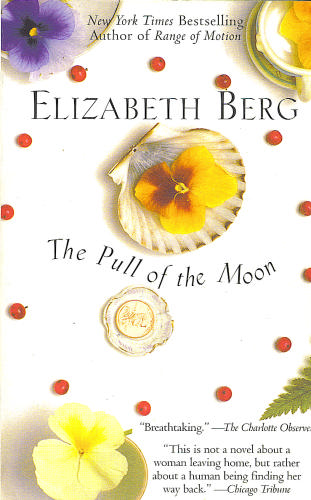
pullofthemoon Nan is fifty. One day she wakes up and just decides to leave. Her daughter, Ruthie, is grown and gone; her husband, Martin, remains at home receiving the letters Nan writes to him from the road. In the first she tells him

I just wanted you to know I was safe. But I shouldn’t have said I’d be back in a day or two. I won’t be back for awhile. I’m on a trip. I needed all of a sudden to go, without saying where, because I don’t know where. I know this is not like me. I know that. But please believe me, I am safe and I am not crazy, I felt like if I didn’t do this I wouldn’t be safe and I would be crazy.

Elizabeth Berg’s novel The Pull of the Moon is one of those novels that book clubs (whose members are of a certain age) will have a field day over. And I would be the dissenting voice. (I usually am.) It’s not because I don’t get it, it’s just because I didn’t wholly believe it.

So Nan (who has enough money at her disposal that she can just take the car and wander off and stop whenever and wherever she wants – and there’s the first fly in this self-discovery ointment; it’s Eat, Pray, Love for the middle-aged set) has had it with her suburban life. But it’s not even that so much as that she no longer recognizes the woman she’s become. All her dreams and aspirations have buckled under the weight of being a mother and wife and now she wonders “who in the hell am I?”

This question is likely something most women of a certain age can understand because many of us chuck our own desires under the bus when the kids come along. Nan takes this opportunity to examine who she was and who she is and what she wants going forward. She writes letters to Martin and also writes in a journal, something she hasn’t done since she was eleven.

She meanders along back roads, stopping for food and rest and pondering the sorry state of her life. She also randomly befriends people: the waiter in the diner where she gets breakfast, a hitchhiker she picks up, a man mourning the loss of his wife, an old woman shelling peas. These interactions weren’t all that believable to me because Berg expects the reader to believe that a simple question will open everyone’s floodgates. Suspicion quickly gives way to confession.

Strangely, despite the fact that I didn’t really buy the characters Nan meets (or the short time she spends with them) I did empathize with Nan.  Maybe that’s because, although my kids aren’t yet grown and gone and I no longer have a ‘Martin’, I am 53. I am way past the mid-way point of my life and although I try not to spend my life wallowing in regret, I do wish I had done some things a little differently. I also desperately wish I could call someone up and say, “I want and new house and this is what it’s going to look like. As soon as I get back from this roadtrip, we’re building that puppy. You got that buster?” (Seriously, Nan writes to Martin that she wants a new house!)

Nan writes in her journal that when she was twelve her life “was like a wild, beating thing, exotic, capable of unfolding and enlarging itself, pulling itself higher and higher like a kite loved by the wind.”  The best thing about The Pull of the Moon is Nan’s attempt to recapture the essence of that feeling, life’s enormous possibilities which have long been buried under the weight of the expectations of others. When she does that, Nan’s journey is one worth taking.


The Devil’s Footprints – John Burnside

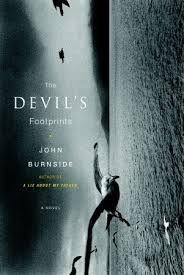
devilAlthough John Burnside is a prolific and award-winning writer (he is one of only two poets to have been awarded both the T.S. Eliot and Forward Poetry prizes for his collection, Black Cat Bone and in addition to over a dozen volumes of poetry he has written non-fiction, novels and a screenplay), The Devil’s Footprints is my first encounter with him.

Michael Gardiner has lived in Coldhaven, a seaside town in northern Scotland, his whole life. His parents were distant, creative people: his father a well-known photographer, his mother a painter. They were outsiders when they came to the village, but it’s the only home Michael has ever known and he lives in the house where he grew up with his wife, Amanda.

When The Devil’s Footprints begins, Michael is considering the deaths of Moira Birnie and her two young sons. Michael had a brief relationship with Moira back when he was nineteen and the circumstances of their deaths troubles Michael. He also wonders why Moira’s 14-year-old daughter, Hazel, was spared. But The Devil’s Footprints is not a mystery.

Burnside effortlessly weaves past and present, illuminating his solitary childhood and the fact that he was mercilessly bullied by Moira’s older brother, Malcolm.

“I always walked to and from school alone. I didn’t have a best friend, I didn’t really have friends at all,” Michael recalls.

As an adult, Michael doesn’t appear to have any friends, either. The reader learns little about his relationship with Amanda, a woman to whom he’s been married for about a decade. Michael doesn’t have to work because his father’s death has left him financially independent. Amanda “liked her job and insisted on going every day, full-time, even though we didn’t need the money.” Michael’s view of his marriage from a strangely impassive perspective. He notes “We had quickly passed the stage in a marriage when being together counts for much” and he knew what Amanda wanted from him was “stability.”

The thing of it is, Michael seems decidedly unstable, especially after he becomes  fixated on Hazel. There are all sorts of Nabokov comparisons to be made in their relationship; Michael makes them himself. But it isn’t until he packs his bags and spirits young Hazel away that the reader starts to understand the huge knot of grief Michael has been carrying around with him.

Did I like The Devil’s Footprints?  I think it’s a book that does an admirable job of reaching into the dark heart of one character. The writing is, understandably, poetic. I am glad that I read it.

The Lantern – Deborah Lawrenson

lantern If you’ve ever been to Provence, I suspect you’ll recognize the lush and aromatic landscape Deborah Lawrenson describes in her novel The Lantern. I’ve never been, but after reading this gothic romance, I’d love to go.

…the lavender fields, sugar-dusted biscuits, wild-flowers in meadows, the wind’s plainsong in the trees, the cloisters of silver-flicking olives, the garden still warm at midnight

The Lantern is two stories in one, stories that share Les Genevriers, an abandoned house in southern France. In one story we meet Benedicte, the youngest of three children who grows up in the house back when it was a working farm. In the other we meet Dom and an unnamed narrator, who is affectionately called ‘Eve,’ who have recently purchased Les Genevries with a view to restoring it to its former glory.

Eve is a twenty-something translator who meets Dom, a forty-something composer, in Switzerland, in a maze – which is prescient, as her life suddenly becomes a tangle of wrong turns and dead ends. She is instantly smitten with him and he seems to return the affection. When they return to London, Eve says “I tried to play it cool. So did he. But we both knew.” Their whirlwind romance eventually takes them to France and Les Genevries.

That summer, the house and its surroundings became ours. Or, rather, his house; our life there together, a time reduced in my memory to separate images and impressions: mirabelles – the tart ornage plums like incandescent bulbs strung in forest-green leaves; a zinc-topped table under a vine canopy; the budding grapes; the basket on the table, a large bowl; tomatoes ribbed and plump as harem cushions; thick sheets and lace secondhand from the market, and expensive new bed covers that look as old as the rest; lemon sun in the morning pouring through open windows; our scent in the linen sheets. Stars, the great sweep of the Milky Way making a dome overhead. I have never seen such bright stars, before or since.

Sounds romantic, eh? But it’s also isolated and when Dom starts to behave strangely and Eve starts to smell things and see things that aren’t actually there, The Lantern  crosses over into gothic territory. There’s also, as it turns out, an ex-wife whom Dom doesn’t want to talk about and a real estate agent in the local town who does. The plot thickens.

Then there’s Benedicte. She lives her whole life at Les Genevries. Her story, and that of her blind sister Marthe and malevolent brother, Pierre, weave throughout Eve’s narrative and make up some of the “many stories about the place.” As an old woman living in Les Genevries, Benedicte becomes convinced that she is being haunted. She sees her brother, Pierre, “standing, waiting expectantly in front of the hearth, silent, as if his intention was perfectly clear.” And then he is gone. Benedicte has never believed in ghosts, but it is hard to deny that Les Genevries is full of spirits.

Lawrenson does a fabulous job of weaving together the stories of Eve and Benedicte, their connection to Les Genevries and of making Provence jump off the page. The novel is creepy, clever and compelling and a lot of fun to read.

Highly recommended.

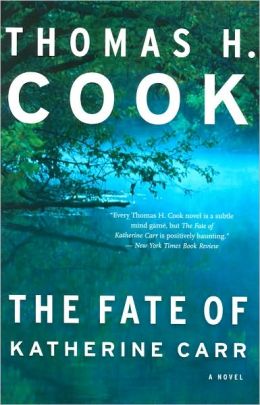
The Fate of Katherine Carr – Thomas H. Cook

katherine carrThe Fate of Katherine Carr is the story of things lost and found. George Gates is a former travel writer who now writes features for the local paper and spends his evenings drinking scotch at his neighbourhood bar. He’s a broken man, but no wonder: his eight year old son, Teddy, had been taken off the street on his way home from school, murdered and the murderer had never been caught. That was seven years ago, but George hasn’t recovered. He was supposed to pick Teddy up at the bus stop and hadn’t because he’d been trying to write the perfect sentence. He’s consumed with guilt.

One night at the bar, George runs into Arlo McBride, a retired police detective. Over drinks, Arlo tells George about the one missing person’s story which has stayed with him because it was never solved.  She vanished, Arlo tells George,  “like she cut a slit in the world and stepped through it into another one.”

George is intrigued. Before he’d retired from travel writing, he’d spent the bulk of his career writing about places where people had disappeared. Creepy places like Saipan, where Japanese parents – fearing American soldiers – had hurled their children and then themselves from the cliffs. He suddenly finds himself investigating what might have happened to Katherine. As it turns out, Katherine was also a writer and she left behind a handful of poems and a story which Arlo provides to George.

During the course of his ‘investigation’ George meets Alice Barrows, a twelve-year-old with progeria, a disease which causes premature aging. At first, Alice is just a potential subject for a story, but their relationship quickly becomes more profound. Alice is alone in the world and so is George. She is interested in mysteries and George is soon sharing  Katherine’s story with Alice.

Thomas H. Cook is one of my favourite writers. I’ve said it before and I’ll say it again – he writes literary mysteries. They’re page-turners, to be sure, but they are beautifully written, too. The characters are complicated and, more often than not, damaged. George is particularly sympathetic. As a parent, I can only imagine how horrific it must be to lose a child to a monster, but to live daily with the guilt of not being where you said you would. Cook ups the ante every single time.

The Fate of Katherine Carr works on many levels. Narratively, it’s a story within a story within a story. Emotionally, it’s hard not to be moved by George’s never-ending grief or Alice’s own sad fate. Some might argue that nothing much happens, but I respectfully disagree. While Cook might not write blood and guts thrillers, and while his endings might not leave all the loose ends tied in a neat bow – I think he writes fantastic books for careful and thoughtful readers.


Life After Life – Kate Atkinson

life-after-life-“What if we had the chance to do it again and again, until we finally did get it right? Wouldn’t that be wonderful,” says Teddy to his big sister, Ursula, the unusual main character of Kate Atkinson’s even more unusual novel Life After Life.

Ursula is born  in February, 1910. She dies and is born again. And again. Attempting to piece these multiple lives into any sort of coherent order is damn near impossible so I suggest you don’t even try. It’s far easier to just be with Ursula as she is born, grows up and then grows up again, each time encountering different possibilities based on life’s many variables. The reader is dropped into Ursula’s life at different points, just as she seems to be. Ursula hits the ground running, and eventually – with a little bit of attention paid –  so does the reader.

Ursula is a fine character with which to spend your time. She was “born with winter already in her bones” and when winter comes around again she “recognized it from the first time around.” It is through her eyes we see her parents: her perfect and beloved father, Hugh and her slightly snippy mother, Sylvie. When she is born she already has two older siblings, Maurice and Pamela, and then her arrival is followed by Teddy and James. The siblings and their parents live at Fox Corner, an English estate. Her lives and deaths flow almost seamlessly together, darkness falls and she is no more until she is again – still with the same family, still Ursula.

I don’t pretend to understand the novel’s finer points (it would take at least another reading), but I can say this: Life After Life clocks in at almost 500 pages and it was a joy to read. Sometimes Ursula makes choices which are ultimately detrimental to her well-being. One bad decision tips the balance and causes her life to spin out of control.  It’s only human to wonder how things might have been different if only… Other times her life is better, but not perfect. People suffer and die. World War I and then II upset the status quo.

There is a part of Ursula’s conscious that recognizes that her life seems to be on repeat. Her mother tells her it’s déjà vu, “a trick of the mind.” Dr. Kellet introduces her to the word “reincarnation” when she is just ten. But explanations are not necessary for Ursula or the reader. And although not every version of her life is a joy to read about, each one is as compelling as the next. Perhaps Ursula knows instinctively that ” If there’s no great glorious end to all this, if nothing we do matters… , then all that matters is what we do. ‘Cause that’s all there is. What we do. Now. Today. ” (Thanks for that quote, Joss Whedon! From the Angel episode “Epiphany.”)

It might be interesting to consider that Atkinson is also playing with the notion of novelist as God. Of course a novelist really does have the opportunity to make anything they want to happen to their characters happen. They don’t however, under normal circumstances, make every scenario occur in the same novel. If this was an experiment for Atkinson, it paid off in spades. The writing is beautiful. Ursula is everything you’d want in a protagonist; the minor characters are compelling and each and every one of Ursula’s lives offers something of value to careful readers.

Highly recommended.

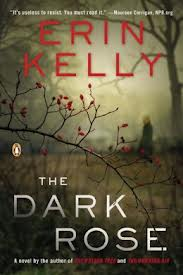
The Dark Rose – Erin Kelly

darkroseSO ANNOYED! I had an awesome review of this book written and when I posted it all that posted was what is below between the **…and I am tired and never going to be able to recreate what I had written and I could SCREAM.

So, briefly:

39-year-old Louisa and 19-year-old Paul are both working on the restoration of a ruined Elizabethan garden in Kelstice, a small town northwest of London. She’s hiding out – as she has done for the past twenty years or so – because she’s still obsessed with the guy she was in love with when she was 18. Paul’s hiding out because his best friend, Daniel, will soon be on trial for murder and he’s the star witness for the prosecution.

Paul’s had a traumatic childhood. He lost his father in a rather traumatic and gory accident which he witnessed. Then he started to get picked on in school and Daniel became his saviour.  He’s really a decent guy who just made some stupid choices because of his loyalty to Daniel.

**It’s also impossible not to relate to Louisa – at least I could relate to her. She falls madly in love with Adam Glasslake, lead singer of the band Glasslake and the more distant and unattainable he is, the more she wants him. What 18-year-old hasn’t been on that roller coaster ride?

After they make love for the first time and after Adam falls asleep, Louisa

…inhaled the thick oily skin between his shoulder blades where he smelled most like himself. If you could distill and bottle the essence of a human being, if you could crush skin like petals , then she would do this with Adam Glasslake. The vetiver scent was faint now, but his neck still bore the visible traces of the oil he had anointed himself with earlier. It was a faint dark green. Below this, on his clavicle, she had marked him for herself, a vivid red circle, half kiss, half bite. She felt intensely female and powerful, like a witch.

Louisa and Adam’s relationship is rocky at best and ends badly and years later she still gives in to a ritual that requires liquor and a few tatty mementos.   The first time she sees Paul she is so overcome that she felt that “the strength of her longing had finally called him [Adam] into being, that she had conjured his spirit.” She is so overcome she “would have smashed through the glass walls of the greenhouse to get away from him.”

When Louisa and Adam’s separate but equally compelling lives intersect, things don’t turn out at all like you might expect. And I mean that in a good way. Kelly does an admirable job making both Louisa and Paul into characters that you actually kind of root for thus elevating The Dark Rose  from run-of-the-mill thriller to literary page-turner.

The Dark Rose is my first encounter with Erin Kelly, but I will certainly be reading more of her work.**

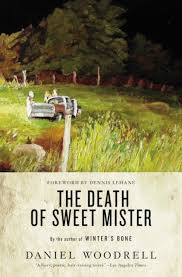
The Death of Sweet Mister – Daniel Woodrell

sweetmisterThe Death of Sweet Mister is grim and virtually unputdownable.

Woodrell’s novel is set in 1960s Ozarks. I don’t know anything about the Ozarks but Wikipedia tells me that “It covers much of the southern half of  Missouri and an extensive portion of northwestern and north central Arkansas. The region also extends westward into northeastern Oklahoma and extreme southeastern  Kansas.”

Morris “Shug” Atkins is thirteen and lives with his mother Glenda and her boyfriend, Red. “The idea that Red was my dad,” says Shug “was the official idea we all lived behind, but I wouldn’t guess that any of us believed it to be an idea you could show proof of or wanted to.”

Red is an ex-con, a mean snake of a man who drinks and does drugs and abuses both Shug and his mother.

…Red was near only the height I was at that age, but a man. He had the muscles of a man and all those prowling hungers and meanesses…

Their lives are just about as miserable as you might imagine them to be.

The three of them live in a house that “looked like it had been painted with jumbo crayons by a kid with wild hands who enjoyed bright colours but lost interest fast”  in the middle of a graveyard. In exchange for their dwelling, Shug maintains the cemetery – mowing and the like.  Red contributes to the family’s meagre existence by sending Shug off to break into houses and steal pharmaceuticals. You know it’s only going to be a matter of time before Shug gets caught.

Shug’s mother, Glenda, is the sort of woman who will never “get too plain or too heavy. Her eyes were of that awful blue blueness that generally attaches to things seen at a distance.” She copes with Red’s nastiness by drinking rum and cola, her special “tea”.

None of the characters in The Death of Sweet Mister seem to hold out much hope for a brighter future, but then into the narrative drives Jimmy Vin Pearce. His shiny green T-Bird and his flashy clothes seem to signal hope, like maybe Glenda and Shug might be able to escape the smallness and meaness of their lives. But one day Shug comes home to find blood had “whirled and whirled in the kitchen.”

I loved the language of Woodrell’s book. I loved Shug’s voice. I felt tremendous sympathy for him. He is a product of his environment and so it’s not particularly surprising how his story concludes. Doesn’t make it any less sad, though.

Highly recommended.


The Boy – Lara Santoro

theboyAnna is 42. The boy is 20. And yes, he has a name. His name is Jack. The Boy is the story of Anna and Jack’s brief but catastrophic affair and as tragic love affairs go, this one has its strengths and its weaknesses.

Anna meets Jack at a party her neighbour, Richard, is throwing.

The boy wore dark, baggy clothes so there was no discerning the profile of his body, yet Anna could tell, simply by the way he sat, that it must be a good one. She raised her eyes to his with calculated slowness and found to her surprise that they were free of fear, free of pretense, free of the myriad layers stretched by age over the human eye.

Okay, I’m not really sure what the last bit means but I’m just going to paraphrase here and say that Jack had it goin’ on and Anna was eventually unable to resist. He is pretty cocky.

There are some obstacles to their forbidden love. For one thing, Anna has an eight-year-old-daughter, Eva, who often seems like more of an adult than her mother. For another Anna has a slightly checkered past. (There were/are some issues with alcohol/drugs.) Then there’s her ex back in England. And okay, yes, there’s a huge age gap between Anna and Jack but Jack isn’t a witless sex toy.  (And there’s no graphic sex in this book anyway.) It’s all complicated and fraught, as lives often are.

When Eva goes to spend a few weeks of the summer with her dad, Anna gives in to the boy’s siren call and before you can say MILF, Jack’s moved his stuff into Anna’s house. Partly, Anna is looking for a way to reclaim her own lost youth. Partly, she seems to genuinely care for Jack. But they are living in a bubble that bursts when Eva returns from England.

Driving Eva to school one morning Anna loses her temper:

“Is this a joke?” she said. “After everything I have done for you? After all the sacrifices I’ve made for you, suddenly I have the audacity to tell you to stop ordering me around and you’re not talking to me. I have given you everything, Eva. Everything. I have traded my own life for yours. In fact, I haven’t had a life. You have. I haven’t. And this is what I get.”

This is, I think, the impetus for Anna’s affair with Jack. He’s this beautiful, motherless boy who wants her and she wants to forget, just for a little while that she has responsibilities that make it impossible for her to have whatever she wants. “We have children,” she says. “We have children, and they’re nothing we’re prepared for.”

Ain’t that the truth.


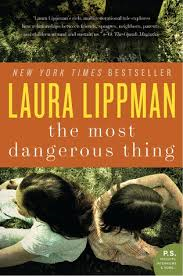
The Most Dangerous Thing – Laura Lippman

mostdangerousIt took me forever (it seems) to finish Laura Lippman’s novel The Most Dangerous Thing, a book that the Wall Street Journal called “a creepy, genre-bending, stand-alone novel.”

Lippman’s novel is the overly long story of five childhood friends, Gwen, Mickey, Tim, Sean and Go-Go who are reunited as adults after Go-Go is killed in a car accident that may or may not have been deliberate.  The real story, though, is about what happened to these five when they were kids – a bit of nasty business that is alluded to and then covered up. It’s the seventies, after all.

The story bounces between then and now and the big reveal  – which comes in the novel’s final pages – doesn’t really equal the sum of its parts. My problem with the book is that it took forever to get anywhere and when I finally arrived I was just sort of meh about the whole affair. As a novel of “psychological suspense,” as the Globe and Mail purports it to be, it was lacking the actual suspense.

Actually, I think the real mystery in The Most Dangerous Thing is  who is telling the story because Go-Go is dead and the remaining four are all referred to in the third person. In the author’s notes at the back of the book Ms. Lippman says: “I don’t want to tell you.”

As another kind of story, The Most Dangerous Thing is quite compelling.  The children are children only in flashback; we are actually dealing with them as adults and their lives are messy and complicated – as lives tend to be. We also spend time with their parents and those lives aren’t much better. But the thing is – is The Most Dangerous Thing a family drama  times three or is it a mystery, or a thriller, Maybe it’s social commentary?

Ms. Lippman says it’s her most autobiographical novel – geographically speaking. She says “I have been circling the unusual neighbourhood in which I grew up, determined to write about it, but wanting to wait for the right time and story.”

If I hadn’t been itching for the book to move along already, I would probably have enjoyed it more. Ms. Lippman is a wonderful writer, no question…but this book was only just okay for me. Maybe if I hadn’t been expecting something different, I would have been less disappointed.