AngelMonster – Veronica Bennett

Veronica Bennett reimagines the life of Mary Shelley, author of the novel Frankenstein, in her novel AngelMonster. It is 1814 and Mary is a smart but dreamy 16 year old. She and her sister, Jane, often imagine finding true love with a poet because  as Mary remarks, “a poet is the only acceptable sort of lover these days.”

Jane and I had often discussed the possibility of falling in love with a poet. If poetry was any measure of a man, we had observed, everything we longed for in a lover – romance, desire, spirit, soul – was clearly contained in it.

Into Mary’s life (well, her father’s bookshop) walks Percy Shelley. Not yet the super-star poet he was to become he is nevertheless known as someone to watch and certainly meets Mary’s criteria for a lover. And lovers they become, even though Shelley is already (at the tender age of 20) married with children.

AngelMonster is a thoroughly modern tale. It’s kind of like reading a memoir from a current celebrity. It drops names ( Lord Byron and Polidori are companions of Shelley’s) and is full of dalliances and intrigues and twisted love triangles. Young readers, especially those who dismiss poetry and classic fiction as boring, might be intrigued by the flesh and blood people who actually lived and wrote these works that have endured.

Mary herself is an interesting character.  Her mother, Mary Wollstonecraft, was one of the first feminists and author of A Vindication of the Rights of Women. (Wollstonecraft died a few days after Mary was born.)  Her father  was the writer and political journalist,  William Godwin. Mary herself is clearly intelligent, but youth makes her romantic and dreamy. Still, she wrote Frankenstein when she was just 21. As Bennett writes her, she is young but determined. Her affair with Percy is ill-advised, but she loves him and sticks with him even when he doesn’t deserve it. She is a thoroughly modern creation.

I think AngelMonster would be a great companion to a  young adult’s study  of the works of Byron,  and both Percy and Mary Shelley.

One Day – David Nicholls

One Day was the first book of our book club’s 2011-12 reading season (and our 12th year together!) After last year’s (mostly) snooze-a-palooza, it was terrific to come back to some current fiction. One Day comes with a little bit of hype, but I think it totally delivers on its promise.

Emma and Dexter  meet on the eve of their graduation from the University of Edinburgh in 1988. Although Emma has admired Dex from afar, this is their first real encounter and she is totally smitten. Although they come from different worlds (Emma is working class and Dexter comes from money) their one (unconsummated) night begins a friendship that we see in snapshots over twenty years. The beauty of Nicholl’s novel is that we revisit Dex and Emma on the same day, July 15th, and sometimes threads of their lives are left dangling.

In the beginning, both Emma and Dexter suffer from post-college malaise. What are we going to do with our lives? Dexter travels and Emma writes him long letters. He falls into a plum job in TV production. Emma works at a crappy tex-mex restaurant, then becomes a teacher. Through it all they prop each other up and tear each other down in the manner of friends who might be more if only they could get their act together.

This is one of the things Nicholls handles so beautifully in this novel. He juggles their lives – their various liaisons and miscommunications- with such finesse. Even when Dexter is acting like a complete prat we see exactly what Emma sees in him. When Emma is perhaps too serious, we just want to shake her. They are beautifully realized characters, flawed and heartbreakingly fragile.

But Nicholls has even more in store for the reader. The book’s denouement adds a layer of richness to the story, bringing us full circle and allowing the reader to consider the infinite possibilities inherent in just one meeting. Oh, the difference a day makes.

I loved this book.

The Housekeeper – Melanie Wallace

Melanie Wallace’s novel, The Housekeeper, was longlisted for The Orange Prize. For about the first 100 pages, I couldn’t figure out why. The story itself – if the synopsis is to be believed – sounded intriguing: When Jamie Hall finds a boy tied to a tree and cuts him loose, she can have no idea of the desperate chain of events her act of humanity will trigger.

Jamie is 17. When her mother dies of cancer, she leaves home with her dog and heads for Dyers Corner – the only place she has any connection to; a place her grandmother, while alive, lived. She has nothing and she seems to want nothing. She falls into a strange relationship with Damon, a married man who eventually returns to his pregnant wife. She becomes housekeeper for an elderly photographer, Margaret. Galen, a trapper, pines for her. It is winter and the stark landscape adds to Jamie’s isolation.

The boy Jamie cuts loose is wrong. “He thought of nothing in words and so gave no thought to those things he saw before him…” Jamie’s act of kindness begins a series of violent acts that culminate in a tragedy that seemed inevitable, but still left my mouth hanging open.

It took me a while to warm up to Wallace’s story and the way it was written, but once I fell into its rhythms, I loved Jamie. She is a smart and resilient character who seems to accept her lot in life without complaint. But her life is grim. And so is Wallace’s story. Spring never comes for these characters, even those who deserve it most.

Body Surfing – Anita Shreve

I have been an Anita Shreve fan for several years – well, okay, decades. I read her first novel, Eden Close back in the 70s when it first came out and remember really liking it.  Her novel The Pilot’s Wife was an Oprah pick and, thus, huge. But I’m partial to the quieter novels: Where or When, The Last Time They Met.

Body Surfing is the story of Sydney, a once-divorced, once-widowed woman who comes to live on the New Hampshire coast to tutor the beautiful but intellectually challenged Julie, youngest daughter of icy matriarch Mrs. Edwards and kind architect, Mr. Edwards. Her summer at the seashore is disrupted by the arrival of Julie’s older brothers, Ben and Jeff. Soon, Sydney is caught in the undertow of the strange and antagonistic relationship between the brothers.

I found the novel odd and oddly compelling. Shreve unfurls Sydney’s story in short elliptical passages, layering Sydney’s  day-to-day routine with memories of her divorce and dead husband. It’s hard to say what she is searching for because most of the time she isn’t even aware of it. Perhaps she is looking for family – but the Edward’s have issues of their own despite the appearance of perfection. Whatever she is looking for, it is complicated and there aren’t any easy answers.

Shreve is a good writer, but I wouldn’t say that Body Surfing is her best book. Of course, even on a bad day, she’s still a cut above the rest.

Song of Kali – Dan Simmons

Dan Simmons’ novel Song of Kali was first published in 1985. At the time, Simmons was not the  well-known writer he is today – he had a few published short stories under his belt, but that’s about it. Song of Kali was the winner of the World Fantasy Award and received universal priase as a novel as “harrowing and goulish as anyone could wish” (Locus) and “an absolutely harrowing experience” (F. Paul Wilson).

“Some places are too evil to be allowed to exist,” narrator Bobby Luczak says. He’s talking about Calcutta. Bobby, a  poet and editor (with his partner, Abe) of a literary magazine called Other Voices is being sent to India to retrieve a manuscript by an important Indian writer, M. Das. Das is presumed dead: he’s been missing for years. Bobby takes his wife, Amrita (who was born in New Dehli, but left for England when she was seven) and their infant daughter, Victoria.

Although Bobby lives in New York City, Calcutta is unlike any place he’s ever been. The heat, the poverty, the stench:

Rotting residential slums gave way to larger, even more decayed-looking buildings. There were few street lights. Vague flickers of heat lightning were reflected in the deep pools of black water that filled the intersections…the buildings seemed ancient beyond age, decayed remnants of some forgotten millennium – some pre-human age – for the shadows, angles, apertures, and emptiness did not fit the architecture of man. Yet, on every second or third floor there were open-windowed glimpses of humanity inhabiting these druidic shambles: bare bulbs swinging, bobbing heads, peeled walls with plaster rotting off the rib-bones of the building…the sight of sheeted figures lying like corpses in the sidewalk shadows.

From the moment Bobby and Amrita arrive in Calcutta life as they’ve known it as intellectuals is tested. Perhaps it is the heat; perhaps it is the lack of those conveniences they’ve always taken for granted, but Bobby’s quest for Das’ lost manuscript takes him to the edge of sanity. Secret meetings, whispered stories and Kali – the Goddess of death- all contribute to the claustrophobic atmosphere Simmons does such a terrific job with. There are some truly heart-pounding moments in this book.

But – this is not a horror novel in the traditional sense. Yes, it’s horrific, but ultimately the truly horrible thing that happens to Luczak’s family is not supernatural. And as we all know, men are  the most evil beings we’ll ever encounter in our lifetime.

So, Song of Kali is atmospheric, creepy and strangely affecting but not in the ways you might expect.

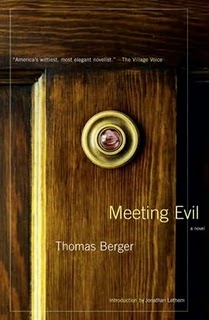
Meeting Evil – Thomas Berger

According to Jonathan Lethem, Thomas Berger is  “one of America’s three or four greatest living novelists.”  I’d never heard of him when I added Meeting Evil to my tbr list, then shelf – where it languished for several years before I fnally got around to reading it. 

Meeting Evil is the story of John Felton, a young real estate agent suffering through the downturn in the American economy. He’s married to Joanie, father to Melanie and Philip and his life is about to get very complicated.  It’s Monday morning when his doorbell rings. Standing there is Richie, a young man of John’s general age. His car has stalled in front of John’s house and Richie asks for assistance. What begins as a an act of good samaritanisim, quickly devolves into a harrowing crime spree – with John along for the ride.

I’ve never  read a book quite like Meeting Evil before. While sometimes John seemed ridiculously naive and stupid to me, the character of Richie is a creation of pure malevolence.  He’s dangerous and unpredictable. Before John even knows what has happened, he’s part prisoner and part co-conspirator in Richie’s road trip from hell.  Although John soon realizes the danger he is in, Richie turns out to be a master manipulator. At one point John even announces “We’re all in this together.”  Try as he might to escape (and he does try) John’s day just keeps getting worse.

Berger is a masterful writer. The book has a propulsive energy and is often wickedly funny. It’s quite unlike anything I’ve read before and I look forward to reading the second Berger title on my tbr shelf, Best Friends.

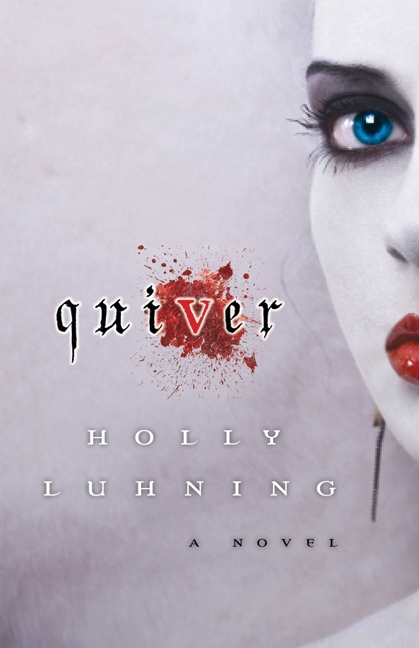
Quiver – Holly Luhning

Saskatchewan native Holly Luhning  has written a compelling novel based on the shocking life of the Hungarian Countess, Elizabeth Bathory.  Bathory, who was born in 1560, earned her shocking reputation for having tortured and killed over 600 young girls so that she might bathe in their blood and thus retain her youthful beauty.

Luhning’s novel, Quiver, is a creepy crawly book that follows Danica, a young foresnic psychologist, who has moved to London with her artist boyfriend, Henry, to work at Stowmoor, a Victorian hospital for the criminally insane. Danica’s patient is Martin Foster, a young man incarcerated for murdering a young girl as a tribute to Bathory.

Danica’s fascination with Bathory grows when a woman from her past, the  beautiful and duplicitous Maria, comes back into her life. Maria, it seems, has discovered Bathory’s private diaries and as she translates them and begins sending the horrific snippets to Danica, Danica’s life starts to shift.

We’re all, to some degree at least, train-wreck fascinated by the heart of darkness.  Danica’s morbid curiousity about Bathory (and the translated diary entries are not for the weak-stomached, believe me!) is complicated by her attraction/repulsion to Maria. Maria is impossibly beautiful and crazy-cool. I didn’t trust her at all, but I could see Danica’s attraction. There was something sinister about her and always an undercurrent of sexual attraction, too.

Quiver races along like the best thrillers, but it also has something compelling to say about art and that 15 minutes of fame so many of us seem to desperately crave.

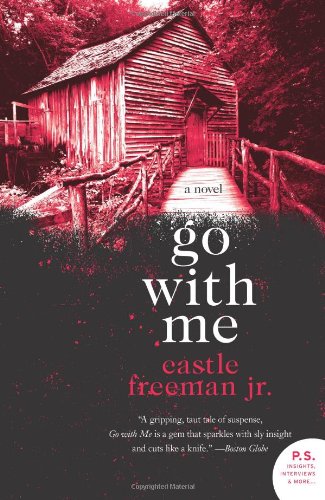
Go With Me – Castle Freeman Jr.

Lillian is a young woman who has recently moved to a small Vermont town. Early one morning, the town sheriff finds Lillian asleep in her car in the police station parking lot. She’s come for help. The town thug, Blackway, has been harrassing her; has, in fact, driven her boyfriend out of town and killed her cat. The sheriff’s advice is simple: go home.

Blackway is an enigmatic, altogether menacing, figure. The sheriff himself is afraid of him.

“You’re telling me you can’t do anything. You’re telling me I have to wait till he does something. till he gets to me, kills me, before you can do anything?”

“You could put it that way, I guess,” the sheriff said.

“How would you put it?”

“That way.”

The sheriff’s advice is to head over to the mill and find Scotty Cavanaugh because “he and Blackway have had dealings.” But Cavanaugh is not at the mill and instead Lillian solicits the help of the strange, quiet brute, Nate, and an old man named Lester to help her find and confront Blackway.

Go With Me is the strangest book I’ve read in a long time. It is both laugh-out-loud funny and strangely creepy. The book tracks Lillian and her small posse to various places where they might find Blackway, breaking the tension of their search with the commentary of the men at the mill who wonder – Greek chorus style –  at how it might all turn out.

Blackway, as it turns out, is not a man to be trifled with. He deserves his reputation. Lester is resourceful, though, and Nate “ain’t scared” and this slim book rockets along to its shocking climax.

I’d never heard of Castle Freeman Jr. before, but this book was well received and although it wasn’t really my cup of tea, it was weirdly compelling.

The Book of Lost Things by John Connolly

Once upon a time – for that is  how all stories should begin – there was a boy who lost his mother.

Thus begins John Connolly’s amazing story The Book of Lost Things. When I finally turned the last page of this book this morning, I felt that keen sense of satisfaction one feels when they have read an amazing book, a book you know you are going to recommend to everyone. I loved every minute of it.

David is just twelve when his mother dies. An only child, David is devoted to his mother and does everything in his power to keep her alive.

He prayed. He tried to be good, so that she would not be punished for his mistakes….He created a routine, and he tried to keep to that routine because he believed in part that his mother’s fate was linked to the actions he performed.

David is not able to save his mother however; she dies. Soon after, his father remarries and he and his new wife, Rose,  have another son, Georgie. David, still heart-broken over the loss of his mother, resents his father’s wife and his new brother.

This family drama plays against the backdrop of WW2. One night, after a fight with Rose, David escapes to the garden. From the sky, a German bomber falls and to escape, David slips into a crack in the swimming pool cum sunken garden. He finds himself, suddenly, in another world — a world of dark and twisted fairy tales.

I am making the book sound much simpler than it actually is. The Book of Lost Things is a coming-of-age-tale and a hero’s journey, a quest for truth and a horror story all rolled into one. Fairy tales, many familiar, are upended, revealing their slimy and rotten underbellies. David’s youth is slowly taken from him as he must fight, both alone and with companions, for his survival.

David begins his journey as a scared and self-involved adolescent, but as he makes his way towards the castle where the old king apparently has a ‘book of lost things’ which may have the answer to how David can get home, he matures and comes to understand certain truths. It’s an exciting  story — funny in places, creepy in others.

And like Dorothy’s journey to Oz, David soon comes to understand the value of what he has left behind. At journey’s end, he is  a changed person. I was profoundly moved by the book’s final pages.

Love Falls by Esther Freud

Esther Freud (Sigmund’s great-granddaughter) has written a compelling, if slightly unsatisfying,  coming-of-age tale with her novel, Love Falls. When 17 year old Lara heads to Tuscany with her father (a man who is practically a stranger to her) for a summer holiday, she isn’t quite sure of what to expect. Her father, a slightly distant intellectual historian called Lambert, has been invited to visit an old friend and wants Lara to accompany him. Lara is well-traveled: she and her bohemian mother, Cathy, have been all over together, but Lara has never been to Italy, so she’s excited at the prospect of leaving London for a few weeks.

Italy is transformative for Lara. She has the opportunity to observe her father, his relationship with the woman they are visiting, the elegant and slightly snobbish, Caroline, and observe the complicated and fraught relationships of the adults around her.

At a nearby villa, Lara meets Willoughbys. There are a lot of names and relationships to keep track of but the most important Willoughby is Kip – a boy about Lara’s age who is irreverant and beautiful.

Lara spends her weeks swimming and visiting with the Willoughbys and the days unfold in a sort of dreamy, hot haze. It’s as you imagine a summer in Italy might be…or, at any rate, as I imagine it.

There’s menace, though, in Lara’s world and it’s this menace that speeds the reader along. Even though it doesn’t amount to much in the end, Lara is certainly changed by the events which she experiences. I think Freud does a terrific job of suspending Lara in that particular space between youth and adulthood. Lara is as much an observor as a participant in what happens during those long, hot days. And because we see things only from Lara’s point of view, many of the tangled relationships are never untied; animosities are never explained and wrongs never quite righted.

As a coming-of-age tale, though, it is compelling and well-written.