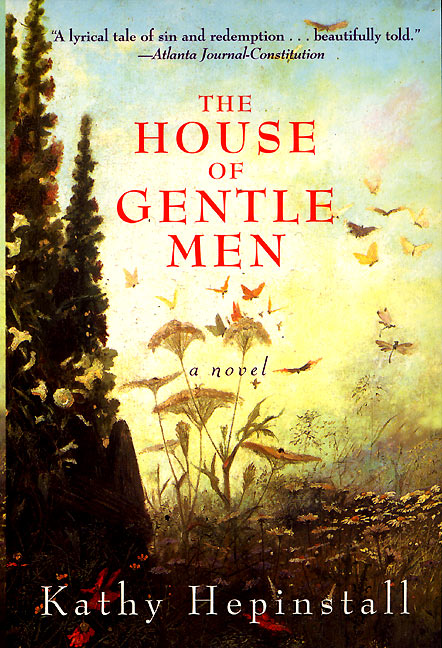
The House of Gentle Men by Kathy Hepinstall

My book club meets once every five weeks or so. It’s organized so that each of the ten members chooses one book per year…and the rule is that it has to be a book you haven’t read. The reveal is a big deal to us – we all love to see what’s coming next. Although we do have a big book store in town now, it’s still not always possible to stray too far off the beaten track. That’s why, when I was preparing my reveal in December, I took advantage of the great fiction sale at Book Closeouts. com. I read reviews and blurbs and blogs and finally made my decision. Book Closeouts had 12 copies of the book and they were $1.24 each…for a hard cover! So, I was able to buy a copy for everyone in the group and hand them out – gift-wrapped – at our Christmas meeting. So much fun!

Last night we discussed my pick. The House of Gentle Men has been on my radar for a long time. A few years back I read Hepinstall’s novel The Absence of Nectar which I liked quite  a lot.  There was something intriguing about the premise of The House of Gentle Men so I took a chance. I’m not sure that everyone in my book club would agree, but this book paid off for me.

The House of Gentle Men is actually the name of an establishment run by Mr. Olen, a single father who is hoping that if he makes up, in some way, for neglecting the wife who subsequently left him, she’ll return to him. He opens a house for Gentle Men, offering men who have the need to atone for some past wrongdoing the opportunity to redeem themselves.

“You think you could spend all night with someone, just kissing? Touching? Whispering sweet nothings? Maybe a little waltzing?”

These are the questions he asks, Justin, a young man who wanders into the house looking for a way to right his own wrongs.  Justin, as it turns out, has a lot to atone for. Seven years previous, while he was a young soldier on maneuvers, he came upon two fellow soldiers raping a young girl in the woods. Instead of doing the right thing, he took his turn.

Several lives intersect at the house for gentle men. Hepinstall deftly creates interior lives for even minor characters. All of them are damaged in some way; some of them are reprehensible; many of them deserve the redemption they so ardently seek.

This book took a few pages (about 75) to work for me. It seemed somehow cheesy –  this whole idea of a place where tired, frustrated, broken women could go to find comfort – not from sex  (although everything but intercourse is allowed), but from companionship. But, in the end, it did work . I grew attached to the characters, Charlotte in particular – who loses her voice (or chooses not to speak) after the attack. As she navigates her way out of her pain and anger, into the light offered by forgiveness, it’s almost impossible not to feel something for her.

So The House of Gentle Men may require a suspension of disbelief, but I think it’s worth it in the end.


How I Live Now by Meg Rosoff

How I Live Now by Meg Rosoff  has been on my tbr shelf for a few months. Coincidentally, a friend gave a copy of the book to my 12-year-old daughter, Mallory, for Christmas. We decided it would be cool to read the book at the same time and then share our thoughts about the novel here. This is actually something I’d like to do on a semi-regular basis because there are a lot of YA novels I’d like to read and Mallory is a voracious reader. In any case, we’ll start with this book and see how we make out.

I’ll start by letting Mallory tell you a little bit about herself:

Hi, everyone! I’m a grade seven student in French immersion. Besides reading, I enjoy drawing, dancing, (I study ballet and modern dance ten hours a week), and hanging out with my friends. I do love to read. Some of my favourite books are: Airborn, Skybreaker, A Little Princess, The Twilight Saga, Little Women, and The Little House on the Prairie books.

Christie: Thanks, Mal. So, I’m going to let Mallory tell everyone what How I Live Now is about.

Mallory:  Basically,  How I Live Now is about a teenage girl named Daisy who goes to England to live with her cousins after her father remarries. Once she’s there, two life-changing things happen: she falls in love with her cousin, Edmond, and war breaks out.

Christie: That’s it in a nutshell, Mallory. But this is a pretty remarkable book; it’s certainly not like anything that I’ve ever read before. What did you like about it?

Mallory: You know how when you read you can hear the author’s voice? Well, this book had the strongest voice of any I’ve ever read. Meg Rosoff created an incredible character, and when Daisy spoke she could make you believe anything.

Christie: I think Mal’s touched on the main reason this book is so wonderful. Daisy is a breathless, intelligent, self-deprecating, emotional fifteen-year-old girl whose personal world has been turned upside down….and then she has a catastrophic war to contend with.

When she arrives at the airport and meets her cousin, Edmond, she tells the reader “Now let me tell you what he looks like before I forget because it’s not exactly what you’d expect from your average fourteen-year-old what with the CIGARETTE and hair that looked like he cut it himself with a hatchet in the dead of night, but aside from that he’s exactly like some kind of mutt, you know the ones you see at the dog shelter who are kind of hopeful and sweet and put their nose straight into your hand when they meet you with a certain kind of dignity and you know from that second that you’re going to take him home? Well that’s him.” (3)

The whole story spins out of Daisy’s amazing brain and everything that happens to her is skewed by her needy intelligence.

Mallory: Her relationship with Edmond was really interesting to me. At first, I thought it was sort of freaky because I couldn’t imagine falling in love with my cousin. But after the war starts, and things get more complicated, I began to believe, like Daisy did, that they were meant to be together– related or not.

Christie: The war certainly made the story interesting. What did you think of the way we didn’t really know too much about who was fighting whom?

Mallory: When I was reading any bits where the war is described, my mind was never thinking of who was fighting or what they were fighting for. Mostly the whole time I was on edge with fear for Edmond and Daisy and whether they would make it through.

Christie: I was worried for them too, but I thought it was really interesting to see this war through Daisy’s eyes. Even though she didn’t really understand the hows and whys, she was able to articulate how people were affected by the fighting and the deaths she witnessed were horrific.

Mallory: I agree. Daisy seemed to be in the know and completely out of it at the exact same time — but it didn’t seem to matter. I was just wondering, what were your thoughts on Isaac and Osbert, who didn’t seem to play a big role in this story. And about Piper, who did.

Christie: We should tell people that Isaac is Edmond’s twin, Osbert is his sixteen-year-old brother and Piper, his nine-year-old sister. Their mother, Daisy’s Aunt Penn, goes off to Oslo very early in the book, leaving the children on their own. I think that’s one of the interesting aspects of this book — how these kids have to fend for themselves when the war is relatively distant and how all that changes when it suddenly shows up in their back yard. You’re right, though; Isaac and Osbert don’t really have a large part to play although Isaac does have an impact at the novel’s conclusion. Piper, on the other hand, is extremely important and I think gives Daisy a reason to go on. She’s a great character.

Who should read this book, Mal?

Mallory: Well, this book is suggested for 12 and up- but it’s a pretty intense read. It might not appeal to everybody, but if you’re a strong reader, and aren’t easily upset or offended, I recommend this book. Before I read How I Live Now, The Twilight Saga were my favourite books. I stayed faithful to them for a long time, and was almost positive that I’d never find a book (or series) that was better. How I Live Now was a pleasant surprise. It ended up overtaking Twilight by a longshot– and it’s now the reigning champ.

Christie: That warms my heart Mal because, as you know, not a fan of the sparkly vampires! Now we have to decide what we’re going to read next. Stay tuned!

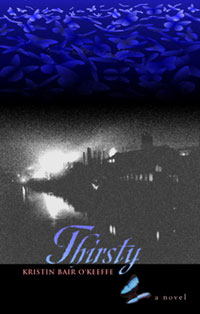
Thirsty by Kristin Bair O’Keeffe

Kristin Bair O’Keeffe’s debut novel, Thirsty, professes to be a novel about domestic abuse, its horrible legacy and one woman’s struggle to get out from under its damaging fist.

The novel opens in Croatia in 1883: “In the beginning, Drago smelled of dirt and bloom, the odor that would rise if you peeled the erath back at its seams.”

Klara is just 16 when Drago arrives on her doorstep. Her mother is dead; her father is mean; she’s responsible for looking after five younger siblings and she dreams of a better life somewhere else. Drago is handsome and he’s going to America.

Thirsty is a pretty compelling story, but there’s too much story here for 200 pages. I never felt like I knew any of the characters well enough to really understand their motivations, fears, dreams. The book covers 40 years and, honestly, it felt unfinished to me.

Klara learns pretty early on in her marriage that Drago is just as violent as her father. Why? Who knows. We do learn, half way through the book, that he loved someone else –  a blonde woman who married his brother. When Klara decides, out of the blue, to get her hair dyed – of all things – blonde and Drago beats the crap out of her, Drago’s reminiscence  seems less like character development and more like plot contrivance.

Klara’s daughter, Sky, grows up to be promiscuous – clearly searching for something to take away the pain of having watched her mother be her father’s punching bag. Then she marries an abusive man. We get a page and a half of his story and then eight years zip by and Sky and her two young daughters arrive on her parent’s doorstep. She’s a mess.

Thirsty felt like a string of little set pieces, strung together, rather than a novel with a central character we understood or could root for. My frustration with Klara wasn’t because she didn’t leave Drago. I understand well enough the psychology of battered wife syndrome. My problem was that I just didn’t care.

I might have given up on the novel all together if it hadn’t been for the fact that the writing was quite lovely at times.  But as a story of abuse and one woman’s efforts to break free – it falls short. The ending is not a triumph for Klara. Ultimately Klara’s new life, when it begins, has more to do with good luck than good management.

Thirsty, the web site

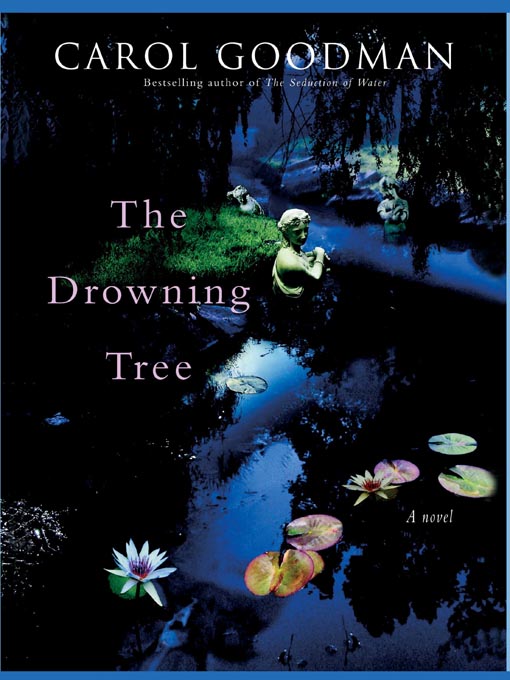
The Drowning Tree by Carol Goodman

It’s been thirteen years since I last saw Neil – and fourteen years since we both nearly drowned in the river – and I still dream about him every night, and because he told me once that he believed that we could visit each other in our dreams, I always have the feeling that that is what he’s doing – coming to me in my dreams each night. – The Drowning Tree

Carol Goodman’s interest in Latin and Art and Literature is obvious. The first novel I read by her, The Lake of Dead Languages concerned a Latin teacher at a private girls’ school. The Drowning Tree tells the story of Juno  McKay, a woman who runs a glass business (she’s in the business of building and restoring stained glass windows and is currently working on the reconstruction of a beautiful window from her old  school, Penrose College.) The novel is steeped in Greek and Roman mythology.

Juno’s best friend from college is the beautiful and wildly smart, Christine. She blows into town to deliver a lecture about Augustus Penrose and his wife Eugenie and her sister, Clare and the very window Juno is currently restoring. After the lecture, Christine disappears. Juno spends the next 300 pages trying to figure out what happened to Christine and why.

My feelings about The Drowning Tree are lukewarm, I’m sad to say. Goodman is a fine writer. She clearly cares about the craft and her work has depth…but she’s supposed to be a writer of literary thrillers and her books (at least the two I’ve read) move slower than cold molasses. Nothing. Happens.

In fact, in The Drowning Tree, it isn’t until Juno’s long- institutionalized husband, Neil, makes a reappearance some 200 pages into the book that things start to perk up a little. I guess Juno herself just isn’t engaging enough to carry the novel all on her own. And the book’s central mysteries –  what happened to Christine and what was the deal with Eugenie and her sister –  aren’t compelling enough to hold 338 pages aloft.

Perhaps it’s the publisher that does Goodman a disservice by calling the book a “literary thriller”. Literary for sure; thrilling, no way.

The Bright Forever by Lee Martin

Lee Martin’s novel The Bright Forever has restored my faith in fiction. After a long drought, The Bright Forever accomplished what all good novels should: it held me spellbound. It is beautifully written, has a cast of damaged and damned characters and is almost impossible to put down.

Nine-year-old Katie Mackey goes missing one hot July night in small-town Indiana. She’s the youngest child of Patsy and Junior Mackey. Junior is a man about town; he owns the glass factory. Katie and her older brother, Gilley, are not spoiled rich kids, though – they are smart and kind.

The Bright Forever is told from the viewpoints of Gilley, Mr. Dees (the bachelor math teacher who is helping Katie improve her math skills that hot summer) and Raymond and Clare, a couple of misfits who live on the other side of town, close to Mr. Dees. Occasionally, the story drops into 3rd person omniscient, allowing us to see how the town is reacting to Katie’s disappearance. These transitions are handled effortlessly and the various voices are distinct and original. Each perspective adds to the story’s central mystery – what happened to Katie – but also allows us to see how fragile and broken these people are.

It’s clearly early on that Mr. Dees and Ray are the prime suspects in this case, but what the reader isn’t suspecting is their complicated complicity and the way their story unfolds. Suffice to say – there is more than one victim in this story.

The Bright Forever is remarkable – it moves at a suspenseful clip and yet, ultimately, it’s a tragedy.  A worthy read, indeed.

The Moment You Were Gone by Nicci Gerrard

moment

Nicci Gerrard writes terrific psychological suspense thrillers with her husband Sean French. As Nicci French they have written a few books I have enjoyed immensely, particularly Killing Me Softly. On her own, Gerrard is a thoughtful and talented writer, generally concerned with the minutia of  daily life and the relationships which both trouble and sustain us.

So I’m going to blame the fact that I didn’t love Nicci Gerrard’s third novel The Moment You Were Gone on the fact that August was a bit of a bust for me reading-wise. Perhaps it was the spectacular weather, but this was the third novel I’ve started in the last couple of weeks (and the only one I finished).

The Moment You Were Gone is the story of Nancy and Gaby, childhood friends. We see them as children, as young adults and then we meet Gaby  again as she’s dropping her only son, Ethan, off at university.  At this point in the story, she and Nancy have been estranged for almost 20 years, although Gaby has an inkling of where her old friend is.  Instead of going home after leaving Ethan, Gaby decides to revisit her past and hops a train to Cornwall where she tracks Nancy down. It is this reconnection which sets off a chain of events which you can see coming a mile off. What you might not see coming, however, is the way these  revelations change and shape the people involved.

This is a novel about friendship, certainly, but is also a novel about love:  the love between siblings and families, between husbands and wives and between friends. As Gaby’s life begins to unravel, Ethan’s life begins to flourish. We watch him navigate those first few weeks away from home and we watch him fall in love with his best mate’s girl.

Despite the secret that is central to this novel, there are no bad guys here. Everyone makes the choices they think are the best for the right reasons. Watching Gaby deal with the fall out from her discovery is more like watching a fender bender than a train wreck, but I think I actually mean that as a compliment. Although I didn’t necessarily warm to Gaby, I did admire the way she moved forward despite the fact that her world had been tipped over.

The last third of this book is a thoughtful meditation on what happens when you reach a certain point in your life.  From this vantage point you can look back.

She asked herself  what point there was in the frantic emotions of the past few weeks if in the end she was just a pinprick on a dot in a galaxy that was itself negligible. All the scrabbling around, the desperate search for happiness, meaning and union – while around us the millions of stars shine on, implacably distant and remote…. How strange, to care so passionately and yet to mean so little and to die alone and go where no one can follow. (362)

It would be impossible not to relate to some aspect of this book and I can’t fault either the story or the writer for the fact that I didn’t love it. Just reader’s fatigue, I guess.

The Elegance of the Hedgehog by Muriel Barbery

Several months ago Muriel Barbery’s novel The Elegance of the Hedgehog was chosen as the book for the bookstore reading group I lead. We have a sort of willy nilly way of choosing our books and this novel ended up on the top of the heap. When we came together to discuss it a month later, other than the woman who had thrown it into the pile, no one else had finished the book- including me. I got about halfway through…and I just really didn’t like the book at all. So imagine my dismay when the novel was chosen by my longstanding book club as our first novel for our new reading year! I had no choice but to finish the book.

So, I started again. And strangely, this time around, I didn’t find the book so grating. That’s not to say that I found it all that plausible, either. Still, I did manage to get through it.

Barbery’s novel tells the story of Renee, a concierge at an elegant apartment building in Paris.

I am short, ugly and plump, I have bunions on my feet and, if I am to credit early mornings of self-inflicted disgust, the breath of a mammoth. I did not go to college, I have always been poor, discreet and insignificant. (19)

Renee has, despite what she considers her considerable flaws, a deep and abiding love for literature, art and music. Seriously, the novel opens with a rumination on Marx – which is perhaps the reason why I didn’t groove to the novel straight away the first time around: I know nothing about Marx.

Paloma lives in the building with her parents and older sister. At twelve, Paloma is already sick of the world and everyone in it.

My parents are rich, my family is rich and my sister and I are, therefore rich….Despite all that, despite all this good fortune and all this wealth, I have known for a long time that the final destination is the goldfish bowl. How do I know? Well, the fact is that I am very intelligent. Exceptionally intelligent. (23)

The Elegance of the Hedgehog is about appearances. Renee is forever fearful about giving away her love of the finer things; after all, she’s just a concierge. Paloma,  is keeping a journal of profound thoughts and plotting her own death. And then into their lives comes a Japanese gentleman named Kakuro Ozu. He sees straight through these women, into their very heart of hearts and changes them in ways they might have never imagined.

This novel was a sensation in France. As with any translation, it’s important to remember that you are not reading it in its original form; something is bound to be lost in the translation no matter how good it is.

I have a feeling that when we discuss this novel tomorrow night, most everyone will have loved it. I didn’t love it (in fact I didn’t like the ending at all!), but I did see the novel’s charms- even though I often found the novel pretentious (all these mini-lessons on art and literature) and perhaps just a tad contrived.

Talking to the Dead by Helen Dunmore

talkingdead

The events of Helen Dunmore’s beautifully written novel Talking to the Dead take place during a blazing summer on the Cornwall coast. Nina has come to spend time with her sister, Isabelle, who has just given birth to Antony. It is a difficult labour and delivery and Isabelle is having a slow recovery.

You don’t look very alike, Susan said yesterday. I wouldn’t have guessed you were sisters. (29)

Susan has been hired to care for Antony while Isabelle recovers from the complications of Antony’s birth. Although the sisters are, as Susan notes,  unalike physically, they share the bond of family: an emotionally distant mother who worked as a potter, a drunkard father and the crib-death of their little brother, Colin.

They also share knowledge, perhaps suppressed, about the death of their little brother. It is during the hot days that follow that a family secret is revealed and Nina begins an illicit affair that sends shrapnel through the house Isabelle and her husband, Richard, have leased for the summer.

I’m a Dunmore fan. She’s a beautiful writer and much of the prose in this slim volume is breathtaking. So I am going to attribute the fact that I didn’t tear through this  novel (only 214 pages!) to the fact that I’ve had a serious case of book lethargy over the last few weeks. After all, like all of the Dunmore novels I’ve read – as literary as they are – this one has an element of psychological suspense. The pace isn’t fast though; information is revealed slowly, like veils pulled back one at a time. Under normal circumstances, this wouldn’t be a problem for me…like I say, I was in a bit of a slump.

If you haven’t yet read Dunmore, you really should.  She’s quite remarkable.

Dismantled by Jennifer McMahon

I was so excited to be given this book which had arrived at the bookstore where I used to work. The manager there knew I was a huge fan of McMahon’s novel Promise Not to Tell, and so she passed this along. Dismantled is the story of the Compassionate Dismantlers, four art students: Tess, Henry, Winnie and the charismatic Suz. The Compassionate Dismantlers believe that “to understand the nature of a thing you have to take it apart.” What they really believe, it seems, is that you can ruin someone’s career and set fires and manipulate lives for your own personal gain. At the end of their post-graduation summer in a cabin by the lake, Suz is dead and the remaining Dismantlers go their separate ways. Flash forward ten years. Henry and Tess are unhappily married and have a 10 year old daughter, Emma. Winnie has had her own struggles with mental illness. A simple act by Emma sets off a chain of events with far reaching consequences.

Dismantled was a big disappointment for me and it truly pains me to say that because I loved Promise Not To Tell and encouraged everyone I know to read it. For me, there was just too much going on. Was Dismantled a novel about a failing marriage, infidelity, the nature of art, childhood fears, imaginary friends, ghosts – real and imagined? Was it a mystery? Was it a ghost story? Was it a novel about revenge?

Honestly, I really struggled to finish Dismantled and only kept going because I thought maybe the end would justify the rest.  I didn’t like any of the characters and worse, I didn’t care about any of them.

Read Promise Not to Tell instead.

Testimony by Anita Shreve

Testimony

Explosive… Shreve flawlessly weaves a tale that is mesmerizing, hypnotic and compulsive. No one walks away unscathed, and that includes the reader. Highly recommended. – Betty-Lee Fox, Library Journal

Pretty much everyone has raved about Shreve’s latest novel, Testimony. I’ve been a Shreve fan since Eden Close, so I was looking forward to reading this book. The novel opens when Mike Bordwin, headmaster of Avery Academy, a private New England boarding school, views a tape depicting three of the school’s top basketball players having sex with  a female student who is clearly underage. While the story opens with Mike’s point of view, the novel flips back and forth allowing us to see how this event and its aftermath affects everyone concerned: the so-called victim, the three boys, their families and even members of the press called upon to report the event once the story is leaked from the school’s hallowed halls.

Shreve is  a talented writer and she manages to make individual characters come alive in this novel by employing third, first and even second person points of view. When the young girl speaks, she seems every bit like a fourteen year old, both naive and culpable. One  boy’s mother speaks in the 2nd person – perhaps to distance herself from the news that her son has done something reprehensible, inexplicable.

It may seem odd that the story’s inciting action is revealed in the novel’s opening pages, but as it turns out, the story unravels to reveal another event which contributes to at least one of the boy’s bad decisions. Silas’s story is heartbreaking and, for me at least, he  carried much of the story’s emotional weight on his shoulders.

We had an excellent discussion about this novel at Indigo’s book club. The ripple effect this event sends through the school and community- upsetting lives and relationships- was immensely powerful. In less confident hands, the novel might have slipped into tabloid sensationalism. Not for Shreve; she’s far too good a writer and Testimony is far too good a book.