Her bed is a raft on the ocean. It’s a cloud, a forest, a spaceship, a cocoon we share. I stretch out big as I can, a five-pointed star, and she bundles me back up in her arms. When I wake I’m tangled in her hair.
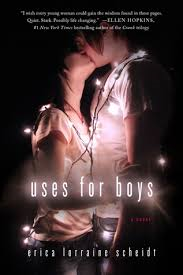
That’s Anna, protagonist of Erica Lorraine Scheidt’s YA novel Uses for Boys, remembering. She remembers a time before stepfathers and step brothers, a time she calls the “tell-me-again-times.” Those were the times when her mother would gather her up and tell her how much she was wanted, “more than anything in the world.”
Unhappily for Anna, the “tell-me-again” times don’t last long. By the time Anna is eight her mother insists that she is “too big for stories.” It’s also the time that Anna’s mother decides that she is tired of being alone and ventures out to meet a man and it seems just about any man will do. Early on Anna learns the lessons that her mother teaches: men will leave.
Despite its cover depicting kissing teens wrapped in twinkley lights, Uses for Boys is mostly the grim story of Anna’s search for unconditional love – the love she should have received from her mother if her mother had bothered to pay attention. Instead, Anna must seek it elsewhere and she does it by chasing (mostly) sexual relationships with boys.
First there’s Desmond who sticks his hand on Anna’s thirteen-year-old breast on the school bus in full view of his friends. Then there’s Joey. And Todd. You get the picture. It isn’t until Anna meets Sam and his family that Anna realizes what she’s been looking for (and willing to give away to get it): family.
“Sam’s house is everything I wanted, but didn’t know to want.” Anna says about her first visit to Sam’s house. “I want to wrap myself in this house like a blanket.”
It’s hard not to sympathize with Anna. She has a nice home but a mostly absent mother. No one has guided her to make wise choices about her body or to value herself as a person, so it’s difficult to blame her when she makes poor decisions. Scheidt’s writing is often poetic although I’m not sure if that makes Anna’s life any easier to bear.
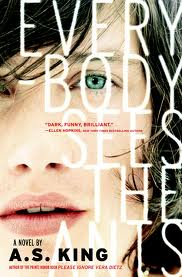
Every night in his dreams, 15-year-old Lucky Linderman, the narrator of A.S. King’s novel Everybody Sees the Ants, visits the jungles of Vietnam in a desperate attempt to rescue his paternal grandfather, Harry, who never made it home from that conflict. In the real world, Lucky isn’t as lucky as his name. In the real world he’s been at the mercy of bully Nader McMillan since he was a little kid and Nader peed on his shoes during a horrible encounter in a restaurant washroom. Lucky wants to stand up to Nader, or at least stay out of his way, but that isn’t always possible and Nader is a huge jerk.
I used to hang out with Nader sometimes, too, because of Danny, even after all the crappy shit Nader did to me, but that was before my famous freshman year social studies suicide-questionnaire screwup, when he decided to make my life a living hell again.
Lucky is an only child. His father is a chef who doesn’t seem able to cope with anything even remotely confrontational, an unfortunate predicament when you have a teenager who is being picked on. Lucky’s mom is a little more proactive, but even she isn’t aware of everything going on in her son’s life. After a particularly nasty incident at the community pool, Mrs. Linderman and Lucky fly out to visit family in Arizona. This summer changes Lucky’s life for a variety of reasons.
Given the fantastic nature of Young Adult literature these days, I doubt most young readers would even bat an eye at Ms. King’s use of magical realism in Everybody Sees the Ants. It’s relatively obvious that Lucky’s dreamy ventures into the jungle to save Grandpa Harry are related to his own circumstances in the real world and his inability to defend himself against Nader. The dual narrative would work just fine like this, but magical realism operates on another level, one where magical elements are a natural part of an otherwise realistic world. So sometimes Lucky wakes up with leaves in his hair or clutching tokens of his latest visit to Laos. He also sees a lot of ants.
Ants appear on the concrete in front of me. Dancing ants. Smiling ants, Ants having a party. One tells me to hang on. Don’t worry, kid! he says, holding up a martini glass. It’ll be over in a minute.
Everybody Sees the Ants is a well-written, thoughtful and thought-provoking. Lucky is a character who will resonate with young adult readers who are climbing their own hill towards adulthood, but can’t quite see over the top.
“Here is the boy, drowning” is the opening line of Patrick Ness’s confounding, riveting, philosophical and profoundly moving YA novel More Than This. If you are a regular visitor to The Ludic Reader then you know that I am a Ness fan. I have huge love for his novels A Monster Calls, The Knife of Never Letting Go, The Ask and the Answer and Monsters of Men.
More Than This was my pick for book club and we gathered on Feb 18th to discuss the novel over dinner. The discussion was rich with differing viewpoints; the dinner itself was only moderately successful. My book club – despite the fact that three of its members, myself included, are teachers – doesn’t normally choose YA fiction. The only other book we’ve chosen from the YA canon was Marcus Zusak’s amazing novel, The Book Thief. In any case, as I was reading I had a feeling that my choice might not float everyone’s boat. Even I had trouble wrapping my head around Ness’s ‘big picture.’
More Than This is the story of a boy who, in the novel’s riveting opening, drowns. And then he finds himself, well, not dead.
He seems to be lying on a concrete path that runs through the front yard of a house, stretching from the sidewalk to a front door behind him.
The house is not his own.
And there’s more wrong than that.
For 163 pages, Seth (as the boy eventually remembers) is alone in a post-apocalyptic town in England. This is, as it turns out, the town where he grew up before he moved to America. Bits and pieces of his story come back to him when he dreams. For example, he remembers something horrible happening to his younger brother, Owen, something for which his mother never forgave him. He remembers Gudmund, a boy for whom he has more than friendly affection. He remembers his other friends, H and Monica. As his previous life filters back to him in dreams, he tries to survive in this new wasteland.
And then he meets Regine and Thomasz. And the Driver, a creepy faceless virtually indestructible being whose sole purpose seems to be to try to catch the three teenagers. And how can there be just them? What has happened to the world?
One member of book club was certain that Seth was suffering from a psychotic break and while her argument is certainly plausible, I am happier taking Seth’s dilemma at face value. I think it’s a more interesting book if we believe in what he sees and experiences. Otherwise, it just feels like Bobby Ewing in the shower.
But believing what Seth does also proves problematic. I’ll admit: I was often confused. But that didn’t negate my love of Seth or his new friends. And, ultimately, I think More Than This has interesting things to say about the myopic lens through which teenagers view their lives. As Seth’s past and present converge, he starts to understand how his story, the story of his life, is unknowable, but that “whatever is forever certain is that there’s always more.”
The last couple of pages of More Than This are outstanding. Some members of my group felt that the novel was 150 pages too long, but I disagree. I think the novel packs a terrific punch and Seth’s journey from self-centered adolescence to manhood is memorable and magnificent.
I continue to be filled with admiration for Ness and look forward to talking about this novel with my students. But make no mistake – this novel has lots to offer thoughtful readers of any age.
Easy was easy to love. So easy, in fact, that I started it and finished it in pretty much one sitting – abandoning all else yesterday after I got home from school and fed my kids – reading until I’d turned the last page…about midnight. This novel by Tammara Webber hit all my guilty-pleasure buttons and a few others besides.
I think Easy is one of those novels that belongs in this New Adult category I see everyone talking about. I actually wish we didn’t spend so much time shelving books into these categories but, anyway, I can see how this book just crosses over the line from YA. For those of you unclear about the New Adult designation, Goodreads defines it as ” fiction [that] bridges the gap between Young Adult and Adult genres. It typically features protagonists between the ages of 18 and 26.” I also think that New Adult is a little more forthcoming with details of a sexual nature. (I should also add that at Indigo, this book is filed in the Adult section.)
Okay, so now that we’re all on the same page with regards to New Adult, let’s get to the good stuff.
Easy is narrated by Jacqueline Wallace, a sophomore (for Canadians who don’t know what that means because we don’t use those terms it’s 2nd year) at an unnamed university. She’s there because she followed her high school sweetheart, Kennedy. He’s just dumped her. She’s heartbroken. But that’s not how Easy starts. It starts with Jacqueline leaving a frat party and getting jumped by someone she knows and always considered benign. Buck has other things on his mind, though, and the relatively graphic nature of the attack is an early indication that we’re leaving strictly teen fiction behind.
Jaqueline has a knight in shining armour, though. The stranger, Lucas, pulls Buck off Jaqueline before he actually rapes her and beats the crap out of him. After Jaqueline declines a trip to the hospital or police station, he whisks her to her dorm and safety. I pretty much fell in love with Lucas from this moment on.
I stared back into his clear eyes. I couldn’t tell their color in the dim light, but they contrasted compellingly with his dark hair. His voice was softer, less hostile. “Do you live on campus? Let me drive you. I can walk back over here and get my ride after.”
Easy is a lot of things, but what it isn’t is the clichéd bad boy, good girl story we’ve all read a thousand times. Yes, Lucas has a pierced lip and lots of tattoos and a body to die for (I wish Ms. Webber’s editor had told her it was biceps not bicep though – even when referring to one) but anyway – that’s beside the point. He’s HOT. Smokin’ hot. And smart. And kind. And mysterious. And tragic. And sometimes, when he speaks, there was swooning – and I’m not just talking about Jaqueline’s reaction.
There’s more than just a love story going on in this novel. To Ms. Webber’s credit she’s created several other compelling minor characters including Jaqueline’s roommate bestie, Erin, and, Benji, a boy in Jacqueline’s Economics class. The book offers lessons about personal safety and girl power without being didactic. In addition, there’s enough push/pull between Jaqueline and Lucas to sustain Easy through its 310 pages and I never once found myself screaming “just get on with it.” If Lucas sounds just a tad too mature for his age – his childhood experiences will explain all. He’s a keeper and Jacqueline deserves him.
Will it go in my classroom library? Yep. I can think of a dozen girls who will love it as much as I did.
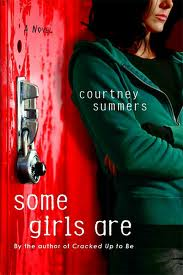
Some girls are bitches. In Courtney Summers’ compelling and disturbing YA novel Some Girls Are, calling the characters bitches is an extreme understatement. Some of these girls are psychopaths.
Regina Afton used to be one of the Fearsome Fivesome – a pack of girls led by Anna Morrison. Every high school has them, I suppose, that group of mean girls who take extreme pleasure in ruining the lives of others. That said, I don’t recall any from my high school days (yeah – okay, it was a million years ago!) and I don’t know of any at the school where I teach – at least none as venomous as this. And man, these girls are really, really awful.
The novel opens at a party where “everyone is wasted.” Everyone except Regina, that is, because it’s her turn to be the designated driver, a job she takes relatively seriously even though it’s “boring.” When she tries to rouse a passed out Anna, she encounters an obstacle of another kind: Anna’s equally intoxicated boyfriend, Donnie.
I’d turned him down in the ninth grade. Anna says we’ve been close to hate-fucking ever since, which is too gross for me to even contemplate. It’s a gunshot kind of thing for her to say – a warning. The way she says it, it’s like she can see it happening, and the way she says it lets me know I better not let it happen.
But then the unthinkable almost does happen and when Regina turns to another member of the Fearsome Fivesome for help and advice, she suddenly finds herself frozen out of the group she was once an integral part of.
The interesting thing about Regina is that she isn’t all that likeable. She’s mean. She wasn’t always mean, though. That would have to be true for readers to root for her even a little bit, but her exterior is so prickly it takes a while to warm up to her. Like, a long while. And I found that interesting. She’s an anti-hero.
Life becomes almost unbearable for Regina once Anna and Kara, Regina’s replacement, get going. It’s not just covert tactics they employ to ostracize Regina – they humiliate her, physically abuse her and truly make her life a living hell. Regina has no allies because when she was part of the clique, she’d been horrible to just about everyone in the school.
I’m used to everyone’s eyes on me; that’s nothing new. When you’re Anna Morrison’s best friend, people look. We’re the kind of popular that parents like to pretend don’t exist so they can sleep at night, and we’re the kind of popular that makes our peers unable to sleep at night. Everyone hates us, but they’re afraid of us, too.
There’s really no relief for Regina until Michael Hayden – one of her former victims – slowly lets her into his life. And with his friendship comes Regina’s redemption.
Okay, I’m a teacher – I know that the vast majority of teens aren’t like the people portrayed in this book – but some of them are. Some teenagers are nasty, messy, insecure, and hateful. And hopefully some of those will, like Regina, have the opportunity to make amends for the damage they do.
Some Girls Are crackles with real energy and I couldn’t put it down.
I read Jenny Downham’s first novel Before I Die a few years ago and I really like it a lot. I liked You Against Me, too. Downham certainly isn’t afraid to tackle the big stuff.
Eighteen-year-old Mikey McKenzie’s life is far from perfect. His mother is an alcoholic and he has two younger sisters, Karyn, 15, and Holly, 8, for whom he is responsible. He’s doing the best he can, but he’s all too aware that sometimes it’s just not good enough. Especially now. Karyn was recently raped while at a party and she now won’t leave the house. Mikey figures he can make everything right again if he beats the crap out of the guy who did it, Tom Parker. He and his best friend, Jacko, come up with a plan but everyone knows nothing ever goes to plan.
Sixteen-year-old Ellie Parker is every bit as anxious as her parents for her older brother Tom’s homecoming. He’s spent the last couple of weeks detained after having been accused of rape, but now he’s coming home to await the trial. Ellie’s her brother’s star witness; she was home the night Tom brought a bunch of friends back from the pub, Karyn included. She’s already told the police that she didn’t hear or see anything much and her parents are convinced that Tom will be found not guilty.
And this might have been nothing more than a he said – she said YA novel except that Mikey and Ellie meet and discover…they like each other. Of course it’s more complicated than that, but once the wires are uncrossed and trust has been earned, Ellie and Mikey really do genuinely fall in love.
Downham does a good job of balancing the story of Ellie and Mikey with everything else that’s going on including Ellie’s doubts about her brother’s innocence, Mikey’s concern for his sisters and frustration with his mother’s lack of responsibility. The novel moves pretty quickly, allowing the reader plenty of time with both Ellie and Mikey so we get a real sense of who they are and how they’re coping with their complicated circumstances. What started as one thing quickly becomes something else for both of them and as Mikey says to Jacko
When I first saw Ellie, I knew it was her – she was my fantasy. I didn’t want it to be true, but every time I met her it was obvious, and the funny thing was that she was better than the fantasy, like I got more stuff than I’d imagined.
You Against Me is about family and friendship and making choices that have far-reaching consequences. Downham offers careful readers lots to think about and has created two young people worth rooting for.
Eleanor & Park turned up on Kirkus’s list of Top Teen Books in 2013, and rightfully so. Rainbow Rowell is a new-to-me author, although I have been wanting to read Fangirl for a while.
Set in Omaha, Nebraska in the 1980s, Eleanor & Park is a novel about two young people who find each other and themselves despite the many obstacles in their way.
When Eleanor moves to a new house and school she’s already aware of how different she is. Park notices her right away because she is
…big and awkward. With crazy hair, bright red on top of curly. And she dressed like…like she wanted people to look at her. Or maybe like she didn’t get what a mess she was. She had on a plaid shirt, a man’s shirt, with half a dozen weird necklaces hanging around her neck and scarves wrapped around her wrists. She reminded Park of a scarecrow or one of the trouble dolls his mom kept on her dresser. Like something that wouldn’t survive in the wild.
Park notices something else, too. He notices that she starts to read his comic books out of the corner of her eye.
At first he thought he was imagining it. He kept getting this feeling that she was looking at him, but whenever he looked over at her, her face was down.
He finally realized that she was staring at his lap. Not in a gross way. She was looking at his comics-he could see her eyes moving.
Eleanor notices Park, too. (“Stupid, perfect Asian kid.”) And soon, over a shared love of comic books and new wave music, the two teenagers discover a mutual appreciation for each other.
The course of true love doesn’t run smoothly, of course. It never does.
Eleanor lives with her mother, four younger siblings and her step-father, Richie, who is not a nice man. At all. In fact, Eleanor has just returned home after living with family friends for a year. She’d been kicked out and the stay was supposed to be temporary. Now Eleanor lives in a home where everyone is always walking on eggshells, especially her.
Park is half Korean and lives with his parents and younger brother, Josh. Everything about his home life is stable and ‘normal’, but Park still finds it difficult to fit in.
Eleanor is a prickly person and Park is exceedingly patient with her, but that doesn’t always prevent hurt feelings and misunderstandings. It’s impossible not to love her, though. Park, too. They are not nearly as frustrating as other ‘teens in love’ might be. I wanted to shake Eleanor’s mom though. But then I had to take into consideration the year in which the novel takes place – 1986.
I was a young(er) person in the 1980s and I loved the pop culture references in Eleanor & Park. Setting it then also allows the reader to forgive the lack of outside agencies (school, Child Protective Services, police) involved in Eleanor’s dreadful home life. Even Park’s dad knows Eleanor’s stepfather and offers Eleanor a safe place to be.
If I have any criticism of the book it’s that I didn’t love the ending. I’m all for ambiguity, but it just seemed a little anti-climactic after everything that happens. It’s a small thing, though. Time with Eleanor and Park is time well spent.
I can’t remember the last time I rooted for a character the way I rooted for Arnold ‘Junior’ Spirit, the fourteen-year-old narrator of Sherman Alexie’s YA novel, The Absolutely True Story of a Part-Time Indian.
Junior is a member of the Spokane Tribe and lives with his parents, grandmother and older sister on the Rez. Without a drop of self-pity, Junior tells the reader that his “head was so big that little Indian skulls orbited around it” and that “the bullies would pick me up, spin me in circles, put their finger down on my skull, and say, ‘I want to go there.'”
Skinny, born with ten extra teeth, and prone to seizures, Junior is also determined, smart, and really funny. He says, “With my big feet and pencil body, I looked like a capital L walking down the road.” He both stutters and lisps and so everyone calls him a retard. “Do you know what happens to retards on the rez?” he asks the reader. “We get beat up. Yep, I belong to the Black-Eye-of-the-Month-Club.”
As if Junior’s physical problems weren’t bad enough, Junior and his family are also very poor. They’re so poor, Junior often goes hungry. But, as he explains, “It’s not like my mother and father were born into wealth. It’s not like they gambled away their family fortunes. My parents came from poor people who came from poor people who came from poor people, all the way back to the very first poor people.”
His father is an alcoholic who often disappears on benders. His mother is slightly flakey, but also super smart. Junior is perfectly aware of the limitations that come from being an Indian on the rez.
…we reservation Indians don’t get to realize our dreams. We don’t get those chances. Or choices. We’re just poor. That’s all we are.
Strangely, none of this seems like whining coming from Junior’s mouth. It is what it is and he’s found ways to cope. For one thing, his best friend, Rowdy, is the toughest kid on the reservation. For another thing, his parents are kind and loving and supportive. While it seems like there are too many obstacles in Junior’s way, the reader soon learns not to underestimate him.
An incident at school prompts a visit from one of his teachers and suddenly Junior has left the rez and is traveling 23 miles into a town to attend a white school where he has the chance to make something of himself. (But not without a lot of soul-searching about what it means to have to leave the rez behind and enter the white world.) But make something of himself, he does. I can’t imagine anyone reading this book and not getting a little va-klempt at Junior’s journey.
The back cover of my edition of The Absolutely True Story of a Part-Time Indian says that the novel is inspired by Sherman Alexie’s own experiences growing up. The book has won numerous awards including the National Book Award. It’s most deserving of the praise.
This is a laugh-out-loud, tear-in-your-eye, 100% uplifting novel about the challenges of growing up and making your own way in the world. Everyone should read it.
If you are a person of a certain age, you probably have fond memories of John Hughes’ films. Even though I was already in my early 20’s when he started producing arguably the best teen movies ever – I was still young enough to see myself in the characters he committed to celluloid.
Sixteen Candles is my all-time favourite Hughes film, for reasons which will be apparent to anyone who has ever seen the film. I still watch it occasionally and it still makes me laugh and it breaks my heart a little now that Hughes has died.
Yes, you can argue that Jake Ryan isn’t perfect – he did let an underage, unlicensed driver take his very drunk girlfriend home in his father’s Mercedes, but it was the 80’s and, come on, Jake Ryan is pretty damn dreamy. Also, who didn’t see some part of themselves in the other characters on the screen: Molly Ringwald’s slightly awkward Samantha Baker, Anthony Michael Hall’s loveable dork. Everyone you ever went to high school with is lovingly represented in this flick and in Hughes’ other teen masterpieces, Pretty in Pink, The Breakfast Club, and Ferris Bueller’s Day Off.
I would posit that John Green is this generation’s John Hughes and I hope Mr. Green will consider that a compliment because it is certainly meant as one.
Last year because everyone and their dog was reading The Fault in Our Stars I did, too. That was a reading experience I will never forget – curled in the fetal position on my bed at 2 a.m., laughing then crying, then laughing again. That is the experience I want my students to have.
The only other John Green book I have in my classroom library is Paper Towns and I just finished it yesterday. (Trust me, I’ll be rectifying the lack of Green books post-haste.) Paper Towns received rave reviews and the Edgar Award (a prize awarded by the Mystery Writers of America) and it’s totally deserving of both.
Quentin Jacobsen is just weeks away from graduating from high school when his next door neighbour Margo Roth Spiegelman shows up at his window in the middle of the night. Although Quentin and Margo had been childhood friends, they’d drifted apart as they’d gotten older and now, in Quentin’s eyes at least, Margo is this exotic and beautiful creature, but not necessarily his friend.
Margo Roth Spiegelman, whose six-syllable name was often spoken in its entirety with a kind of quiet reverence. Margo Roth Spiegelman, whose stories of epic adventures would blow through school like a summer storm: an old guy living in a broken-down house in Hot Coffee, Mississippi, taught Margo how to play guitar. Margo Roth Spiegelman, who spent three days traveling with the circus – they thought she had potential on the trapeze.
…
The stories, when they were shared, inevitably ended with, I mean, can you believe it? We often could not, but they always proved true.
Quentin’s best friend, Ben, describes Margo as “the kind of person who either dies tragically at twenty-seven, like Jimi Hendrix and Janis Joplin, or else grows up to win, like, the first-ever Nobel Prize for Awesome.”
Anyway, Margo needs Quentin’s help. She also assures him that this will be the best night of his life. Quentin is a guy who generally plays by the rules, so his decision to help Margo is slightly out of character for him. Nevertheless, he helps Margo carry out a list of tasks, some of them vengeful and some of them contemplative and he is indeed changed by the experience. Which is why when Margo suddenly disappears, he is compelled to follow the breadcrumb trail of clues she’s left behind.
Paper Towns is a clever mystery for sure, but that’s not the only reason to admire the heck out of it. What I love about John Green is the way he writes dialogue. His characters are smart and funny and honest-to-goodness people. In the same way that John Hughes made his characters painfully awkward or awesome or self-deprecating or ironic, Green’s teens are whole and fragile and super smart and laugh-out-loud funny.
And they think thinky-thoughts. The fact that Paper Towns is set in Orlando, Florida (John Green’s hometown) is significant. Margo says “you can see how fake it is…It’s a paper town. I mean, look at it Q: look at all those cul-de-sacs, those streets that turn in on themselves, all the houses that were built to fall apart.”
Quentin’s journey to find Margo makes him question not only everything he thought he knew about her, but also everything he believes about himself and Green does a great service to his characters (and the young adults who will be reading this book) by not giving us pat answers.
So – read John Green. Watch John Hughes. Through their eyes you’ll see teenagers at their worst…and their best. And it’s all beautiful.
Sara Zarr’s debut novel Story of a Girl kept me turning the pages far past my bedtime – a sure indicator of its quality. I read before bed and most nights I’m lucky if I manage a couple dozen pages, but last night I settled in early and once I started, I couldn’t stop.
Story of a Girl begins with sixteen-year-old Deanna Lambert’s admission that she “was thirteen when my dad caught me with Tommy Webber in the back of Tommy’s Buick, parked next to the old Chart House down in Montara at eleven o’clock on a Tuesday night. Tommy was seventeen and the supposed friend of my brother, Darren. I didn’t love him. I’m not even sure I liked him.”
Deanna had been parking with Tommy for a year before she’s finally caught, but her dad’s discovery of her in a compromising position casts the reality of her life in a harsh light. Now her dad can barely look at her. And when the novel opens, at the end of sophomore year (that’s grade ten here in Canada), it’s clear that the story of her tryst with Tommy is still the topic du jour in her small hometown of Pacifica, a sea-side suburb of San Francisco. At least pretty much everyone at Deanna’s high school knows about it – or some version of it. The only people who don’t care are her two best friends: Jason, a boy she’s known forever and Lee, a girl who moved to Pacifica after the incident.
Story of a Girl takes place during the summer between sophomore and junior year. Deanna’s strained relationship with her dad causes her to daydream about leaving home and living with her older brother Darren, his girlfriend, Stacy and their infant daughter, April. Currently they live in the basement. Stacy and Deanna’s dad don’t get along. In fact, Deanna’s household is pretty dysfunctional and so Deanna quickly finds work at a local pizza dive…where, it turns out, Tommy also works.
What I loved about this book was how realistic it seemed. Everyone judges Deanna for a decision she made when she was thirteen, but it isn’t until she comes into contact with Tommy again that she figures out why she always went off with him. And forgiving him – and herself – also allows her to empathize with her father.
…I imagined us through his eyes – his family, sitting in a pink kitchen: his tired wife, who never complained; his son who looked exactly like him; his daughter, who used to be the baby, his baby girl; and now April, his grand-daughter, who had a whole life in front of her, with no real mistakes in it yet. Could he look at us someday, I wondered, maybe today, and not be disappointed? Could he see us, and himself, for who we really were?
Story of a Girl is a beautiful book because, although it is Deanna’s story, no one’s life is lived in isolation. This is a book about family – the family given to us by biology and the family we choose. The path to adulthood is thorny and it’s good to have some people who are on your side. There are no villains in this book. Even Tommy, douche that he is, is probably trying to fill in the gaps in his own life. The thing is, we carry our mistakes with us and as Deanna’s boss at the pizza place, Michael, tells her: “…don’t mistake a new place for a new you.”
Her bed is a raft on the ocean. It’s a cloud, a forest, a spaceship, a cocoon we share. I stretch out big as I can, a five-pointed star, and she bundles me back up in her arms. When I wake I’m tangled in her hair.




 The Ludic Reader