Paper Covers Rock – Jenny Hubbard

paper-covers-rockJenny Hubbard, the author of Paper Covers Rock, was a high school and college English teacher for seventeen years and I am guessing she was a good one. Her debut novel is filled with  references to poetry and literature and how they make us have “the feels” and allow us to connect with the world etc.

Sixteen-year-old Alex Stromm attends Birch Academy, a boarding school in North Carolina. He is, by his own admission, a good solid kid. When the story opens, Alex is writing in a journal his father had given him to write his impressions in when he’d started at Birch two years previously. Although the book has remained blank, now has something to write about: his friend Thomas is dead. He writes:

What I carry in my backpack down to the river, I carry not knowing that in less than an hour Thomas Broughton will be dead. That is not a knowledge I carry yet, but I will carry it soon – the knowledge of my darkest self – and I will carry it forever.

The reader learns about what happened that fateful day when Alex, Thomas, Clay and Glenn were at the rock by the river in fits and starts. Alex’s feelings of grief and guilt are only part of what compels him to scribble in his journal. He is also in love with his English teacher, Miss Dovecott, a recent Princeton graduate who is only a few years older than the boys she teaches. When she takes an interest in Alex’s writing he becomes even more conflicted about what happened that day on the rock.

Sounds sinister, eh? It’s not really, but I have to say that I did keep turning the pages and read the book in one sitting. Alex’s feelings for Miss Dovecott are complicated by his feelings of loyalty for Glenn. (Clay has taken the blame and left school; I’ll leave you to discover the reason why on your own.) Turns out that just after Thomas drowned, drawn by the screams, Miss Dovecott arrived on the scene and Glenn is convinced that she knows more than she is letting on. Oh what a tangled web.

And I have to say, the writing is stellar. The poetry Alex writes is lovely and it’s easy to see why Miss Dovecott takes an interest in him. Ms. Hubbard captures the male voices beautifully (not as crass as they might be now because, after all, the story is set in 1982) and also manages to make Alex both sympathetic and self-serving on his journey to manhood.
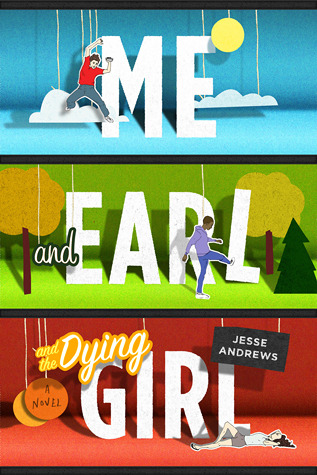
 

Me and Earl and the Dying Girl – Jesse Andrews

earlThis book contains precisely zero Important Life Lessons, or Little-Known Facts About Love, or sappy tear-jerking Moments When We Knew We Had Left Our Childhood Behind For Good, or whatever. And, unlike most books in which a girl gets cancer, there are definitely no sugary paradoxical single-sentence paragraphs that you’re supposed to think are deep because they’re in italics.

Meet Greg Gaines. He’s the seventeen-year-old narrator of Jesse Andrews’ debut novel Me and Earl and the Dying Girl.  He lives with his parents, and two younger sisters in a Pittsburgh suburb. He’s a trash-talking, cynical, slacker who is just trying to make it through his final year of high school.

…you have to to start from the premise that high school sucks. Do you accept that premise? Of course you do. It is a universally acknowledged truth that high school sucks.

Greg goes through the days in a weird state of disconnect because he feels as though the only way to survive school is to stay on the periphery of all the various groups, rather than belonging to any one of them.  He says, “I didn’t join any group outright, you understand. But I got access to all of them.” Of course, that makes having real relationships slightly problematic.

Greg’s only friend is Earl; well, as Greg puts it, they are more like co-workers.   They’ve known each other since they were in kindergarten and discovered a shared love of movies. Since then they have made several films together.

So Greg goes through his days doing as little as possible, using his sense of humour to cover up the fact, I think, that he is insecure about his weight and his looks and his life (all totally relateable to anyone who has ever survived a difficult – or any –  high school  experience.) And then Rachel Kushner is re-introduced to his life.

Greg and Rachel had been sort-of friends when they were kids although Greg admits that he hadn’t been all that nice to her. Turns out Rachel has recently been diagnosed with leukemia and Greg’s mom calls in a favour – rally around Rachel.

Me and Earl and the Dying Girl is not a cancer book, though. It is a profane, often funny and honest look at a teenager on the cusp of adulthood who doesn’t get it…and then does. Despite a great family, Greg is sort of closed off to the world. He doesn’t know how to have authentic relationships even though he is clearly capable of them. He spends his time with Rachel making lame jokes, trying to divert the focus away from Rachel’s illness –  not for her benefit, but for his own.

There is no way Greg is going to come away from spending time with “the dying girl” unscathed and he doesn’t. Mature readers won’t either.

I read this book as part of a program that lets teachers read books being considered for classrooms in New Brunswick. I do think this is a worthwhile and well-written book. My one caveat would be that there is a lot of swearing. A lot a lot. That said, as a high school teacher and a mom of teenagers I think we are fooling ourselves if we think kids don’t talk like this (not my kids, of course!). I think we do mature teens a disservice by leaving books like this off the shelf. I think some students will see themselves in Greg and Earl and it would be a shame not to give strong readers the opportunity to share time with them. I don’t believe in censorship anyway, but beyond that Me and Earl and the Dying Girl has real merit.


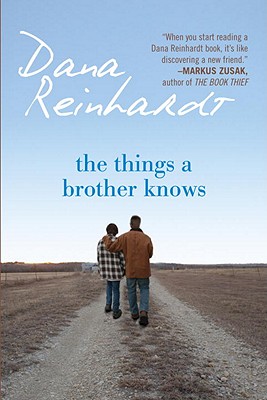
The Things a Brother Knows – Dana Reinhardt

brotherWhen  17-year-old Levi Katznelson’s brother, Boaz, returns from his stint as a marine in an unnamed Middle Eastern country, he’s a changed man.  This relationship between the brothers is what propels The Things a Brother Knows by Dana Reinhardt along.

When Levi was a kid, he adored Boaz.

I used to worship him too. All little brothers worship their big brothers, I guess. It sort of goes with the job description. Think about it. Your brother’s face is one of the first you ever see. His hands are among the first to ever touch you. You crawl only to catch him. You want nothing but to walk like he does, talk like he does, draw a picture throw a ball, tell a joke like he does, let loose one of those crazy whistles with four fingers jammed in your mouth or burp the ABCs just like he does. To your mind, he’s got the whole of the world all figured out.

Levi didn’t really understand why Boaz, a popular high school athlete went off to war anyway. So  his homecoming is a complicated thing. The Boaz who returns to Levi and his parents is withdrawn, rarely speaks and won’t get in a car. He spends hours and hours in his bedroom studying maps and doing stuff on the computer. It frustrates Levi because he doesn’t understand and Bo doesn’t seem willing to explain.

Then Boaz announces that he’s going to walk the Appalachian Trail. Levi is suspicious and does a little snooping and discovers a map that reveals a different route altogether. That’s when he makes the decision to abandon his summer job and go after Boaz.

Although Levi’s figurative  journey is quite a bit different from his brother’s, that summer is pivotal on his journey to adulthood. And while it’s true that The Things a Brother Knows is a “road-trip” book of sorts, the real story here is one of understanding. Understanding each other, sure, but also understanding ourselves. What do we believe in? What matters to us? I think Reinhardt manages this without coming off too preachy.

Levi is a great character and so is his best friend, Pearl. an out-spoken Chinese girl Levi met in Hebrew school. Levi’s grandfather, Dov, is also  memorable. Spending time with these characters is no hardship.

At the end of the day, though, The Things a Brother Knows was just okay for me. The writing is fine. (There’s some swearing, for those concerned with that in a YA book.) The story moves a long, but I just felt it was sort of superficial and that, ultimately, the bow was tied a little too neatly. Still, it’s a book worth having in my classroom library.


All Unquiet Things – Anna Jarzab

allunquietthingsAnna Jarzab’s first novel All Unquiet Things is  mature and thoughtful. Kirkus called it “a sophisticated teen mystery.” It’s actually hard to believe that this book is written for young adult readers; its prose, while not exactly sophisticated, is a cut above many other books published for young readers.

It was the end of summer, when the hills were bone dry and brown; the sun beating down and shimmering off the pavement was enough to give you heatstroke. One winter came, Empire Valley would be compensated for months of hot misery with three months of torrential rain, the kind of downpours that make the freeways slick and send cars sliding into one another on ribbons of oil.

All Unquiet Things is the story of Carly, Neily and Audrey, students at Brighton Day School, a prestigious private school outside of San Francisco. Through a series of flashbacks – told from Neily and Audrey’s perspective – we learn about how Carly and Neily’s middle school friendship blossomed into something more, and how the arrival of Carly’s cousin Audrey changed the dynamics of their relationship.

These teenagers are smart, but they also have a lot of other issues including deadbeat or overly demanding parents. Neily’s parents are divorced and according to Neily his father “hadn’t really parented me since I was very young and I tended to get away with most things….” The girls have problems of their own.

So what’s the mystery? Well, Carly’s dead. (Don’t worry – her ghost doesn’t speak.)  Someone shot her four times and the circumstantial evidence points to Audrey’s alcoholic/drug addicted father Enzo, so he’s serving time in jail. Audrey is convinced that her father is innocent and even though her relationship with Neily has been strained by events, she seeks him out to help her try to figure out who really ended her cousin’s life.

Their investigation exposes the slimy underbelly of Brighton’s facade, but also allows the reader a glimpse into the messed up lives of students with too much money and not enough parental involvement. As Neily and Audrey try to figure out what really happened to Carly, they become friends, at first united in their search for the truth but then because they grow to genuinely care for each other.

You can’t really see whodunnit early on, which makes this a perfect read for students who like a page-turner. All Unquiet Things works on another level, too. Neily has to consider how he has been shaped by his love for Carly and how that love, no longer sustainable or attainable, is holding him back from living a fulfilling life. Audrey has to own up to her own part in Carly’s story and come to terms with the fact that her father might not be capable of all she hopes for him.

All in all, a terrific book.


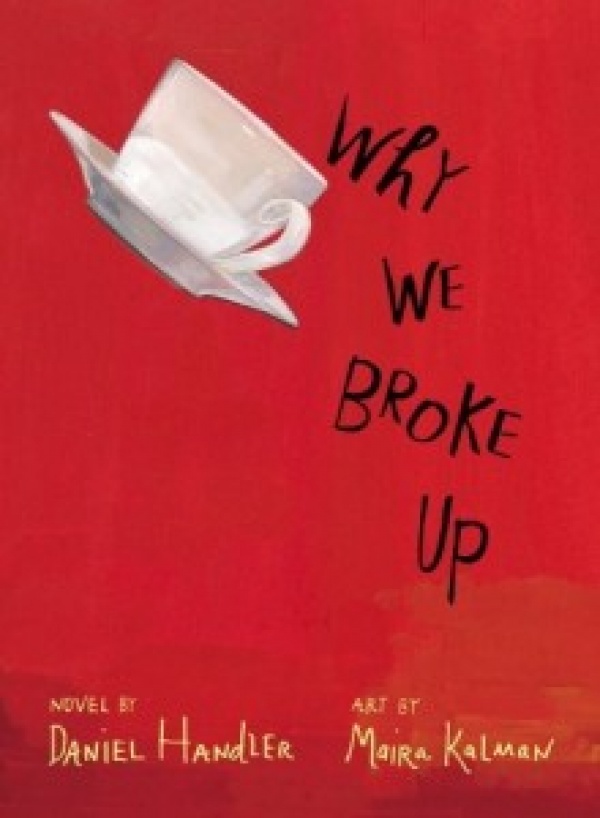
Why We Broke Up – Daniel Handler

whywebrokeup_cover-220x300__span

Daniel Handler has written a book that will resonate with just about anyone – young or old – who has ever had their heart stomped on. Which means YOU will love this book. Yes you.

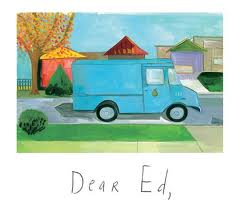
Why We Broke Up is Min Green’s farewell letter to Ed Slaterton, a boy she met at her best friend Al’s Bitter Sweet Sixteenth birthday. As she recounts her brief but meaningful relationship with Ed, hunky co-captain of the basketball team, she also returns to him all the detritus of that relationship.

I’m telling you why we broke up, Ed. I’m writing it in this letter, the whole truth of why it happened. And the truth is that I goddamn loved you so much.

You don’t have to be sixteen to appreciate what’s in Min’s box: the bottle caps and ticket stubs and note on a napkin. Every relationship has its stuff. Min’s relationship with Ed lasted only a few weeks, but as is often the case with the very young, they pronounced their feelings (Ed first) very early on.  They might have seemed, at first glance, totally mismatched. Min, the Jewish girl and movie aficionado and Ed the cool jock with a string of past-girlfriends. But, as Min says: “…the thing with your heart’s desire is that your heart doesn’t even know what it desires until it turns up.”

When I was in grade nine I was madly in love with a boy called Dana. I loved him as only an awkward fourteen-year-old girl can possibly love a much cooler fourteen-year-old boy: from afar. I still have a picture of us taken on our grade nine trip to Prince Edward Island. Me in my Indian cotton shirt and really unfortunate flared jeans, a Bay City Rollers haircut; him in the uniform of the day (and also, perhaps, a Bay City Rollers haircut. Come on, it was the 70s). Anyway. He drank from my coke bottle and I saved that bottle and the inch of pop left at the bottom for years! And I never even got a kiss.

Why We Broke Up is a good bye letter, but it’s also love letter. It’s quirky for sure. (Daniel Handler is perhaps better known as Lemony Snicket, author of the very popular Series of Unfortunate Events books. My 13 year old son is almost through the series and he is constantly reading me bits because he finds them so funny.) The book is illustrated by Maira Kalman and it’s a lovely book – glossy papered and heavy.  brokeupIt’s a clever way to tell an often told story – boy meets girl. Etc.

It’s hard not to feel for Min, though, as she sifts through the mementos, calling up the events associated with them. There’s a story for every artifact and even though she’s giving them all back, the reader understands that her heart will not easily be mended. That’s love for you.

Visit The Why We Broke Up Project


Perfect Chemistry – @SimoneElkeles

perfect chemistryI admit it: I have a type. I like bad boys with kind hearts. Stories that feature these guys (and I’ve read a lot of them) fill in those ticky boxes faster than you can say smoldering eyes and tattoos. You’d think by now I’d be over it, but clearly not. I devoured Simone Elkeles YA novel Perfect Chemistry in one sitting.

Brittany Ellis is eighteen and just beginning her senior year of high school in a Chicago suburb. She’s pretty and popular, captain of the cheerleading team, dating the hunky high school quarterback.  She lives in a huge house on the right side of town.

Everyone knows I’m perfect. My life is perfect. My clothes are perfect. Even my family is perfect. And although it’s a complete lie, I’ve worked my butt off to keep up the appearance that I have it all. The truth, if it were to come out, would destroy my entire picture-perfect image.

Alejandro “Alex” Fuentes is also eighteen and also in his senior year, but his life is vastly different from Brittany’s. For one thing, he comes from the wrong side of the tracks. For another, he’s a gang banger.

Senior year. I should be proud I’ll be the first family member in the Fuentes household to graduate high school. But after graduation, real life will start. College is just a dream. Senior year for me is like a retirement party for a sixty-five-year-old. You know you can do more, but everyone expects you to quit.

The interesting thing about both of these characters is that what the reader sees on the surface is only part of their story. The alternating first person points of view allows us a glimpse into lives which are much more than what they initially appear. Brittany and Alex would have no reason to ever interact. In fact on the first morning of school, Brittany’s reaction at almost hitting Alex while trying to nab a parking spot pretty much says it all:

Alex takes a step toward my car. My instincts tell me to abandon my car and flee, as if I was stuck on railroad tracks with a train heading straight for me….

But Brittany is no shrinking violet and when, later that day, she’s paired with Alex for a year-long chemistry project, she gives as good as she gets. So, naturally, sparks fly.

Perfect Chemistry is a love story, true, but it is also a story about making choices, standing up for what you believe in,  and breaking down those stereotypes which often hold us prisoner.  Brittany and Alex are well-written characters, believable and relateable. I really wanted things to work out for them.

Back in the 70s there was a movie very similar to this book. It’s cheesy now because frankly, blue-eyed Robby Benson was never going to make a very convincing “Chicano”. Still, it has similar themes. In case you have some time to kill, check out Walk Proud.

Reality Check – Peter Abrahams

realityI loved Peter Abraham’s novel End of Story. It was fast paced and well-written and had a right-out-of-left-field curve ball that was suspense-thriller awesome. His YA thriller Reality Check doesn’t have quite the same punch, but young readers, particularly boys, will likely find this story fast-moving and quite exciting.

Seventeen-year-old Cody has it pretty good. He’s captain of the football team and he’s dating Clea,  the prettiest (and smartest) girl at his Colorado high school. His life’s not perfect, though. His mom died of cancer and his father tends to drink a little too much. Then Clea’s father decides his daughter needs to go to boarding school in Vermont – separating the teenagers. Things go from bad to worse when Cody does some serious damage to his knee and Clea suddenly disappears. Cody does the only thing that makes sense: he quits school, hops in his car and drives to Vermont to join in the search.

That’s the basic premise of Reality Check.  It has the requisite twists and turns, the shady characters who aren’t quite what they seem and just enough character development to keep the average reader invested.

Cody is central to the story. The third person narrative is limited to his perspective and that’s a good thing because Cody is likable. He’s tenacious and fearless, too. Because he knows Clea intimately, he’s not willing to accept the party line – that she’d somehow fallen off a horse and had somehow gotten lost in the woods. He keeps digging, looking for clues and then answers.

I suspect that many teens won’t figure out the mystery too early and that they will root for Cody and Clea’s reunion as I did. There is some language in the book, so it’s perhaps not for younger teens, but it’s an enjoyable book for those who like fast-paced page-turners.

Things Change – Patrick Jones

When sixteen-year-old Johanna accepts a ride home from a meeting with Paul, even she is surprised when she boldly asks him to kiss her. Paul is sort of a well-known figure at their high school, not because he’s an athlete or a particularly good student, but because he is funny and good-looking. People want to be around him. Johanna, on the other hand, is studious and  not very popular. Her one and only friend, Pam, calls her “Books” and the two girls have a standing date at the local bookstore on Saturday.

Patrick Jones’ debut novel Things Change will appeal to fans of realistic fiction. Johanna will be immediately recognizable to young girls; they will either see themselves or someone they know in her. Like many teenage girls, Johanna tries to please her parents, tries to balance school and life and falls head over heels in love with a boy who is fighting his own demons. Because one thing Things Change is not is a straight up love story.

Paul and Johanna eventually hook up and it’s all sunshine and roses – except for when it’s not. Paul is possessive and jealous and has a temper that causes him to lash out at Johanna, inflicting physical and emotional pain for which he is almost immediately contrite. But that’s the pattern, right? And Johanna – young and inexperienced – does what many much older women in her situation might do: she makes excuses, tries to be perfect, forgives.

Although the third person narration is mostly limited to Johanna’s point of view, Jones does something smart,  giving the reader a glimpse of Paul’s psyche by letting us read letters he writes to his dead father. I say it’s smart because it prevents Paul from being a one dimensional monster and the book from being a one-note cautionary tale. Paul’s demons in no way excuse his deplorable behaviour, but it does make him human and somewhat sympathetic.

Patrick Jones used to be a Young Adult librarian and Things Change certainly demonstrates that he’s listened to and observed teens carefully. This book doesn’t preach nor talk down to his target audience. It’s not overly graphic, but there is some sexual content and bad language. That said, I will happily be recommending it to readers in my classroom – both those students who claim they don’t like to read and those who want to read compelling and realistic fiction.

The Fault in Our Stars – John Green

Late in the winter of my seventeenth year, my mother decided I was depressed, presumably because I rarely left the house, spent quite a lot of time in bed, read the same books over and over, ate infrequently, and devoted quite a bit of my abundant free time to thinking about death.

Meet Hazel. She’s got cancer. It started as thyroid cancer, but now it’s in her lungs. There is no cure, but there is this miracle drug, Phalanxifor (Green points out in his acknowledgements that it’s a made up drug.), and although Hazel’s lungs are practically useless and she has to be hooked up to her oxygen tank all the time, she does okay. Except for, you know, the depression. Or whatever.

Her parents insist that she go to the  cancer survivor’s support group meeting – which she had grown to “to be rather kicking-and-screaming about” – and it is there that she meets Augustus Waters.  He’s in remission after losing his leg below the knee from “a little touch of osteosarcoma.” Her immediate reaction: he’s hot. From this point on, I flew through the pages of  John Green’s YA novel The Fault in Our Stars, alternately laughing and crying.

Telling you much more about the plot won’t actually do the book any justice. Besides, it isn’t so much about what as it is about to whom. The Fault in Our Stars is driven by the magic that is Hazel and Augustus.

Their relationship begins over an exchange of books (be still my heart). Hazel lends Augustus her favourite novel,  An Imperial Affliction, the story of Anna, a girl with a rare cancer of the blood. But, Hazel says:

it’s not a cancer book, because cancer books suck. Like, in cancer books, the cancer person starts a charity that raises money to fight cancer, right? And this commitment to charity reminds the cancer person of the essential goodness of humanity and makes him/her feel loved and encouraged because s/he will leave a cancer-curing legacy. But in AIA, Anna decides that being a person with cancer who starts a cancer charity is a bit narcissistic, so she starts a charity called The Anna Foundation for People with Cancer Who Want to Cure Cholera.

Hazel has some unanswered questions about An Imperial Affliction. She has tried for months to get in touch with the book’s author, Peter Van Houten. When Augustus actually makes contact with Van Houten, it sends the pair on the trip of a lifetime.

But much of that is plot and while the story might be predictable in many ways, there is nothing ordinary about this novel. Nothing. Hazel has been sick for a long time; she has already come to terms with her mortality. What she doesn’t know how to do is live. Augustus is the perfect antidote to her doldrums, beautiful and funny.

And make no mistake – this book is funny. These kids know how to laugh at themselves. When  Isaac, another member of the support group, loses his remaining eye to cancer he says: ” …people keep saying my other senses will improve to compensate, but CLEARLY NOT YET. Hi, Support Group Hazel. Come over here so I can examine your face with my hands and see deeper into your soul than a sighted person ever could.”

As if navigating the thorny path to adulthood weren’t difficult enough, the teenagers in this book must also contend with bodies that have forsaken them.  It is also heartbreaking to watch Hazel’s parents try to protect their daughter, even when they know they can’t. As a mom myself, I can only imagine how horrific it must be to care for a terminally ill child.

Augustus sums it up best: “…the thing about pain…it demands to be felt.”

Absolutely my favourite book this year.

Gone – Kathleen Jeffrie Johnson

Connor, the 17-year-old protagonist of Kathleen Jeffrie Johnson’s YA novel, Gone, is straddling the  fence between innocence and experience. He has just graduated from high school, lives with his Aunt Syl, and visits his father in a nursing home where he has been living ever since he crashed his car while driving drunk. His mother is also a recovering alcoholic.  He is certainly vulnerable to the advances of Corinna Timms.

Ms. Timms was one of Connor’s high school teachers.

Zach…called Ms. Timms serious babe material – too bad she was their teacher. Connor called her, just to himself, beautiful. Half the time in her class had been spent trying not to stare at her, then failing his resolve, ducking his head when she turned around from the blackboard and caught him.

For the nanosecond that their eyes locked – what?

It’s this what that drives the narrative of Gone. As Connor moves through his days, avoiding his mother, working at Chow Line, hanging with his friend, Zach – he does his best to avoid thinking about his growing feelings for Ms. Timms. But it is clear to the reader (and Connor’s closest friends) that something is happening. And make no mistake – the fuel for Connor’s growing obsession is hormones.

Connor’s feelings for Ms. Timms are, in part, exacerbated by his parental issues. When his father dies and his mother, newly sober, comes to town, Connor is forced to confront some of his painful family problems. By then, though, things with Ms. Timms have crossed the platonic line and his world spins off its axis.

Gone is not a love story. Ms. Timms has her own demons. In the end, she comes across more as predator than genuine friend. And while Connor’s world does shift dangerously off track, he is a smart kid and I suspect that he’ll be okay in the end.

This book won’t be everyone’s cup of YA tea. But it’s intelligent and well-written, although there is some strong language. Obviously.