
 I don’t think I have ever read a book quite like Frances Hardinge’s YA novel Cuckoo Song. I am not much of a fantasy fan, you know – word building and that sort of thing, but I was totally enchanted by Hardinge’s story, which is as much about grief and loss, as it is a creepy story about…well, I can’t really tell you.
I can tell you that the story follows 13-year-old Triss, who wakes up after falling into the Grimmer – a pond near the cottage where she is vacationing with her family. Her mother comforts her, telling Triss that she’s “just been ill again, that’s all. You had a fever, so of course you feel rotten and a bit muddled.”
Triss’s younger sister Penny, Pen for short, doesn’t seem all that thrilled with Triss’s recovery. “She’s pretending!” she screams, when she comes to Triss’s bedroom. “It’s fake! Can’t any of you tell the difference?”
Things just get weirder for Triss because even she has to admit that something isn’t quite right. For one thing, she has a voracious appetite – never mind easing herself back into the world of food, as “soon as she saw the first bowl of soup arrive, great crusty rolls on the side of the tray, her hands started to shake.” Triss is horrified to discover that food is not the only thing that will sate her hunger; she’ll willingly eat just about anything and lots of it.
Other strange things begin to happen in Triss’s life. Dead leaves in her hair when she wakes up. Dolls that move in her hands. Dolls that speak to her. And then what’s with all the letters from her brother, Sebastian? Those letters are impossible because Sebastian was killed in the war.
Hardinge has created a masterful, creepy and mysterious novel that is both exciting and kind of heartbreaking. I don’t want to spoil the novel’s surprises, but I will say this: you won’t forget Triss because she is brave, endearing and clever. Her desire to solve the mystery of what’s happened to her keeps the plot ticking along, but her capacity for self -reflection and self-awareness is what makes her a character who will stay with you long after the last page is turned.
Highly recommended.
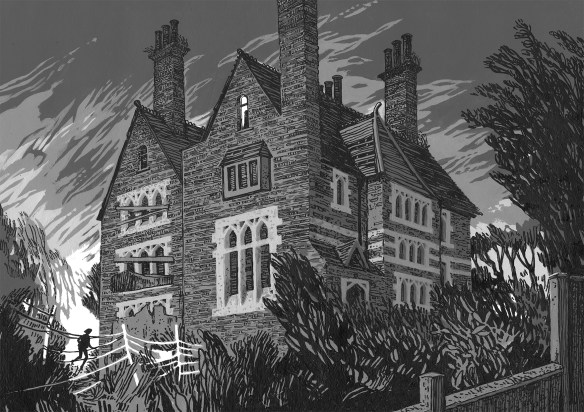 Pam Smy’s lovely hybrid novel tells the story (in words) of Mary and (in pictures) Ella – two girls separated by twenty-five years. Ella and her father have moved into a house that looks out onto Thornhill Institute which was “established in the 1830s as an
  orphanage for girls” and sold in 1982 “after the tragic death of one of the last residents, Mary Baines.” For the last twenty-five years, the house has remained vacant, although plans have been made to develop the site.
 In the present day, Ella spends much of her time alone, too. Her father, who clearly seems to love her, is away a lot. Her mother is presumably dead. Ella is curious about the house she can see from her bedroom window and the girl she sometimes glimpses in the overgrown garden behind the walls
 The Giver takes place in a community that values Sameness. On the surface it might even appear like a Utopia. Eleven-year-old Jonas lives in a family unit lives with his younger sister, Lily, and his mother and father. None of them are biologically connected. His life is structured around school and volunteering and ceremonies that mark the important moments in the lives of the citizens. He is apprehensively waiting the next ceremony. His mother tries to calm Jonas’s nerves by telling him
 talk, too. The book is based on the true story of California history teacher Ron Jones’ social experiment. (He’s been renamed Ben Ross in this book.) The year was 1969 and Ross had just shown his senior class a film about the Holocaust. When one of his students asked how the Germans could have just sat back and let the Nazis do what they did, Ross tried to think of a way he could illustrate the power of a fascist movement. He came up with “The Wave” and began to teach his students about discipline, community and action. Although the experiment was meant to be short-lived, it grew to include a salute, slogans and even a secret police force before it was finally dismantled due to complaints from parents and colleagues.

 The Ludic Reader