I love books featuring English teachers because I am an English teacher. Vera Lundy is 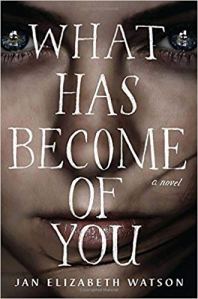 the protagonist of Jan Elizabeth’s compelling thriller What Has Become of You. She’s pushing forty and has just accepted a maternity leave position at a private school in Dorset, Maine. Although Vera is well educated – she earned her master’s degree at Princeton – she is also somewhat awkward, and although being at the front of a classroom doesn’t come naturally to her she has “come to appreciate certain aspects of teaching.”
Jensen Willard is in Vera’s first period class, Autobiographical Writing: Personal Connections. Before Vera has even begun to teach, she receives an email from the precocious Jensen, asking her if it’s okay if she uses her own personal copy of Catcher in the Rye. This first correspondence sets in motion a peculiar relationship between teacher and student. In her journal, Jensen reveals very personal things, and Vera is both flattered to be on the receiving end of such honest reflection, but also, as time goes on, troubled.
What Has Become of You mines the teacher/student dynamic to great effect. I think all teachers have had students to whom we feel a special bond. Things get tricky for Vera, though, because Jensen is not your average kid. She’s odd, doesn’t fit in with the other students, is a bit of a loner. She reminds Vera of herself.
She herself had not enjoyed being that age. On the contrary, those had easily been the worst years of her life. They had been the years of being ostracized, of being heartbroken, of being hunted down.
Vera sees something of a kindred spirit in Jensen, but then life goes off the rails for Vera. One night, walking home through the park, she stumbles upon the body of another one of her students. The ensuing investigation, and Jensen’s subsequent disappearance, puts Vera in the cross-hairs.
What Has Become of You is a well-written – I hesitate to say ‘thriller’ so I am just going to say mystery. Our narrators are wholly unreliable, the plot is intricate and, although it mines somewhat familiar territory, it still manages to be surprising.
I would definitely recommend it.
 finally picked it up. The book was well-reviewed and was a finalist for Crime Writers’ Association’s Steel Dagger Award. What can go wrong, right?
 Although I don’t usually trust author endorsements on book covers (except for Stephen King’s praise; he’s a pretty reliable reader), Simone St. James’s novel The Broken Girls had an equal number of positive reviews from places like Kirkus, Library Journal and Booklist. I felt pretty confident when I chose it as my book club pick back in March.
 Rufus Holt is having a really fucking bad day. I use the expletive because, well, there’s a lot of F-bombs in Caleb Roehrig’s YA mystery White Rabbit. I’m not a prude by any stretch, but I have to admit that by the end of the novel I was getting a little tired of all the swearing. Surely teenagers as smart as the ones who populate Roehrig’s world would have the vocabularies to match.
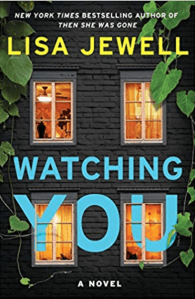 The current flavour-of-the-month in book stores these days seems to be duplicitous nannies or wives, unreliable narrators of all stripes, characters and plots that simply can’t be trusted. In my experience, books like this come with varying degrees of pedigree. But then there’s Lisa Jewell.
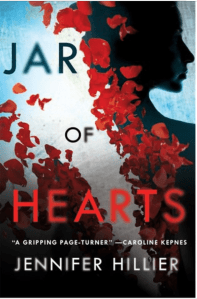 actually a bit surprised that I even picked up Jar of Hearts. I guess I didn’t put two and two together before I forked over my money. I am happy to report that Hillier has redeemed herself a little in my eyes because Jar of Hearts wasn’t nearly as cringeworthy as Creep. In face, I liked it quite a bit until the end.
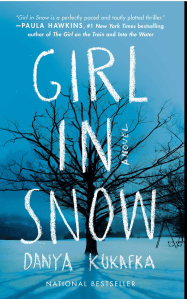 Danya Kukafka’s debut novel, Girl in Snow, earned copious praise from anybody who’s anybody in the book world and it’s easy to see why everyone was hyped up.
 I don’t think I have ever read a book quite like Frances Hardinge’s YA novel Cuckoo Song. I am not much of a fantasy fan, you know – word building and that sort of thing, but I was totally enchanted by Hardinge’s story, which is as much about grief and loss, as it is a creepy story about…well, I can’t really tell you.
 Jessica Mayhew in Charlotte Williams’ novel The House on the Cliff.
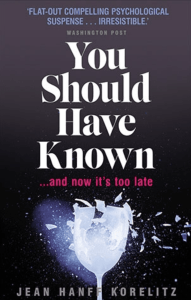 Grace Sachs, the protagonist in Jean Hanff Korelitz’s compelling domestic thriller You Should Have Known, is an outspoken marriage counsellor who believes that women know from the very beginning if their partners are duds.
 The Ludic Reader