Sweetbitter – Stephanie Danler

9BC8A38C-E581-4BB6-A29F-B5302D5437FCAlthough I didn’t lead the life of debauchery that Tess, the first-person narrator of Stephanie Danler’s novel Sweetbitter lives, I did spend most of my twenties working in the service industry.  Those were the best of times and the worst of times. For Tess, too.

Tess arrives in New York City without a plan. She’s 22-years-old and she left home to escape something – although she is perhaps not quite sure what:

The twin pillars of football and church? The low, faded homes on childless cul-de-sacs? Mornings of the Gazette and boxed doughnuts? The sedated, sentimental middle of it. It didn’t matter. I would never know exactly, for my life, like most, moved only imperceptibly and definitively forward.

She moves in with the friend of a friend, a guy with an apartment in Williamsburg. And then she scores an interview at New York’s most famous restaurant, a place in Union Square. Tess has no real experience (because you can’t count the coffee shop she worked at back home) and when Howard, the restaurant’s general manager asks her why she chose NY, Tess says “It really didn’t feel like a choice Where else is there to go?” She smiles too much; sweats through her sundress. And lands a job.

This job changes Tess. In some ways it chews her up and spits her out. She encounters lifers who make a lot of money – so much money, it’s understandable why they’ve chosen this life as their career.

One of these people is Simone – an ageless goddess who seems to know everything. Tess develops something of a crush on her, longs to be like her, hangs on her every word.

“Tasting is a farce,” Simone tells her. “The only way to know a wine is to take a few hours with it.”

Then there’s Jake, possessor of the pale, spectral eyes. His total disregard for her traps Tess in his orbit.

Of course, there are loads of other characters at the restaurant: the gay Russian, the cranky waitresses, the handsome owner who tells the staff that “The goal…is to make  the guests feel that we are on their side. Any business transaction – actually any life transaction – is negotiated by how you are making the other person feel.”

Tess  starts as a “backwaiter”, a job I’d call server assistant. It’s hot, thankless work, but Tess is a quick learner. She’s soon part of the family – drinking and snorting coke until the wee hours, sleeping, and doing it all again and again.

I had a few summers like that – without the coke snorting. I do remember running from the restaurant where I worked down to another bar and knocking back a drink during my fifteen-minute break. That was about as wild as it got for me. Still, I could relate to Tess and her topsy-turvey lifestyle. Up late into the night, sleeping late into the day. Always cash in your pocket.

Sweetbitter will definitely remind anyone who’s worked in the the restaurant business of those crazy days when those “loose, slippery bills” filled your pockets. But it is a business that can ruin you. Tess says that “What I didn’t see was the time had severe brackets around it. Within those brackets nothing else existed. Outside of them, all you could remember was a blur of temporary madness.”

I very much enjoyed my time with Tess. And I am very happy that those days are behind me.
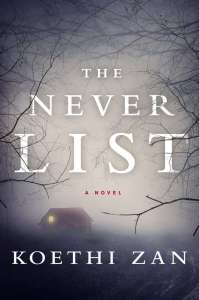
The Never List – Koethi Zan

Never-List-Blog-pictureThe Never List never really got off the ground for me, although the premise had a lot of potential. Koethi Zan’s debut novel is the story of Sarah, a reclusive young woman who is still suffering from the psychological scars of having been held captive by a sadist, Dr. Jack Derber.
There were four of us down there for the first thirty-two months and eleven days of our captivity. And then, very suddenly and without warning, there were three. Even though the fourth person hadn’t made any noise at all in several months, the room got very quiet when she was gone. For a long time after that, we sat in silence, in the dark, wondering which of us would be next in the box.

That was ten years ago. Now Sarah is living a quiet life as Caroline. She’s an actuary in New York City (specifically chosen so that there would always be a lot of people around). Her therapy is at a standstill, she doesn’t have any meaningful relationships (unless you count Jim McCordy, an FBI agent) and she rarely leaves her apartment. Every so often Jack Derber sends Sarah a letter from prison, and it’s the latest letter and the fact that Jack’s parole hearing is coming up that sends Sarah digging into her past.

The novel’s title comes from Sarah and her best friend Jennifer’s ‘never list.’  The two girls, friends since childhood, had compiled a list of all the things they should avoid in order to lead a safe life: “never go to the campus library alone at night, never park more than six spaces from your destination, never trust a stranger with a flat tire. Never, never, never.”

Sarah’s decision to speak at Jack’s parole hearing, even though the thought of facing Jack again fills her with dread, is prompted by her love for Jennifer, who was the girl in the box and whose body was never recovered from Jack’s remote house, where the girls were kept chained in the cellar.

So, the ingredients for a creepy, twisted thriller, are certainly there, but there are lots of things that didn’t work. For one, too many characters and sub plots that just all come together in a rather unsatisfying way in the end. Also, Sarah’s character development was unbelievable. Can the reader really be expected to believe that a woman who is afraid to drive alone in the dark, will actually lead her fellow survivors back to the very place where they’d been held prisoner? Without police? Cue eye roll. And these reserves of strength come out of the blue.

Jack Derber is only seen through the eyes of other characters, so he is never really a threat. Whatever he was doing to those women – none of it is described. I don’t necessarily need to hear all the graphic details – I’ve got a pretty good imagination – but other than ‘the rack’ it’s all pretty vague. Likewise, a trip to a BDSM club is pretty vanilla. And although there is clearly something going on, with Jack Derber still safely behind bars Sarah (and the reader) hardly needs to worry about him.

Some readers will probably be genuinely freaked out by The Never List. For me, it was just okay.

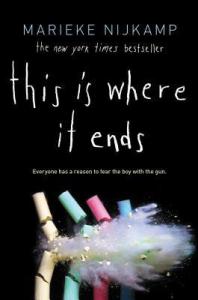
this is where it ends – Marieke Nijkamp

Columbine. Newtown. Parkland. The fact that we know these towns because of the school shootings that happened there is shocking. According to Everytown there have been 302 school shootings in America since 2013. True, not all of these incidents have resulted in death, but the fact that someone brought a gun into a school is pretty horrifying.

For comparisons sake, there have been seven school shootings in Canada with a total of 28 fatalities. (And I’m not talking since 2013, I’m talking in total.) The first happened at a high school in Brampton in 1975. The worst happened at École Polytechnique in 1989 where 14 women were killed. The most recent happened in La Loche, Saskatchewan in 2016 where four people were killed and seven were injured.

I know that guns (and gun control and 2nd amendment rights) are a contentious bowl of soup, but, people! Seriously.

thisiswhereMarieke Nijkamp tackles gun violence in her compelling (and heartbreaking) YA novel this is where it ends.
Four narrators tell the story of what happens when a student locks the entire student body (almost) into the gym and starts shooting.

There’s Claire, a senior track star who isn’t in the gym because she’s training for an upcoming track meet.

There’s Autumn, a dancer who can’t wait to blow her popsicle stand of a town, a backwater named – ironically – Opportunity.

There’s Sylv, a girl who would sacrifice anything to keep those she loves safe, including Autumn.

And there’s Tomas, Sylv’s twin, who is breaking into the principal’s office with his friend Fareed when the chaos start.

What do these four people have in common? That would be Tyler, Autumn’s brother, a beautiful but damaged boy who clearly feels he has nothing left to care about. But really, Ty’s motives for shooting up the school don’t matter, really. The terror is real. The violence is real.

The action of the novel takes place over the course of 54 minutes. In that time, we come to understand how these five students are connected. We also learn about their hopes and dreams; we see their bravery and their fear; we root for them and we mourn with them. It’s pretty compelling stuff especially now when school shootings seem to be happening with alarming regularity.

Nijkamp was smart to let us into these character’s heads. They reveal secrets they’ve kept from each other – mostly out of love. They admit to weaknesses and also dig deep for reserves of bravery and strength. And, they even find compassion.

“Grief is one big, gaping hole, isn’t it?” Sylv says to Ty.

I don’t know if he hears me, but my words are as much for myself as for him. “It’s everywhere and all consuming. Some days you think you can’t go on because the only thing waiting for you is more despair. Some days you don’t want to go on because it’s easier to give up than to get hurt again.

this is where it ends is a timely book with an important message.


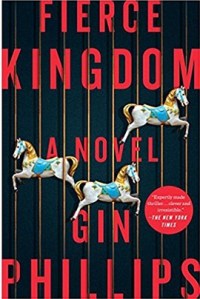
Fierce Kingdom – Gin Phillips

fierceJoan and her four-year-old son Lincoln are enjoying a late afternoon in the zoo when Gin Phillip’s novel Fierce Kingdom begins. It’s almost five o’clock and they are in the Dinosaur Discovery Pit playing with Lincoln’s menagerie of action figure heroes and villains.
She and Lincoln come here sometimes after she picks him up from school – they alternate between the zoo and the library and the parks and the science museum – and she steers him to the woods when she can. Here there are crickets, or something that sounds like crickets, and birds calling and leaves rustling but no human sounds except for Lincoln calling out his dialogue.

With only a few moments left before the zoo closes, Joan and Lincoln make their way to the exit. Joan has a moment of prescience when she imagines “camping in the zoo overnight, maybe even intentionally hiding back there, going to visit the animals in the pitch-black of midnight.” They are almost at the exit when Joan notices the bodies (at first she thinks they are toppled over scarecrows, but no…) and the man in dark clothes, carrying a rifle. Joan grabs Lincoln and they run. For the next three hours the pair are trapped in the zoo with armed men intent on killing them – and anyone else they find.

The scariest thing about Fierce Kingdom is probably that in the current climate it’s not such a far-fetched premise that innocent people are gunned down in what is supposed to be a safe place. I live in Canada and we don’t have the same love affair with our firearms as Americans do, but even so, it’s hard not to be paranoid about being  at the wrong place at the wrong time. Joan might have taken Lincoln to any one of their regular spots – but today they are at the zoo.

Joan’s number one priority is to get them to safety and for a big chunk of the novel they hide out in an old porcupine enclosure “deep in the twists and turns of the primate house. It does not look fit for humans, and that is what strikes her as perfect about it.”  Everything Joan does, every decision she makes, is about protecting Lincoln, and her ingenuity and bravery will likely strike a chord with anyone who has kids. Well, with anyone, really, who has a desire to live.

Phillips keeps the focus  – for the most part – on Joan and Lincoln, but she does introduce a handful of other characters (Kailynne, a teenager who works in a concession stand; Margaret Powell, an older school teacher; Robby Montgomery, a young man with a connection to the shooters), which keeps the narrative from being too insular.

As Joan works to keep Lincoln safe, she ponders the peculiarities of motherhood…the myriad of ways that harm might come to our children. As any parent knows, you can’t think about that stuff or you’ll go crazy; you’d never let your children leave the house.

Fierce Kingdom  is a book about what it means to be a parent wrapped up in a page-turning thriller.

Into the Darkest Corner – Elizabeth Haynes

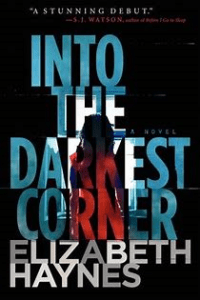
Party girl Catherine Bailey meets handsome and mysterious Lee Brightman at a nightclub. C’mon, ladies. Nothing darkest corner good ever comes from meeting some guy at a nightclub – especially a guy who seems too good to be true. But this meet cute is what sets Elizabeth Haynes’ crazy stalker story in motion. There are two narrative threads in Into the Darkest Corner. There’s the unraveling of Cathy and Lee’s romance (if you can call it that),  and there’s Cathy’s subsequent escape from Lee’s clutches and her attempt to live her life.
Post-Lee Cathy lives a quiet life in a flat in London. Just getting out of the house causes her severe anxiety.

I shut the front door firmly and turned the lock, checking that the bolt had shot home by rattling the door a few times. With my fingertips I traced around the edges of the doorframe, feeling that the door was flush with the frame. I turned the doorknob six times, to make sure it was properly closed. One, two, three, four, five, six. Then the doorframe again. Then the doorknob, six times. One, two, three, four, five, six.  Then the lock. Once, and again. Then the doorframe. Lastly the knob, six times. I felt the relief that comes when I managed to do this properly.

Although it may be hard to reconcile this Cathy with the girl who admitted that the best part of a night out is “finding some dark corner of the club and being fucked against a wall”, her transformation won’t seem so far-fetched once she tells the story of how her Prince Charming turned into a sadistic psychopath. (Well, ‘turned into’ is a bit of a misnomer; Lee was always a sadistic psycho.)

There’s nothing new in Into the Darkest Corner. Readers know from the beginning how the story will unfold; the only things missing are the particulars. Haynes metes out the details in a timely fashion and it’s a page-turner, for sure, but Cathy isn’t a particularly likeable character. Sure, it’s hard not to feel sympathy for her; she has suffered terribly, but I just didn’t love her. Maybe that doesn’t matter. Because Stuart does.

Stuart’s the handsome, single child psychologist who moves into the flat upstairs and very willingly dives head-first into Cathy’s crazy. It’s perhaps the teensiest bit contrived, but without the introduction of someone in her life, Cathy would probably still be triple (times two) checking the locks on her door.

Into the Darkest Corner is not the worst of the genre, for sure, and I definitely wouldn’t be opposed to reading more books by this author.

Final Girls – Riley Sager

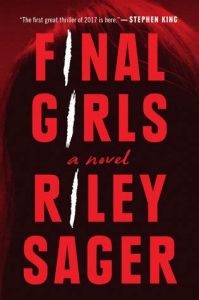
finalI didn’t realize that the term “final girls” actually referred to the last girl standing in a horror film. I chalk it up to not being a fan of stalker-type films; I can’t deal with the violence.  According to Vox “Final Girls are tough enough and strong enough to make it to end — the only people still standing when the last trickle of blood has hit the floor.” (It’s worth reading the whole article, actually, as it’s a really interesting look at Final Girls.)

Riley Sager (a  pseudonym for author Todd Ritter – and what is it about all these pseudonyms lately?) has taken this horror movie trope and spun it into his best seller Final Girls…although I would disagree with the ‘best’ part of it.

Ten years after her best friends were massacred in a remote cabin, Quincy Carpenter, the only survivor,  is still trying to recover. Now she’s a NYC baking blogger living with her lawyer boyfriend in NYC. She smooths out the rough edges of her life with Xanax, a little kleptomania, and sporadic visits with Coop, the cop who saved her life that night in the woods. He’s her touchstone, the one person who understands what she endured and ultimately survived that night when she escaped from Him. (That’s what Quincy calls the killer – a moniker that never stopped reminding me of  a BDSM master/slave.)

She’s not the only Final Girl, though. There’s Lisa, who survived a sorority house massacre at the hands of a crazed psycho and Sam, who lived through the Sack Man’s rampage at the Nightlight Inn. Lisa reaches out to Quincy with an offer to teach her how to be a Final Girl.  Sam is MIA until she unexpectedly shows up on Quincy’s door and Quincy’s life begins to unravel.

It’s Lisa’s death – an apparent suicide –  which is the catalyst for Sam’s arrival in New York and Quincy’s sudden departure from her quiet life. Sam is a bit of a wild child and suddenly Quinn’s drinking too much Wild Turkey and walking through Central Park after midnight – just looking for trouble. Sam provokes Quinn.

I want to see you get angry. You’ve earned that rage. Don’t try to hide it behind your website with your cakes and muffins and breads. You’re messed up. So am I. It’s okay to admit it. We’re damaged goods, babe.

The past starts closing in on Quincy and the book definitely does pick up some momentum even if I didn’t believe the ending one bit.

Final Girls suffers in comparison to  The Woman in the Window even though the books aren’t strictly in the same genre. I started Final Girls and read probably 100 pages and then started The Woman in the Window, which I absolutely couldn’t put down, even though I did figure out some of the twists in advance. Final Girls just felt clunky to me by comparison. Quincy is shrill and not particularly sympathetic and yes, of course, she survived a horrific event and I should cut her some slack, except that I just didn’t  care about her.

I am a big fan of psychological thrillers and I am definitely in the minority here. Even Stephen King called this book “the first great thriller of 2017.” For me, Final Girls just didn’t fulfill its blood-spattered promise.


Cracked Up to Be – Courtney Summers

crackeduptobeCourtney Summers is one of my favourite YA writers. Cracked Up to Be was her debut novel, but it’s the fourth book I have read by this talented Canadian author. I have also read her terrific zombie novel This is Not a Test, her caustic novel about high school bullies, Some Girls Are and All the Rage, a frightening look at the aftermath of sexual assault.

In Cracked Up to Be, Parker Fadley has clearly gone off the rails. The once perfect student, cheerleading captain, and homecoming queen is potentially not going to graduate, must adhere to a strict curfew and she’s come to school hung over on more than one occasion. What could have possibly happened to upend Perfect Parker’s perfect life?

Figuring that out is what pushes this novel along and whether or not you’ll feel satisfied with the explanation for Parker’s fall from grace will be up to you. This is high school – so everything has a heightened sense of drama, but ultimately, that’s not what is so awesome about Summers’ book.

What’s awesome is Parker herself, a fully realized character that is both 100% unlikeable and 100% sympathetic…if that’s even possible.

The problem with alienating, self-destructive behavior is people get it into their heads it’s a cry for help. I wasn’t. It was just a really poorly executed plan to get everyone off my back. So now I’m halfway between where I started (not alone) and where I want to end up (alone) and I just have to roll with it if I want to graduate or else I’ll never be alone.

The thing about Perfect Parker is that she doesn’t sound like she was an altogether stellar human being even before whatever happened happened. Perhaps it’s true of all perfectionists: it’s their way or the highway. But post-event Parker is particularly prickly. Becky, the girl who has taken over as head cheerleader and hooked up with Parker’s ex-boyfriend, Chris, takes the blunt end of most of Parker’s vitriol.

“Screw him, Becky. I don’t care.”

“Parker – ”

“Becky, really. I don’t want to hear it. You’re dull.”

She rolls her eyes. “For five seconds you almost seemed human.”

The truth is that Parker is very much human. She is someone who feels as though she has done an awful thing and must be punished. If the universe can’t punish her sufficiently, she’ll punish herself. And if that means pushing away everyone who cares for her (Chris is about as good a friend as Parker has and he remains steadfastly in her corner even when she is utterly horrible to him.), well, that’s what she’s going to do.

The thing I have always admired about Summers’ writing is that it always feels unflinchingly honest. Her characters speak their minds. They are awful and vulnerable in equal measure. The more time we spend with Parker, the more we  start to see the cracks in her veneer. And by the novel’s conclusion, readers will be hopeful that those cracks will let a little healing light in.

Highly recommended.

The Woman in the Window – A.J. Finn

The-Woman-in-the-Window-A_-J_-FinnHoly unreliable narrator, Batman! There seems to be a whole slew of books of this type post- The Girl on the Train. A.J. Finn (nom de plume of Daniel Mallory, executive editor at Morrow) adds yet another to the cast with Anna Fox, the first person narrator in The Woman in the Window. A student in one of my classes wanted to read this book, so I bought it for my classroom library. He read it lickety-split and then encouraged me to read it, which I did, in two breathless days.

Anna Fox is a watcher. From the windows of her  Victorian home in Harlem, she watches the lives of her neighbours. “My Nikon D5500 doesn’t miss much, not with that Opteka lens,” she admits.

From her vantage point, she can observe people living their daily lives: cheating spouses, book club meetings, teenagers playing video games and musical instruments. Slowly it is revealed that Anna is separated from her husband and daughter, and also suffers from agoraphobia. As Anna explains “Agoraphobic fears…include being outside the home alone; being in a crowd, or standing in a line; being on a bridge.” She considers herself to be an extreme case, “the most severely afflicted…grappling with post-traumatic stress disorder.”

She occupies her time on the Internet, learning French and playing chess and overseeing a discussion board called Agora, set up for other sufferers of her condition. (She’s actually qualified because before her life went south, Anna was a psychologist.)  She’s a fan of old movies, particularly noir films, and merlot – of which she drinks a lot. The fear of being outside the safety of her mansion/prison is not the only problem in Anna’s life; she is clearly depressed and self-medicating with alcohol and the drugs her own psychiatrist prescribes, a lethal combination that impacts what Anna sees one night.

That would be a murder.

By then, Finn has done such a good job of portraying Anna as such a hot mess that readers won’t know what to believe. Anna doesn’t either. When the police investigate the crime, they discover there’s no body and the person Anna thought she saw doesn’t even exist. Oh, what a tangled web.

Keeping Anna trapped in her house ups the suspense ante, for sure. Her days are often a drunken blur and even when she tries to get it together so that she can figure out what she saw or didn’t see, she just can’t. Despite this, Anna is a sympathetic character, whose well-being you will care about, especially when you discover one of the novel’s central plot points (which I did relatively early on but, trust me, that in no way hindered my enjoyment of this novel).

The Woman in the Window has garnered a lot of buzz and for good reason. It’s well-written, page-turning fun, with a beating heart at its core.

Highly recommended.

The Burning Air – Erin Kelly

burning airI was a big fan of Erin Kelly’s novel The Dark Rose and so I was very much looking forward to reading The Burning Air. Kelly is a terrific writer, which is what saved The Burning Air for me because while the writing was great and I certainly had no trouble turning the pages, I just thought it was a lot of fuss for nothing.

The MacBrides have it all. Dad, Rowan, is the headmaster at a prestigious school; mom, Lydia, is a magistrate, and then there are three adult children: Sophie, Tara, and Felix. The novel opens with a deathbed confession. Lydia writes:

Of course it was love for my children, love for my son, that caused me to act as I did. It was a lapse of judgment. If I could have foreseen the rippling aftershocks that followed I would have acted differently, but by the time I realized the extent of the consequences, it was too late.

When Sophie, Tara and Felix and their families arrive to spend a weekend with their father at the family’s special getaway, Far Barn in Devon, it’s clear that the death of their mother has caused some collateral damage. But there were cracks in the family’s perfect façade anyway. And they aren’t the only ones with secrets.

Darcy also has a connection to the MacBride family. I am carefully going to avoid saying too much about Darcy, other than to say that they are filled with vitriol for the MacBride family. Their lives intersect when Darcy interviews for a place at Rowan’s school and fails to make the grade, so to speak. What happens next sets the course for all their lives.

The novel flips back and forth between present day and back when Darcy and Sophie, Tara and Felix were children, mostly concentrating on Sophie’s 3rd person and Darcy’s first person narrative.

There is a lot of stuff happening in The Burning Air, complicated resentments and personal trauma. Darcy’s revenge plot seems over-the-top considering its impetus, but the thing about Kelly is that she can manage to make just about anything believable. I believed in Darcy’s hatred towards the MacBrides, but I felt that underneath all that pent up anger was little more than hot air and when the denouement finally arrived, it felt rather like a fallen soufflé.

That said – The Burning Air is way better than a lot of books in the genre and I will definitely be checking out the third Erin Kelly book on my TBR shelf: The Poison Tree.

My Sunshine Away – M.O. Walsh

My-Sunshine-AwayJust when I thought my reading slump was never going to end, I read M.O. Walsh’s compelling debut novel My Sunshine Away. I can’t even begin to tell you how much I loved this book – start to finish.

The unnamed adult narrator is recalling the time between ages 14 and 16, when he lived with his mother on Piney Creek Road, in an affluent area outside Baton Rouge, Louisiana. He’s obsessively in love with Lindy Simpson, the beautiful fifteen-year-old track star who lives across the street. After Lindy is raped, our narrator’s life is irrevocably changed. Through his eyes we try to unravel the mystery of who hurt Lindy and so, in that respect, My Sunshine Away is a total page-turner. But it is so, so much more than that.

First of all, Walsh evokes a sense of time and place that is both exotic (I have never been to Louisiana, although I would love to visit once Trump is no longer in office) and familiar. Set in 1989, the book’s sense of time and place is practically nostalgia now. The children on the street get together and play football, go fishing, wander the woods, gather piles of moss. It’s pre-Internet and so reminiscent of my own childhood despite the fact that it’s 20 years later. You know, back when kids played outside. With each other.

The main character is completely authentic. From his vantage point as an adult, he spills both the varnished and unvarnished truth about those two turbulent years when he watched Lindy so closely that readers might actually believe he could have had something to do with her attack. He even admits that  he was “one of the suspects”,  but then begs the reader to “Hear me out. Let me explain.”

There was something about My Sunshine Away that reminded me of Thomas H. Cook.  This is a compliment. Really. At his best, Cook writes literate mysteries that often plumb the complicated depths of family and memory. I couldn’t help but think of Cook while reading Walsh because Cook’s characters are never stereotypes. They are so fully realized that his novels always feel like  much more than just a straight-up mystery. This was true of My Sunshine Away, also. Like our narrator, we want to find out who had hurt Lindy, but we also want to come to terms with the narrator’s relationship with his father who has left the family home, and his wife and son bereft. We want to see him work his way through his awkward adolescence. This is  a bildungsroman done so well that your breath will literally catch in your throat.

The narrator’s self-awareness is so profound that it takes My Sunshine Away to another level entirely.

And it is not until times like these, when there are years between myself and the events, that I feel even close to understanding my memories and how the people I’ve known have affected me. And I am often impressed and overwhelmed by the beautiful ways the heart and mind work without cease to create this feeling of connection.

I highly and wholeheartedly recommend this book.