Joyland – Stephen King

joylandAlthough I devoured Stephen King as a teen and young adult, it’s probably been 15 years since I’ve read a King novel (Bag of Bones, which I loved). I decided to give Joyland a go and it was like settling into a comfortable pair of slippers. (I know, it’s ridiculous to compare the Master of Horror to a pair of comfy slippers, but I’m talking more about that feeling of just knowing that you are in really good hands — which you always are with King.)

Joyland is not a horror story really. It’s the story of Devin Jones, a college student who takes a job at Joyland, a Disney-style amusement park (I imagined Family Kingdom at Myrtle Beach, S.C., which I visited once as a teen) in North Carolina.  Devin tells the story of his summer and autumn at Joyland through the lens of late middle age. He says

That fall was the most beautiful of my life. Even forty years later I can say that. And I was never so unhappy. I can say that, too.

Devin’s unhappiness stems from his recent break-up with his first serious girlfriend, Wendy. Devin has an inkling that their relationship has run its course when Wendy doesn’t even hesitate to encourage him to take the job at Joyland, even though it means that they will be separated for the summer. “It’ll be an adventure,” she tells him, without realizing just how much of an adventure it’ll actually be.

Devin meets a cast of interesting characters at Joyland and in the little seaside town he calls home while he works there. Characters like Lane Hardy (who shows him the ropes around the park) and Rosalind Gold (the resident fortune teller who makes a couple of astute predictions about Devin’s future) and Emmalina Shoplaw (who owns the boarding house where Devin rents a room and who tells him about the murder associated with Joyland’s  Horror House) add a bit of local character to the story.  Other characters, like Mike and his mother, Annie, have a more profound impact on Devin’s life.

Devin Jones calls that summer “the last year of my childhood” and he is right. King expertly balances the story’s nostalgic look back, and his protagonist’s bittersweet reminiscences (“I still want to know why I wasn’t good enough for Wendy Keegan”). Joyland is as much a coming-of-age tale as it is a murder-mystery. Both aspects of the novel will keep you turning the pages.

Master of the Delta – Thomas H. Cook

masterofthedeltaI always say Thomas H. Cook is a mystery writer and he is…but I think he is also so much more than that. Master of the Delta is my 8th outing with Cook and it didn’t disappoint, even though some of the themes were familiar. The novel has the propulsive energy of a mystery, a book with a thread of whodunit twined with a ribbon of ‘is this going to end like I think it’s going to end?’ And of course – nothing is ever quite what it seems. But Cook operates on another level and this is where I think he excels.

Master of the Delta is Jack Branch’s story. Branch is a twenty-three year old teacher who has returned to his hometown to teach at Lakeland High School. Branch has had a priviledged upbringing: he grew up at Great Oaks, one of the town’s massive plantation homes.  It is 1954.

As a boy I’d sat with my father on just such a veranda, evenings that despite all that has happened since still hold a storied beauty for me. There was something calm and sure about them, and it would never have occurred to me that anything might shatter the sheer stability of it all, a father much admired, a son who seemed to please him, a family name everywhere revered and to which no act of dishonour had ever been ascribed.

Branch is a fussy young man – no, fussy isn’t the right word. He’s cocky. He believes his own hype. I don’t mean to say that he is without merit, but his youthful arrogance is partly to blame for events that haunt him for the rest of his life.

And that’s one of the cool things about Master of the Delta (and Cook’s novels in general). Cook always manages to weave past and present together seamlessly so Branch’s story is told as it unfolds, but also from the vantage point of Branch as a much older man – someone who is, from this vantage point at least, able to see his own character flaws.

Branch is teaching a course on evil through the ages and he discovers that one of his students, Eddie Miller, is the son of Luke Miller, the Coed Killer – a man who had killed a local girl and subsequently been killed in jail. Branch encourages Eddie to write a paper about his father. He feels it will help Eddie get out from under the weight of his awful heritage. So Eddie starts to research the father he barely remembers, but when this research reaches into his own life, Branch’s age and inexperience begin to show.

Really, Master of the Delta is a book about fathers and sons, about the part luck plays in how our lives turn out, about kindness and cruelty.  It is a book that has something to say about teachers and books and as a teacher who loves books, I enjoyed that. I truly believe Cook is a masterful observor of human life – our weaknesses and our strengths.  He might wrap it all up in a mystery, but I can’t think of anyone who does it better than he does.

The Doctor’s Wife – Elizabeth Brundage

thedoctorswife_325Interesting timing. I finished Elizabeth Brundage’s novel The Doctor’s Wife just a couple days before Dr. Henry Morgentaler passed away at the ripe old age of 90.  What do a novel and a  doctor who changed the laws regarding abortion in Canada have to do with each other? Well, it’s the polarizing subject of abortion which is at the centre of Brundage’s over-written and  uneven novel.

Annie and Michael Knowles live in upstate New York. Michael is an obstetrician who practices in Albany. Annie is a journalist who teaches at the local college. When the novel opens, it is clear that their marriage is rocky: Michael is a workaholic; Annie is dissatisfied with her role as mother and the doctor’s wife.

Then there’s Lydia and Simon Haas. Simon was a renowned artist, but now he’s a bit washed up and he teaches at the same college as Annie. His wife, Lydia, is much younger and clearly unstable. She’s also found Jesus and is hanging out with a bunch of bible thumping right wing conservatives.

When Lydia discovers that Simon and Annie are having an affair and her church friends decide that Michael’s new role at the local abortion clinic is worthy of punishment, The Doctor’s Wife propels the reader into page-turner territory.  But it’s a weird mash-up of social commentary and scorned-wife-gone-wild.

None of the characters in this novel are particularly likeable. Usually when people enter into an extramarital affair it’s sort of easy to choose a side. Simon might be sympathetic if you really had a better of understanding of his relationship with Lydia. Does he love her? Is he afraid of her? (If not, he should be!) Does he love Annie?

And Annie’s feelings for her husband are equally ambiguous. She is “no longer the college girl Michael had fallen in love with.” When she and Simon hook up at a faculty party it’s like they hop a fast-moving train that’s not able to stop until it either runs out of fuel or crashes. The fact that Simon is a bit of a doofus makes you question Annie’s sense.

I actually didn’t mind the affair part of the story. And Lydia was bat-shit crazy. Where the story really  veered off the believability path was how Lydia was involved with these crazy church people and how she had the cunning to plan and execute some of these outlandish crimes.

By the end of the book, the whole thing felt a little bit like a made-for-tv-movie. Which is too bad, as there was potential there at the beginning.


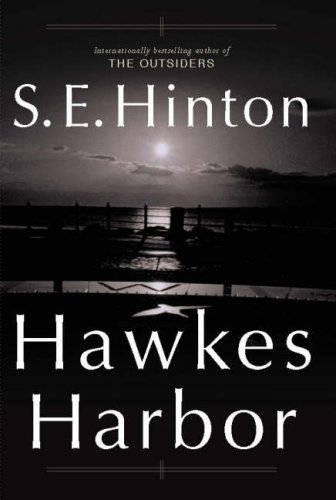
Hawkes Harbor – S.E. Hinton

hawkes

There was a time — perhaps not in recent memory, but in my memory at least — when the Teen section of a book store didn’t offer quite the selection that it does now. Books written specifically for a teen audience were not so readily available; I did most of my book buying from the Scholastic flyer and a great deal of my reading from the stacks of the local library. Perhaps the fact that there weren’t so many ‘teen’ books is the reason why so many people of my vintage have read many of the classics (and all of Trixie Beldon and Nancy Drew!)  But if you had to compile a list of YA fiction from the 70s (which is when I was a teen) S. E. Hinton would surely be at the top of the list. (I also have a very vivid memory of this romance that took place at the beach – an insecure, plain girl falls in love with this Greek Adonis, who just happens to have a prosthetic leg. Can’t remember the book or the author, though. Damn.)

Anyway.

S.E. Hinton is best known for her novel, The Outsiders. Seriously, is there a person on the planet who is not familiar with this book? Hinton was still a teenager when the book was published. (I love to tell my students she was just 16 when she wrote it, but I don’t know that for sure.) The Outsiders is pretty much the slam-dunk book to give to a student who claims he doesn’t like to read. Works for girls, too, by the way. But then I love to tell them that if they enjoyed Ponyboy and Johnny and the rest of the greasers, they’ll love That Was Then, This is Now, which is my favourite Hinton novel. Her characters feel authentic to me and I suspect that’s why teens still love them, even though some of the references feels dated.

Which brings me to Hawkes Harbor. Published in 2004, it was Hinton’s first novel in 15 years. It was also her first adult novel. It’s also really, really strange. And, truthfully, I don’t know if I mean that in a “don’t waste your time” way or in a “I couldn’t stop reading it even though it was really bizarre” way.

Jamie Sommers (not to be confused with the bionic woman) is orphaned at a very young age and sent to live with the nuns.  It is 1950…and that is all you get to know about that. When we catch up with him he’s a mental patient at Terrace View Asylum. Bad stuff has happened and Dr. McDevitt is trying to help him remember. McDevitt can’t decide if Jamie’s tales of derring-do are authentic or the fantasies of an addled brain. In any case, the reader learns that after a stint in the navy, Jamie hooked up with an Irishman named Kell and the two of them sailed around the world looking to make their fortune – mostly illegally. Eventually they ended up in Hawkes Harbor and that’s where things took a turn for the worse.

Um. This is where we meet the vampire. It’s not what I was expecting. At all. And I can’t say that I believed it because it was at this point that Hinton broke her contract with me. Really? A vampire? I just didn’t get it.

The writing is decent, albeit choppy, which might have something to do with the nature of the narrative  and the fact that the story jumps around. Jamie is compelling enough. This is a decidedly adult novel, so I won’t be recommending it to my students.  Sadly, I doubt I’d recommend it to anyone.

No matter. I still love you, Ms. Hinton.

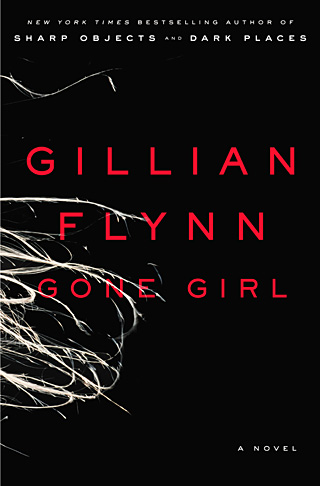
Gone Girl – Gillian Flynn

gonegirl

That I read Gone Girl so soon after finishing Dark Places is a tribute to Gillian Flynn’s talent. With so many books on my tbr shelf, I don’t generally read books by the same author back-to-back. Gone Girl had a few extra things going for it, though. Virtually everyone has been talking about it and I just couldn’t resist its lure any longer.

Nick Dunne and Amy Elliott Dunne are just about to celebrate their fifth wedding anniversary when Amy goes missing. There are signs of a struggle in their rented Missouri home and Nick can’t really account for his whereabouts that morning, so it doesn’t take too long for the police to start treating him like the prime suspect.

Flynn uses a dual narrative approach to tell the story of their courtship and life in New York where Nick was a magazine writer and Amy wrote quizzes for a variety of publications. Life was pretty good for them. They were beautiful, smart and rich. Well, Amy was rich because her parents – Rand and Mary Beth – had written a series of books called Amazing Amy which had, until recently, been a bit of a cash cow. Then Nick and Amy’s fortunes take a turn for the worse and suddenly they find themselves back in Nick’s hometown.

From the start we know that the golden lives of these two protagonists is slightly tarnished. On the morning of the anniversary, Nick’s reaction to his wife’s greeting of “Well, hello, handsome” is one of “bile and dread” inching up his throat. Then: Amy’s missing.

Gone Girl is a supremely entertaining game of cat and mouse. Their married lives had been marked with anniversary treasure hunts and this year is no different. Amy has left the first in a series of clues for her husband. The clues, and the letters which accompany them, seem to indicate Amy’s  awareness of her husband’s unhappiness and her own part in it. But Amy wants to patch things up. The treasure hunt also seems to point to Nick as the person responsible for Amy’s disappearance and slowly the media, Amy’s parents and even his twin sister, Go, start to regard him with suspicion.

But there is more to Gone Girl than a suspenseful mystery. There’s actually quite a damning indictment of the fakery of  relationships; the  potential for infidelity, boredom, entitlement. We want the fairy tale until we don’t. Marriage is hard work. Nick and Amy’s story is extreme, but recognizable nonetheless.

Flynn is a terrific writer. I mean – gifted. She inhabits Nick’s brain as easily as she inhabits Amy’s. They are sympathetic and reprehensible and downright scary in equal measure. To say much more about the plot would be to spoil the novel’s twists. Suffice to say, this is one married couple I wouldn’t be inviting over for dinner any time soon!

Dark Places – Gillian Flynn

dark-places-book-coverLibby Day is a survivor. She’s survived a drunken, dead-beat father, Runner,  extreme poverty, and the horrific massacre of her mother, Patty, and two older sisters, Michelle and Debby. Well, maybe to call her a survivor is a stretch because Libby is reclusive and mean. She says it herself at the beginning of Gillian Flynn’s terrific novel, Dark Places.

I have a meaness inside me, real as an organ. Slit me at my belly and it might slide out, meaty and dark, drop on the floor so you can stomp on it. It’s the Day blood. Something’s wrong with it. I was never a good little girl, and I got worse after the murders.

Ah, yes, the murders. For the past 24 years Libby’s older brother, Ben, has languised in prison for the crime. He was 15 when he is alledged to have killed his mother and younger sisters. Libby has never once visited him partly, perhaps, because it was her testimony that sent him there. She was seven at the time.

Now, at 30, Libby is alone, broke and desperate. That’s how she comes to accept The Kill Club’s offer. Lyle, one of the Kill Club’s members, reaches out to Libby and makes her a propostion. If she’s willing to come to a meeting and talk about the case, they’ll pay her $500. That original deal morphs into something more and suddenly Libby is revisiting the night that changed her life forever.

gillian-flynnGillian Flynn (right) is a new-to-me writer although everyone and their dog has likely heard about her by now due to her recent novel, Gone Girl. She started her writing career as a journalist and was the TV critic for Entertainment Weekly for a decade before turning her hand to fiction. Look at her: she’s beautiful. And scary. And it just occurred to me that her writing reminds me of one of my all-time favourite writers, Lisa Reardon. Her writing is fearless…and fear-inducing.

Dark Places unspools the Day murders in two ways: as Libby digs for the truth and as the events of the day unravel. For this, we spend time with Patty and Ben. Patty is a sympathetic character, a mom who loves her children and tries to care for them, but whose dwindling emotional and financial resources make it nearly impossible. Ben, on the other hand, is a fifteen-year-old boy in a house full of women. He’s desperately searching for a place to belong and an outlet for the anger which bubbles inside him.

Flynn skilfully weaves the threads of this story together offering the reader equal measures of horror and heartbreak.  I couldn’t put the book down – that’s just about the highest praise I can give a book.

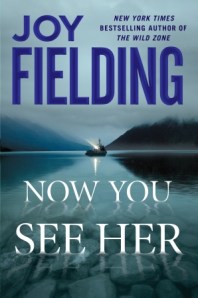
Now You See Her – Joy Fielding

now you see her

Well, there’s a few hours I’m never getting back.

I am not a book snob. I like a fast-paced, plot-driven suspense thriller as much as the next girl. Now You See Her, on the surface at least, seems like a book that would be right down my dark alley. Marcy Taggert is on holiday in Ireland. It was supposed to be a second honeymoon, but her husband, Peter, has run off with the golf pro from his country club and so Marcy has gone solo. While enjoying a cup of tea with a man she’s met on her day-trip to Cork, Marcy sees her daughter, Devon. Which isn’t possible because Devon is dead. (cue music)

I really wanted to like Now You See Her. For one thing it’s written by Canadian Joy Fielding (who has had a great deal of success in this genre). For another, I felt like I should be able to relate to Marcy. We’re of the same vintage, at any rate. But nothing about this book spoke to me.

So Marcy sees Devon and tears off looking for her. Of course, she doesn’t find her. But she returns to Cork and sets up camp and becomes more and more convinced that Devon is not dead. Marcy’s supposition might, in fact, be possible because Devon’s body was never found. She meets various characters along the way, some of whom have nefarious motives, some who want to help her. Some who think she’s crazy and as the book plods along it’s possible that crazy is exactly what Marcy is.

Here’s why the book didn’t work for me:

1. Marcy is stoo-pid. She actually meets a man in a pub and goes off with him after he tells her that, yes, miraculously, he knows her daughter. Really? Really?

2. The writing is clun-ky. Sometimes,  apropos of nothing, we get a little history lesson.  No one sounds Irish. The transitions are often confusing.

3. There are characters who just appear — out of nowhere — conveniently. Fresh baked muffins, anyone? Also, the characters are not believable. Seriously, wait until the lackluster denouement, see who plays a part in it and then see how you’ve been mislead all along.  But not in a plausible way. Peripheral characters, Marcy’s son, for example, are footnotes.

4. If you are going to weave a tangled web, the spider at the center wants to be believable. Um. Just no.

I don’t know where Now You See Her comes in Fielding’s canon, but I won’t be rushing to read any more of her work.

Evidence of Blood – Thomas H. Cook

Jackson Kinley, the protagonist of Evidence of Blood,  is a true-crime writer. His career has brought him close to unimaginable horrors: rapists and murderers and people who torture others for pleasure. Kinley (as he is most often called) seems somehow immune to these horrors. Perhaps it’s his IQ, which is reportedly off the charts. Perhaps it’s his own childhood – he was raised by his grandmother in backwater Sequoyah, Georgia. Whatever the reason, Kinley  is able to face the dark deeds of the world’s most reprehensible criminals without flinching.

His armor is breached, however, when he gets the call that his childhood friend, Ray Tindall, has been found dead. He returns to Sequoyah and learns that Ray was trying to uncover the truth about a murder which had occurred many years before.

Thomas H. Cook  – as those of you who are regular readers here already know – is my favourite mystery writer. True, I am not a mystery scholar by any stretch, but an accidental discovery of his book Breakheart Hill several years ago has turned me into a fan and I have read several of his books (and I am thrilled to know there are more waiting to be read.)

Cook is particularly adept at creating nuanced characters and Kinley is no exception. Kinley’s past is deeply rooted in Sequoyah, but even he is unaware of just how deep those roots go. He can’t help himself – he’s an investigator and the shocking death of his oldest (and perhaps only) friend, has him sifting through the past. Ray, it turns out, was looking into the mysterious disappearance of Ellie Dinker, a sixteen year old whose bloody dress was found on a tree branch in 1954. A man was sentenced to death for that crime and Ray was trying to prove his innocence.

Like all of Cook’s novels, the mystery will keep you guessing. I tried out several potential (and I thought entirely plausible) solutions and was still surprised at the end of the book. I like the way Cook writes; his are literary mysteries. I feel like the craft of writing is just as important to him as telling a cracking good story – which he does. You keep turning those pages.

As Kinley follows Ray’s paper trail, interviews the players who are still alive and recalls childhood memories, he slowly begins to understand the implication of Ray’s words to him at one of their final meetings: “It’s better to know, don’t you think, Kinley? No matter what the cost?”

If you like well-written  mysteries, you really can’t beat Cook.

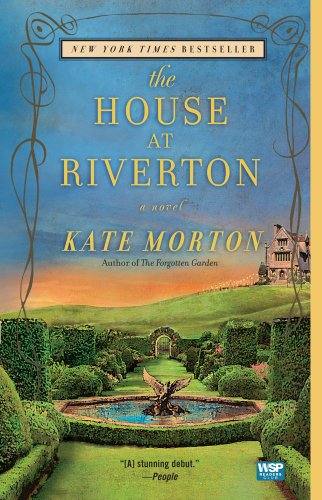
The House at Riverton – Kate Morton

I’m sure many of you have already read Kate Morton’s debut novel, The House at Riverton, but I only just finished it yesterday afternoon. If you haven’t already found a book to while away the dog day’s of summer, might I suggest you run to your bookstore immediately and purchase this one. Whew. What a read!

Grace Bradley is fourteen years old when she comes to Riverton House to work. Her mother had also worked at the sprawling Essex manor house, but had to leave under mysterious circumstances.  It is through Grace that we learn of Riverton and its inhabitants.

I have been thinking about the day I started at Riverton. I can see it clearly. The intervening years concertina and it is June 1914. I am fourteen again: naive, gauche. terrified, following Nancy up flight after flight of scrubbed elm stairs. Her skirt swishes efficiently with every step, each swish an indictment of my own inexperience.

The story, though, starts in the present. Grace is an old woman now. Her husband is dead; her daughter is in her sixties and her beloved grandson, Marcus, has been missing for several weeks. When a filmmaker from America writes to ask if Grace would consult on a film she’s making about a tragedy at Riverton, Grace is pulled back into her memories.

Fans of Downton Abbey will be able to picture Grace’s life perfectly: the servants downstairs, their dedication to service, their hierarchy. But Grace is more concerned with the Hartford siblings: David, Hannah and Emmeline. Over the years she becomes particularly close to Hannah and  when Hannah marries, she is whisked off to London to live.

The House at Riverton is about an aristocratic family in decline. Set between the two great wars, characters go off to their deaths, or come home damaged. The Roaring Twenties usher in an era of shifting sensibilities. Morton does a spectacular job of evoking a time and place. It’s easy to sympathize with the female characters who yearn for  a different life and although criticism has been leveled at Grace for choosing service over personal happiness, I believe I understand her choice.

Because Grace is looking back, the reader knows early on that some tragedy has befallen the Hartford family. That alone would be enough to turn the pages. But the novel takes its time arriving at its conclusion. Perhaps some readers found the novel slow and the prose over-written; I know it took me a while to settle into the story.

However, when I left Grace, 468 pages later, it was with great sadness because even though this is the story of Riverton, Grace’s own story is inextricably linked.

Fifty Shades of Grey – E L James

E L James’s novel Fifty Shades of Grey has caused something of a stir in the literary world. First published as fanfiction called “Master of the Universe” under James’s pseudonym Snowqueen’s Icedragon (and, really, fanfiction writers need to give their pen names a lot more consideration before they choose them!), the original story was set in Stephenie Meyer’s Twilight universe. Yeah – there’s your first problem.

For those of you  unfamiliar with fanfiction, writers (of varying degrees of proficiency) pen stories based on characters and situations created by other writers.  Wikipedia has a competent explanation of its origins here. Really good fanfic writers can make their stories seem almost like canon. And really good fanfic is out there; but so is really, really bad fanfic. Back in the day I read (and wrote) a lot of it, so I can actually say this with some degree of authority.

Anyway, E L James publishes this wicked long Twilight-based fic – which I suspect is long gone from places where it was originally posted…although fans of the series can still be found gushing about it online. Someone (many someones, probably) suggested that she change the names of the characters and publish it — which James did, in eBook format and print on demand in June 2011 using  The Writers’ Coffee Shop. Word of mouth (ahem) fanned the flames and the rights to the book were purchased by Vintage. Suddenly, everyone was talking about Fifty Shades of Grey and weighing in on its subject matter. I talked a little bit about that here.

If you are a fic reader, I suspect that you’ll find Fifty Shades of Grey relatively tame.  Seriously. I’ve never read Twilight fic, but I’ve read the first two and a half books (and could barely manage that) and I’ve seen the movies (I have a 14- year-old daughter, although her literary tastes are, thankfully, more advanced than Twilight). Despite the name changes, there’s enough of Bella/Edward in Anastasia/Christian that even a casual reader will recognize them. They are, at the very least, completely derivative characters: she the winsome, beautiful-but-doesn’t-know-it, feisty yet innocent virgin and he is the over-the-top rich, fantastically beautiful (and like Meyer’s Edward, the reader has to be reminded of his beauty virtually every time he appears) control freak with a sad/complicated — or, as Christian himself says “fifty shades of fucked up”– past.

Bella Ana does her roommate a favour by going to interview the reclusive Christian for the university paper. She  literally falls into his office — she’s kinda klutzy — and we are to believe that Christian is instantly smitten. He tries to stay away– unsuccessfully. But does he really like her, or does he just recognize in her a submissive personality?  Because one of Edward’s Christian’s dark secrets is that he likes to tie women up. And other stuff. Stuff that requires a contract and a safe word.

If you’ve read fanfic, you’ve read this scenario a bazillion times. If you’re going to pay for it, it wants to be good. So, is Fifty Shades of Grey good? For me, it was okay. The writing is okay. The sex is okay. The characters are okay. It didn’t particularly shock me, nor did it, you know, rev my engine.

Ana is prone to saying: Holy fuck! and Holy shit! and Holy crap! a whole lot. A whole lot! She also channels her inner goddess in what I suspect is her way of trying to decide whether or not the amazingly mind-blowing orgasms make up for the occasional spanking. Ana and Christian say, “Laters, baby” to each other.  It’s weird. Noticing this stuff is always a sign that I am not really invested in the story. Oh come on, who reads a book like this for the story anyway?

I suspect that lots of people will find Fifty Shades of Grey shocking. I suspect a lot of the soccer moms who were reading it were clutching their pearls as they perspired daintily.  But, truly, it’s pretty tame. If you want the really good stuff, you can read it online. For free.