Lilac Girls – Martha Hall Kelly

Lilac Girls, the debut novel by Martha Hall Kelly,  is the first novel for my book club’s 2016-17 reading year. When it was chosen I can’t say that I was all that interested in reading it. We have all summer to read the book chosen for our first meeting of the new reading year, but I tend to like to read fast, snappy thrillers/mysteries in the summer – with the occasional YA or lit fic thrown into the mix. Also – not a tremendous fan of historical fiction. But I always read the book club selection because our get-togethers are a lot more fun when I’ve read the book. All this to say that I started this novel with a relatively negative attitude.
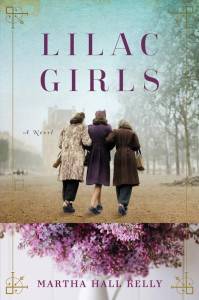
Lilac book jacketKelly’s novel tells the story of three very different women: New York socialite Caroline Ferriday, Polish teenager, Kasia Kuzmerick and German doctor Herta Oberheuser. It is 1939 and the one thing these women have in common is Adolf Hitler.

Caroline is 37 when the story opens. She’s a retired actress who volunteers at the French consulate. Kasia is just 16 when Germany invades Poland and changes her life forever. She is working as a courier for the underground resistance movement when she and her older sister, Zuzanna, and their mother are arrested and shipped off to Ravensbruck, a Nazi concentration camp for women. It is there that she encounters Herta, a young doctor who has taken a post at the camp because it is difficult for women in the medical field to find work.

The novel is told in three separate first person narratives and once the book gets going it’s almost impossible not to be carried along by the horrors of Ravensbruck and Kasia’s desperate attempts to survive. There’s also a little angsty love story between Caroline and famous French actor Paul Rodierre.  I read the first 200 pages in one sitting.

Caroline and Herta are real people, as Kelly explains in her notes. Kazia and her sister are

22907ea70de32fa19f35246c55131f05

Caroline Ferriday

“loosely based on Nina Iwanska and her physician sister, Krystyna, both operated on in the camps.”

It is almost impossible not to invest in these characters, and the sections concerning Kasia in Ravensbruck are particularly harrowing. There, she and her sister are among hundreds of women used as real-life guinea pigs (or “rabbits” as they are called) for the Ravensbruck doctors to experiment on. Herta’s participation in these horrific experiments,  crimes that are against every aspect of the Hippocratic oath, seal her fate as a villain.

The book is long and the ending seemed a little rushed to me and I could never figure out the title or the dumb book cover- which makes it seem like three girls are the best of friends. I also wasn’t fussy about Kasia and Herta’s showdown, but ultimately Lilac Girls was a good read.
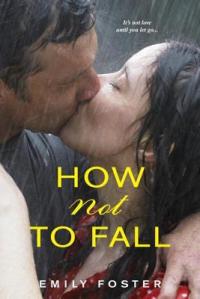
How Not To Fall – Emily Foster

Remember when Fifty Shades of Grey was all the rage? Sure you do.  125 million people bought that piece of crap. (Okay, yes, I read it. But I did not read its sequels. I have standards, people.) Suddenly everyone was reading erotica — loud and proud or behind the more secretive screens of their e-readers.

I love a good smutty book, but the problem with smut is that no two readers will be alike when it comes to what turns them on. Perhaps E.L. James just got lucky. In fandom, which is the loins from which her books sprang, BDSM is as common as sex in the missionary position with the lights off. My objection to the Fifty Shades book(s) had nothing to do with the subject matter (I spent ten years in fandom; I’ve read it all) and everything to do with the quality of the prose and one-dimensional characterization. (It couldn’t be any other way, Edward/Christian and Bella/Anastasia are about as one-note as they come.)

27208942Enter How Not To Fall. Of course I’d seen this book at the book store, but I don’t think I even picked it up to read the blurb. Then I read a review – although I can’t remember where. The reviewer avoided comparisons with Fifty Shades, but did sing the book’s praises. Smart and hot — which is probably a pretty good combination. So, the next time I was at Indigo, I bought the book and now I’ve read it.
Annabelle (Annie) Coffey is a 22-year-old student at a university in Indiana. Dr. Charles Douglas is a 26-year-old postdoctoral fellow in Annie’s psychophysiology lab. He’s British and brilliant and “a dreamboat” and, technically, her teacher.  Annie’s been lusting after him for two years, but as her undergraduate degree draws to a close, she figures it’s about time to take matters into her own hands — so to speak. She tells her roommate and best friend, Margaret, that she is “going to ask Charles to have sex.” She asks, he declines, but Annie is convinced that she hasn’t misread the signals. She tells him

“The thing is, I think you and I have A Thing, and I know if I don’t at least put it on the table, I’ll always wonder ‘what if’ and so I’m just…putting it on the table, you know, and leaving it there. Like bread. For sharing.”

Turns out, Charles does reciprocate Annie’s feelings; he’s just too professional to act on them. So they make a deal – once all her research is in, once there is no possibility of a sex act compromising ethics – they’ll do it. Cue about 200 pages of smut.

Here’s what I really liked about How Not To Fall.

  1. Annie/Charles  Annie is self-deprecating and her narration is charming and often funny.

Am I a beauty queen? I am not. My nose has a great deal of character. My hair has some interesting ideas about its place in the world. My body is built more along the lines of a wristwatch than an hourglass – flat yet bendy. It works for me – I am my body’s biggest fangirl – but I recognize where it falls short of the culturally constructed ideal.

Charles is smart — like brilliant smart — but also kind and, as we learn gradually, a little bit damaged, too. Also, on the hotness scale — according to Annie “it is a mercy to the world that the man doesn’t try to look good.”

2.  The sex is well-written. That’s a big one for me. If I am going to read erotica, I want to read well-written erotica. And since How Not To Fall contains a lot of sex it might have easily gotten boring. You know – geesh, are they going to do it again? I didn’t skim. Actually, overall, the book is well-written.

3. Personally, I kinda loved the way the book ended – although it did break my heart a little. Apparently, there’s a sequel coming out next year. (I will probably read it: see #1.)

I did have a couple little things that irked me. Charles often sounded like a middle-aged man. He called Annie “Young Coffey” a lot. Like he was twenty years her senior rather than four. He also refers to her as “termagant,” a word I was not familiar with, so I had to look it up. It means a “harsh or overbearing woman.”  I couldn’t really make the connection. Also, I don’t have a foot fetish — clearly Charles does. Too much feet/toes for me. These are niggles, because overall, I enjoyed the book for all the reasons one might enjoy a book of this type.

So – if you are looking for a fun, smutty book to pack in your beach bag – give this one a go.

The Girls in the Garden – Lisa Jewell

Although I have hundreds of books waiting for me on my tbr shelf, I can’t seem to stop buying new books whenever I am at the bookstore, which is – let’s face it – often. There’s been all these suspense thrillers out there like I’m Thinking of Ending Things and The Widow and Twisted River  and The Crooked House which I seem to be drawn to like the proverbial moth to the flame. Maybe it’s because it’s summer and I just like to read something that’s fun, I dunno. But I have no trouble ignoring the huge catalogue of back-listed books I have waiting to be read and, instead, buy the shiny new books.

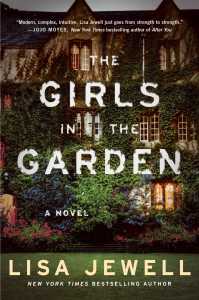
the-girls-in-the-garden-9781476792217_hrThe Girls in the Garden is one of those books. Although it turned out to be not the book I thought it would be, it was a great read nonetheless.
Clare has moved to a small enclave somewhere in urban London. Virginia Park is “formed in the space between a long row of small, flat-fronted Georgian cottages on Virginia Terrace and a majestic half-moon of  stucco-fronted mansions on Virginia Crescent, with a large Victorian apartment block at either end.” She and her children, eleven-year-old Pip and twelve-year-old Grace are recovering from a horrible incident involving Clare’s husband, Chris. (And again, what is it with book blurbs getting it wrong? The back cover says Pip is older, but she’s not.)

From the outside, Virginia Park seems like a miracle of a place. In the boundary formed by the buildings is a beautiful park which Pip describes in a letter to her father as being “like Narnia.”

…there are all these pathways and little tucked-away places. A secret garden which is hidden inside an old wall covered with ivy, like the one in the book. A rose garden which has bowers all the way around and benches in the middle. And then there’s a playground, too.

It’s a place of magic for the girls and a place for Clare to catch her breath. Except, of course, the magic is short-lived.

Adele also lives in Virginia Park with her husband, the handsome and slightly oily Leo, and their daughters Catkin, Fern, and Willow. The girls are home-schooled and the family leads a slightly bohemian life. Soon, Clare and her girls are brought into the welcoming embrace of Adele’s family. (Okay, maybe the girls aren’t 100% welcoming; you know how kids are.)

Tyler, another pre-teen who lives in one of the flats and her best friend, Dylan, the beautiful thirteen-year-old boy who also lives at the park, round out the gang that Grace and Pip find themselves hanging around with.

The Girls in the Garden reads like a thriller. The novel begins with the discovery of Grace’s unconscious and bloody body being discovered by her sister in the rose garden and then backtracks to unspool the story, mainly from the point of view of Clare, Adele, and Pip.

Jewell cleverly manipulates the reader into imagining a variety of very plausible scenarios before the story takes an unexpected (but not unbelievable) turn, ultimately making The Girls in the Garden less of a thriller and more of a domestic drama. But really, is there anything more thrilling than that? Isn’t it absolutely true that we never really know people, even those closest to us?

I thoroughly enjoyed this book.

The Crooked House – Christobel Kent

I can certainly see why Christobel Kent’s novel The Crooked House has drawn comparisons with the British mystery Broadchurch. Like that story, Kent’s novel takes place in an isolated village (in this case, Saltleigh) and concerns a horrific crime which has rippled out into the community.

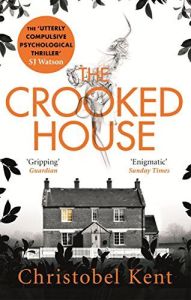
Alison used to be Esme and when she was fourteen her entire family was slaughtered. 748d3761900605840ce32be83a67d549Since that horrible night, Alison has flown under the radar. She lived first with her aunt in the south and then, after school, she moved to London where she worked in publishing, and where she met Paul. Paul is older, in his forties, and a professor. They had “Long, lazy conversations about books and movies and work, eating dinner at his big wooden table, or leaning against each other on his old sofa.” Alison likes him, so when he asks her to accompany him to Saltleigh to attend the wedding of a former girlfriend, she can’t seem to refuse even though she hasn’t been back since the crime.
Saltleigh is the same as Alison remembers. The smells, the colours, the landscape, and the memories of living there with her older brother, younger twin sisters, and her parents are palpable. On the first morning, while Paul sleeps on, Alison answers the memories and goes to her childhood home.

The house was boarded and derelict, weathered plywood splintered and graffitied at each window and the purple spikes of some plant sprouting above the lintel over the front door. The little enclosed yard behind where they had hidden and whispered and left secret messages. Thirteen years.

Despite the fact that she has spent the last thirteen years trying to forget, the memories have been triggered by coming back and she can do nothing but follow where they lead. What really happened that night?

The Crooked House was clearly a big hit in the UK. My version was covered with praise — a combination of praise from other authors, which is always suspect to me, and from the press.  Good Housekeeping said it “Demands to be read in one sitting.” I think that might actually be wise advice because although I did like this book (it’s clever, smart and well-written), I found it really disjointed. It shifts time periods all over the damn place and there are loads of characters and subplots (all relevant, mind you) to keep track of. If I managed to read without interruption, I easily settled into the book’s rhythms. but it definitely wasn’t a book you could pick up on the fly.

I think this book would make an excellent mini-series or movie. Get on that, would you, BBC!

The Interrogation – Thomas H. Cook

My love affair with Thomas H. Cook goes back several years when I stumbled upon his novel Breakheart Hill in a secondhand bookstore. Since then I have read several of his books including Instruments of Night, The Chatham School Affair, Places in the Dark, Evidence of Blood, The Fate of Katherine Carr, Master of the Delta, Red Leaves and The Cloud of Unknowing. Geesh, that’s a lot of books by one author!  In my reading life perhaps Stephen King is the only author I’ve read more of. (Yes, I am ending that sentence with a preposition; sue me.)

Cook is a prolific writer (he has over 30 novels to his credit) and has won many awards including the Edgar and the Crime Writers’ Association Duncan Laurie Award, yet you’d be lucky to find any of his novels on the shelves at your local bookstore – trust me, I look.  So how come he isn’t as well known as other authors writing in the same genre? Unless you’ve read him, or are a super mystery novel aficionado, you may have never even heard of him. How come? Ali Karim asked the same question for an article in January magazine.

I buy his books whenever I find them and I hang on to them, usually until I can replace the one I am about to read with a new one. I like to have one waiting in the wings for the next time I need a fix.

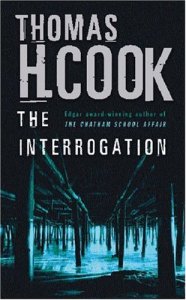
Albert Jay Smalls is an odd little man who lives in a drain pipe in a local park. He’s been 237180arrested for the murder of a little girl. The problem is there’s no evidence and no witnesses and so the police can only hold him for twelve hours before they have to cut him loose. Thomas Burke, the chief of police ( a man with his own troubles) sends  his two best interrogators into the room to get a confession from Smalls.
The Interrogation is the story of those two cops, Norman Cohen and Jack Pierce. Each man has a heart full of demons (Cohen is haunted by his experiences in war; Pierce’s young daughter was a murder victim), but they are tenacious and accomplished interrogators. Since the story is set in 1952 they have to rely on the evidence they gather the old-fashioned way: visiting crime scenes, talking to people, chasing leads. There’s no Google and everything takes time and time isn’t on their side.

As Cohen and Pierce question Smalls and try to follow a breadcrumb trail, the reader will try to determine Smalls’ guilt or innocence too. Make no mistake, Cook’s novels are mysteries and half the fun is trying to figure out whodunit, but that’s not the only thing Cook’s got going on.

As with every single Cook novel I’ve read – his characters are really dynamic. You believe them from the minute they open their mouths. They have complicated interior lives. His heroes are always men trying to do the right thing – even when they can’t. Minor characters, like garbage collector Eddie Lambrusco, are equally well-drawn. Cook can create empathy with just a few word as he does when we watch Eddie handle his father’s watch and thinks

a laborer’s timepiece with its chinks and scratches and slightly skewed hands that circled turgidly around the yellowing dial. After a lifetime, he thought, this.

There are a lot of father/child motifs in The Interrogation –  dads who are helpless to save their children; dads who do everything for them; dads estranged from their children. It’s a theme Cook visits often and yet he always seems to have fresh things to say about the topic.

And like with virtually every Cook novel (I almost said book there and then thought better of it) I’ve read, the story’s resolution will be a surprise. It won’t feel like a cheat, either…because with Cook the clues always exist.

If you like mysteries that are thoughtful, intelligent and well-written – try to get your hands on Thomas H. Cook. You will not be disappointed.

Pretty Girls – Karin Slaughter

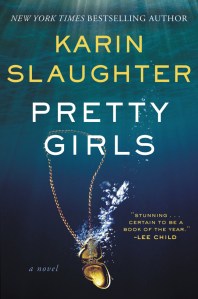
So my son asked me how I liked Karin Slaughter’s novel Pretty Girls and I really had to think about my answer. I couldn’t just say “yes” because that isn’t exactly true. I couldn’t say “not really” because that isn’t true either. I read about 300 pages of it last night, turning the pages to get to the end, my skin crawling and my eyes burning.PrettyGirls_HC

Pretty Girls is the story of  sisters Julia, Lydia and Claire – actually it’s mostly about Lydia and Claire because twenty years back Julia, then 19, went to a bar with friends, and disappeared. Claire is married to Paul, successful architect and doting husband; Lydia is single mom to 17-year-old-Dee. She’s 19 1/2 years sober.  Lydia and Claire have been estranged for twenty years, but when Claire’s husband is brutally murdered in a botched alleyway robbery Claire turns to her sister to help her make sense of her unraveling life. And trust me – Claire’s life is about to go belly up, big time.

That’s pretty much all I can tell you about the plot without giving too much away.

The one other voice we hear in Slaughter’s novel is the girls’ father. He never gives up trying to find Julia and keeps track of his search and his feelings in journals. “When you first disappeared,” he writes, “your mother warned me that finding out exactly what had happened to you would be worse than never knowing…’The details will tear you apart.'” She wasn’t wrong.

There’s some bad blood between Claire and Lydia, but soon enough they find themselves in a heap of trouble and they have no choice but to put the past aside. The plot catapults along and if you don’t care too much about the quality of the prose (not that there’s anything wrong with it – Slaughter’s writing is more than up to the task at hand) you’ll fly through the pages unhindered by flowery language. What will give you pause are the gruesome crime details – or maybe not. Maybe we have been desensitized to that sort of thing. I’m not easily bothered, but this book bothered me.

There’s nothing pretty about Pretty Girls. If there is redemption to be had, it comes at a high price for Claire and Lydia and readers will have to have a strong stomach to go along.

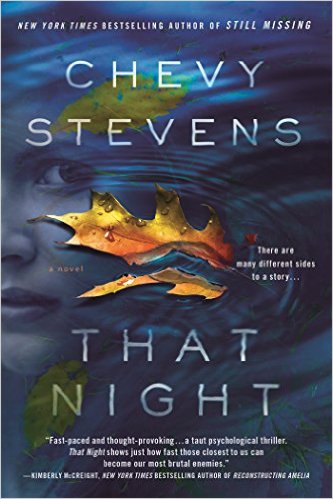
That Night – Chevy Stevens

I suppose that some fans of psychological suspense might call BC-based Chevy Stevens the Canadian Gillian that nightFlynn – except that, in my opinion, Flynn takes the prose prize and the plotting prize and, well, all the prizes, really. Sorry, Chevy.

This is the second novel I’ve read by Stevens. The first, Still Missing, won the International Thriller Writers Award for Best First Novel in 2011. I liked Still Missing, actually, though – if memory serves – I wasn’t keen on its ending. I didn’t like anything about That Night, although I wanted to. I didn’t abandon it to my Book Graveyard, though,  and I guess that’s saying something. Maybe it’s because Stevens is Canadian.

Toni Murphy and her boyfriend, Ryan Walker,  are in prison for the murder of Toni’s younger sister, Nicole. They maintain their innocence and while the evidence against them is circumstantial at best, they’ve both been locked away for fifteen years. (Not in the same institution, obviously.) The novel weaves between the events leading up to Nicole’s horrific murder, Toni’s incarceration and ultimate release (after serving her full sentence) and her attempts to reintegrate herself into society in her hometown of Campbell River, a town on Vancouver Island.

Toni is the problem child and Ryan is the son of a drunken criminal – so a bad boy by blood. Everyone seems to be waiting for them to get into trouble even though Toni seems more like a victim than a victimizer. She and Ryan are just waiting for high school to be over so they can get on with their lives together. Toni is especially anxious to get out of Dodge because of Shauna McKinney. “Most of the girls in our class either feared her or desperately wanted to be her friend, which I guess was kind of the same thing in the end,” Toni observes. Toni and Shauna used to be friends, but a misunderstanding over a boy changed all that and now Shauna does whatever it takes to make life living hell for Toni. Clearly, Toni is not as bad-ass as people think she is.

Nicole is the golden girl, the  mom’s favoured daughter because of her grades and sunny disposition. Until she starts hanging out with Shauna and her hench-women. Then she’s sneaking out of the house, coming home drunk and acting all weird.

Stevens’ first person narration allows us to see Toni’s journey through her final months in high school and then a sped up fifteen years in the big house where we watch Toni negotiate her way through a system that is bound to fail her. She makes friends; she makes enemies, and finally she is paroled. One of the conditions of her parole is that she has no contact with Ryan, who has also been released and who has also headed back to Campbell River. Despite the no contact rule which, if broken, has the potential to send them back to jail,  Toni and Ryan are determined to find out what really happened to Nicole.

Mostly I didn’t like That Night because I didn’t care about any of the characters. Toni’s parents were particularly irksome. Yes, it’s true that they’ve lost one daughter at, supposedly, the hands of another. But she swears she didn’t do it. How about a little faith, people?

When the true story of what happens is finally revealed, all the pieces click into place with precision, but ultimately this is less a mystery and more a story (sort of) of redemption. I found the writing a bit clunky – lots of exposition – and the characterizations superficial. For me, That Night wasn’t all that.


The Husband’s Secret – Liane Moriarty

It’s no secret to the ladies in my book club: I didn’t like Liane Moriarty’s novel The Husband’s Secret. At all. But here’s the thing, the critics loved it. Geesh, even Anne Lamott called it “smart, wise, funny.” husband

The husband in question in The Husband’s Secret is Cecilia’s husband,  John-Paul Fitzpatrick, he of the “deep, warm and comforting” voice; hopeless at the minutiae of daily life, but “he took care of his wife and daughters, in that old-fashioned, responsible I-am-the-man-and-this-is-my-job way.”  One day, while searching in the attic for a little piece of the Berlin Wall (cue metaphor alert) to give to her  daughter, Esther, who has recently shown an interest, Cecilia discovers  (by accident…or is it fate?)  an envelope upon which is written: For my wife Cecilia Fitzpatrick,  To be opened only in the event of my death.

In another part of town is Rachel, a woman whose life has been forever coloured by the death of her teenage daughter, Janie, some twenty-eight years ago. She has a son, Rob, and daughter-in-law, Lauren and a two-year-old grandson, Jacob. Rob and Lauren have just told Rachel that they are moving to New York to take advantage of a terrific job opportunity for Lauren. Jacob is the light of Rachel’s life and the news is devastating to her – never mind that she has discounted Rob and Lauren forever, because – you know – she’s grieving. Still. Always.

The third woman to figure in Moriarty’s over-stuffed plot is Tess, who has recently come home with her young son, Liam,  because her husband, Will, and cousin, Felicity, (who are also her business partners) have just revealed that they have fallen in love. Ouch.

Really, there’s enough going on in The Husband’s Secret to fuel three novels, but Moriarty chooses, instead, to tangle the fates of all these three women together and also try to comment on infidelity, love, marriage, family, parenting, friendship, and how to make a million bucks selling Tupperware.

A novel like this, let’s call it domestic drama, depends on one thing and one thing alone and that’s believability. I didn’t believe any of these characters, nor care about them one iota. The book seemed interminable to me, over 400 pages bookended with a prologue and epilogue that asks you to consider the myriad of ways your life might have gone had you only chosen a different path. But as Robert Frost’s misunderstood poem “The Road Not Taken” warns us “the passing there/ Had worn them really about the same.” No matter which path you choose in life,  a belief in fate is also a belief that everything turns out as it should.

The Husband’s Secret is an “everything but the kitchen sink” novel that tries hard to be all things to all readers: mystery (though not so much for careful readers), and family drama, with a little bit of sex thrown in for good measure. When one of my friends joked “just wait until you get to the aliens,” I actually considered she might be telling the truth.

A world of no.


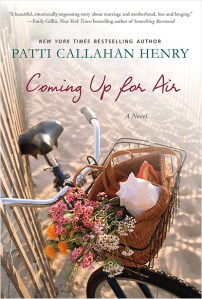
Coming Up For Air – Patti Callahan Henry

Patti Callahan Henry’s heroines all have the same problem: they are women of a certain age at a crossroads in their lives. For Amy, the protagonist in my first Henry novel Losing the Moon, it’s the unexpected reunion with her college boyfriend, Nick. In Where the River Runs  it’s the emotions rekindled by revisiting a tragedy from Meridy’s youth.

Then there’s Ellie Calvin, the main character in Coming Up For Air. Ellie realizes at her coming-up-for-airmother’s funeral that she no longer loves her husband, Rusty. Truth be told, he’s a bit of a douche, a passive aggressive clout from the right side of the tracks. What Ellie really longs for is Hutch, her “bad boy” college boyfriend. Of course, she doesn’t know that just yet. It’s not until he’s suddenly standing in front of her and
…I saw his face. Twenty years later, minutes and hours and days rearranged to allow me to see him again as if time hadn’t passed at all. Mostly I saw his eyes: almond shaped and kind, brown with green underneath, as if the eyes had meant to be the color of forest ferns and then at the last minute changed their mind.

As a reader, you pretty much know what’s going to happen about then – all that remains to be seen is just how meandering the journey. In this instance, Hutch is an historian and he’s been working on an exhibit at the Atlanta History Centre, an exhibit honouring some of the South’s great dames – in which Ellie’s mother, Lillian,  figures prominently. Ellie has had a prickly relationship with her mother. Much of the acrimony,  ironically, involved Hutch.

Then Ellie finds a journal her mother kept. The entries, one a year, reveal that Ellie’s mother wasn’t always the proper and stiff woman Ellie had grown up with. In fact, she’d had a deep and passionate love affair  with a man identified only as Him before she’d married Ellie’s father. (Not sure why Him is capitalized.)  Furthermore, she’d been involved in the Civil Rights Movement.

Obviously, Ellie and Hutch need to find out what all this means and so they head down to the Alabama coast where Lillian’s best friend, Ms. Birdie, lives. Ms. Birdie also happens to be Ellie’s best friend’s mom…so, see how that all works out? Of course, Ms. Birdie is reluctant to tell Ellie anything much. There’s still half a book to get through, after all.

I read the whole thing, of course I did. It’s not because it’s full of hot sex, either. Hutch and Ellie barely exchange a platonic kiss. It’s not because I particularly cared about any of the characters. Even the revelation of who the mysterious Him was is a disappointment. I was hoping Lillian had been really brave.

I guess I didn’t give up on Coming Up For Air because the romantic in me wants to see the potential for love at a certain age. I’m older than Ellie and I don’t have a marriage to walk away from anymore, but I do — sometimes — long for that chemical connection. Of course, I don’t have pots of money allowing me to step away from my life and go live in a magical cottage on the water. I also don’t have a “one-that-got-away” college boyfriend.

If our lives are a story and we are characters in that story, perhaps Ellie’s Uncle Cotton’s question is valid: “What’s the next best thing to happen here?”

Unfortunately, I think Henry took the path most traveled, but I guess if you like happily-ever-after that’s probably okay.

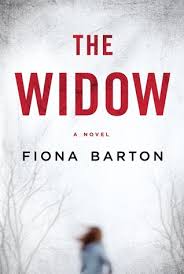
The Widow – Fiona Barton

Although I often enter book giveaways on Good Reads, I never win. That is until a couple weeks ago when an ARC of Fiona Barton’s novel The Widow showed up at my door compliments of Penguin Random House Canada. The book was cleverly packaged in an ‘evidence bag’ along with a package of Skittles. Awesome to get a book in the mail, but Skittles, too. Jackpot!

widowI seem to be on a roll these days, reading books I can’t seem to put down. I motored through The Widow in a couple of days.  Although the subject matter (porn) may not appeal to everyone, rest assured that there’s no graphic content in Barton’s book. Your imagination will fill in the gaps, trust me.

Jean and Glen Taylor are an average thirty-something couple living in England. Jean is a hairdresser and Glen, a banker. They are unremarkable  until they come under the scrutiny of the police because of the disappearance of a little girl, Bella, who has gone missing from her front garden.

Told from various viewpoints, The Widow mostly revolves around Jean as she decides whether or not to share her story with the press. Glen has been killed, “knocked down by a bus just outside Sainsbury’s” and now Jean no longer has to keep his secrets or put up with his “nonsense.”

When we are not with Jean, we’re with Kate, the reporter who is trying to convince Jean to tell her side of things or Bob Sparkes, the police detective trying to figure out what happened to little Bella. It’s Bella’s disappearance that drives Kate and Bob, although each of them views the crime from a different perspective. As Sparkes follows a trail of clues, many of which don’t pan out, Jean reveals her own misgivings about Glen and what he does on the computer in the spare room. Slowly she unravels the story of her marriage and while she may seem like a victim, there is something unreliable about her narrative. She admits “I had to keep his secrets as well as mine.”

The Widow delves into the sordid world of online pornography, skeezy Internet clubs where men hide in booths to pay-per-view and magazines sold out of the back of trunks at gas stations on the motorway. When Jean finally learns about her husband’s preferences

he told me it wasn’t his fault. He’d been drawn into online porn by the Internet – they shouldn’t allow these things on the Web. It was a trap for innocent men. He’d become addicted to it – “It’s a medical condition, Jeanie, an addiction.” But he’d never looked at children. Those images just ended up on his computer – like a virus.

Whether or not Jean suspected Glen of anything is one of the key elements that will keep you turning the pages. Barton’s crisp, no-nonsense prose is another. The Widow will keep you turning the pages way past your bedtime.