Bellman & Black – Diane Setterfield

bellmanWe were all pretty excited when Marianne chose Bellman & Black as this month’s book club selection. We all loved Diane Setterfield’s first novel The Thirteenth Tale when we read it a few years back. Sadly, this novel lacked that book’s  – well, everything.

As I pointed out when we met last night: “Did you notice that all the praise on the back of the book was for The Thirteenth Tale.”  And true enough – there isn’t a single endorsement for this novel on its cover or inside its pages. Okay, maybe that doesn’t mean much in the whole scheme of things and I know I’m making it sound as though Bellman & Black is horrible and I guess I wouldn’t go so far as to say that, but it isn’t very good, either.

William Bellman is just a kid playing somewhere in the English countryside  when he decides to show off in front of his friends and uses a catapult to shoot a rook (similar to a crow) out of a tree.

It took a long time for the stone to fly along its preordained trajectory. Or so it seemed. Time enough for William to hope that the bird, flapping into life, would rise upwards from the branch. The stone would fall harmlessly to earth and the rook’s granite laughter would taunt them from the sky.

Instead, William hits and kills the bird and thus leaves innocence and childhood behind him and begins  the downward slope towards death. And yes, it’s really this heavy-handed.

Will’s life is marked with great successes and tremendous tragedies. We watch him turn his uncle’s mill into a financial success. We watch him fall in love and have a family. And we watch things start to fall apart. But the thing is – and it is a thing that we talked about last night – none of it mattered all that much because Will was a character we knew or cared little about. He was driven, surely and haunted, certainly, but not by the rooks which made strange appearances (sort of like encyclopedia entries) throughout the book.

When William suffers a tragic personal loss, he makes a deal with a mysterious stranger, Mr. Black, and he suddenly finds himself building a one-stop funeral emporium. We’re talking Victorian England here, when people mourned for years and spent money (apparently) on all manner of funereal accoutrements. So, just as we watched him build Bellman Mill, we learn all the nooks and crannies of Bellman & Black, but none of it is interesting enough to sustain a 300 plus page narrative. And trust me, the stuff about the rooks doesn’t help.

At the end of the day, Setterfield’s book is a less schmaltzy take on, say, a book like Tuesday’s With Morrie. We’re meant to understand that life must have checks and balances, and that when we care too much about things that don’t matter (wealth, success) we miss out on those things that truly do.

Bellman & Black wasn’t hard to read, but I won’t be recommending it to anyone else.

Crazy Beautiful – Lauren Baratz-Logsted

crazyMy arm rises toward my face and the pincer touch of cold steel rubs against my jaw.

I chose hooks because they were cheaper.

I chose hooks because I wouldn’t outgrow them so quickly.

I chose hooks so that everyone would know I was different, so I would scare even myself.

That’s Lucius Wolfe. He’s 15 and the new kid at school. He and his younger sister, Misty, and his parents had to move because Lucius got in the middle of a bomb making experiment gone wrong and blew himself – and most of his house – up. Now he’s got hooks for hands. Why was Lucius making a bomb, one might ask? Ask away – you’re not going to get any real insight from Lucius other than a vague “I was practicing to do harm, somewhere, sometime, maybe.”

I hear the dog alarm go off in the same instant I become aware of the first morning light in my room. I like rising early, like sleeping with the blinds open, because I’m scared of the dark.

In the dark, almost anything can happen.

That’s Aurora Belle. She’s 15 and also the new kid at the school. She and her father moved because Aurora’s mom had recently died of cancer and her dad thought it was time to change the scenery. Aurora is beautiful and smart and perfect…and immediately popular at school.

On the bus on the first morning  (and what are the chances, eh?) Aurora and Lucius’s eyes meet and wowza. But it’s even more than that for Lucius; he decides to become Aurora’s Gallowglass. It means ‘foreign soldier’ but to Lucius it is “the greatest personal protection service you can think of all rolled into one person.”

Aurora doesn’t really strike me as the person who actually needs protecting. She’s absorbed almost immediately into the school’s who’s who and soon thereafter wins the lead in Grease (which, unbelievably, Lucius has never even heard of).

Still, there is Jessup Tristan (and by now the names are starting to be as irritating as the characters), school douche-bag, and a couple of superficial girls and Nick Greek, the security guard who frisks Lucius after he sets off the alarm going through the school’s metal detector. It’s an embarrassing moment for Nick, but then it’s all made well when the 15 year old boy and the 22 year old security guard become fast friends and Lucius actually helps Nick reconsider his career path. I kid you not.

If Lucius didn’t have hooks for hands and a slightly suspect psyche, Crazy Beautiful would be nothing more than an adequately written YA novel.  Take away those hooks and Lucius’s raison d’etre and you’ve got…nothing. Seriously. At a mere 193 pages there’s no time to really develop the characters or their relationships.

Boy sees girl on the bus and falls instantly in love.

Girl sees boy on the bus and “there was an instant connection.”

We’re on page 28.

And what are the chances, when the plot twist comes – separating these two ‘damaged kids’ – that Aurora knows exactly what Gallowglass is?

As it turns out, pretty damn good.

Give this one a miss.


Wild – Cheryl Strayed

WildTP_Books-330I am of the opinion that everyone has a story to tell – that doesn’t mean everyone should tell it, though. Cheryl Strayed’s memoir should have made for a compelling read, but ended up winning “Book I Enjoyed Reading the Least” at our final book club meeting. (Although in my mind, it was  neck and neck with Death Comes to Pemberley for the position.)

When I teach memoir to students in my writing class, we talk a lot about the ‘why’? Why is this the story you are telling? What have you taken away from this experience? If you want to take a reader on the journey through your life, there has to be a pretty compelling reason.

Some memoirs are more successful than others. In order for a memoir to work – for me at least – it has to combine three elements: story, character and writing. So, for example, Elizabeth Gilbert’s best selling memoir Eat, Pray, Love both worked and didn’t work for me. The writing was terrific; I loved the idea of her journey, but I didn’t like her very much. Let’s compare Eat, Pray, Love to another best-selling memoir, Julie & Julia. I loved the story, the writing and Julie herself.

Then there’s Wild. At twenty-six Cheryl Strayed is still mourning the death of her mother, who died when she was 22,  the dissolution of her marriage, which ended soon after, and recovering from her addiction to a guy named Joe and their shared heroin habit. Good times. Impulsively, she decides to hike the Pacific Coast Trail. That’s 4268 km of therapy. With very little preparation (or at least it seemed that way to me – she bought a book and some ill-fitting hiking books and suddenly she was walking), Strayed embarks on a journey which she hopes will clear her head or mend her broken heart.

Pacific-Crest-TrailWhen the book opens, Cheryl has lost a boot over the edge of a mountain:

My boot was gone. Actually gone.

I clutched its mate to my chest like a baby, though of course it was futile. What is one boot without the other boot. It is nothing. It is useless, an orphan forevermore, and I could take no mercy on it. It was a big lug of a thing, of genuine heft, a brown leather Raichle boot with a red lace and metal fasts. I lifted it high and threw it with all my might and watched it fall into the lush trees and out of my life.                                         …

I looked south, to where I’d been, to the wild land that had schooled and scorched me, and considered my options. There was only one, I knew. There was always only one.

To keep walking.

I felt like Strayed’s journey had all sorts of potential. I mean, her life was a total mess and here was her opportunity to work out her issues and reset her course. But the more I read the less I cared. I can’t quite say what it was about her, but others in book club had the same sort of feeling: we just didn’t like Strayed.

Wild felt like a missed opportunity to me.  Regardless of whether your relationship is awesome or toxic, the death of a parent is a game-changer. Strayed’s brother and sister and her beloved step-father, Eddie, sort of scatter to the wind and it made me wonder why. When my parents died – first my mom and then a couple years later, my dad – my three younger brothers and I circled the wagons and became even closer. We understood that it was just us now and ‘us’ was important. Strayed’s brother doesn’t even visit his mother when she is dying in the hospital.

So, is Strayed ‘cured’ after her long walk.  I doubt it. While on the surace it would seem that her journey to  the Bridge of the Gods (and oh, those heavy-handed metaphors!) delivers her back to herself, I’m not sold.

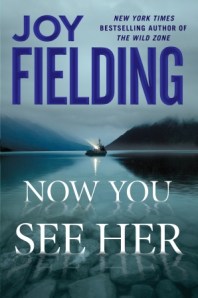
Now You See Her – Joy Fielding

now you see her

Well, there’s a few hours I’m never getting back.

I am not a book snob. I like a fast-paced, plot-driven suspense thriller as much as the next girl. Now You See Her, on the surface at least, seems like a book that would be right down my dark alley. Marcy Taggert is on holiday in Ireland. It was supposed to be a second honeymoon, but her husband, Peter, has run off with the golf pro from his country club and so Marcy has gone solo. While enjoying a cup of tea with a man she’s met on her day-trip to Cork, Marcy sees her daughter, Devon. Which isn’t possible because Devon is dead. (cue music)

I really wanted to like Now You See Her. For one thing it’s written by Canadian Joy Fielding (who has had a great deal of success in this genre). For another, I felt like I should be able to relate to Marcy. We’re of the same vintage, at any rate. But nothing about this book spoke to me.

So Marcy sees Devon and tears off looking for her. Of course, she doesn’t find her. But she returns to Cork and sets up camp and becomes more and more convinced that Devon is not dead. Marcy’s supposition might, in fact, be possible because Devon’s body was never found. She meets various characters along the way, some of whom have nefarious motives, some who want to help her. Some who think she’s crazy and as the book plods along it’s possible that crazy is exactly what Marcy is.

Here’s why the book didn’t work for me:

1. Marcy is stoo-pid. She actually meets a man in a pub and goes off with him after he tells her that, yes, miraculously, he knows her daughter. Really? Really?

2. The writing is clun-ky. Sometimes,  apropos of nothing, we get a little history lesson.  No one sounds Irish. The transitions are often confusing.

3. There are characters who just appear – out of nowhere – conveniently. Fresh baked muffins, anyone? Also, the characters are not believable. Seriously, wait until the lacklustre denouement, see who plays a part in it and then see how you’ve been mislead all along.  But not in a plausible way. Peripheral characters, Marcy’s son, for example, are footnotes.

4. If you are going to weave a tangled web, the spider at the center wants to be believable. Um. Just no.

I don’t know where Now You See Her comes in Fielding’s canon, but I won’t be rushing to read any more of her work.

Jane – April Lindner

Although I read it almost 40 years ago (and, oh, it pains me to say that!) Charlotte Bronte’s novel Jane Eyre, the story of  Jane, an orphan who is mistreated by her awful cousins and finally finds love and a home at Thornfield Hall, the estate of the enigmatic and darkly handsome Edward Rochester, has stayed with me my entire life. I remember the specific feeling of satisfaction I had while reading it – my first ‘adult’ novel; but, more than that, I fell in love with Jane. I felt, in her, a kindred spirit –  a bookish, sensible and rather plain young woman – someone I could relate to.

I tell my writing students that  we tell the same stories over and over and our real job as writers is to find fresh and inventive ways to do that: to make the old new. Perhaps that explains the glut of sequels and prequels and little women turned zombie killers on the bookshelves these days. Despite my reservations about these books, I have to say that I have a few on my bookshelves; mostly these books are ones I hope I can pass on to my students.

April Lindner’s book Jane comes with the tagline “What if Jane Eyre fell in love with a rock star?” Lindner herself is a Jane Eyre fan and claims that as much as she “love[s] the Pride and Prejudice spin-offs … if I had to choose between Jane Austen and Charlotte Bronte, I’d be on Team Bronte.” She wondered why there wasn’t some sort of Jane Eyre redux and thought it might have to do with some of the complicating factors of the original: a crazy woman locked in an attic could hardly happen with today’s modern medicine.

Still, Lindner decided to see if she could finesse Jane’s story into the 21st century.  Sadly, I can’t say that she’s altogether successful.

Jane Moore has to leave her East Coast college after the death of her parents. The stocks they left her turn out to be worthless; her older siblings did marginally better, but she isn’t close to them. At all. In fact they are horrible. Unlike Bronte’s Jane, though, we aren’t given any real insight into why the family dynamics are so messed up. So, we just have to accept that Jane’s stiff-upper-lip is because of some deep-rooted childhood trauma. So, without a degree or money, Jane decides to become a nanny. Lucky girl, she gets to work for Nico Rathburn – über famous rock star guy. Seriously, if there is a bigger star on the planet, we don’t know who he is. Jane sort of knows who Rathburn is because her brother used to blare his music all the time, but Jane is above all that.

Off Jane goes to the Thornfield Park where she meets various employees of Rathburn’s and his five-year-old daughter, Maddy. She’s also warned to stay away from the third floor because, despite Nico’s wealth,  “the floorboards are old and rotting.”  Nico, when he finally shows up, is prickly and kinda hot. And despite the awkward conversation between them, it’s not long before Jane realizes she’s in love with Mr. Rathburn (yes, she still calls him that!)

Here’s where I started to giggle. We are expected to buy into this relationship – and yet I never believed any of it. All their conversations were extremely awkward and somehow inappropriate. I’m not just talking about the age difference (Jane is 19 or perhaps 20 and Rathburn has had one marriage, one child with another woman and scads – by his own admission – of liaisons with groupies and super models). He seems to have no problem revealing very personal details to Jane, almost from the moment he meets her. But he also has no problem fawning over a beautiful photographer, ostensibly to make Jane jealous. Really? Nico seems less tortured and more torturer.

There’s no emotional center to Lindner’s Jane. Ironically, the novel ends up being as glossy and superficial as the magazines Jane manages to avoid after she runs away from Nico and his dark secret. (Which also, really?)

If Jane manages to encourage a new generation of readers to pick up Bronte’s vastly superior novel, that will be an accomplishment. But I can’t imagine any fans of the original thinking this update has anything much to offer.


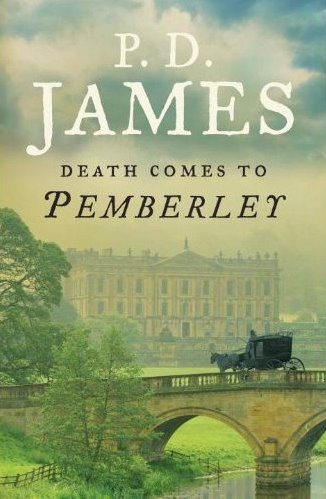
Death Comes to Pemberley – P.D. James

Death Comes to Pemberley by famous British crime novelist P.D. James is fan fiction. That’s right: P.D. James borrowed characters and settings made famous by Jane Austen and wrote them into a new story which takes place six years after Elizabeth and Darcy marry. That’s essentially what fan fiction is; writers (albeit, generally amateur writers) find new ways to breathe life into familiar characters. Because James is a crime writer, she wrote a mystery (although a relatively tame one, even by my standards.)

Fan fiction is (according to Wikipedia) “is a broadly-defined term for fan labor  regarding stories about characters or settings written by fans of the original work, rather than by the original creator. Works of fan fiction are rarely commissioned or authorized by the original work’s owner, creator, or publisher; also, they are almost never professionally published.”  I would have agreed with that definition except for all the fan fiction that has found its way into bookstores recently (Fifty Shades of Grey, for example, literally started its life as Twilight fanfiction; Pride and Prejudice and Zombies and Android Karenina are two examples from Quirk Classics). Perhaps I am misinterpreting the definition of fan fiction, but to me when you borrow another writer’s characters and just give them a new plot – that’s fan fiction. Yes, even if it’s a parody. (Fan fiction writers write parodies all the time.)

But, hey, I’m a huge fan of fan fiction and so pointing it out isn’t meant as a criticism. Even Pulitzer Prize winning author, Michael Chabon understands the merits of derivative fiction. In his book of essays Maps and Legends: Reading and Writing Along the Borderlands he says:

 …all literature, highbrow or low, from the Aeineid onward, is fan fiction. That is why Harold Bloom’s  notion of the anxiety of influence has always rung so hollow to me. Through parody and pastiche, allusion and homage, retelling and reimagining the stories that were told before us and that we have come of age loving – amateurs – we proceed, seeking out the blank places in the map that our favorite writers, in their greatness and negligence, have left for us, hoping to pass on to our own readers – should we be lucky enough to find any – some of the pleasure that we ourselves have taken  in the stuff we love to get in on the game. All novels are sequels; influence is bliss.

No matter the source material, all literature, ultimately, has to stand on its own two feet. Readers needn’t be a fan of Austen – or even know who she is – to read Death Comes to Pemberley because in the opening chapter James fills us in on the backstory. Once readers have the lay of the land, they can jump into the mystery which for me was only so-so. I like Austen fine, although I wouldn’t say I am a huge fan. I love a good mystery. I don’t have any problem with dense, old-fashioned prose (really good fan fiction mimics the original author’s style and recreates characters that are recognizable to readers of the original work). But Death Comes to Pemberley was a big YAWN. Seriously: nothing happens.

Elizabeth and Darcy are madly in love – although they spend virtually no time together. Elizabeth is preparing for Pemberley’s yearly Lady Anne’s ball when her younger sister, Lydia, arrives screaming that her husband George Wickham has been murdered in Pemberley Wood. Wickham is a bad apple and has been a constant source of embarrassment for Darcy. When it turns out it’s not Wickham who is dead but another male who was traveling with him, Darcy isn’t sure Wickham actually committed the crime.

It’s not much to make a mystery meal out of, but James fills page after page with lengthy descriptions of relationships and manners and protocol and the moon on the woods and it was so S-L-O-W. If it hadn’t been our first book club pick (and by a new member, no less) I would have abandoned it, for sure. I kept plodding along, but for me, the original charm of the Elizabeth/Darcy relationship was absent and the rest of the book just wasn’t my cup of tea.

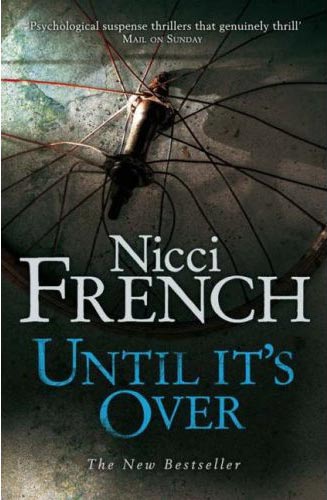
Until It’s Over – Nicci French

I can honestly say I’ve been a Nicci French (husband and wife team, Sean French and Nicci Gerrard) for over a decade, but I may have to quit them after reading Until It’s Over.

Astrid Bell is in her early 20s and works as a bike messenger in London. She lives in a huge house with university pals Pippa and her former boyfriend (and owner of the house) Miles. They share the space with Mick, Dario, Davy and Owen. They’re a family, in a sense.

Until It’s Over opens with an accident. Astrid is riding home from work and is almost at her house when someone opens their car door and Astrid goes flying off her bike. The woman in the car is a neighbour and she’s mortified at the accident she’s caused. Astrid is unhurt except for minor cuts and bruises. But later, the woman turns up dead. And hers is just the first murder connected to Astrid Bell.

Until It’s Over is supposed to be a mystery. About two thirds of the way through, though, the narration changes. Instead of following Astrid’s first person narration, we suddenly find ourselves in the killer’s head. I guess this was so we could understand their motivation. Um. The killer is Crazy.

Nicci French is usually such a dependable author -books that are  page turning, psychologically complex and fun. Until It’s Over was none of those things. I didn’t believe in (or care about) any of the characters. It wasn’t suspenseful. I often felt myself shaking my head in disbelief at the way characters interacted each other in a sort of oh please way.

I think if you’ve never read Nicci French – you absolutely should. But don’t read this. Read Killing Me Softly (which remains my favourite) or The Safe House.

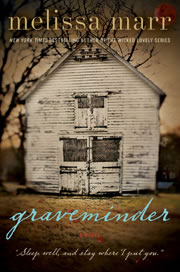
Graveminder – Melissa Marr

Melissa Marr’s first novel for adults (she’s better known for her YA novel series Wicked Lovely) was my first read in 2012. Actually I started Graveminder  in 2011 and was hoping to get it finished but I just couldn’t manage it. Graveminder was recently voted Best Horror novel at Goodreads, but it’s been on my radar for a few months and I was really looking forward to reading it.

So, so disappointed.

The premise of Graveminder is actually quite intriguing. When Rebekkah Barrow’s grandmother, Maylene, is murdered, Rebekkah comes back to the town where she grew up. Claysville is not like other towns; it has strange traditions, particularly where the dead are concerned.

Matlene was a graveminder.

If anything happens to me, you mind her grave and mine the first three months. Just like when you go with me, you take care of the graves. …Promise me.

Rebekkah, as it turns out, is a graveminder, too. Her job – which she knows nothing about until she returns to Claysville, is to guard the graves of the dead.

Her return to Claysville is complicated by her on again off again relationship with Byron,  the town’s undertaker.  (Graveminder, undertaker – sounds like a couple wresters,eh?) Byron was Rebekkah’s sister’s high school sweetheart until tragedy struck and now Rebekkah just can’t seem to get it together where Byron’s concerned. These unresolved feelings make up a large part of the novel’s energy – but not in a good way.

None of Graveminder actually lives up to the promise of the plot.  The writing is generally clunky, the characters vacillate between annoying and insipid and many promising plot threads are never satisfactorily resolved.  Rebekkah continually pushes Byron away and they have the same conversation over and over – like they are 12 – drove me c-r-a-z-y.  Their interaction was not adult in any way.

Graveminder wasn’t scary, either. The premise was: the dead must be tended or maybe they’ll come back and if they do – watch out. Also, Marr has created an intriguing ‘other’ world, a place where the dead go and live. The thing is, it feels like she’s dropping the reader into the middle of a story – where questions are asked but never answered.

If there’s a sequel coming, I won’t be reading.

11/365

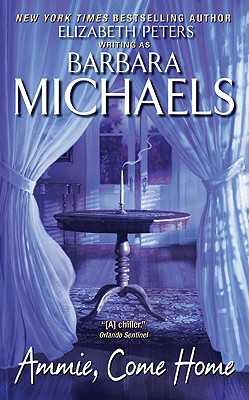
Ammie, Come Home – Barbara Michaels

Barbara Michaels is a prolific writer, having penned over 30 novels (some under her real name, Elizabeth Peters). Somehow her book  Ammie, Come Home found its way onto my tbr list, then shelf and I finally got around to reading it.

Published in 1968, Ammie, Come Home is an old-fashioned ghost story (emphasis on the old-fashioned.) It concerns Ruth, her 19-year-old niece, Sara (who is living with her while she attends college), Pat MacDougal (Sara’s professor and Ruth’s love interest) and Bruce, Sara’s boyfriend. Ruth and Sara live in a house they Ruth inherited from an aunt. It’s quite a famous house, one which causes Professor MacDougal to exclaim “Good God Almighty!” the first time he enters.

A seance kicks off the other-worldly events in Michaels’ novel. Then Ammie, Come Home plods along with all the requisite ghostly bells and whistles (moaning, doors opening and closing, cold air.) Perhaps I am jaded. No, I am definitely jaded because I didn’t find the book even remotely scary and no one likes a good horror story more than me.

It’s got me thinking though. What books have truly frightened me?  I’m going to have to do some thinking on that one. I’ll get back to you. In the meantime, what’s the scariest book you’ve ever read?

Along Comes A Stranger by Dorie McCullough Lawson

Okay – so another book that sounded so promising and ended up being mediocre. What’s up!?

Kate Colter has lived in small-town Wyoming for 15 years. Her husband, George, is a paleontologist; her daughter, Clara, is just seven and suffers from MCADD, a disease that requires her to eat regularly or else her body runs out of glucose and starts to shut down.

What we’re expected to believe – because the author tells us , is that Kate is somehow dissatisfied with her beautiful family and lovely life, that she’s  an East Coast girl at heart and has never really settled into life in the West. That’s why when she meets her mother-in-law’s new boyfriend, Tom Baxter, she’s immediately smitten. He’s from away and as far as Kate’s concerned, he’s exciting and intelligent and they have things to talk about.

About 50 pages in, Kate mentions her aunt Joanie. She’s clearly a plot device, so the author can tell us about Kate’s fascination with criminals.

I can’t say Joanie’s and my interest in the underworld arises from a concern for something greater, like justice, nor does it come from something emotional or psychological within either one of us, like a deep-seated fear of evil, for instance. No, Joanie and I just like to talk about all these crimes and criminals because they make for good, fast-moving stories.

So, life ticks on. George goes off on a dig and Kate is required to fill her days – which she does. Maybe this is the reason why she doesn’t notice, at first, the huge red flags that something is not 100% square with Mr. Baxter. Oh no! Then, even the tiniest things start alarm bells ringing until the novel’s wholly ridiculous conclusion.

Look, I’ve read dozens of these stories – you have, too – lots of them are terrific. This one is not. The characters, every last one of them, are one-dimensional and the  whole thing is contrived and lacks any sort of suspenseful momentum.