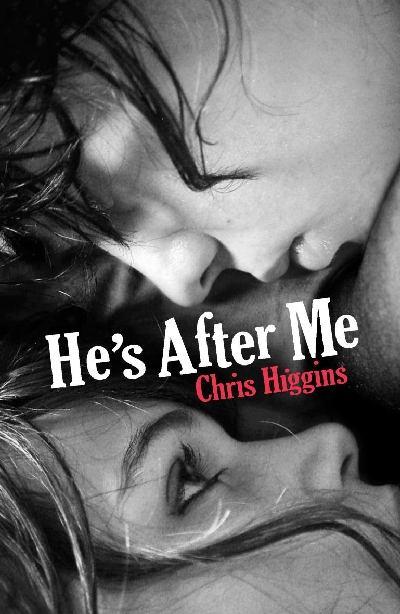
He’s After Me – Chris Higgins

When smart but plain Anna meets Jem in Chris Higgins’ novel He’s After Me, her life is falling apart. Her parents have recently separated, her mother has retreated from the world and her younger sister, Olivia, is suddenly dressing far too provocatively and hanging out with kids that Anna doesn’t particularly like.

Jem is, well, electrifying. “…his smile faded and our eyes held and that’s when it happened. A charge passed through me like an electric shock.”

The first person narration sweeps the reader along and allows us to see both Jem’s many charms and also Anna’s growing doubts about the intensity of  her first serious relationship. Her best friend Zoe sees it though. “He’s got inside your head, Anna! He controls you. Can’t you see it?” she says.

But Anna can’t – or won’t see it. As Jem leads her further and further away from the safety of her life, she takes risks and chances she would never have previously considered.

That might have been enough to drive this YA novel’s breakneck pace – but there’s more. Someone seems to be watching Anna and Jem.

And so love’s arrow finds its target.

And she’d seemed like such a sensible girl too, not the kind to lose her head over some bloke.

That’s love for you.

Anna is a likeable character. I found myself really turning the pages to find out what was going on – wavering between believing in Jem’s charms and wanting to scream at Anna for not seeing through them. The anonymous third person kept me guessing, too. So, in that respect – good little page turner.

But I didn’t like the ending much.

I’ll Be There – Holly Goldberg Sloan

Holly Goldberg Sloan is a screenwriter/director (Angels in the Outfield, Made in America) and maybe that’s the problem with her debut novel, I’ll Be There. It’s the story of Emily and Sam who lock eyes in a church where Emily is singing, badly, her first solo, The Jackson Five’s hit I’ll Be There.

Emily is the daughter of Tim, a music professor, and Debbie, an ER nurse. Her younger brother is Jared. She leads a nice life. She believes in order and destiny.

Emily’s interest in personal histories made her accessible to people’s deepest emotions. It was as if she had some kind of magnet that pulled at someone’s soul, often when he or she least expected it.

And that same magnet, which had to have been shaped like a horseshoe, allowed someone to look at her and feel the need to share a burden.

Hers was a gift that didn’t have a name.

Even she didn’t understand what it all meant.

Emily just knew that the grocery store clerk’s cousin had slipped on a bathmat and fallen out a second-story window only to be saved because the woman landed on a discarded mattress.

But what interested Emily the most about the incident was how the cousin had subsequently met a man in physical therapy who introduced her to his half brother who she ended up marrying and then running over with her car a year later after a heated argument. And that man, it was discovered, had been the one to dump the mattress in her yard.

He’d saved her so that she could later cripple him.

Emily found that not ironic but intriguing.

Because everything, she believed, was connected.

I quote this passage because it’s a great example of how Sloan’s omnipotent narrator does the work for the reader. This character is like this; here is a story to illustrate that.

Sam is the son of Clarence,  a  psychotic criminal. Sam’s brother, Riddle, is somewhere on the autism  spectrum. He is also plagued with constant colds. Sam and Riddle have been on the run with their father for the last ten years. They sleep in their truck or in run-down houses. Sam looks after Riddle as best he can. They don’t go to school; they don’t eat properly. Everything they know they’ve learned from books they’ve found. Riddle is artistic. He draws intricate mechanical drawings in a phone book. Sam is a self-taught musical genius. He’s also beautiful, selfless and perfect.

So, Emily and Sam’s eyes meet and that sets off a chain of events which propels the novel forward. Not everyone gets what Emily sees in Sam. Yes, he’s good-looking and polite, but he’s not forthcoming with details about his life and that’s worrying to Emily’s parents. Until Tim hears Sam play the guitar and then all bets are off. Suddenly Sam and Riddle are pulled into the Bell’s warm and welcoming circle and it’s unlike anything they’ve ever experienced. So, clearly, it can’t last.

There are reasons to like I’ll Be there. Riddle is a terrific character and the relationship between the brothers is lovely. The narrative moves along quickly, perhaps because it’s written in short little scenes. But that happens to be one of the book’s weaknesses for me. The omniscient narrator doesn’t take the trouble to develop any one character particularly well. The novel is like a bunch of soundbites strung together. Worse, even minor characters (the hairdresser who cuts Sam’s hair; an old lady who finds Clarence’s stash of stolen goods; the guy who buys his stolen penny collection) get their moment in the sun. Do I really need to know how their stories pan out? I guess I do if I want to wholeheartedly buy into Ms. Sloan’s over-arching theme of destiny.

The tone of the novel is off-kilter for me, too. It careens from swoony romanticism to lives-in-peril to  slap-stick comedy.

Will young adults enjoy this novel? Probably. It’s easy to read and Sloan does most of the work for you – right down to putting white hats on the heroes and tying the whole thing with a pink bow.

Oh, wait, that’s just destiny.


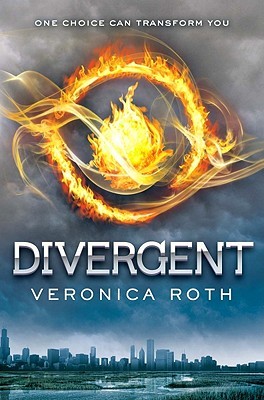
Divergent – Veronica Roth

The dystopian landscape is popular in young adult fiction. If it’s not vampires and werewolves, angels or fairies – it’s likely some future version of our world where society has run amok and children are often left to fend for themselves. The most famous recent example is likely Suzanne Collins’ beloved book,  The Hunger Games. Veronica Roth’s popular novel Divergent has gained its own rabid fans and while I understand the book’s appeal, I didn’t like it as much as The Hunger Games.

Beatrice is sixteen. When you turn sixteen you must choose a faction: Abnegation (selflessness), Amity (peaceful harmony), Candor (frankness, honesty), Erudite (seeking knowledge) or Dauntless( fearless). Beatrice has grown up in an Abnegation household with her parents and older brother (by just a few months, so  her brother, Caleb, must also choose a faction), but she has never felt like she belonged. Selflessness doesn’t come easily to Beatrice.

When I look at the Abnegation lifestyle as an outsider, I think it’s beautiful. When I watch my family move in harmony; when we go to dinner parties and everyone cleans together afterward without having to be asked; when I see Caleb help strangers carry their groceries, I fall in love with this life all over again. It’s only when I try to live it myself that I have trouble. It never feels genuine.

So when it comes time to choose a faction, Beatrice chooses Dauntless. Most of Divergent is concerned with Beatrice’s (renamed Tris) training at the Dauntless compound. It’s a bit like a reality show: candidates are put through a series of tests and the best man (or woman) wins. Those who don’t make it – because they either quit or fail – suffer worse fates. You can’t go home again so you’re factionless, left to scrounge for food or do the most menial jobs available.

Tris is smart, no question, but what was missing for me was the back story which Katniss Everdeen had in spades. Katniss is a beautifully written character, someone I rooted for and understood. Tris, despite her upbringing, adapts relatively easily to her new faction – learning how to fight and lie with relative ease. Perhaps Roth was thinking of the nature versus nurture debate: how much of what we are is because of environment and how much is because of biology?

My issues with the book are minor quibbles, though. Despite being almost 500 pages long, I breezed through it. Sometimes I felt like the plot was being served rather than unraveled in a meaningful and organic way. Characters turned up conveniently and were dispensed with equally trouble-free. I know many will argue that Divergent offers lots of talking points, but I didn’t leave that shattered Chicago landscape feeling all that inclined to revisit.

All that said, I know there will be students in my class who will enjoy the novel and I would have no trouble recommending it – even if only as a way to talk about characterization: it’s difficult to mourn for people you don’t feel you know.

Nothing But Ghosts – Beth Kephart

For anyone who has lost their mother, Beth Kephart’s YA novel, Nothing But Ghosts is a gift. In it, 16 year-old Katie navigates the lonely and traumatic days after her mother dies of cancer by solving the mystery of what happened to Miss Martine, the shut-in who lives in the estate down the road. When Katie is hired to help dig a spot for a new gazebo at the estate, the experience draws her out in the present – even as she investigates the past.

Kephart’s novel is beautifully written and Katie is a thoughtful and likeable character. Kephart expertly weaves a story that casts a light on several characters who have been broken by  events in the past. Katie’s own story, and that of her parents, is told through her memories of a family trip to Spain. In remembering she thinks:

She’d kept her secret the whole trip long. She stood in the strange, chill mist, alone, alive, but knowing what would come. History is never absolute truth. It isn’t just the thing that was. It’s the thing that could have been.

Her father, a brilliant art restorer, is drowning in his own grief. The librarian who helps Katie dig into the history of Miss Martine’s life has had her own heartache. Even Sammy, the little boy who lives across the street has had his share of disappointments.

Nothing But Ghosts is a story about loss, but it is also a story about love and rebirth and hope. Katie must travel the road to acceptance on her own, but she does it with a grace that belies her age.

I very much enjoyed this book.

Things You Either Hate or Love – Brigid Lowry

Georgia is the 15-year-old narrator of New Zealand  novelist Brigid Lowry’s YA book, Things You Either Hate or Love. I was smitten with her almost as soon as she opened her mouth to announce:

I like to think of myself as a brilliant creative person, but sometimes I just feel like a sad lonely girl with a big bum.

Georgia is madly in love with Jakob, the lead singer of a funk band called Natural Affinity. She spends long hours talking to his poster – free therapy – and plotting ways to earn money so she can fly off to Brisbane to see his band in concert.

In an effort to make some money, Georgia tries (and fails) at babysitting, working in a video store and then a bakery, before finally landing as a cashier at the local supermarket. When she isn’t moaning about regular teenage stuff (her mother, school, friends) she’s trying to navigate the fraught path from childhood to adulthood.

Georgia is charming and funny, but lacks any real confidence. She is a character that would definitely speak to a lot of girls. She certainly spoke to my former self. When she ends up working with Hunter, the gorgeous boy who used to come into the bakery, she can’t help but develop a bit of a crush. But she’s sure Hunter could never be interested in a girl like her.

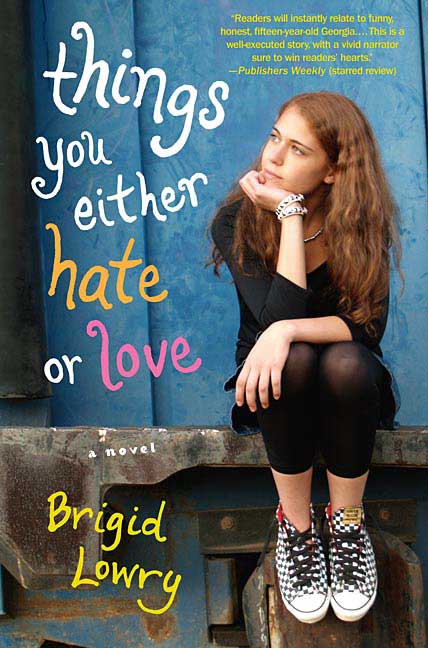
If I have any complaints about the book it’s that the girl on the cover is a misrepresentation of the Georgia in the book  – although I have no doubt that Georgia is nowhere near as plain as she thinks she is. Also, Georgia contracts glandular fever and loses a lot of weight…just in time for the book’s happy ending.

That said, I really enjoyed Things You Either Hate or Love. Georgia is lovely and her trials are relate-able without being overwrought. It is a skilled writer who can make a book without an overabundance of teenage drama compelling and entertaining.

Monsters of Men – Patrick Ness

My love affair with Patrick Ness’s Chaos Walking trilogy began with The Knife of Never Letting Go. The next book, The Ask and the Answer was also fabulous. Last night I finished the third book, Monsters of Men. I am not ashamed to say that I cried.

Monsters of Men begins on the eve of war. Todd and the Mayor, and  Viola and Mistress Coyle are not only at a stand-off with each other, The Spackle (the indigenous people of New World) have risen up to annihilate them. War proves to be frightening and messy and dangerous.

The flames spill out from the top of the horned creacher and cut thru the middle of soldiers and men are screaming  and burning and screaming and burning and soldiers are turning back and running and the line is breaking and Angharrad is bucking and bleeding and squealing and we’re slammed by a wave of men retreating and she bucks up again and–

The lines between hero and villain, good and evil, are  blurred in Monsters of Men. I found my feelings about the Mayor constantly changing. Is he a decent man caught up in extraordinary times? Is he a master manipulator? Is he a monster? Mistress Coyle didn’t fair much better in my estimation. Viola and Todd ask the same questions about the adults nearest them and as they aren’t physically together for much of this book, they also ask it of each other. How have circumstances changed them?

There’s also a new point of view to consider in Monsters of Men: the Spackle. For the first time we get to hear their noise. Truthfully, I found some of this bothersome because of the names they ascribed to things: the Burden, the Clearing, the Knife, the Sky, the Source. I was caught up in the narrative and it slowed me down trying to figure out who or what  they were talking about. Nevertheless, the Spackle are no longer a faceless enemy — if they ever were the enemy at all.

There are big questions to be considered in this novel, in the series as a whole. Despite the fact that Chaos Walking is marketed as a Young Adult series, Ness doesn’t shy away from asking them. Why do we fight? What does it mean to be human? I even think there is something in the books about this information age — the constant bombardment of data and noise we endure every day. With no quiet space to think, don’t we all have the potential to be driven a little mad? Alternatively, can’t we use this information to better understand and empathize with each other?

As the Mayor says to Todd near the end of the book, “War makes monsters of me, you once reminded me.” It is messy business, to be sure. But there is great humanity in these books. And Todd and Viola, as characters, will be with me for a long, long time.

A Must Read series!

Nevermore – Linda Newbery

This is the kind of book I would have loved as a young reader. Plucky heroine, manor house in the English countryside, an intriguing mystery. The problem for me, of course, was that I solved the mystery early on – but that doesn’t mean the book wasn’t fun to read.

Twelve-year-old Tizzie and her mother, Morag,  have moved to Roven Mere, where Morag has taken a job as a cook. The huge estate is a constant source of intrigue, especially for Tizzie, who hopes that for once Morag will give up the wanderlust that has driven them from town-to-town most of her life.

Owned by Sir Rupert Evershall, but run by the crusty Finnigan, Roven Mere is always at the ready for the return of Sir Rupert and his young daughter, Greta.

“Is he very grand, Lord Rupert?” Tizzie asks Mrs. Crump, the housekeeper.

“Oh, I’ve never actually met him,” said Mrs. Crump. None of us have. Only Finnigan. We’re expecting him home in a week or two. Him and his family. Very exciting it’ll be, meeting them at last.”

Tizzie spends her early days exploring the house – which does seem to be in a constant state of readiness for Sir Rupert and Greta’s homecoming – making friends with Davy, Mrs. Crump’s grandson, and trying to manage her mother’s moodiness.

The book is intended for younger readers whom I am sure would be charmed by Tizzie, the novel’s mystery and Roven Mere itself. I certainly was.

The Heights – Brian James

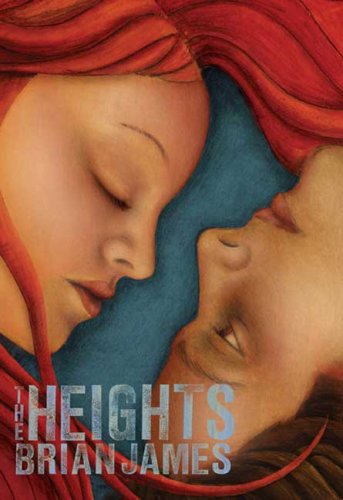
Ask anyone, I am a sucker for stories about star-crossed lovers. I love angst with a capital A. So the premise of Brian James’s YA novel The Heights would seem like a perfect fit for me. I mean the tagline was “theirs was a love that would last forever.”

Sadly, for me, this book was a pale cousin to its predecessor, Wuthering Heights. James sets his novel in foggy San Francisco where Catherine Earnshaw and her older brother, Hindley, live with their widowed father. Henry lives there too. He’s the orphaned Mexican boy Catherine’s father scooped off the mean streets and raised as his own. Now, years later, Mr. Earnshaw is dead and Hindley, a big shot lawyer, has come home to make sure Henry doesn’t get anything he’s rightfully entitled to (as Mr. Earnshaw preferred Henry to Hindley – and no wonder, Hindley is a misogynistic asshat.)

Hindley is also intent on splitting up Catherine and Henry, siblings on the cusp of admitting that their feelings for each other might be just a teensy bit more complicated than they should be. Of course, they never get around to admitting their feelings to each other before Hindley throws his oar in and muddies the waters.

Told in alternating view points, we see Catherine mooning over Henry and Henry mooning over Catherine – but nothing much comes of it, especially once Hindley banishes Henry to the basement of their huge house in The Heights (a tony neighbourhood in San Francisco) and sends him to a rough school way across town where Henry is constantly in danger of being beat up. Make no mistake, he’s tough and can handle himself – and without Catherine’s calming influence, he’s more likely to swing than swoon.

James tries at Bronte’s themes: obsession, class, revenge – but the problem with The Heights, for me at least, is that the novel’s contemporary setting makes the characters seem sort of inert. I never wanted them to be together because neither of them seemed all that sympathetic. And yes, you could make the same case for Catherine and Heathcliff – but Bronte’s sweeping tale somehow elevates those characters to mythic, romantic heights in a way James never quite manages.

I will be happy to encourage my students to read The Heights, but even happier if they go on to read Wuthering Heights.

40 Things I Want To Tell You – Alice Kuipers

Amy, or Bird as she is called by those nearest and dearest, is a list maker. She’s super organized and has her future planned down to the last detail.

Read chapter for History

Essay for English.

Start “Top Tips” Section

Tidy room and pack bag for school tomorrow

Bird is 16 and lives with her mother and father in a London suburb. From her bedroom window, she can look over into Griffin’s bedroom window. Bird and Griffin have been best friends since they were kids and Griffin and his family moved into the house next door. Recently, though, their relationship has morphed into something more romantic.

Bird seems to have it all together – so together, in fact, that she runs an advice column on a website. There are cracks though: in her relationship with Griffin, in her parents’ marriage, in her own life.  And Bird is about to learn that the best laid plans… Meet Pete Loewen.

I raised my gaze to see a guy lounging against the open doorway. I couldn’t help but notice that he was really hot. …He was older than us. He wore jeans and a black shirt with the words Born to Diescrawled over it. His sandy blond hair hung slightly long, like he hadn’t got round to cutting it, and he had stubble on his jaw line. he managed to look like he didn’t care about his appearance at all, and yet he was one of the – No, he was the most gorgeous man who’d ever walked into our school.

40 Things I Want To Tell You worked on many levels. Bird is engaging and intelligent. Pete is mysterious and, well, hot. When Bird’s world starts to careen off course, her problems are realistic and relate-able.

But one thing about this book did not work for me and that was the relationship between Bird and Pete. It’s not that I didn’t buy their instant attraction. It’s not that I didn’t buy where that attraction led them (*use your imagination*). It’s just that nothing about Pete’s story is fleshed out. There are all sorts of rumours swirling around about him, but we’re not privy to any of his back-story,  and neither is  Bird. It makes it hard to care for him, especially because he acts like a jerk to her.  And then he doesn’t. Then Bird acts like a jerk. But the problem is, I couldn’t ever root for them to be together – although perhaps I wasn’t supposed to.

That said – I gobbled up 40 Things I Want To Tell You pretty quickly and I will happily add it to my class library. I am sure my female students will love it.

The Ask and the Answer – Patrick Ness

Oh, Todd. Oh, Viola.  You’re breaking my heart.

Patrick Ness has done it again with the second book in his Chaos Walking trilogy. When we left Todd and Viola in The Knife of Never Letting Go, they were running for their lives into the town of Haven. Well, Todd was running at least; Viola had been shot.

Haven turns out to be exactly the opposite; the pair are captured and separated. When Todd comes to, he is tied to a chair and the Mayor (remember how evil he was in the last book? You ain’t seen nothing yet!) is interrogating him. But all Todd can think about is Viola.

“Where is she?” I spit into the dark, tasting blood, my voice croaking, my Noise rising like a sudden hurricane, high and red and furious. “WHERE IS SHE?”

“I will be the one doing the asking here, Todd.

That voice.

The opening scene in The Ask and the Answer is but a taste of the horrors to come. Ness doesn’t pull any punches: literally.  Haven has been taken by the Mayor and his men and Todd finds himself separated from Viola.  No one is safe and the lines between who is good and who is not are constantly shifting.

The Ask and the Answer is about war. The themes are universal: outsiders rounded up like cattle and branded; a leader crazy for power (or perhaps just plain crazy), and two kids trying desperately to make meaning and find a way to do the least damage.So much comes at them and I often forgot that they were just kids. That was the hardest thing to believe about the whole book: Todd is supposed to have just turned 13 and he seems a lifetime older.  But I am looking at him from my cushy, never-been-in-war, perspective. Who knows what you might be capable of if there was no alternative.

And that question is at the very centre of Ness’ terrific book. If you had no choice – what would you do? If you thought all was lost – what would you do? People constantly surprised me in this book, particularly the Mayor’s son, Davy. It’s a testimony to Ness’ considerable talent that he is able to make Davy sympathetic.

As for Todd and Viola – they continue to be resourceful and bloody amazing and true to each other is ways that are both heart-breaking and inspiring. They’re so brave and so resilient, I hated to leave them again.

Book three, coming up: Monsters of Men