
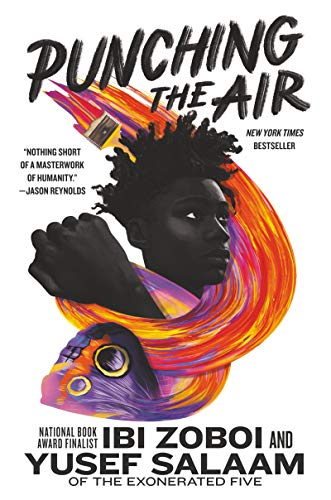
I try to remember what I privileged position I inhabit when I read books like Punching the Air by Ibi Zoboi and Yusef Salaam. What can I, a white, middle-aged (I know, it’s a stretch to call me middle-aged), middle-class woman from Eastern Canada, really know about what it is to live in this world as a BIPOC? Nothing. It would be a stretch to even say that I have been discriminated against because I am female because if I have been, I haven’t really been aware of it.
I do think I have a responsibility, as an educator – sure – but also as a human being, to educate myself and expose myself to experiences that are unfamiliar to me. It’s not enough to hope that our children will be better humans than we are; we all have to do better.
Punching the Air is a novel-in-verse that tells the story of sixteen-year-old Amal Shahid, an artist and poet, who finds himself in the wrong place at the wrong time and ends up in jail for a crime he didn’t commit, although he does admit that he “threw the first punch.” Turns out “…it wasn’t about/who threw the first punch/ It was about courts, turf, space/ Me and them other boys/ were just trying to go home”.
Jeremy, the white boy who gets hurt in the altercation is in a coma, and Amal ends up in a juvenile detention facility. He tries to work through his confusion and anger, but it isn’t easy. “I went from/kid to criminal to felon/to prisoner to inmate” and despite a supportive family he must navigate his new reality on his own.
Punching the Air tracks Amal’s time in the facility where he vacillates between hopelessness and hopefulness. Although he is not doing hard time with hardened criminals, juvie is still an unpleasant place. Amal tries to keep his head down. He goes to school. He does what is asked of him – mostly. But he’s a kid and the system is stacked against him and the weight of all those bricks of discrimination weigh heavy on him.
I read Punching the Air in an afternoon. Amal’s voice is clear as a bell. This experience, while fictional, comes from a place of truth. Yusef Salaam himself was convicted of a crime he did not commit when he was just fifteen. (Central Park Five) His experiences with a justice system that is clearly stacked against people of colour – and there is no one in their right mind who could dispute this – adds a layer of authenticity to Amal’s story. But even without Salaam’s experiences, this novel has much to contribute to the discussion and is a worthy addition to classroom and personal libraries. I will certainly be recommending it to my students.
 I have a deep and abiding love for John Green. He’s a passionate advocate for reading and learning. He makes nerdish pursuits cool and I think he’s a terrific writer. Lord knows, I was a sobbing, snotty mess at 2 a.m. finishing
  Pam Smy’s lovely hybrid novel tells the story (in words) of Mary and (in pictures) Ella – two girls separated by twenty-five years. Ella and her father have moved into a house that looks out onto Thornhill Institute which was “established in the 1830s as an
 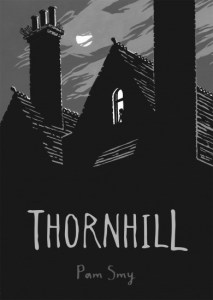 orphanage for girls” and sold in 1982 “after the tragic death of one of the last residents, Mary Baines.” For the last twenty-five years, the house has remained vacant, although plans have been made to develop the site.
 In the present day, Ella spends much of her time alone, too. Her father, who clearly seems to love her, is away a lot. Her mother is presumably dead. Ella is curious about the house she can see from her bedroom window and the girl she sometimes glimpses in the overgrown garden behind the walls
 is a celebrated graphic novelist, whose series Diana: Queen of Two Worlds, tells the story of “a suburban girl who lives with her “painfully average” family which includes her high-strung easily overwhelmed mother, her ineffectual father, and her dull-witted, staring lump of a sister.”
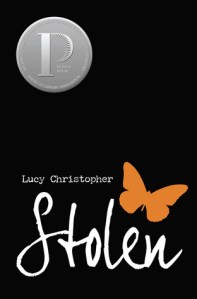 This encounter is the beginning of Gemma’s journey in Lucy Christopher’s debut novel Stolen. Before Gemma has even realized what’s happening, the man is buying her coffee, introducing himself as ‘Ty’ and engaging Gemma in a conversation that makes her feel “grown-up, sitting there with the most handsome man in the café, drinking a coffee he had just bought for me.”
 able, folks.
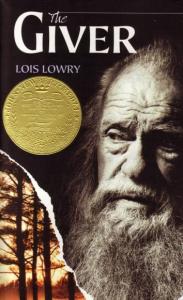 The Giver takes place in a community that values Sameness. On the surface it might even appear like a Utopia. Eleven-year-old Jonas lives in a family unit lives with his younger sister, Lily, and his mother and father. None of them are biologically connected. His life is structured around school and volunteering and ceremonies that mark the important moments in the lives of the citizens. He is apprehensively waiting the next ceremony. His mother tries to calm Jonas’s nerves by telling him
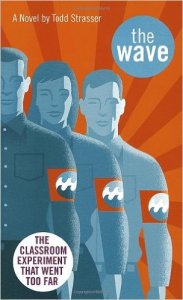 talk, too. The book is based on the true story of California history teacher Ron Jones’ social experiment. (He’s been renamed Ben Ross in this book.) The year was 1969 and Ross had just shown his senior class a film about the Holocaust. When one of his students asked how the Germans could have just sat back and let the Nazis do what they did, Ross tried to think of a way he could illustrate the power of a fascist movement. He came up with “The Wave” and began to teach his students about discipline, community and action. Although the experiment was meant to be short-lived, it grew to include a salute, slogans and even a secret police force before it was finally dismantled due to complaints from parents and colleagues.
 A teenage girl wanders out of a field, her feet “bare and bloodied” tugging at the “garbage bag she’d refashioned as a poncho.” She doesn’t know who she is or where she is. It turns out she’s Annaliese, missing and presumed dead for the past year.
 The Ludic Reader