The Splendor Falls – Rosemary Clement-Moore

splendorClement-Moore’s novel, The Splendor Falls, contains several recognizable gothic characteristics including an atmosphere of mystery and suspense, an ancient prophecy, a heroine who experiences visions, and supernatural events (there’s ghosts galore). Sadly, the book is too long and too slow to add up to much that would be considered frightening.

Seventeen-year-old Sylvie Davis is the “youngest-ever principal dancer for the American ballet” when she suffers a freak accident which ends her dancing career forever. Dancing is all Sylvie has ever known and the fact that she no longer can sends her into a tailspin of depression which is completely understandable. What is not understandable, however, is the fact that she starts to see things that she can’t explain. She starts to doubt her sanity and her mother, who has recently married a psychiatrist, decides to send her to her deceased father’s ancestral home in Alabama.

Sylvie and her purse dog, Gigi, arrive at Bluestone Hill, a plantation house which is currently being restored by her father’s cousin, Paula. It won’t take long for the reader to recognize the bit-players: the snotty daughter of Paula’s business partner, Clara; the golden-boy president of the Teen Council, Shawn; the mysterious and handsome, Rhys.

Sylvie is petulant about her circumstances. She doesn’t really know, Paula, and knows even less about her father’s childhood. It seems, though, that everyone in the small town knows her family. To make matters worse – she starts seeing things and hearing things.  The reader, by rights, should be creeped out right along with her. I can’t quite figure out why I wasn’t.

The Splendor Falls’ biggest problem is, I think, with pacing. At just over 500 pages, there just weren’t enough thrills and chills to keep the pages turning. The novel’s denouement, when it comes, doesn’t really live up to its potential.

I’d been really looking forward to this book. I loved the title and the cover and the promise of things that go bump in the night, but at the end of the day the book was more whimper than bang.

Totally Joe – James Howe

totally joeWhen Joe Bunch is given an ‘alphabiography’ as a seventh grade English project he thinks it’s lame. Joe’s teacher, Mr. Daly wants students to write about themselves from A-Z and that’s all well and good, except as Joe writes “I’m not exactly your average Joe.” But that, as it turns out, is just one of the many charms of Totally Joe by James Howe.

Howe is a prolific writer; he’s written over 70 books including the Bunnicula series. Totally Joe is also part of a series, The Misfits. Anyone who has read that book will be familiar with Joe and his friends, Addie, Skeezie, and Bobby, but you don’t need to have read it to fully appreciate Totally Joe.

It won’t take the reader very long to figure out that Joe is gay. When he meets Addie for the first time she says: “I thought you were supposed to be a boy. Why are you wearing a dress?” They were four at the time and have been fast friends ever since.

Joe is totally self-aware. It’s one of the pleasure of Totally Joe, really, that he is a person who understands and accepts himself. That doesn’t mean he’s not susceptible to the taunts of others. For instance, Kevin Hennessey who has “an IQ smaller than his neck size” has been picking on Joe forever.

“I’m not calling you a name, faggot, I’m calling you a girl, which you are.”

Somehow, though, despite the name-calling, Joe manages to rise above and he does this with the help of his parents (who are pretty awesome), his aunt Pam and even his older brother, Jeff whom despite being a “total guy-guy who’s all “yo” and “dude” and grabbing at his crotch and belching” is still decent.

Totally Joe is aimed at a 12-14 year-old audience and if Joe does, at times, sound way more mature than the average teenager it’s pretty easy to cut him some slack. He’s had time to settle into himself and he’s smart. The novel manages to be both funny and affirming and Joe even manages some sympathy for the mostly undeserving Kevin Hennessey. It would be a great middle school novel to generate discussion about what it means to be yourself, be a friend and the positive outcome of standing up to the bullies. I really liked it.


The Raft – S. A. Bodeen

raft Robie, the fifteen-year-old protagonist of S.A. Bodeen’s YA novel The Raft has been back and forth between Hawaii and the island of Midway dozens of times. She lives there with her research scientists parents, but when the novel opens she’s visiting her aunt in Honolulu. When her aunt is unexpectedly called to work on the mainland, Robie isn’t bothered about being alone. She’s used to it and knows how to look after herself.

Looking after yourself on 2.4 sqaure miles of island, as it turns out, is different from looking after yourself in downtown Honolulu. Unfortunately Robie gets accosted on the street one evening – nothing serious – but it spooks her and she decides to take the cargo plane home. Unfortunately phone and Internet service is spotty on the island and so Robie isn’t able to let her parents know she is coming home. Even more unexpectedly, the plane hits bad weather and goes down. Only Robie and the co-pilot, Max, survive.

This novel is terrific. Like, couldn’t-put-it-down terrific. Robie is resilient and smart and is able to cope with her circumstances better than people twice her age. The raft she floats in leaks, there are sharks in the water – and not much else. It’s impossible to imagine that Robie will make it, but she does.

I don’t want to say too much about the things Robie endures. Once you start reading The Raft you’ll find out pretty quickly because you won’t be able to stop turning the pages. I should also mention that Bodeen slips some compelling stuff about ocean and bird life, conservation and pollution into the mix and it all feels necessary and organic. Robie is at home in this environment and knows “more about ocean fish and seabirds than most post-graduate researchers.” It’s a good thing, too.

Bodeen’s prose is straightforward and Robie’s voice is authentic. In a moment of prescience she remarks: “Lately it seemed there were a lot more days when my life felt less  like luck and way more like suck.”

I’m not one for survival stories, really, but I enjoyed Robie’s tremendously.

Highly recommended.


The Worst Thing She Ever Did – Alice Kuipers

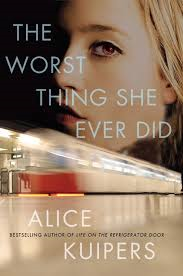
worstthing Sophie releases the details of the worst thing she ever did through journal entries and this turns out to be a blessing and a curse in Alice Kuiper’s second YA novel, The Worst Thing She Ever Did. It’s a blessing because we get to hear Sophie’s authentic teenage voice and a curse for the same reason. Teenagers are, by definition, insular and of course no where is this made more apparent than in the pages of a teenager’s diary.

Sophie is keeping this journal at the request of her therapist, Lynda, who tells her that “Writing in here will help you remember.” Sophie doesn’t want to remember, though, and The Worst Thing She Ever Did  takes its own sweet time revealing what it is Sophie is so desperately trying to forget. I’m not suggesting that Sophie’s tragedy is not worth the effort, just that Sophie often teeters on the edge of coming across more like a petulant child than the survivor of a horrific act of violence.

But maybe that is part of what would make this story so compelling to young adults. I think they will recognize themselves in the pages of Kuiper’s novel. Here is a girl who is living her life. Her sister, Emily, is home from art school and Sophie doesn’t varnish their sibling relationship. Sometimes Emily really pisses her off. Sometimes Sophie feels like Emily is the favourite child. Mostly though, Sophie misses her older sister and it is clear that something horrible and unspeakable has happened.

Sophie’s mother is coping with the loss as badly as Sophie is, but the two of them don’t talk about it. In fact, sometimes they “circled each other like cats.” Sophie pretends not to hear her mother crying. There is no joy in the house they share.

There’s no joy for Sophie at school, either. Everything is different. “Everything going on around me – the others, the noise, the ring of the bell to get to class – was so loud it gave me a headache.” Sophie’s best friend, Abigail, has moved on.  Sophie tries to navigate the aftermath of the tragedy (which is only alluded to until almost the end of the novel) and work her way through being a teenager with varying degrees of success. There’s school to contend with and fractured friendships and boys – one boy in particular – and her mother. All of these elements would have been enough for a YA novel and a half, but Kuipers ups the ante here.

If some of the reconciliations seem a tad trite at the novel’s end (I wasn’t really fussy about the subplot concerning Abigail), they don’t really detract from the story’s larger theme: healing takes time. Kuiper’s is a lovely writer and although my feelings about The Worst Thing She Ever Did are similar to my feelings about 40 Things I Want To Tell You, I still think Kuipers is worth checking out.


Breathless – Jessica Warman

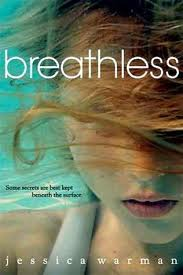
breathlessA few months back I read Jessica Warman’s novel, Between, and although I didn’t love it straight off it definitely grew on me. A student in my writing class saw Breathless on my bookshelf and told me that I had to read it next. All I can say is that I kept reading for her because there’s really nothing to recommend this book.
Breathless was written when Warman herself was just out of high school and sadly, that’s how it reads. The novel is apparently semi-autobiographical and tells the story of Katie Kitrell, a fifteen-year-old championship swimmer with an alcoholic mother, workaholic father and psychopathic older brother.  When her brother, Will, goes off the deep end again, Katie’s parents make the decision to send her off to boarding school. Breathless ends up cramming every possible teenage trope into its 331 pages: friendship, drinking, religion, sex, drugs, wealth, first love, jealousy, mean girls and damaged girls etc etc.

The characterization is all over the place, too. At the beginning of the novel Katie seems to almost idolize her brother. They spend hours on the roof of their house smoking and talking, but Katie can always sense “his emotional axis shifting a little, off-kilter. It’s something I’ve come to call privately the kaleidoscope pf crazy- shimmering and beautiful in certain lights, paisley and horrifying in others.”

Her parents seem unable to cope. Her father, a doctor, just works more and her mother paints and drinks. In no way is Katie’s family functional.

Once she goes off to school the focus shifts away from her family and we are forced to endure 1) the bitchy pretty girl with whom everyone wants to be friends and her 2) nice but kowtowing friend and 3) Katie’s MIA roommate who suddenly shows up but barely says a word and 4) the most perfect boy in the world who just happens to fall in love with Katie.

Nothing happens, though. This is a coming-of-age story and there are some lovely moments here (it’s clear that Warman has talent) but Breathless  is in desperate need of an editor. It’s biceps not bicep and the glaring error in this sentence almost made me shut the book for good “…all of our hands, white gloves pulled taught  and flawless over out fingers-” Who is editing books these days anyway?

Warman clearly had a story to tell and even at a young age, she had the ability to tell it, but the novel’s uneven characterization and bloodless plot made this a miss for me.

Keep Holding On – Susane Colasanti

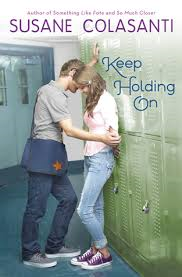
keepholdingonNoelle, the narrator of Susane Colasant’s YA novel Keep Holding On,  is just trying to make it through high school so that she can get the hell out of Dodge. (Dodge isn’t actually the name of the town where she lives; Noelle actually calls it “Middle of Nowhere, USA.” ) Every day Noelle wishes she could “be transported to another school in an alternate universe where required learning doesn’t have to involve this traumatic test of survival skills.” Noelle doesn’t stand out, not really, but nevertheless she’s an outsider. Mostly she’s a target because she’s poor; her lunch and clothes are often cause for ridicule. There’s also some stuff following her from her middle school days – a misunderstanding that was blown out of proportion and hangs over her like a dark cloud. The biggest problem in Noelle’s life, besides the jerks at her school who make her life miserable, is her mother.

This one time last year, she came home really late and woke me up when she slammed the front door. Then she whipped my door open. I could see her glaring at me, the light from the hall illuminating the hate in her eyes. She didn’t say anything. She just slammed my door.

Noelle’s mom isn’t abusive per se, but she is neglectful. Noelle can’t remember a time when her mother really looked at her, but it’s certainly been since her stepfather, her mom’s second husband, died of cancer. This was clearly a traumatic event for mother and daughter and yet it’s hard to feel any empathy for Noelle’s mom; she’s just awful.  “There are plenty of days,” Noelle observes,” when mother says less than ten words to me.” Noelle’s biological father isn’t in the picture at all. Then there’s Matt, the boy Noelle likes who seems to like her back at least enough to make out with her – although the fact that they make out is top-secret. Even though you can see the reason for Matt’s need for secrecy a mile away, it still a believable situation for Noelle. Keep Holding On treads familiar teen ground, but the book separates itself from the pack in part because Noelle is immensely sympathetic. She wants, more than anything, to fit in, but what she eventually figures out is that fitting in isn’t nearly as important as finding your own place to belong.

Friends with Boys – Faith Erin Hicks

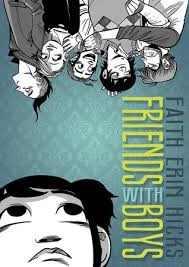
friends I didn’t know that the author and illustrator of the graphic novel Friends with Boys, Faith Erin Hicks, was  from Halifax until I finished the book. I am not going to let the fact that we are practically neighbours (well, by Canadian standards we actually are!) influence my thoughts about Friends with Boys.

…which overall I liked (although I am by no means an authority on graphic novels and have really only started to read them in any number since I started building my classroom library.) I did feel the novel missed some great opportunities and had some structural problems – but, yeah, liked it.

So, Maggie is starting grade nine. This is a pretty big deal because she has been homeschooled her whole life. She’s super nervous about it. When her dad asks how she’s feeling she says  “It’s only my first day of high school. Nothing to be nervous about. I’m not nervous. I’m not.”

Maggie’s three older brothers, twins Lloyd and Zander and Daniel have already made the transition to high school and as Daniel admits to Maggie, he likes being at school better than learning at home. Of course he’s been there a few years, and is well-known and liked.

School isn’t the only thing complicating Maggie’s life – her mother has left home. Her father says “It’s exactly seventeen years since your mom started homeschooling you lot,” to which her brother Zander replies “Yeah and to celebrate she took off.” There is all sorts of unspoken angst in this situation, which is never satisfactorily dealt with.

And she has a ghost. An actual ghost that she met when she was a kid and whom occasionally follows her around. We never quite find out what the deal is there, either.

Then there’s Lucy and Alistair, the brother and sister who befriend Maggie.  At least we learn why Alistair is a social piranha.

That’s a lot of stuff on the plate of a fourteen-year-old and any of it would could have made a rich and compelling story on its own. I was intrigued by the ghost, loved Maggie’s older siblings and wondered what had happened to the mom. Ultimately, though, I felt like Hicks only scratched the surface of all these stories.


Miss Peregrine’s Home For Peculiar Children – Ransom Riggs

peregrineMiss Peregrine’s Home for Peculiar Children by Ransom Riggs is the  unusual story of fifteen-year-old Jake Portman who travels to Wales to find out the truth about his much-loved grandfather.

Growing up, Grandpa Portman was the most fascinating person I knew. He had lived in an orphanage, fought in wars, crossed oceans by steamship and deserts on horseback, performed in circuses, knew everything about guns and self-defense and surviving in the wilderness, and spoke at least three languages that weren’t English.

I had a grandfather like that. Well, at least to me, he seemed like the most exotic person ever. When I was a kid, I believed he’d been to every single country in the world. He’d been a Chief Petty Officer with the Royal Navy in the war and then worked on the tugs with the Coast Guard. He knew sea shanties and dirty jokes (which he only ever told to my brothers) and had tattoos on his arms back when they meant something. I loved being in his company.

Jacob’s grandfather had been born in Poland but shipped to Wales when he was twelve because “the monsters were after him. Poland was simply rotten with them.” It seems obvious that Mr. Portman is talking about the Nazis, and he is – but there are other monsters lurking. In Wales, he comes under the care of Miss Peregrine, a most unusual woman – as it turns out – who was also responsible for the children in Grandpa Portman’s fabulous stories. These children could do amazing things: fly, make fire, turn invisible. Grandpa Portman even had pictures of some of them. These pictures, many of which are included in the book, create a degree verisimilitude for the narrative. (The pictures have actually been culled from private collections)

miss-2But then something horrible happens to Grandpa Portman and Jacob is intent on finding the answers to many of the questions his grandfather leaves behind so he convinces his father to take him to Cairnholm Island, off the coast of Wales.

Nothing could have prepared Jake for what he finds there. The island is caught in time and Jake soon finds himself believing in things he never really thought possible. Miss Peregrine’s Home for Peculiar Children is a coming-of-age tale, an adventure, a love-story. It’s sad and funny and creepy. And as an allegory for the horrors of  the Holocaust – it works very well indeed.

Tim Burton is directing a movie version of this novel – can’t think of anyone better to capture the novel’s strange and wonderful story.


Where Things Come Back – John Corey Whaley

wherethingsThe members of the English department at my school decided before Christmas that it might be fun to have a book club to look specifically at Young Adult fiction. There’s so much great fiction for teens…and this will be a no-pressure way to look at some of the titles.

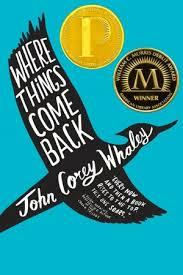
Last night I hosted the first meeting where we discussed John Corey Whaley’s much-lauded debut novel Where Things Come Back. Seriously, this book has won several prizes including two of the biggest: Michael L. Printz and William C. Morris. I’ve learned that prize winners don’t always live up to the hype and I am sad to say that I’d put this book in that category.

It started off okay.

I was seventeen years old when I saw my first dead body. It wasn’t my cousin Oslo’s. It was a woman who looked to have been around fifty or at least in her late forties. She didn’t have any visible bullet holes or scratches, cuts or bruises, so I assumed that she had just died of some disease or something; her body barely hidden by the thin white sheet as it awaited its placement in the lockers. The second dead body I ever saw was my cousin Oslo’s

Intriguing enough. And the character’s voice was distinct and I was interested. But to say that Where Things Come Back fulfilled its early promise would be a lie. And my fellow teachers agreed; not a single one of them liked it either.

The first question I asked at last night’s gathering was whether or not we should hold YA  to the same rigorous standards we hold other literature to. And the answer is – of course. As a teacher I want my students to read the really, really good stuff, but I also know that often times they will read stuff that is below my lofty standards. Geesh – I often read stuff that is below my lofty standards! I have many books on the shelves in my classroom that are just…yuck. But someone will read those books and love them and as long as they are reading I feel like they are walking that path towards better literature.

Once we determined that no one liked the novel, we set about trying to determine why.

“Fiction is driven by character,” said Karen. (Karen is a colleague and has also been one of my dearest friends for the past 30-odd years. Our philosophies are quite similar when it comes to teaching and reading.) “I just didn’t like any of the characters in this book.”

Other teachers had problems with the novel’s narrative structure.

And who cares about the woodpecker? None of us.

Where Things Come Back  is mostly Cullen  Witter’s story. He lives with his parents and younger brother, Gabriel, in Lily, Arkansas. Lily is a backwater little town where nothing ever happens. One day Gabriel just vanishes.  Where Things Come Back is also, superficially at least, the story of Benton Sage, a teenager doing missionary work in Ethiopia who suddenly has a crisis of faith. How Cullen and Benton’s stories connect finally becomes apparent in the novel’s final pages – but by then I didn’t care. And that’s a failing of two things: character and telling. So much of this story is told to the reader.

Perhaps there was just too much story to handle. Cullen’s journey after Gabriel’s disappearance might have made for some riveting reading.  Benton’s story, too, had potential. But the clunky denouement tipped over into melodrama that didn’t serve either character, really.

One teacher had a student who read this book and loved it and I will happily add it to my classroom bookshelf – but I won’t be rushing to recommend it.


You Against Me – Jenny Downham

youagainstmeI read Jenny Downham’s first novel Before I Die a few years ago and I really like it a lot. I liked You Against Me, too. Downham certainly isn’t afraid to tackle the big stuff.

Eighteen-year-old Mikey McKenzie’s life is far from perfect. His mother is an alcoholic and he has two younger sisters, Karyn, 15, and Holly, 8, for whom he is responsible. He’s doing the best he can, but he’s all too aware that sometimes it’s just not good enough. Especially now. Karyn was recently raped while at a party and she now won’t leave the house. Mikey figures he can make everything right again if he beats the crap out of the guy who did it, Tom Parker. He and his best friend, Jacko, come up with a plan but everyone knows nothing ever goes to plan.

Sixteen-year-old Ellie Parker is every bit as anxious as her parents for her older brother Tom’s homecoming. He’s spent the last couple of weeks detained after having been accused of rape, but now he’s coming home to await the trial. Ellie’s her brother’s star witness; she was home the night Tom brought a bunch of friends back from the pub, Karyn included.  She’s already told the police that she didn’t hear or see anything much and her parents are convinced that Tom will be found not guilty.

And this might have been nothing more than a he said – she said YA novel except that Mikey and Ellie meet and discover…they like each other. Of course it’s more complicated than that, but once the wires are uncrossed and trust has been earned, Ellie and Mikey really do genuinely fall in love.

Downham does a good job of balancing the story of Ellie and Mikey  with everything else that’s going on including Ellie’s doubts about her brother’s innocence, Mikey’s concern for his sisters and frustration with his mother’s lack of responsibility. The novel moves pretty quickly, allowing the reader plenty of time with both Ellie and Mikey so we get a real sense of who they are and how they’re coping with their complicated circumstances. What started as one thing quickly becomes something else for both of them and as Mikey says to Jacko

When I first saw Ellie, I knew it was her – she was my fantasy. I didn’t want it to be true, but every time I met her it was obvious, and the funny thing was that she was better than the fantasy, like I got more stuff than I’d imagined.

You Against Me is about family and friendship and making choices that have far-reaching consequences. Downham offers careful readers lots to think about and has created two young people worth rooting for.