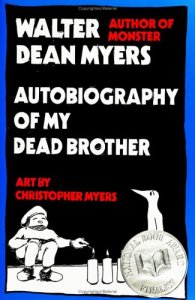
Autobiography of My Dead Brother – Walter Dean Myers

Image

9780060582913-LWhile this wasn’t a book I particularly enjoyed, I absolutely see its merits. Autobiography of My Dead Brother is the story of 15-year-old Jesse who grows up in a violent New York neighbourhood.  He’s smart, talented and although he’s got all the typical teenage issues – he’s not going to make decisions which adversely impact his life.

His best friend is Rise. Rise is seventeen and he and Jesse have been friends since they were little.

His mother likes to tell me that when Rise first saw me, he was scared of me. She said they had a puppy and a turtle and he liked to play with them both, but when he saw me he started crying.

I didn’t remember any of that, but me and Rise grew up to be really close. He was more than my best friend – he was really like a brother.

Myers’ novel opens, Jesse and his friend C.J. are at the funeral of their friend, Bobby, who has been killed in a drive-by shooting. While Jesse and Bobby are horrified by the event because, after all, Bobby wasn’t doing anything, just sitting on his stoop, Rise thinks Bobby “went out like a man.” It’s an early indication that Jesse and Rise might be heading in two different directions.

Rise wants Jesse, an artist, to draw his autobiography and so the reader starts to see Rise through Jesse’s very focused lens. We see his “funny way of walking, with one shoulder higher than the other”; we see Rise’s home life (he lives with his mom and aging maternal grandparents); we see Jesse start to feel the troubling disconnect between him and Rise.

Myers also captures the adults in this book very well. None of these kids come from uncaring families. While some come from single parent households, all the parents work and care and even the police are painted as fair and reasonable human beings. But there still manages to be trouble for Jesse and his friends.

The book is interesting; the drawings are great (done by Christopher Myers, the author’s brother) and Myers certainly writes authentically about the experience of  – in this case – African American kids who just happen to live in a neighbourhood where crappy things happen. Ultimately though, this is a story about the friendship between two kids which unravels over time.

I know a lot of boys would really enjoy it.
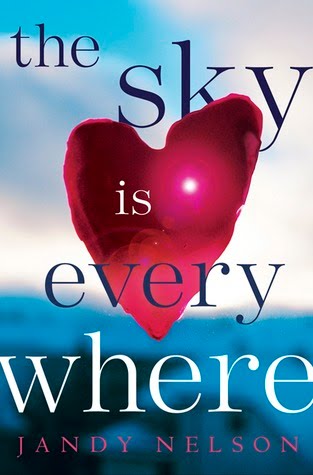
The Sky is Everywhere – Jandy Nelson

The Sky is EverywhereJandy Nelson has written a debut novel which will resonate with anyone who has ever lost someone they’ve truly loved.  The Sky is Everywhere is seventeen-year-old Lennie Walker’s journey through the grief of losing her nineteen-year-old sister.

My sister Bailey collapsed one month ago from a fatal arrhythmia while in rehearsal for a local production of Romeo & Juliet. It’s as if someone vacuumed up the horizon while we were looking the other way.

The loss of her sister isn’t the first significant loss of Lennie’s young life. She lives with her grandmother and her uncle ‘Big’ (yes, he is indeed) because her mother abandoned her and her sister when Lennie was only one. Despite the fact that Gram and Big are awesome, Lennie is finding it difficult to cope. Lucky for her, Bailey’s boyfriend, Toby, is on hand to share her grief.

“How will we do this? I say under my breath. “Day after day after day without her…”

“Oh, Len.” he turns to me, smooths the hair around my face with his hand.

I look into his sorrowful eyes and he into mine, and I think, He misses her as much as I do, and that’s when he kisses me –

There isn’t a thing I didn’t love about Lennie. She’s lived, thus far, in her sister’s shadow; Bailey was the outgoing, beautiful one.  Now, suddenly, Bailey is gone and Lennie is lost. Perhaps that’s what makes Toby so desirable. They can share their grief, but also their memories of someone they both loved.

But, then it gets complicated.

“Even in the stun of grief, my eyes roam from the black boots, up the miles of legs covered in denim, over the endless torso, and finally settle on a face so animated I wonder if I’ve interrupted a conversation between him and my music stand.

Meet Joe Fontaine, the “gypsy,” “rock star,” “pirate,” who arrived at school while Lennie was away. Suddenly Lennie finds herself in a precarious predicament: she is  impossibly drawn to Toby even as she crushes hard on Joe. Those feelings are compounded by her guilt because she’s supposed to be sad. And she is.

Make no mistake, The Sky is Everywhere is not a romantic comedy; it’s a beautifully written novel about loss, about being left behind and about what it means to be alive. All the characters are fully realized; even the adults have interior lives, a fact Lennie only begins to understand months after her sister’s death. She also comes to understand that grief is a living thing. Lennie thinks, “I don’t know how the heart withstands it.”

I’m not a fan of eReaders, but I can’t imagine reading this book on one would offer as satisfying an experience as reading the book the traditional way. The novel is filled with poetry written on scraps of paper and found in various places which are named on the back of the found object.  How they came to be collected is revealed at the end of the story. The poetry itself is beautiful (Nelson herself is a poet) and I loved its inclusion in the book.

This is a novel I will really look forward to passing on to and talking about with my students.

You – Charles Benoit

youKyle Chase, the 15-year-old protagonist of Charles Benoit’s novel You, isn’t much different from a lot of boys his age. He doesn’t get along with his parents, he’s crazy about a girl who just thinks of him as a buddy and he has a habit of getting into trouble.

Every day you get up, go to school, fake your way through your classes, come home, get hounded about your homework, go online, fake your way through your homework, go to bed – and the next day you get to do it all over again.

This is Kyle’s life. He’s not a bad kid, really. He’s not particularly motivated, but he’s also not as dumb as he pretends to be. Still, his life isn’t really going anywhere…and then Zack arrives.

Zack is clever and charismatic and suddenly Kyle finds himself doing things he never imagined he’d be doing. In some ways, on the surface at least, it would seem that Zack is looking out for Kyle. It turns out, though, that there is nothing magnanimous about Zack at all. Kyle (you) moves through his days in a sort of  anesthetized daze, a sort of listless funk that will perhaps be familiar to teens. When Zack starts to shake things up, at first seemingly benignly, the reader might get the impression that Kyle will make something of himself. Zack is nobody’s friend, however.

Charles Benoit has chosen to write You in the second person, a point of view that will likely be unfamiliar to many young readers unless they are exceptionally well-read. Let’s face it, not many novels are written in the second person. It’s a distancing point of view, somehow, but it serves this story very well because it drops the reader into Kyle’s skin.

When Kyle’s association with Zack starts to spin out of control, the reader knows it will end badly because of the book’s opening line: “You’re surprised at all of the blood.”

You is an ALA Quick Pick for Reluctant Young Adult Readers and I suspect many readers would find the book enjoyable..

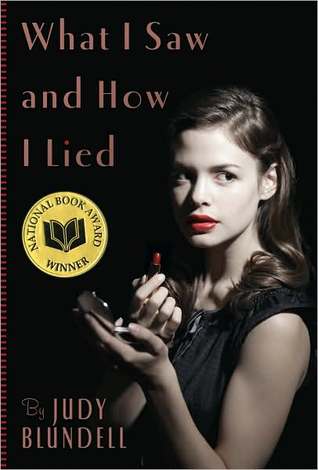
What I Saw and How I Lied – Judy Blundell

liedJudy Blundell’s YA novel What I Saw and How I Lied won the National Book Award and was named a best book by both the School Library Journal and the ALA (American Library Association). The accolades are well-deserved. This novel offers a glimpse into another time and another world and makes a nice change from reading all the dystopian and fantasy novels crowding the shelves these days.

Fifteen-year-old Evie lives with her beautiful mother, Bev, and her step-father Joe, a  veteran of World War 2,  and Joe’s mother Grandma Glad in Queens, New York. It is 1947. Things have been different since Joe returned from the war. Evie remembers a man who “made walking look like dancing…had a special greeting for everyone on the block.”  The post war Joe was different.

It was the war. You couldn’t ask him about it. You didn’t want to remind him. What every wife and daughter could give was a happy home. That was our job.

One night, out of the blue, Joe announces that he is taking Bev and Evie on vacation to Palm Beach, Florida. he makes the holiday sound so glamorous, but when they arrive it is to discover that Palm Beach is practically a ghost town, “the rest of the hotels didn’t even open until December. All of the stores on Worth Avenue, Palm Beach’s main drag, were closed. The Paramount Theatre was closed.”

Into this strangely other-worldly cotton-candy coloured world walks Peter Coleridge.

…I saw him under the moon. My breath stopped. He was not just handsome, he was movie-star handsome. Dark blond hair, a straight nose. A hunk of heaven

Peter turns Evie`s world upside down and creates a strange friction between her parents that she does not  quite understand. Not that she cares too much. Peter is older and more sophisticated and despite his mixed signals, Evie begins to take those first tentative steps towards adulthood.

As a coming-of-age story, What I Saw and How I Lied works quite well. It is definitely evocative of  another time and place. Once she realizes what is waiting for her on the other side of childhood, Evie is desperate to grow up. But there is a price to pay. This would be a great book for careful readers. It`s not action-packed, but it is well-written and thoughtful. When Evie and her parents finally return from their holiday, Evie`s life has been  altered. The line between innocence and experience has been crossed and for Evie at least, a terrible price has been paid.

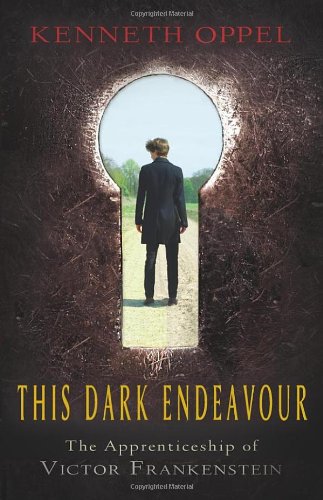
The Dark Endeavour – Kenneth Oppel

oppelKenneth Oppel’s novel This Dark Endeavour was a finalist for Canada’s Governor General’s Literary Awards and it’s no wonder. It’s a terrific book. We’ve been talking about it at school recently as several of my colleagues have read it and think it would make a great addition to the classroom. I agree. The language of the novel is almost old-fashioned, but the action will appeal to boys and the elements of romance will appeal to girls (or vice-versa) making This Dark Endeavour the perfect gateway drug to introduce students to classic novels like, well, Frankenstein.

Sixteen – year – old Victor Frankstein lives with his twin brother, Konrad, younger siblings and parents in a chateau in Bellerive on Lake Geneva. They also share their home with their cousin, Elizabeth. Their friend Henry also spends a great deal of time at the chateau. They four teenagers spend their time riding, boating, studying and exploring the centuries old chateau.

One day, the foursome discover a narrow passage behind a bookshelf and upon further investigation, a door with the greeting “enter only with a friend’s welcome.”  Upon gaining entry, they find “tables scattered with oddly shaped glassware and metal instruments – and row upon row of shelves groaning with thick tomes.”

When the young people are discovered by Konrad and Victor’s father he says, “You’ve discovered the Biblioteka Obscura I see.” Mr. Frankenstein is a local magistrate, a powerful and intelligent man who encourages his children’s intellectual pursuits but is none too happy about their discovery of this Dark Library.

You must understand that these books were written centuries ago. They are primitive attempts to explain the world. There are some shards of learning in them, but compared to our modern knowledge they are like childish dreams….This is not knowledge….It is a corruption of knowledge and these books are not to be read.

But when Konrad falls seriously ill, Victor returns to the Dark Library looking for a cure and This Dark Endeavour ramps up the fun.  Victor, Elizabeth and Henry try to  gather the ingredients for the Elixir of Life in the hopes that its mystical properties will restore Konrad’s good health and their quest is what propels the plot forward. It’s exciting and dangerous work, but Victor is a character readers will easily root for – even though he is hot-tempered and sometimes struggles to do the right thing – especially where it concerns Elizabeth.

Careful readers will spot some of the literary shout-outs embedded in the novel. For example, Victor seeks the help of Dr. Polidori who was, in fact, a real physician and writer ( 1795 – 1821), consort of Lord Byron and credited with writing the first vampire story, “The Vampyre.” Dr. Polidori lives on Wollstonekraft Alley. Fans of Mary Shelley’s novel Frankenstein might recognize Wollstonekraft as Shelley’s mother’s name. Wollstonekraft  (1759 – 1797) was a writer and feminist, well-known for her work A Vindication of the Rights of Women. It’s references like these which would make This Dark Endeavour such a great book for the classroom.

See You at Harry’s – Jo Knowles

seeyouh

I spend as much time reading about YA fiction as I do reading the books, it seems; I am always adding new titles to my list and often the same book will be recommended time and time again. That was the case with Jo Knowles’ book See You at Harry’s. It was waiting in my mailbox at school today – I’d ordered it from Scholastic before the March Break. I started reading it during my third period Grade Ten English class and just finished it a few minutes ago.

The happiest day of  Fern’s life was the day she “threw up four times and had a fever of 103 degrees.” It’s a day lodged in Fern’s (yes, she’s named after the little girl in Charlotte’s Web) memory because it’s the day she didn’t have to share her mother with her two older siblings Sarah and Holden (yes, he’s named after that Holden).

That day at home, my mom spent every minute with me. My older sister and brother were at school, and my dad was working at my parents’ restaurant. I was eight and had never been home alone with just my mom before, at least not all day and definitely not with her full attention.

Shortly after Fern’s recovery, her mom discovers she’s pregnant and instead of being the youngest, Fern suddenly has to contend with a new baby brother, Charlie.

When See You at Harry’s begins, Fern is twelve. Her sister is eighteen, Holden is fourteen and Charlie is three. Her world is chaotic because her family is chaotic…and while Fern might not always get the attention she craves, in that self-centered way all twelve-year-old’s crave attention, she is by no means neglected. She shares a close sibling bond with Holden and there is much to admire in their relationship. Things are little more complicated with Sarah and there’s Charlie.

“I wanna go to school,” he says.

“School is overrated.”

“Huh?”

“Look. All little kids want to go to school. And kindergarten is pretty great. But it just goes downhill from there.”

“Oh.”

“Enjoy your freedom, bud.”

Fern knows what she’s talking about, too. She’s just starting seventh grade and it starts to go downhill on day one. I think a lot of middle school kids will see themselves in Fern. She is, as her mother once told her, “a special soul.”

Fern’s parents run the family restaurant. Her mom is a little on the flaky side and her dad is always coming up with crazy  and embarrassing schemes to improve the business. In all the ways that matter, though,  this is a nuclear family. They aren’t perfect, but they are real. They’re distracted and selfish and  human and fragile.  It takes a  terrible  tragedy to  fill up their empty places.

While this book might not appeal to some of my  students (it is geared for middle school readers, after all), I think many of them will be quite moved by Fern’s family’s story. I was.


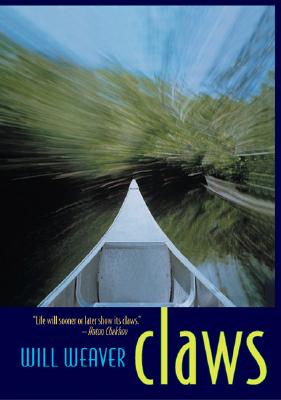
Claws – Will Weaver

Claws-9780060094751There’s something for everyone in Will Weaver’s YA novel, Claws, but that might have been part of the reason I didn’t love this book. Is Claws a family drama, a suspense thriller, an adventure novel?

Jed Berg is sixteen. He lives with his parents, Gary and Andrea, who are successful (a freelance house designer and lawyer respectively) and according to Jed, “the most successful couple [he] can think of.” Sometimes Gary even lets Jed drive his mint 1969 Camaro. Jed is a good student, a better- than – average tennis player and goes out with Cassie, a popular and pretty senior. Life is good. Until it’s not.

Weaver admits that he “set out to write an unremittingly sad novel.” Partial to a quote by Chekhov which states that “life will sooner or later show its claws,” Weaver endeavors to unravel Jed’s surprisingly uncomplicated teenage life. He says: “I essentially wrote the novel around that idea (of life tipping upside-down).”  (from the author’s website)

And Weaver isn’t lying. Crap starts heading towards Jed at a rapid rate starting with Gertrude, a surly pink-haired girl who has evidence that Jed’s father is having an affair with her mother. Unsure of how to handle this new information, Jed tries to figure out whether or not he has a clear picture of his parent’s marriage. But then, Weaver throws the reader another twist: Gertrude isn’t being exactly honest about her identity. And then when all the infidelity cards have been played, Jed finds his own life going off the rails in ways that are both realistic and, perhaps, slightly melodramatic.

I have to give Weaver props; I kept turning the pages. Jed was likeable and intelligent. His parents and older sisters were sketched in, though,  and so it wasn’t easy to see things from a perspective other than his, but I suppose that’s the point. When you’re a kid, you want to believe that your parents will always be together. I still remember sitting at the top of the stairs with my brother, Tom,  listening to my parents talk about divorce. I was twelve. That’s 40 years ago and I have the clearest memory of it.

I wish Weaver had found another way to show his claws at the end of the book, though. It felt slightly contrived to me, but I suspect that the climax will elicit the desired result from teenage readers. It’s certainly well-written and deserving of its place in my classroom library.

The Geography of Girlhood – Kirsten Smith

girlhoodTurns out The Geography of Girlhood was written by someone who knows a lot about teenage girls – at least in the movies. Kirsten Smith is the co-writer of some classic teen flicks including 10 Things I Hate About You, Ella Enchanted and one of my all-time, never-get-sick-of-it faves She’s the Man. (I can not stress how much I love She’s the Man. I’ve seen it many times and it still makes me laugh I love that I can share it with my students when we study Twelfth Night.)

When The Geography of Girlhood starts, Penny is just fourteen.  Having rowed herself out into the middle of the bay to contemplate her life she thinks: “One day, I’ll find my way away from here/ and go somewhere real/ and do something great/ and be someone wonderful.”

Of course, the problem with being a teenage girl is that there’s a whole lot of crap to wade through before you get that “someone wonderful.” Fourteen, Penny intones, “is like rotten candy.”

The novel, told in free verse form, follows Penny from the end of grade nine until just after her sixteenth birthday.

Penny is jealous of her  perfect, older sister, Tara, her “long torso,/ the breasts lodged high/ like tea cakes/ on her powdery skin.” She longs to experience “love” as she imagines it exists between Tara and Bobby, her sister’s boyfriend. “I look at her/ and memorize everything./ So when the time comes,/ and the boy’s eye glitters like a crime,/ I will know what to do.”  We learn about Penny’s complicated feelings for the mother who left her, who, in fact “always wanted to leave wherever she was.”

Readers will recognize themselves in Penny. While it’s true that fourteen was a L-O-N-G time ago for me, I can totally remember that feeling that  “you look good only once a week/ and it’s never on the day of the dance.”

Penny navigates the treacherous geography of  her girlhood, in language that is both  poignant and pointed.  She falls in and out of love in the way of all teenaged girls. She makes stupid choices and does stupid things, but she is also smart and resilient and open to all the possibilities life has to offer.

“If anyone tells you that life is predictable,/ DO NOT BELIEVE THEM,” she remarks.

I really enjoyed this book.


Wonder – R. J. Palacio

wonder

R. J. Palacio’s debut novel Wonder is wonderful. It tells the story of ten-year-old August (Auggie) Pullman who was born with “a previously unknown type of mandibulofacial dysostosis caused by a autosomal recessive mutation in the TCOF1 gene,” or, in other words, he’s not “normal” looking.  Auggie has already had twenty-seven surgeries in an effort to correct some of the problems, but he has  come to terms with the way he looks. He doesn’t like it, but he accepts it.

August lives with his parents and 14-year-old sister Olivia (Via) in North River Heights, which is located at the very top of Manhattan. His parents have decided to take the very brave step of enrolling August in school for the first time. Until now his mom has been home schooling him. They are all hyper-aware of August’s stare-inducing face, but  his mom and dad also understand that they can’t protect him forever.

Wonder follows August through fifth grade, not only from his point of view, but from the perspective of some of his classmates and his sister, too. One of his new friends, Summer, says:

I sat with him that first day because I felt sorry for him. That’s all. Here he was, this strange-looking kid in a brand-new school. No one was talking to him. Everyone was staring at him. All the girls at my table were whispering about him. He wasn’t the only new kid at Beecher Prep, but he was the only one everyone was talking about. Julian had nicknamed him the Zombie Kid, and that’s what everyone was calling him.

August’s favourite day of the whole year is, you guessed it, Hallowe’en.  He says it’s “the best holiday in the world. It even beats Christmas. I get to dress up in a costume. I get to wear a mask. I get to go around like every other kid with a mask and no one thinks I look weird. Nobody takes a second look. Nobody notices me.” If that doesn’t break your heart, I don’t know what will.

Olivia is also spreading her wings and her fierce love for her brother is  tinged, realistically, with some adolescent id. For example, she doesn’t want her parents to attend a school play because they’ll bring August and she doesn’t want her new high school friends to see him.  Despite understanding the extreme nature of Auggie’s problem  – she would never call it deformity, but there you have it – she is starting to want some of her mother’s very  August – focused attention for herself. Still, she is a good sister.

August is  smart and funny and well-supported by parents who love him and understand that they cannot shield him from life’s cruelty forever. He is beginning to make his way in a world that may not always show him kindness and yet he is so buoyed by the love of his family and the support of friends, one can only imagine that he will be just fine.

If  the ending is perhaps just the teensiest bit instructional, the proffered lesson is one I can get behind. We must be kind to each other. Cynical readers might also argue that Wonder‘s ending is a bit saccharine. I disagree. Instead, I agree with Auggie’s mother when she  tells him: “You really are a wonder.” And so is this book.

A must read.

All Unquiet Things – Anna Jarzab

allunquietthingsAnna Jarzab’s first novel All Unquiet Things is  mature and thoughtful. Kirkus called it “a sophisticated teen mystery.” It’s actually hard to believe that this book is written for young adult readers; its prose, while not exactly sophisticated, is a cut above many other books published for young readers.

It was the end of summer, when the hills were bone dry and brown; the sun beating down and shimmering off the pavement was enough to give you heatstroke. One winter came, Empire Valley would be compensated for months of hot misery with three months of torrential rain, the kind of downpours that make the freeways slick and send cars sliding into one another on ribbons of oil.

All Unquiet Things is the story of Carly, Neily and Audrey, students at Brighton Day School, a prestigious private school outside of San Francisco. Through a series of flashbacks – told from Neily and Audrey’s perspective – we learn about how Carly and Neily’s middle school friendship blossomed into something more, and how the arrival of Carly’s cousin Audrey changed the dynamics of their relationship.

These teenagers are smart, but they also have a lot of other issues including deadbeat or overly demanding parents. Neily’s parents are divorced and according to Neily his father “hadn’t really parented me since I was very young and I tended to get away with most things….” The girls have problems of their own.

So what’s the mystery? Well, Carly’s dead. (Don’t worry – her ghost doesn’t speak.)  Someone shot her four times and the circumstantial evidence points to Audrey’s alcoholic/drug addicted father Enzo, so he’s serving time in jail. Audrey is convinced that her father is innocent and even though her relationship with Neily has been strained by events, she seeks him out to help her try to figure out who really ended her cousin’s life.

Their investigation exposes the slimy underbelly of Brighton’s facade, but also allows the reader a glimpse into the messed up lives of students with too much money and not enough parental involvement. As Neily and Audrey try to figure out what really happened to Carly, they become friends, at first united in their search for the truth but then because they grow to genuinely care for each other.

You can’t really see whodunnit early on, which makes this a perfect read for students who like a page-turner. All Unquiet Things works on another level, too. Neily has to consider how he has been shaped by his love for Carly and how that love, no longer sustainable or attainable, is holding him back from living a fulfilling life. Audrey has to own up to her own part in Carly’s story and come to terms with the fact that her father might not be capable of all she hopes for him.

All in all, a terrific book.