Cora has never liked the name Gordon. The way it starts with a splintering sound that makes her think of cracked boiled sweets, and then ends with a thud like someone slamming down a sportsbag. Gordon. Bu what disturbs her more is that she must now pour the goodness of her son into its mold, hoping he’ll be strong enough to find his own shape within it.
This is Cora’s dilemma after the birth of her second child. She doesn’t want to name the baby after his father, a prominent, beloved doctor who is also a physically and mentally abusive husband. So, on the day that Cora and her daughter Maia, 9, walk to the registry office to officially register the baby’s name, they imagine other names instead of Gordon. Maia is fond of Bear because “It sounds all soft and cuddling and kind.” Cora is partial to Julian, which means “sky father.”
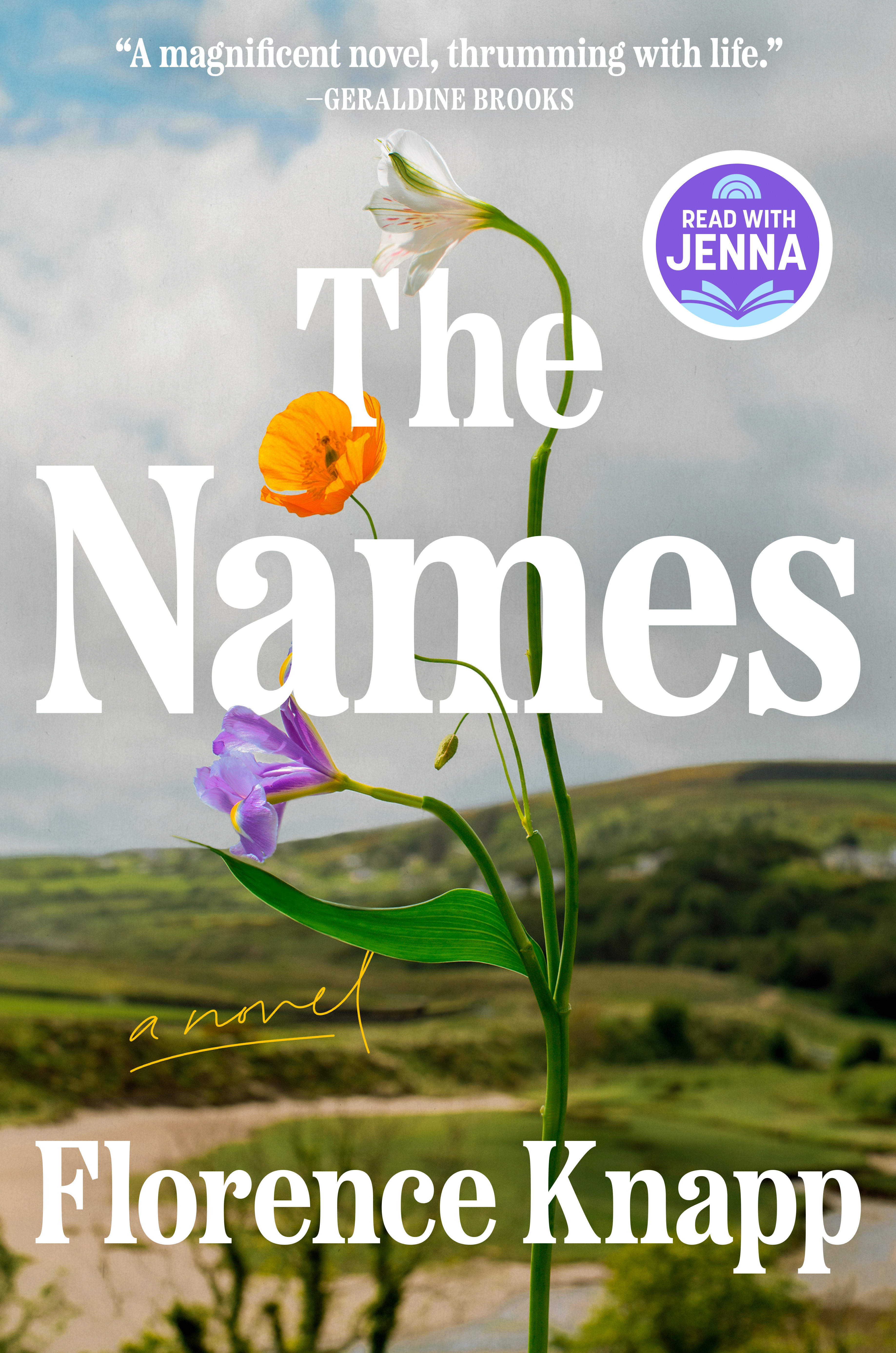
Florence Knapp’s novel The Names imagines the lives of these characters if the baby had been named Bear, Julian or Gordon – skipping forward at seven year intervals for thirty-five years. Who dos this little boy become and how does his name affect the people in his life?
I loved everything about this book, honestly. Although the author has written books previously, The Names is her debut novel and it’s a corker. I loved the glimpses into Bear/Julian/Gordon’s life, loved seeing what things were similar in each iteration an what things were vastly different.
But the novel is not just concerned with his life. We are also privy to Cora’s story, her early courtship with Gordon, her upbringing in Ireland, and what becomes of her in each of these scenarios. Maia, too, gets her story.
What’s in a name? Turns out, quite a lot. Highly recommended.
When Sara and her husband Damien move into their new house in Northern Ireland, she almost immediately begins to feel uneasy. For one thing, there’s a stain on the flagstone in the kitchen that no amount of scrubbing seems to remedy. For another, a strange woman shows up one morning and yells at Sara to get out of her house. As if this weren’t disconcerting enough, Damien is clearly controlling and emotionally abusive and it’s clear that he’s gaslighting Sara.
Stuart Neville’s novel The House of Ashes unspools the story of the horrific history of “The Ashes” (as the house is called) in several different voices. There’s Sara’s, of course, but there are other voices too, including Mary, a little girl who lived at the house sixty years ago, and Esther, another girl who comes to The Ashes. It is clear early on that The Ashes is not a happy place. Mary says
I always lived in the house. I never knew any different. Underneath, in the room down the stairs. In the dark. That’s what I remember most, when we were telt to put the lamps out. They locked the door at the top of the stairs and that was that. Dark until they opened it again. I still don’t like the dark.
Neville’s book is about abuse. Sara’s husband is abusive – the kind of domestic abuse that might be familiar to modern day audiences, abuse that is couched as a love so deep the person just can’t help themselves. The abuse at The Ashes in Mary’s story is something completely different. Mary and Mummy Joy and Mummy Noreen are at the mercy of the Daddies: Ivan, Tam, and George. Although many of the details are spared, your imagination will have no trouble filling in the blanks.
As Sara digs deeper into the dark secrets of The Ashes, she also finds her own voice, and it all makes for a compelling read.
True to my word, after finishing Binding 13I immediately went out to Indigo and purchased Keeping 13 which continues Johnny and Shannon’s story. I headed for the YA section, only to discover that the books were not there. Someone had moved them to the Romance section, which is absolutely where they should be, despite the ages of the main characters.
Keeping 13 is another brick of a book – 651 pages – but I knew what I had signed up for and I ripped through it in just a couple days. When we left our characters at the end of the first book, Shannon’s brother Joey was asking his mother to make a choice, a choice that she seems incapable of making. I won’t say much more about that here because…spoilers…but let’s just say that Keeping 13 starts extremely dramatically.
The main part of this story concerns Johnny and Shannon’s growing feelings for each other, Johnny’s recovery from an injury that happened before the start of the first book, but which hasn’t healed properly, the domestic abuse that is happening in Shannon’s house and which causes the return of the oldest Lynch sibling, Darren, and the requisite trash talk by Johnny’s BFF, Gibsie. Johnny’s ex-girlfriend Bella is also intent on making Shannon’s life miserable.
I read this because I genuinely cared about Johnny and Shannon and when I got to the end of the first book I had to keep going to find out what happened. Obviously at 600+ pages, there were some instances of repetition: a lot of instances where one character or another needs to be reassured (but for reasons that make obvious sense.) There was also a lot more sex in this one because as Johnny and Shannon grow closer and admit their feelings to each other, clearly they are driven by hormones and want to get nekkid. I actually appreciated how respectful Johnny was about Shannon’s innocence and even when he blabbed to Gibsie, I could sort of forgive him for his lack of discretion because he is, after all, still young. I loved Johnny’s parents a lot and I loved how I could hear the Irish lilt in the character’s voices.
There were some truly pulse-pounding moments in this book, too. I read one scene in particular with my heart in my throat. And, of course, lots of swoony moments as these two crazy kids try to figure out themselves, their lives, and their feelings for each other.
I was all in, but with the same caveats: a lot of swearing and a lot of sexist comments made about the girls in the book, still tropey (helpless, fragile girl saved by massive, hulking dreamboat), just way longer than it needed to be.
Now, there are more books in this Boys of Tommen series, but I won’t be carrying on. Nothing against the other characters (all of whom I have met in these first two books, I am guessing), but I feel like I would just be getting more of the same and I am pretty happy with what I got.
If there was a series, though, I would 100% watch it.
Here is something that you may not know about me: I love YA romance way more than I love adult romance. I don’t know why. Maybe it’s because when I was a teenager I was always in love (and out of love and then in love again). Maybe it’s because that’s as far as I ever got on the romantic maturity scale. Whatever the reason, adult romances rarely ever hit for me, but YA often does. (There are exceptions to this rule, of course. I love Talking at Night and The Paper Palace and everything by David Nicholls.)
I am all in for shows like The Summer I Turned Pretty and To All the Boys I Loved Before and Maxton Hall. Books like Perfect Chemistry and Easy and The Do-Over are way more palatable to me than books by Emily Henry (I’ve tried two and DNF either.)
So, that brings me to Binding 13 by Chloe Walsh, a book that I picked up and put down a million times at the bookstore. Then it was recommended by a couple reviewers that I like, and it was on sale, so I bought it. It’s long, just over 600 pages, but I read it in just a couple of days.
Fifteen-year-old Shannon has endured a life time of bullying and not just at school; her father is abusive, too. She lives with her parents, one older brother, Joey, and three younger brothers, on a council estate in Ballylaggin, Ireland. Finally, her mother decides to send her to Tommen, a private school, where she hopes her daughter will be safe from the students who have tormented her her whole life. (She mostly conveniently ignores the fact that her husband is physically abusive, too.)
On the first day of school, while crossing the sports field, Shannon gets hit with a rugby ball, which knocks her down, cracking her head off the ground and causing a mild concussion. This is how she meets Johnny Kavanagh, captain of the rugby team and all around super stud.
Okay, you know how these things go. Girl who doesn’t know how beautiful she is meets boy who totally knows how beautiful he is try to ignore their feelings, can’t, and eventually <<insert 600 pages of Irish slang, rugby talk, longing looks, expletives>>….yeah, apparently I will have to read the gosh darn sequel Keeping 13 to find out what happens – even though, of course, I know what happens.
Although Binding 13 is shelved in the YA section at my local Indigo and even though the main characters are all teenagers, I wouldn’t actually consider this to be YA. And neither, apparently, would the author. On her website, Walsh says “Please note that all of Chloe’s books are intended for mature readers of 18 years and above. Chloe’s self-published work has alwaysbeen categorized as new adult and contemporary. The topics of conversation in these stories areNOT suitable for younger audiences. The first four books in the Boys of Tommen series were self-published and marketed for adult readership only.”
I don’t believe in censorship, but I probably wouldn’t put this book in my classroom library. To be fair, though, I would be happier with my students reading this than I would be if they were reading Colleen Hoover. That’s saying something.
There’s lots to like about Binding 13. I really grew to love both Shannon and Johnny. There are a lot of great secondary characters, too. The book is often laugh-out-loud funny. I wouldn’t say that there is swoon-level romance, but Johnny proves himself early on to be protective and not above throwing a fist if he needs to. I was definitely invested in these characters and their individual struggles: Shannon’s safety and the pressure Johnny puts on himself to be an elite athlete. How will these crazy kids ever get together?
There are also some things I didn’t like. It is tropey, for sure. Shannon is teeny, child-like and Johnny is a 6’3″ wall of muscle. Shannon falls down a lot – she is constantly running into Johnny’s muscular chest and landing on her ass. I didn’t like the way the boys talked about the girls sexually. Their conversations are far more graphic than anything the characters might have gotten up to. Sometimes the conversations between Johnny and Shannon seem to do a complete 360 out of nowhere, which I guess you can explain away by their ages. And much is made of their ages, although there is really only two years between them: Shannon turns 16 in the book and Johnny will turn 18. They read a lot older, although I guess you could explain that away by their life experiences.
Look, I know that I am certainly not the audience for this sort of book, but I will be purchasing Keeping 13 and reading it straight away and that is something I never do.
By page fifteen of Susan Mihalic’s novel Dark Horses, I knew that I was in for a ride – and not just because this is the story of fifteen-year-old equestrian Roan Montgomery. This early into the story I’d learned that Roan is a skilled rider and shares a special bond with her horse, Jasper, that her relationship with her mother is tenuous partly because she’s having an affair with a teacher at Roan’s school, and that her relationship with her father, Monty, is close. And when I say close I mean he enters the bathroom while Roan is in the tub and kisses her, “his mouth gentle and persuasive.”
Roan only cares about riding and her life revolves around training. Her father was an Olympic medal winner and now trains Roan. She goes to school because she has to, but what she really wants is to do well at competitions so that she can earn a spot on an Olympic team.
Roan’s life is pretty insular. Although their farm, Rosemount, employs a handful and people, including Gertrude and Eddie who have been there since before Roan was born, Roan is isolated. She doesn’t have friends or a cell phone; her life is strictly controlled by her father. That is until she starts getting to know Will Howard, a guy at school.
Her friendship with Will amps up the tension between Roan and Monty because she has to keep Will a secret. And she has to keep the sexual relationship with her father a secret from Will. Mihalic does an interesting thing with the incestuous relationship. Roan is trapped by her complicated feelings for her father: she loves him and she loathes him, sometimes at the same time. She acknowledges how confusing it is that “I didn’t fight or scream, […] my body responded to his, the ease with which he made me come–the fact that I came at all.” She has spent a long time compartmentalizing all these feelings. She admires her father’s coaching abilities. But she is becoming increasingly uncomfortable with the sexual relationship. There’s no saying no to Monty.
There’s nobody reading this book who is going to think what Monty is doing to Roan is anything but abuse, but Roan is only coming to that realization as her feelings for Will grow. When Monty realizes that Will is a real threat to this prison he has kept Roan in, he tightens the noose. Then there is no question that he is raping his daughter. It’s devastating.
It’s not right to say that I “enjoyed” this book, although I did fly through it, wholly invested in Roan’s story. If I have one complaint it’s that I hated the way the book ended. Well, maybe ‘hate’ is too strong a word. Something big had to happen, for sure, and something big does happen. For me, it just wasn’t big enough. I hated Monty Montgomery and he just didn’t suffer enough.
Dark Horses is an unflinching look at sexual abuse and what it means to be a survivor. It’s graphic and certainly has the potential to be triggering, but I thought it was a compelling read.
Stephanie Kuehn’s latest YA offering We Weren’t Looking To Be Found concerns the lives of Dani and Camila, two teenagers who end up as roommates at Peach Tree Hills, a live-in treatment facility for young women who suffer from addiction/mental health issues.
Dani comes from an affluent Dallas family. Her mother is a city councilor, about to make another re-election bid. Dani’s relationship with her mother is strained.
…leave it to Emmeline Rosemarie Washington to care more about our community than she cares about her only daughter’s happiness. But that’s par for the course around here, as is my insistence on ignoring her concerns. My mother only cares about the Black community so much as it can make her look good and boost her political clout…
Dani’s father is “clueless; he’s always griping about stuff like eating disorders and depression being these frivolous “white people problems””.
Dani deals with her messy life by not really dealing with it at all. Instead, she self-medicates with alcohol and the pills she steals from her parents’ medicine cabinet: Xanax, Adderall and Vicodin.
Camila comes from decidedly less affluent circumstances. She lives in Lamont, Georgia where “A foulness […] clings to our clothes, seeps into our skin, and haunts our dreams.” Her father is from Colombia and her mother is Mexican American and although she knows they love her, she doesn’t feel as though they understand her. What Camila wants more than anything is to attend Fieldbrook, a prestigious dance school in New Jersey. She’s auditioned twice before and failed to gain entry; she’s hoping this time will be different. And when it is different, and then her plans are kiboshed, Camila takes drastic measures.
When their lives go off the rails, Camila and Dani end up at Peach Tree Hills. Peach Tree Hills is “the best place for adolescent girls, especially girls of color. The staff is very diverse and sensitive to context and culture.” Neither girl wants to be there, but it is also clear that they have a lot to work through in order to become whole and healthy.
Kuehn is a clinical psychologist and it would probably be easy for this book to feel didactic, but it doesn’t. The professionals who work with the girls certainly sound authentic, but they don’t “instruct” the reader or the characters. More importantly, they aren’t able to wave a magic wand and fix these girls. Each of the main characters are a work in progress and the work is often messy and difficult. Often, it’s two steps forward and one step back.
I have read several other books by Kuehn (Charm & Strange, Complicit, Delicate Monsters, and When I Am Through With You) and each of those books had a sort of psychological suspense element. We Weren’t Looking To Be Found does have a teensy mystery, which I think is oversold in the book’s synopsis. The book really doesn’t need it anyway. Camila and Dani are engaging, and intelligent narrators (they take turns telling their story) and their journey to healing — while certainly not easy — is more than enough to keep readers engaged.
Blame it on V.C. Andrews. If you’re a reader of a certain age, you’ll remember the moment you read that attic scene where brother and sister Cathy and Chris do what no brother and sister should ever do. Flowers in the Attic was published in 1979, which is the year I graduated from high school. I flew through the book and its sequels and prequels, until I lost interest. In the characters, not in the subject matter because while incest is certainly taboo, there is something strangely riveting about relationships that are not meant to be. Ever.
Several of my all-time favourite books including Relations by Carolyn Slaughter (which predates this blog), A Spell of Winter by Helen Dunmore and Billy Dead by Lisa Reardon are about incestuous sibling relationships. Meg Rosoff’s masterful How I Live Now is about cousins who fall in love. You might well ask how books that tackle this subject could possibly be made palatable, and yet they can be. But I think that the material must be handled by a skillful writer because it’s certainly a fine line to walk between compelling and believable, and just uncomfortable ickiness. For example, none of the books I’ve mentioned here concern abusive relationships (although there is horrible abuse in Billy Dead between the sister and a different family member), or relationships between an authority figure, a father or uncle for example, and a much younger person. Two other books I really loved include these sort of relationships: My Absolute Darling by Gabriel Tallent and The Roanoke Girls by Amy Engel. Kathryn Harrison’s memoir The Kiss is about the author’s sexual relationship with her father and it has a huge ick factor, but is also so compelling it’s hard to stop reading. I definitely think incest is a kink and I couldn’t tell you why I find it so fascinating, but I do.
I had never heard of Tabitha Suzuma’s 2010 novel Forbidden until a few days ago, when I stumbled across a mention of it on the Internet. I ordered the book and settled down to read it, and I couldn’t stop reading.
Lochan, almost 18, is trying to keep his family together with the help of his younger sister, Maya, almost 17. They have three younger siblings, Kit, 13, Tiffin, 8, and Willa, 5. Their mother is an alcoholic who works as a waitress and spends most of her time across town at her boyfriend Dave’s house or hung over on the couch. Their father left London with his new girlfriend — now wife –and moved to Australia six years ago. The financial support eventually stopped, and so did any contact.
The novel’s narrative alternates between Lochan and Maya, and it is clear that they depend on each other to make it through the craziness of trying to look after three younger children, the house and meals and everything else you might expect a parent to do, and stay on top of their schoolwork, too. Lochan is brilliant and bound for University London College as soon as he finishes his A Levels. What he struggles with is severe anxiety. He is friendless at school, rarely speaks, and spends most of his time sitting in a stairwell, reading. Maya is more outgoing, but her best friend is her brother, and it’s been that way since even before their father left.
Lochan and Maya get each other. With Maya, Lochan can relax. She can make him smile. She can calm his nerves. Lochan realizes his feelings are changing first.
We are still dancing, swaying slightly to the crooning voice, and Maya feels warm and alive in my arms. Just standing there, moving gently from side to side, I realize I don’t want this moment to end.
It’s only when that closeness crosses the line, and it’s revealed that Maya’s feelings are the same, that the brother and sister find themselves in a precarious predicament.
I refuse to let labels from the outside world spoil the happiest day of my life. The day I kissed the boy I had always held in my dreams but never allowed myself to see. The day I finally ceased lying to myself, ceased pretending it was just one kind of love I felt for him when in reality it was every kind of love possible. The day we finally broke free of our restraints and gave way to the feelings we had so long denied just because we happened to be brother and sister.
From that moment, the novel is relentlessly, breathlessly un-put-downable. I kept waiting for some big twist, something that would allow Lochan and Maya to have the life they want, which is a life together. Every stolen moment is fraught with the danger of being found out and being found out would have devastating consequences for their younger siblings, who would surely end up in the foster system, since their mother is rarely around and certainly not fit to care for them.
Suzuma skillfully navigates a story which has the potential to be so problematic, but which ends up being beautiful and devastating. I really loved this book and I keep wondering what it is about these forbidden relationships that keep me coming back for more. Even Maya is self-aware enough to know that her feelings for her brother are unnatural.
Having a physical relationship with one’s brother? Nobody does that; it’s disgusting; it would be like having Kit as my boyfriend. I shudder. I love Kit, but the idea of kissing him is beyond revolting. It would be horrendous; it would be repulsive —
Perhaps it is their circumstances that make the notion of being in love more palatable. “Lochan has never felt like a brother” Maya rationalizes. “He and I have always been equals.” In every instance of incest that I have read, there has been some trauma involved. For Maya and Lochan it is their total sense of abandonment, of having to be adults when they are really still kids; of having no one to turn to but each other. Another quality of this sort of story is the angst. When two people should be together and can’t be together — for whatever reason, not limited to being siblings — I am all in. 100%,
Suzuma does not shy away from any of this story’s minefields and she doesn’t exploit her characters, either. I will definitely be reading more by this author.
Eva V. Gibson’s debut YA novel Together We Caught Fire sounded right up my alley when I added it to my TBR list. My son bought it for me for Christmas and I read it in pretty much one sitting. I wish that I could say that the book lived up to its promise, but it wasn’t quite a hit for me.
Lane Jamison’s life was upended when she was five and discovered her mother lying in a pool of blood in their pristine white bathroom. Now 18, she acknowledges that “Blood itself wasn’t the problem. Cuts, now, those were a different story – the parting of skin beneath steel, blood or no blood, never failed to fuck me up.” Lane’s mother’s suicide has left her with deep, unhealed psychic wounds and an inability to sleep properly.
Her life is further unsettled when her father marries Skye, mother to the boy Lane has been in love with since he took over frog dissection duty in eighth grade AP Biology. Suddenly this unattainable boy is sharing her house and, well, that situation is just untenable because Grey McIntyre was the “longtime occupant of my heart’s most vulnerable nook, hopeful and buoyed in the chair next to mine. The only boy I’d ever loved.”
Grey’s girlfriend Sadie is the daughter of the local televangelist. Sadie has her life mapped out, and that life involves getting married and having a truckload of kids. She’s a good person, if perhaps a little judge-y. Her older brother, Connor, is the black sheep, kicked out of the house when he was fourteen and only just now finding his footing as an artist. That’s one of the ways he and Lane bond: she is also an artist, crafting creations from yarn. Connor sees right through Lane and claims he sees right through Grey, too. That his sister is caught between them is problematic, even though Lane assures him that her feelings for Grey predate Sadie and, anyway, she would never act on them. Thus, you know, the angst.
One of the main issues I had with this book is how over-the-top dramatic everything is and I think that drama isn’t helped by Gibson’s prose, which is beyond purple.
My skin simmered; my veins were kerosene, aching for the touch of a match. Everything hung on that word – our lives and family, past and future; the seconds before and after it left his mouth ran together like gooseflesh melting smooth in the sun, and this wasn’t my fault – he’d found me on his own, plunged blind into dark, brackish depths, dredged me from the groundwater so we surfaced together. Never stopped to think if we should breathe in open air.
The odd thing is that I found some the writing in the book quite beautiful; it’s just that it got in the way of the plot’s momentum – and in a book where nothing really happens, that’s a problem.
I loved the idea of this book because I am all for angst, but I think too much is made of the fact that Grey is now Lane’s brother/step-brother; they are both adults and not related by blood, so the taboo is a bit watered down. C’mon, it’s not Flowers in the Attic level wrong. Truthfully, these young people are going through what many teenagers do: heartache, depression, guilt and lust. It just feels like more because of the way the story is written. Strip that away and what’s left? Your enjoyment will depend on your patience for the way the story is told.


 The Ludic Reader