Normandy Pale, the narrator of Susan Juby’s award-winning YA novel, The Truth Commission, lives with her parents and older sister, Keira, on Vancouver Island. Keira is a celebrated graphic novelist, whose series Diana: Queen of Two Worlds, tells the story of “a suburban girl who lives with her “painfully average” family which includes her high-strung easily overwhelmed mother, her ineffectual father, and her dull-witted, staring lump of a sister.”
Keira published three volumes of Diana, a smash hit with a huge cult-following, and then went off to college in the States.
That’s the same time Normandy (Norm for short) started attending Green Pastures Academy of Arts and Applied Design where everyone knew who she was because of her sister. It was notoriety Norm didn’t particularly covet because “you cannot imagine how embarrassing it is to be in these books, especially when all the Earth plotlines are taken from minor and usually un-excellent incidents in our real life.”
The Truth Commission‘s conceit is that Norm is writing her Spring Special Project, a story which covers three months from the previous fall (Sept-November).
Here’s how the project is supposed to work: Each week I will write and submit chapters of my story to my excellent creative writing teacher. She will give me feedback on those chapters the following week. I will write as if I do not know what will happen next – as if I’m a reporter, which is a device used in classic works of non-fiction.
Norm’s story is about The Truth Commission, a committee consisting of Norm and her best friends Neil and Dusk (aka Dawn) who “went on a search for the truth and…found it.” Norm discovers that the truth is a complicated thing and that is especially true in her own family.
Keira has returned from college under a rather dark cloud. “She wouldn’t tell us what happened,” Norm tells us, “and when my parents asked if everything was okay, Keira got mad and said she’d leave if they asked again.” Now she spends most of her time in her room or in the closet she and Norm share and “when she did leave, she stayed out for days and we had no idea where she went.”
Since Norm and Keira have never been particularly close, Norm is almost flattered when Keira starts sneaking into her room at night admitting “I think it’s time for me to tell someone what happened.”
I loved every minute I spent with Norm and her friends, who are equally smart and funny. There is a sort of mystery at the core of the novel: what happened to Keira? Although that is certainly one reason to turn the pages I think Normandy pretty much had me at ‘hello.’
Highly recommended and BONUS! Canadian.
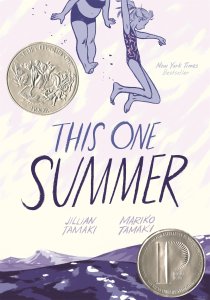 This One Summer by cousins Mariko and Jillian Tamaki is a Governor General’s Literary Award winner in addition to being on several Best Of…lists. I can’t claim any real expertise when it comes to graphic novels, so I don’t really know what the criteria might be for determining what makes a graphic novel superior to others. Like everyone of my generation, I used to be a big fan of Archie and horror comics, but it’s only since I returned to the classroom that I have made it a point to read graphic novels – mostly because I do have students who enjoy them and I want to be sure that I include them in my classroom library.
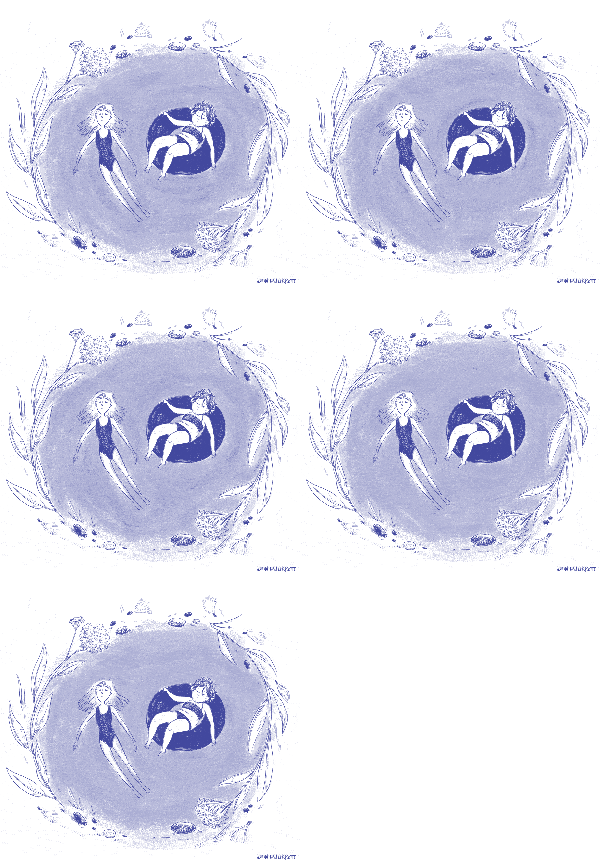 It’s clear, though, that the one and a half year difference between the girls is impactful this year. Rose, the elder, is contemplative and watchful and often reacts to Windy’s suggestions with a shrug and a “maybe.” At Brewster’s “the only store in all of Awago” the girls buy penny candy, rent horror movies and watch (Windy with girlish disgust and Rose with curious fascination) the overtly sexual relationship between older teens Dunc and Jenny.
 scoop Starr Carter and her family up and hug them forever. Starr’s the sixteen-year-old narrator of Angie Thomas’s debut novel The Hate U Give, and her story might have been ripped from recent headlines. It feels especially timely now, given what is happening in the U.S.A and around the world. I would like to think Canada is immune to racism, but I know it’s not true.
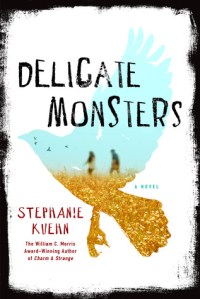 Monsters are hard to spend time with. From the moment we meet Sadie, and Emerson and his brother, Miles, we embark on a journey that is both awful and strangely – redemptive. In any case, these train-wreck teens are hard to look away from.
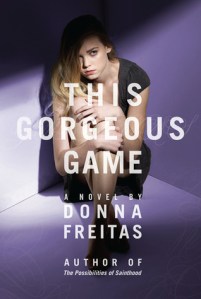 Olivia is beautiful and outgoing, but she’s one of those girls who doesn’t really know it – or, if she knows it, she doesn’t flaunt it. She’s a good girl. She’s obedient. All she wants- all she can ever remember wanting – is to be a writer. When she wins the first annual Emerging Writers High School Fiction Prize she admits “I’ve always loved writing but I didn’t really think it would amount to anything.” The prize is substantial: a ten thousand dollar scholarship towards the college of Olivia’s choice, publication of her story and a spot in Father Mark Brendan’s prestigious summer fiction seminar.
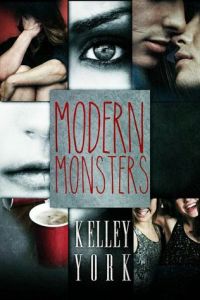 aftermath of a sexual assault. This is my second novel by York and while there is certainly nothing wrong with it, I preferred
 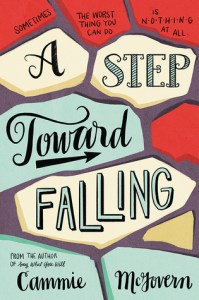 Although Belinda and Emily, the alternating narrators of Cammie McGovern’s excellent YA novel A Step Toward Falling, attend the same high school, the two girls couldn’t be more unalike. Belinda is twenty-one and spends her days in the Life Skills class with other students who have physical or developmental disabilities. Emily is a high school senior who co-chairs her school’s Youth Action Coalition with her gay bff, Richard, but hasn’t ever really taken a stand, preferring to work behind-the-scenes..
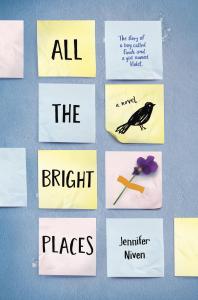 specifically remember reading and falling in love with S.E. Hinton’s That Was Then, This is Now (a book I loved way more than I loved The Outsiders), and Judy Blume’s Forever, but the reading choices certainly weren’t as varied as they are for teens today. I read a lot of YA now because I teach teens. Lots of it is mediocre. Lots of it is good. Then, every so often, you read a book you just want to tell all your students about. You want every single teen you know on the planet to read it. Jennifer Niven’s All the Bright Places is one of those books.
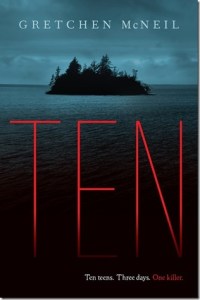 keep attentive readers on their toes. The straight-forward narrative and familiar characters (the mean girl, the jock, the good girl) will certainly be appealing to readers of a certain age, but there isn’t much on offer here for anyone else.
 even though he’s only fourteen. He’s super smart. He’s also a talented artist (many of his drawings, cartoons and graphs are included in this novel) and he’s also a terrific rugby player. His nickname, “Winger”, comes from the position he plays on the team.
 The Ludic Reader