Cuckoo Song – Frances Hardinge

cuckoo songI don’t think I have ever read a book quite like Frances Hardinge’s YA novel Cuckoo Song. I am not much of a fantasy fan, you know – word building and that sort of thing, but I was totally enchanted by Hardinge’s story, which is as much about grief and loss, as it is a creepy story about…well, I can’t really tell you.

I can tell you that the story follows 13-year-old Triss, who wakes up after falling into the Grimmer – a pond near the cottage where she is vacationing with her family. Her mother comforts her, telling Triss that she’s “just been ill again, that’s all. You had a fever, so of course you feel rotten and a bit muddled.”

Triss’s younger sister Penny, Pen for short, doesn’t seem all that thrilled with Triss’s recovery. “She’s pretending!” she screams, when she comes to Triss’s bedroom. “It’s fake! Can’t any of you tell the difference?”

Things just get weirder for Triss because even she has to admit that something isn’t quite right. For one thing, she has a voracious appetite – never mind easing herself back into the world of food, as “soon as she saw the first bowl of soup arrive, great crusty rolls on the side of the tray, her hands started to shake.” Triss is horrified to discover that food is not the only thing that will sate her hunger; she’ll willingly eat just about anything and lots of it.

Other strange things begin to happen in Triss’s life.  Dead leaves in her hair when she wakes up. Dolls that move in her hands. Dolls that speak to her. And then what’s with all the letters from her brother, Sebastian? Those letters are impossible because Sebastian was killed in the war.

Hardinge has created a masterful, creepy and mysterious novel that is both exciting and kind of heartbreaking. I don’t want to spoil the novel’s surprises, but I will say this: you won’t forget Triss because she is brave, endearing and clever. Her desire to solve the mystery of what’s happened to her keeps the plot ticking along, but her capacity for self -reflection and self-awareness is what makes her a character who will stay with you long after the last page is turned.

Highly recommended.

Lessons From a Dead Girl – Jo Knowles

Before Laine McCarthy even hears her mother answer the phone, she knows that Leahlessons Greene is dead.

As I listen to her panicked voice, I feel the tiny bricks that have walled away certain memories continue to crumble….All I see behind my eyelids is Leah. Leah with her red-glossed lips. Leah standing above me. Leah telling our secret to a crowded room of strangers and my only friends in the world. Leah walking away, leaving me in the rubble of my ruined life.

Laine, the seventeen-year-old first person narrator of Jo Knowles’ YA novel Lessons From a Dead Girl, had willed Leah to die, had wanted it more than anything. And now that it is actually fait accompli, her feelings are complicated, an “overwhelming sense of guilt and fear.”

Once Lainey and Leah were best friends. Their older sisters were friends, and they’d decided that Leah and Laine should be pals, too. It’s an awkward relationship at first, for reasons that are obvious,  at least to Laine.

Leah is popular and I’m not. Leah is also beautiful. Everyone wants to be Leah’s best friend. But me? Most people don’t even know who I am.

When the pair are children, the forced friendship soon morphs into something more genuine…and then seems to morph into something else again. The girls practice being husband and wife in Lainey’s “doll closet”, a game that makes Lainey both uncomfortable and “tingly.”

It is easy to see why Lainey is so conflicted. She’s not like the other girls. Her hair is “like a boy’s, short and brown and messy. My striped shirt is too small and has a grass stain on the front. Even my face is dirty. I look like a boy. An ugly boy. And I feel like one, too. Why would Leah be my friend?”

That question is at the root of this compelling novel and as the girls grow up and their relationship shifts and strains against the warped rules of adolescent girlhood, their bond frays and eventually breaks. Laine chafes against the secret she is keeping, but Leah has a few troubling secrets of her own.

Lessons From a Dead Girl is a very different book from See You at Harry’s. Knowles writes with authority no matter the topic, and Laine’s journey from innocence is powerful and compelling.


Sadie – Courtney Summers

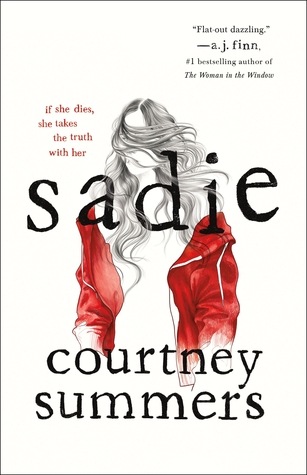
sadieI thought if I waited a few days after finishing Courtney Summers’ latest book Sadie, I would have a better chance of articulating my feelings coherently. Sadly, I don’t think I am actually going to be able to adequately express all the ways I loved (and hated) this book.

The premise is clever. West McCray, a radio producer at New York’s WNRK, is shaking up the station’s format by introducing a new podcast, The Girls. The podcast “explores what happens when a devastating crime reveals a deeply unsettling mystery.”  McCray dives headlong into the story of Mattie Southern, a thirteen-year-old whose dead body was discovered in an orchard near a burning schoolhouse, and her nineteen-year-old sister, Sadie, who is missing.

I’ve decided the gruesome details of what was uncovered in that orchard will not be part of this show. While the murder, the crime, might have captured your initial interest, its violence and brutality do not exist for your entertainment – so please don’t ask us.

Transcripts of the podcast (and you can actually listen to those here) alternate with Sadie’s first person narrative. Sadie leaves Cold Creek’s trailer park and her surrogate grandmother, May Beth, to find Keith, a man who once lived with Sadie and Mattie’s mother, Claire. Claire is currently out of the picture, an addict who’s had a steady stream of creeps in her bed.

Despite being blocked at every turn, Sadie is like a dog with a bone when it comes to tracking down Keith, a man she claims is her father. She buys a junker car, and asks fearless questions, hindered only by her stutter and youth. By about page thirty I was as invested in Sadie’s hunt as she was. She is equal parts vulnerable and tough-as-nails and 100% believable.

And this is where I have to pause and commend Summers, once again, for writing characters who are so real. Regular readers to this blog will know I am a fan of Summers and have read several of her books including Cracked Up to Be, All the Rage, This Is Not a Test, and Some Girls Are. I’ll tell you this – Summers is not writing the same book over and over. Her characters are not stereotypes. They are vulnerable, broken, tough, cynical and hopeful and every combination in between. Sometimes they say or do things that are wince-worthy, but as a mom and high school teacher, I know that Summers cuts as close to the bone as it’s possible to get. Like it or not.

So, I wasn’t surprised that I fell in love with Sadie, rough edges and all. I expected to be invested in her journey and I hated (that’s what I hated, folks) that it was a journey that she felt compelled to take. I hated that I was afraid for her the entire freakin’ time! Sadie loved her sister and made sacrifices for her that Mattie would never have the opportunity to understand. That’s what it is to love someone.

McCray is always just one step behind Sadie, but his podcasts fill in some blanks, allowing us to see how Sadie is viewed from other perspectives. Former teacher, Edward Colburn, says, “She was teased by her classmates because of the stutter and that caused her to withdraw.” Her boss, Marty McKinnon said Sadie was “a good kid, hard worker.” Mae Beth said that “The only thing Sadie was afraid of was losing the family she had left and that was Mattie.”

All of these ingredients add up to a story that McCray describes as being “about family, about sisters, and the untold lives lived in small-town America. It’s about the lengths we go to protect the ones we love…and the high price we pay when we can’t.”

There are few moments of levity in this novel, but Sadie (the novel and the character) will haunt your dreams.

Highly recommended.


Monday’s Not Coming – Tiffany D. Jackson

Thirteen-year-old Claudia and Monday are inseparable, even though they come from twomonday different worlds. Claudia lives with her stable and loving parents; Monday lives with her single mom and three siblings in Washington’s Ed Borough Complex, a part of town Claudia isn’t allowed to visit without an adult.
After returning to DC from a summer with her grandmother, Claudia is looking forward to starting grade eight with her bestie, but Monday is a no-show. When she doesn’t show up at school all week, and when calls to her house yield no answers, Claudia gets worried. A frightening visit to Monday’s apartment only ratchets up Claudia’s concern.

Tiffany D. Jackson’s YA novel Monday’s Not Coming is part mystery and part coming-of-age story. Claudia’s life is upended by the disappearance of her friend. For one thing, Monday helped Claudia with her school work and without her, Claudia is lost and “Without her, the [lunch] line went on for eternity. Without her, I ate alone. Being alone made you a target, though, and ain’t nobody got time for stupid boys throwing food at your head.”

Life ticks along for Claudia. She joins a dance group, meets a boy at church, starts getting help with her schoolwork, but none of these things fill the hole left by Monday. The two girls shared a lot of dreams – attending the same high school, making it on the dance squad, leaving the horrors of middle school behind. The longer Monday is gone, though, the more Claudia has to move forward with her life.

Readers will turn the pages of Monday’s Not Coming desperate to know what has happened to her, but I was interested in Claudia’s personal journey. Monday is a larger-than-life character, not afraid to stand up for herself or go after what she wants including the hottest boy in school. Claudia is shocked to discover new things about her best friend and she begins to wonder just how well she actually knew her.

There’s a twist in this novel that I didn’t see coming, and I can’t say that it worked 100% for me. However, it in no way undermined my overall reading experience. Monday’s Not Coming is a worthy addition to my classroom library.

Belzhar – Meg Wolitzer

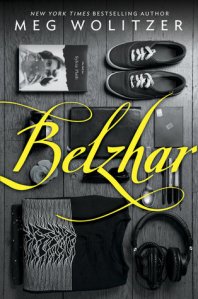
belzharJam Gallahue just hasn’t been able to recover from the death of her boyfriend Reeve Maxfield. “I loved him,” she explains, “and then he died, and almost a year passed and no one knew what to do with me.” As a last resort, Jam’s parents send her to The Wooden Barn, “a boarding school for ’emotionally fragile, highly intelligent’ teenagers.”
Meg Wolitzer’s YA novel Belzhar follows Jam on her journey of recovery, although it probably won’t be the sort of recovery readers will be expecting.

Jam is picked to take a course called Special Topics in English, the “smallest, most elite class in the entire school.” Taught by Mrs. Quenell, Special Topics has a reputation at The Wooden Barn. Jam’s roommate, DJ, tells her that students who haven taken the class act like it’s no big deal, but “when it’s over, they say things about how it changed their lives.”

Jam shares the class with Casey, a girl in a wheelchair, Sierra, Marc, and Griffin, a boy who is “good-looking but in a hostile way.” Their special topic is Sylvia Plath, who will be the only author the five students will study. In addition, they are required to write in journals that Mrs. Quenell hands out to them. Mrs. Quenell tells the students that each of them “has something to say. But not everyone can bear to say it. Your job is to find a way.”

The thing about these five students is that they have each suffered some sort of trauma and it turns out that their journals and the entries they write in them magically transport them back to a happier time in their lives. These experiences, which they call going to Belzhar (a weird take onthe title of Plath’s only novel The Bell Jar) causes them to open up to each other and to the world.

Whether you buy into the magical realism elements of this novel or not, there is certainly truth to the fact that some people get stuck in their grief or anger. Each of these teens has been trapped by their experiences  and the act of writing allows some of the poison in their lives to seep out.  “Words matter,” Mrs. Quenell tells her students, and I wholeheartedly agree.

Not everyone will appreciate Belzhar. I can see how some students might balk at the notion of Belzhar as a real place, but as a metaphor it most certainly works. Human beings do get stuck. We hold on to things and people that are not healthy. We don’t fully live; we deceive ourselves. It takes work, sometimes, to shed trauma, but surely it’s worth it.

“You’re all equipped for the world, for adulthood, in a way that most people aren’t…So many people don’t even know what hits them when they grow up. They feel clobbered over the head the minute the first thing goes wrong, and they spend the rest of their lives trying to avoid pain at all costs. But you all know that avoiding pain is impossible.

Belzhar is worth a look.


Tell Me Something Real -Calla Devlin

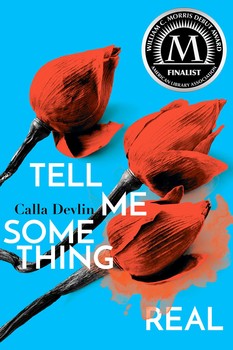
Vanessa Babcock, the protagonist of Calla Devlin’s debut, Tell Me Something Real, is sixteen. She lives with her parents, her older sister, Adrienne, andtell-me-something-real-9781481461160_lg her younger sister, Marie, in San Diego. Their mother, Iris, has leukemia, and Vanessa and her sisters often accompany her to a clinic in Mexico where she is treated with the controversial drug, Laetrile.

…the FDA’s banned Laetrile in the States, [and] a lot of people are coming to Mexico to treat their cancer. Most aren’t as lucky as we are, living in San Diego so close to the border.

Each of the girls have their own quirks. Adrienne is prone to swearing like a sailor. Marie is fascinated with the Catholic saints. Vanessa dreams of attending music school. Their father, an architect, works too much, leaving the care of Iris to his daughters, care that is taking its toll.

On one trip to the clinic Vanessa meets Caleb, a boy just a little older than she is who is also taking Laetrile. When Iris suggests that they open their home to Caleb and his mother, Barb, in an effort to make it easier for Caleb to receive his treatments, it seems like a win-win. Barb cooks real meals, and her sunny disposition improves life for everyone. And then there’s Caleb.

He looks healthy, sunburned, and rosy cheeked like me. It isn’t until he steps through the entryway – away from the protection of the flowers – that I recognize he is one of them.

Caleb becomes Vanessa’s touchstone, until one day he tells Vanessa that he and his mother are going home. Something isn’t right in the Babcock home, but he is reluctant to say just what that something is.

I have mixed feelings about Tell Me Something Real. There’s no arguing that Devlin is a talented writer, even though I didn’t feel like this debut went anyplace particularly special. Vanessa’s first person narrative is compelling enough, but her sisters seem more like a collection of quirky attributes than flesh and blood people. The plot does take an unusual turn, but even that felt somehow contrived.

What I wanted, I guess, was an emotional centre and despite the (melo)drama, Tell Me Something Real just didn’t have a beating heart. I wouldn’t discourage people from reading it, for sure, but it was just only so-so for me.

The Marrow Thieves – Cherie Dimaline

marrowGah! This book, you guys.

Francis, though everyone calls him Frenchie, is on the run from the “recruiters”.  Pretty much every Indigenous person is because their bone marrow holds the key to dreaming, which is something white folks no longer have the ability to do.

“Dreams get caught in the webs woven in your bones. That’s where they live, in that marrow there.”

…

“You are born with them. Your DNA weaves them into the marrow like spinners….That’s where they pluck them from.”

It’s sometime in the not too distant future and we’ve pretty much wrecked the Earth. Because of course we have. When Cherie Dimaline’s YA novel The Marrow Thieves opens, Frenchie is holed up in a tree house with his older brother, Mitch. But then the recruiters show up, and the boys are separated, and Frenchie finds himself on the run once more.

The characters in The Marrow Thieves are all too aware of their rocky history with the Canadian government, and sharing those stories is part of what keeps them focused on getting to safety, which in this case is north where they hope they will find fresh water and clean air and freedom.  So north is the direction Frenchie heads and it isn’t long before he meets a group of travelers. Frenchie joins this ad hoc family and his adventure begins.

The dystopian nature of this novel is really only the story’s framework. It’s enough to know that these people are considered ‘other’ and useful only for what they can provide to the government. Their current plight mirrors the whole residential school debacle, a part of my country’s history, I am ashamed to admit, I was grossly ignorant of until recently.  Those places were less about assimilation (and even that is abhorrent)  and more about annihilation.

The real story, the heartbeat of Dimaline’s novel, is the characters and their stories – both individually (which they tell in their own ‘Coming-To’ stories) and collectively. Getting to know these people felt like a privilege; I fell in love with them and the way they looked out for each other. I experienced a real fear for their safety and on the few occasions they were rewarded with something good, I felt that, too.

I will not forget these people, their connection to the Earth and each other, for a long time. The Marrow Thieves should be required reading for all Canadians…and, trust me, once you start reading, you won’t want to put it down anyway.

Highly recommended.


Falling Into Place – Amy Zhang

fallingAmy Zhang’s novel Falling Into Place tells the story of sixteen-year-old Liz Emerson’s journey from happy child to miserable teen and the drastic choice she makes in an effort to end her emotional pain.

On the day Liz Emerson tries to die, they had reviewed Newton’s Law of  Motion in physics class. Then, after school, she put them into practice by running her Mercedes off the road.

Zhang’s elliptical novel cuts back and forth through time, unraveling Liz’s story in little non-linear pieces, while also offering us insight into the lives of Liz’s friends Kennie and Julia. Adults are pretty much non-existent in this story; Liz’s widowed mother is often away on business, leaving Liz to her own devices. (This usually means she’s partying & making out with random people, drinking alone or making herself puke.)

Liz’s car accident is no accident. She meticulously plans the event to look like an accident because she can’t stand the mess of her life – some of which is beyond her control, but some of which she created for herself. She reaches out, at the last minute, to her school’s guidance counselor, but he’s an ineffective lump (of course he is) and by then Liz has really already made up her mind.

Liz and her friends are shrill and often unkind and not entirely likeable. Which was a problem for me.  An unnamed first-person character recalls when Liz was happy and full of love, but it will be relatively obvious who that person is for careful readers.

She cannot bear to catch fireflies in jars. She hates zoos. She will not let her father teach her about constellations, because she will not trap the stars. She lives in a world made entirely of sky.

Although I didn’t find Liz particularly sympathetic, the glimpses into her childhood do humanize her. Her casual cruelty and lack of empathy, although perhaps realistic enough in today’s world, just didn’t work here the way it might work in a novel by someone like Courtney Summers. None of the characters felt real to me; they felt like shells.

Whether or not Liz survives her ‘accident’ is perhaps what will keep readers turning the pages, but for me, there was no real skin in the game.

Amelia Anne is Dead and Gone – Kat Rosenfield

ameliaanneKat Rosenfield’s YA novel Amelia Ann is Dead and Gone is lush and languid, a coming-of-age story and a mystery that sends ripples through the small, insular community of Bridgeton.
At the same time that eighteen-year-old Becca is anticipating the beginning of a new and better life away at college, the unidentified body of another young girl turns up on the side of the road, outside of town.

People buzzed and hummed and speculated. It seemed impossible that the dead girl, the rag-doll on the road-shoulder, could remain anonymous for long. Not with everybody talking about her, her, her.

Everything is about to change for Becca. She’s just graduated from high school (salutatorian, no less) and her “too-smooth boyfriend with a beater pickup and no diploma of his own” has just broken up with her.

Our first meeting was romantic. High school legend-like, it made me yearn to stay with him just for the chance to tell our someday-kids about how their father had swept me off my feet at the tender age of sixteen.

The news of the dead girl is diverting at first, but then becomes a constant buzz in the back of Becca’s head. She can’t stop wondering about her – who she is and what happened to her, and it’s this compulsive fascination that brings the novel to its dramatic climax.

Amelia is experiencing a similar ‘new beginning’. She’s just graduated from college and decided to  pursue acting, a track-jump that her boyfriend, Luke, simply cannot or will not understand. The time spent with Amelia, is time well-spent. She is a girl who is finding her feet, discovering what she wants to be and understanding that sometimes that means leaving people behind.

When Rosenfield sticks to Becca and Amelia, Amelia Anne is Dead and Gone races along like a thriller (albeit a really beautifully written thriller). Sometimes, though, she diverted my attention away to talk about the town from the vantage point of a sort of disembodied third-person omniscient vantage point.

In a small town, there are things you simply grow up knowing. You need them all – the shortcuts, secrets, and scandals that make up the town’s collective unconscious, the whispered bits and pieces passed from older lips to younger ears.

I found this stuff sort of extraneous to the plot (although I suppose it did, in some ways, explain the town’s mentality), and bogged things down a bit. A subplot about a tractor in the lake was, likewise, unnecessary. When Rosenfield stuck to Becca and Amelia’s story, though, I was all in and even with my minor grumble, I still highly recommend this book.

this is where it ends – Marieke Nijkamp

Columbine. Newtown. Parkland. The fact that we know these towns because of the school shootings that happened there is shocking. According to Everytown there have been 302 school shootings in America since 2013. True, not all of these incidents have resulted in death, but the fact that someone brought a gun into a school is pretty horrifying.

For comparisons sake, there have been seven school shootings in Canada with a total of 28 fatalities. (And I’m not talking since 2013, I’m talking in total.) The first happened at a high school in Brampton in 1975. The worst happened at École Polytechnique in 1989 where 14 women were killed. The most recent happened in La Loche, Saskatchewan in 2016 where four people were killed and seven were injured.

I know that guns (and gun control and 2nd amendment rights) are a contentious bowl of soup, but, people! Seriously.

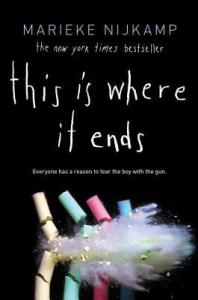
thisiswhereMarieke Nijkamp tackles gun violence in her compelling (and heartbreaking) YA novel this is where it ends.

Four narrators tell the story of what happens when a student locks the entire student body (almost) into the gym and starts shooting.

There’s Claire, a senior track star who isn’t in the gym because she’s training for an upcoming track meet.

There’s Autumn, a dancer who can’t wait to blow her popsicle stand of a town, a backwater named – ironically – Opportunity.

There’s Sylv, a girl who would sacrifice anything to keep those she loves safe, including Autumn.

And there’s Tomas, Sylv’s twin, who is breaking into the principal’s office with his friend Fareed when the chaos start.

What do these four people have in common? That would be Tyler, Autumn’s brother, a beautiful but damaged boy who clearly feels he has nothing left to care about. But really, Ty’s motives for shooting up the school don’t matter, really. The terror is real. The violence is real.

The action of the novel takes place over the course of 54 minutes. In that time, we come to understand how these five students are connected. We also learn about their hopes and dreams; we see their bravery and their fear; we root for them and we mourn with them. It’s pretty compelling stuff especially now when school shootings seem to be happening with alarming regularity.

Nijkamp was smart to let us into these character’s heads. They reveal secrets they’ve kept from each other – mostly out of love. They admit to weaknesses and also dig deep for reserves of bravery and strength. And, they even find compassion.

“Grief is one big, gaping hole, isn’t it?” Sylv says to Ty.

I don’t know if he hears me, but my words are as much for myself as for him. “It’s everywhere and all consuming. Some days you think you can’t go on because the only thing waiting for you is more despair. Some days you don’t want to go on because it’s easier to give up than to get hurt again.

this is where it ends is a timely book with an important message.