The Replacement – Brenna Yovanoff

Brenna Yovanoff’s YA novel The Replacement is quite unlike anything I have read before, which is a good thing. It was well-reviewed when it debuted in 2010 and I have been wanting to read it for a while. I was particularly intrigued by the cover, which is creepy, although I try not to chose books based on their cover alone – that has lead me down a few crap book paths.

Gentry isn’t like other places and Mackie isn’t like other 16-year-olds. He’s a replacement,  left in the crib of a human baby who was spirited away by the strange inhabitants of the the labyrinthine world beneath Gentry.

7507908Mackie lives with his older sister, Emma and his parents. He has a best friend, Roswell. He has a crush on a pretty girl, Alice. But he also can’t abide blood. Or get close to anything made of stainless steel. Or go to church, even though his father is a preacher.

Mackie knows he is different. “I dream of fields,” he says, “dark tunnels, but nothing is clear. I dream that a dark shape puts me in the crib, puts a hand over my mouth, and whispers in my ear. Shh, it says. And, Wait. “

The way his sister tells it, someone took her real brother in the middle of the night when she was four years old.

When she reaches her hand between the bars, the thing in the crib moves closer. It tries to bite her and she takes her hand out again but doesn’t back away. They spend all night looking at each other in the dark. In the morning, the thing is still crouched on the lamb-and-duckling mattress pad, staring at her. It isn’t her brother.

When the little sister of Mackie’s classmate, Tate,  goes missing, Mackie is forced to confront his own origin story and this leads him the The House of Mayhem and The Morrigan, a girl who rules there and whose “jagged teeth and tiny size made her seem more implausible, more impossible than all the rest.” All the rest of what, you might ask? Yeah, that would be the living dead girls. The Morrigan  tells him “We were so pleased that you survived childhood. Castoffs generally don’t.”

When Tate asks for Mackie’s help, he is reluctant; he’s got his own problems. But when The Morrigan offers to help Mackie feel better even he can’t resist. There is a strange barter system between Mayhem and Gentry: Mayhem thrives on adulation. But Mayhem isn’t the only world beneath the town. The Morrigan has a sister, and she thrives on blood sacrifice.

Mackie doesn’t fit in, but  whether or not Yovanoff meant for his journey to be a metaphor (like Joss Whedon’s monsters in Buffy the Vampire Slayer) hardly matters because The Replacement is a thrill ride.

Great book.

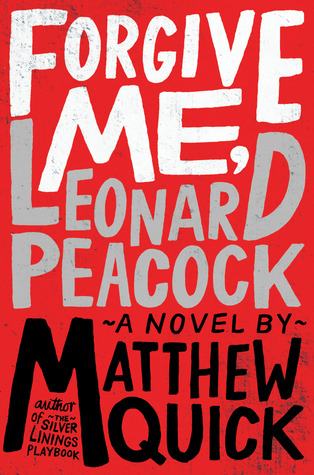
Forgive Me, Leonard Peacock – Matthew Quick

forgive meToday is Leonard Peacock’s 18th birthday. It’s also the day he has elected to kill himself – but first he has to kill his former best friend, Asher Beal.  Before he can do that, though, he has some gifts to deliver, gifts he’s wrapped in pink paper and packed in his knapsack along with his grandfather’s P-38 WWII handgun.

I want to give them each something to remember me by. To let them know I really cared about them and I’m sorry I couldn’t be more than I was  – that I couldn’t stick around – and that what’s going to happen today isn’t their fault.

Forgive Me, Leonard Peacock is a smart, funny, heartbreaking novel by Matthew Quick, perhaps better known for Silver Linings Playbook. I was immediately enchanted by Leonard’s charming, wry and honest narrative – he is immediately believable and sympathetic.

Leonard isn’t your run-of-the-mill teenager. He’s a thinker. He’s also in real emotional distress. It’s no wonder. His father, a former rock star currently on the run from the IRS, and his mother, a fashion designer who lives in NYC with her French boyfriend, are clearly terrible parents.

As Leonard makes his way through his day and we meet the four people he deems worthy of parting gifts, it’s easy to see how lonely and isolated he is.

First there’s Walt, the old man who lives next door. “I met Walt during a blizzard” Leonard tells us in one of the novel’s frequent (and often caustic) footnotes. Leonard’s mother, Linda, had asked him to go “shovel the driveway, even though it was still snowing, because she had to go out to meet another fake designer or some bulimic model.” Walt is an old movie aficionado and soon enough he and Leonard are quoting Bogart and Bacall back and forth at each other.

Then there’s Baback, a kid Leonard has known since grade nine. When Leonard discovers that Baback is an extremely talented violinist, he bribes Baback to let him sit and listen because listening to Baback play is “by far the best part of my day.”

Then there’s Lauren, the home-schooled Christian who hands out pamphlets at the train station. (Sometimes Leonard rides the train into the city, following random adults to see whether there is, in fact, any potential for happiness once you’re out of high school.) That’s where he first sees Lauren and he dreams of kissing her, although they can’t seem to overcome the obstacle in their way: Jesus.

Finally, there’s Herr Silverman, Leonard’s favourite teacher. Herr Silverman encourages his students to think for themselves, a quality Leonard feels is lacking in other faculty members. Also,

There have been days when Herr Silverman was the only person to look me in the eye.

The only person all day long.

It’s a simple thing, but simple things matter.

I’m a teacher; that hit me in the gut.

Leonard goes through his day, hinting at something horrible that happened between him and Asher, the something that necessitates his rash decision to end both their lives. With each gift, he half hopes someone will notice that something is wrong and, thankfully, someone does.

For anyone who has ever felt ‘other’, for anyone who ever considered ending their own life, for anyone who has ever felt neglected, unseen, or desperate, Forgive Me, Leonard Peacock is the book for you.

Highly recommended.

That’s amore

Listen here.

Boy meets girl – it’s the oldest story in the book, right? And now, thankfully for modern readers, we can also add boy meets boy and girl meets girl (and they meets they etc etc)

A couple of years ago I talked about love and the sorts of stories that make my heart skip a beat, or more often than not, break…a feeling I have to admitting I like just a little more than is probably healthy. You can read about what I said here.

I am a romantic at heart. Sappy, even. I’m not sure I grew up believing that a handsome prince was going to ride in on his white stallion and save me, but I did believe in happily-ever-after, although I am currently on the fence about that now.

My most favourite kind of love story is the one where the couple overcomes tremendous obstacles to be together – sacrifices are made – or, even better, that they love each other deeply but just can’t be together. Angst, baby. Buffy and Angel. Hello.

So since Valentine’s Day has just passed, I thought I would talk about romantic books.

I cut my teeth on my mom’s bodice rippers – Rosemary Rogers type stuff. Sweet Savage Love. You know, wild men who can’t be tamed and the virginal women who tame them.

Clearly romance novels have changed over the years – like 40 of them – when I first starting reading them. Some argue that modern romance novels are actually empowering because they are mostly written by women for women, women are generally the hero – or should I say heroine – of the piece and then there’s the s-e-x. In the modern romance novel, women are often in charge of their own pleasure, something I doubt Rosemary Rogers would have acknowledged back in the day.

All that said – I still have a soft spot for romance between two people who have to overcome horrible odds…and if they can’t actually overcome them – even better. Clearly, I have a type and it’s all about the doomed love. I am the person who still blubbers like a baby watching Zefferelli’s Romeo and Juliet.

Ultimately, though, I think there should — at the very least– be the potential for a happy ending, even if it never actually happens.

So, if you are feeling the love – or you want to feel the love – or, you just want to curl up in a ball and cry…I have some recommendations for you.

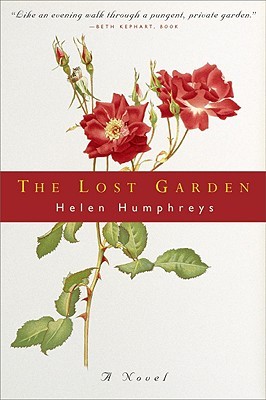
The Lost Garden – Helen Humphreys lostgarden

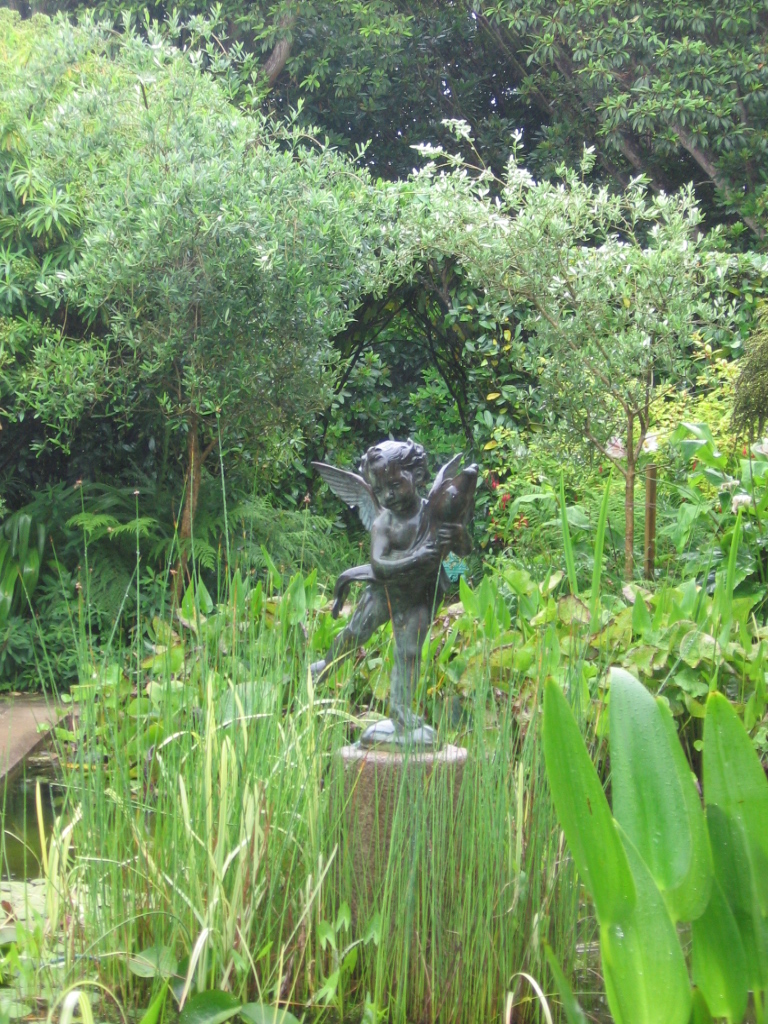
Humphreys is a Canadian writer and The Lost Garden is the story of Gwen Davis a young horticulturist in 1941 London. She gets a job leading a team of Land Girls at a neglected estate in Devon. They’re going to be growing crops for the war effort. While there she meets Raley, a Canadian officer waiting to be posted to the front. She also befriends Jane, a young woman whose fiancé is MIA. From these two people – in these fraught circumstances, Jane comes to understand the meaning of love. I was so enchanted with this book that when I was in England in 2007, my kids and I spent the day at The Lost Gardens of Heligan, an estate which is very much like the one Gwen works on in the novel.

IMG_0834 IMG_0838

Can I just share a little bit from the beginning of the book?

We walk the streets of London. It is seven years ago. We didn’t meet, but we are together. This is real. This is a book, dusty from the top shelf of a library in Mayfair. The drowned sound of life under all that ink, restless waves breaking on this reading shore. Where I wait for you. I do. In a moment. In a word. Here on the street IMG_0846corner. Here on this page.

But it is shutting down, all around me, even now, this moment that I stopped. The story disappears as I speak it. Each word a small flame I have lit for you, above this darkened street.

The Lost Garden is a really lovely, and surprising love story.

So, I asked my eighteen-year-old daughter why she reads romance. She was pretty quick to point out that most of the love stories she reads are unrealistic and that she realizes that. However, that doesn’t get in the way of her enjoyment. She counts books like John Green’s The Fault in Our Stars and Nicholas Sparks’ The Notebook or The Last Song among her favourites. Nicholas Sparks definitely offers readers a heaping helping of schmaltz.

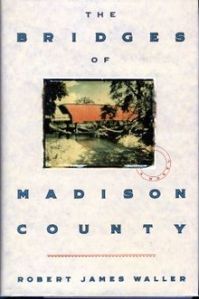
If you’re looking for schmaltz, you can’t go wrong with Robert James Waller’s 1992 novel The Bridges of Madison BridgesOfMadisonCountyCounty. You could read this book in an afternoon; it’s short. I don’t mean to suggest that Waller is a wordsmith, but this book broke my heart when I first read it. Francesca is a war bride and she lives with her husband and her kids on a farm in Iowa and one afternoon – while her family is away at a state fair or something — she meets a photographer named Robert who is in the area to photograph covered bridges. The encounter changes her life and his, too. Sacrifices must be made. Their story is discovered by her adult children after her death and they are shocked to realize their mother was more than the woman who made their meals and washed their clothes. People might know the movie with Meryl Streep and Clint Eastwood and it’s a decent version, but the book is pretty good if you have a couple hours and a box of Kleenex.
So clearly, I’ve just outed myself – if a book can make me cry the writing doesn’t even have to be stellar.

Now – how about a YA romance?

easyEasy – Tammara Webber

This is for mature teens…it kind of just crosses the line, but it’s about a second-year university student named Jacqueline who has just been dumped by her boyfriend. She meets Lucas and he’s — I suppose – the proverbial bad boy, but he’s not really. This book hit all my guilty pleasures and then some. There’s tension galore, there’s a likeable minor cast and the two main characters are smart and kind and when they finally reach their happily ever after, you’ll be swooning.

Yep – there’s something super satisfying about a love story. Check out these:

The Time Traveler’s Wife – Audrey Niffenegger

I cried so hard when I read this book, I couldn’t even see the pages.

The Banquet – Carolyn Slaughter

Henry meets Blossom at Marks & Spencer. He’s a conservative architect; she’s a young shop girl. There’s is an all-consuming love affair. Carolyn Slaughter is one of my all-time favourite writers.

Aristotle and Dante Discover the Secrets of the Universe – Benjamin Alire Sáenz

Two boys, true love. So beautiful and life-affirming.

Me Before You – JoJo Moyes

Just in time for the movie. Plain Jane meets handsome paraplegic.

Jane Eyre – Charlotte Bronte

My first-ever romance. And you never forget your first, right?

What’s your favourite romance novel?
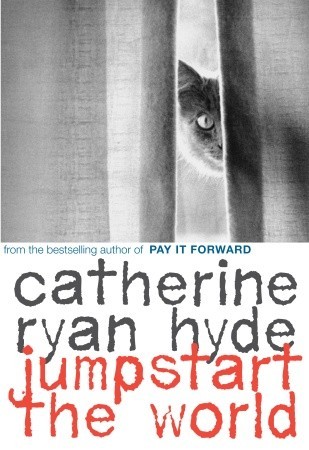
Jumpstart the World – Catherine Ryan Hyde

When Elle’s mother’s boyfriend decides he doesn’t like her, Elle’s mother sets her up in an apartment across town. The town happens to be New York and Elle is just 16.  Catherine Ryan Hyde takes an almost unbelievable premise (like, what mother turns her kid out because she wants to placate her boyfriend?) and spins it into the beautiful and moving coming-of-age story Jumpstart the World.

jumpstartOn moving-in day, Elle meets Frank Killborne, her next door neighbour.

He had a big, friendly smile and there was something cute about him, but in a soft sort of way. Hard to explain what I mean by soft. Gentle, I guess I mean. He made you try not to find fault with him for some reason. The kind of guy it’s hard not to like.

Frank lives with his girlfriend, Molly, and it doesn’t take long for them to become Elle’s de facto family. It also doesn’t take long for Elle to develop more complicated feelings about Frank.

Jumpstart the World is populated with other interesting and sympathetic characters, too, particularly the group of friends Elle makes at her new school. There’s Shane aka Larissa, blue-haired and gay; the Two Bobs – a gay couple; there’s Wilbur, a quiet guy who wears make-up.  These friends have varying degrees of influence on Elle’s life and are also responsible for the novel’s conflict. When they meet Frank,  they point out what is not obvious to Elle: Frank is transgender.

It’s pretty remarkable that there’s a book like this available for teens. It’s the first book I’ve ever read featuring a transgender character, but the fact that Frank is doesn’t mean that Ryan Hyde starts to get all preachy. We might expect that since this story takes place in NYC, the world is filled with individuals ready to embrace everyone’s differences, but – of course – the world isn’t quite so open-minded and, as it turns out, Elle has some reconciling of her own to do.

Jumpstart the World actually tackles the questions of trust and family and what it means to give your friendship and love to another human being, regardless of their sexual orientation. There aren’t any easy answers in life and it might be a bit much to expect a teenager to figure them out, but each of the characters in this book have had their own life-altering experiences. And interestingly, Elle’s journey – painful as it is – also helps her to make a kind of peace with her mother.

I enjoyed this book. I liked spending time with Elle. I appreciated that her journey was a little left of center, but that she discovered – as she does with her cat, Toto, that sometimes “you just have to take a deep breath and let somebody love you.”

Highly recommended.


What We Lost – Sara Zarr

whatwelost“The whole world is wilting,” says fifteen-year-old Samara (Sam), the protagonist of Sara Zarr’s YA novel What We Lost.

She means the comment literally because it’s so hot that she wakes up every couple of hours “in a puddle of sweat,” but the observation is also figurative. Sam’s life is full of conflict and chaos. Her father, Charlie,  a pastor at the local church, is distracted and every day Sam wakes up to something “ruined or broken or falling apart.”

Part of the problem is that Sam’s mother is currently residing at the New Beginnings Recovery Center in an effort to get sober. Without her mother there, Sam feels adrift. There’s not enough money and Sam is tired of having to pretend that her mom just isn’t feeling well enough to attend church or other social functions. Things get even more complicated when Jody, a thirteen-year-old member of Sam’s church, goes missing  and Sam’s small town suddenly becomes a lens through which she is able to see all the world’s flaws, including her own.

I’ve read Zarr’s fantastic book Story of a Girl and her novel Roomies, which she co-wrote with Tara Altebrando, and which I also loved. Zarr has a real gift when it comes to creating empathetic characters and Samara is no different. Her fifteenth summer is a perfect storm of angst and confusion, suspicion and alienation.

I wish I understood what happened between then and now. I wish there was a way to put your finger on the map of life and trace backwards, to figure out exactly when things had changed so much…

As the town searches for Jody, Sam’s dad spends time with her family, acting as a sort of spokesperson. During this time, Sam grows closer to Jody’s older brother, Nick. He “could probably be a model” Sam observes, studying him the way “every girl who has ever known Nick has studied him.”

The problem with their blossoming friendship is that Nick is a suspect in the disappearance of his sister and Charlie doesn’t want Sam to hang out with him. Charlie also doesn’t want Sam to be alone; the town no longer feels safe. Sam is shuttled back and forth between her house and her best friend Vanessa’s. Sam has suspicions of her own; she wonders why her dad is spending so much time with Erin, the church’s youth group leader.

Zarr manages all these threads beautifully, allowing Sam her questions  about her faith in God,  suspicions about her dad, loneliness for her mom and feelings for Nick to percolate under the hot summer sun.

Great read.


The House – Christina Lauren

Okay, there’s suspension of disbelief and then there’s, well, just disbelief. I so wanted to like Christina Lauren’s (the co-writing team of Christina Hobbs and Lauren Billings) YA novel The House, but I didn’t. Actually, my feelings are more conflicted than that: I liked some things about the book and really, really disliked others.

the houseThe good: The writing in The House is actually pretty decent. At least decent enough that I wasn’t groaning over clunky sentences. In particular, the spooky scenes were well-written – propulsive and skin-crawlingly descriptive.

The two main characters, Delilah and Gavin are likeable teens. The story is told in alternating chapters labeled ‘Him’ and ‘Her’ so the reader is privy to the thoughts of both characters. Delilah has recently started high school in her hometown in Kansas after leaving a  school on the east coast. Gavin has lived his whole life in “the House,” an odd patchwork house hidden behind a fence. The two knew each other as children, before Delilah had been sent to live with her grandmother. Now she is intent on rekindling her friendship with Gavin.  It would seem that he is the proverbial bad boy and that Delilah is smitten.

The bad: There is no long burn here, no smolder – which is unfortunate because these stories work so much better when there is. Gavin and Delilah fall pretty much in love almost immediately. Of course, their relationship is not without its problems and that’s the part of the story that was the most problematic for me.

Things inside House can come alive in a way that I don’t think things anywhere else can. When an object is inside House…it can be alive….

*

Things in the house move….They take care of me. They always have. They would never leave….It’s a bit like having a really big family, but no one speaks.

Yep, Gavin’s house is alive. His parents are gone, but House has always taken care of him, anticipating his every desire, making his food, taking care of his needs. He doesn’t see it as particularly strange because, of course, it’s all he’s ever known. For most young adult readers this likely won’t seem like much of an imaginative stretch. They’ve grown up reading books where teens fight to the death, have other-worldly powers and fall in love with vampires and werewolves, but for me, I just found it sort of goofy.

As it turns out, House isn’t all that benevolent when it seems like Delilah might steal Gavin away. The novel gives new meaning to the notion of playing house, that’s for sure.

Kindness for Weakness – Shawn Goodman

One of my students recently read Shawn Goodman’s novel Kindness for KindnessWeakness and when she returned it to my classroom library, she told me that she loved it so much that she’d asked for her own copy for Christmas. Her endorsement encouraged me to read the book and I am so glad I did even though it broke my heart. Seriously.

James is fifteen. He lives with his drug-addicted mother and her scummy, drug-addicted boyfriend, Ron, in a one-bedroom trailer. His older brother, Louis, moved out two years ago. James is adrift; he hasn’t got one positive thing going for him. He is  “just a lonely kid loping along the street with [his] head down.”

Then his brother offers him a job and James, desperate to be a part of Louis’ life, accepts. Problem is, the job is dealing drugs and James gets caught. He won’t rat out his brother, so he’s thrown into Morton, a juvenile facility.

There is nothing good about his new reality. James thinks

I am a loser, I am scared and weak. I want to call Mr. Pfeffer and ask him what I’m supposed to do. I want to talk to him over cold root beers, and have him tell me that everything will be okay. I want him to give me new books, enough to last twelve months, so I can disappear into the pages and not have to deal with this place. I could read one book after the other, stopping only to eat, sleep, and do school or chores or whatever it is they do here.

But James does learns the rules and in some ways he comes into his own at Morton.  There are a couple of guards who are compassionate and make an effort to teach the young men in their charge that there is always an alternative.  Despite his circumstances, James starts to consider what his future might look like.

I want to go to college…I want to live in a dorm where no one will know where I came from or who I was at my old high school. I want to start over and see the world outside of Dunkirk. I want to take writing classes.

James also reaches out to his old English teacher, Mr. Pfeffer, and the two exchange letters. James takes comfort in literature, and I have a soft spot for any character who loves books. James strives to stay out of trouble because he wants to get out and make something of his life.

Shawn Goodman actually worked in New York’s juvenile justice system and this experience gives Kindness for Weakness a real feeling of authenticity, but it is James that is the emotional center of this book.  He is a believable, sympathetic character. I fell in love with him at the very beginning and rooted for him until the book’s devastating conclusion.

Highly recommended.


The Catcher in the Rye – J.D. Salinger

catcher-in-the-rye-cover-imageSo I recently re-read The Catcher in the Rye for the first time in about twenty years (or maybe longer, although I shudder to think) because I am teaching Grade 11 this year and Salinger’s classic coming-of-age story is on the reading list. Now I have to figure out what I really think about this book – not just what I want the kids to think I think about it.  It’s a problem because I believe that Holden Caulfield is definitely a character adolescents should encounter, if only because he (and this novel) is alluded to in so much of the literature, music, and films that followed.

If you’re out of the loop, The Catcher in the Rye was published in 1951 and concerns almost-17-year-old Holden Caulfield, a smart but disenchanted student who has just been kicked out of Pencey Prep, a fancy boarding school in Pennsylvania. “You’ve probably heard of it,” Holden tells us. “They advertise in about a thousand magazines, always showing some hot-shot guy on a horse jumping over a fence. Like as if all you ever did at Pencey was play polo all the time.” Holden is flunking all his courses except for English (he’s a voracious reader) and so he’s being sent home.

When the novel opens though, Holden is recounting “this madman stuff that happened to me around last Christmas just before I got pretty rundown” from a rest home in California. Once he establishes where he is, Holden starts to tell his story – embellishments (by his own admission, Holden is “the most terrific liar”) and all.

There is no question that The Catcher in the Rye is dated. Holden peppers his speech with “goddam” (a rather tame expletive by today’s standards), he smokes and drinks (not that today’s teenagers don’t, but there is something old-fashioned about the way he treats these vices) and he’s able to spend an extended amount of time in New York City without breaking the bank (I wish!). Everyone Holden encounters is a “phony” and despite his obsession with sex, Holden is still a virgin. That said, there is something thoroughly modern in Holden’s quest to make sense of  his life, which has gone seriously off the rails.

At its heart, The Catcher in the Rye is a novel about growing up. Holden doesn’t want to, not really. It is perhaps the reason why he’s still a virgin and why he thinks the Museum of Natural History is a perfect place.

The best thing, though, in that museum was that everything always stayed right where it was. Nobody’d move. You could go there a hundred thousand times, and that Eskimo would still just be finished catching those two fish, the birds would still be on their way south, the deers would still be drinking out of that water hole, with their pretty antlers and their pretty, skinny legs, and that squaw with the naked bosom would still be weaving that same blanket. Nobody’d be different. The only thing that would be different would be you.

Holden can’t stop time, although I think he would desperately like to. He also can’t undo the fact that his beloved brother, Allie, is dead. “You’d have liked him,” Holden tells us. He is preoccupied with the loss of innocence that precipitates the headlong fall into adulthood. He tells his little sister, Phoebe, that he would like to be a “catcher in the rye,”

…I keep picturing all these little kids playing some game in this big field of rye and all. Thousands of little kids, and nobody’s around – nobody big, I mean – except me. And I’m standing on the edge of some crazy cliff. What I have to do, I have to catch everybody if they start to go over the cliff…

Holden’s narrative amounts to a desperate cry for help, for someone to listen to him, for someone to answer his questions, questions which, on the surface (like, where do the ducks in Central Park go when the pond freezes over) seem innocent, but which really demonstrate Holden’s search for meaning.

In Holden, Salinger has created a timeless character who will always have something to say to anyone who cares to listen.

If You Find Me – Emily Murdoch

“Mama says no matter how poor folks are, whether you’re a have, a have-not, or break your mama’s back on the cracks in between, the world gives away the best stuff on the cheap.”

IF-YOU-FIND-METhat’s the first thing fifteen-year-old Carey tells us in Emily Murdoch’s amazing novel If You Find Me. From the moment she speaks, it’s almost impossible not to fall in love with her and as her story unspools, it’ll be even more difficult not to want to want to hug her and her little sister, Jenessa, who is just six.
Carey and Jenessa live in a trailer in  in the middle of Obed Wild and Scenic River National Park or, as the girls call it, “the Hundred Acre Wood.” Their mother, Joelle, is usually gone and has, in fact, been MIA for “over a month, maybe two at this point,” leaving the girls to fend for themselves. Carey does the best she can to look after herself and Jenessa but “when you’re livin’ in the woods…with no runnin’ water or electricity, with Mama gone to town for long stretches of time, leavin’ you in charge of feedin’ a younger sister…with a stomach rumblin’ like a California earthquake” it’s not easy. The girls exist, mostly, on beans fixed in “new and interestin’ ways.”

On this particular day, though, Carey and Jenessa have company. A woman “as thin as chicken bones, her gait uneven as her heels sink into the soft forest floor” and a man stumble into the girls’ campsite.

He hasn’t offered his name, and he isn’t familiar to me. But in that instant, hittin’ like a lightnin’ bolt, I know who he is.

If You Find Me is an amazing story of resilience and family and forgiveness, but it is also a horrific story of abuse and neglect, made all the more powerful because of Carey’s compelling and authentic narration. I fell in love with her the moment she started to tell her story and I know this is fiction, but I also know that children endure atrocities at the hands of their parents and guardians all the time.

Suddenly, Carey finds herself living with a father she doesn’t remember, a new step-mother and a step-sister who clearly resents her, attending school for the first time.  Jenessa seems to thrive in her new surroundings and although Carey contemplates returning to the her life in the woods, her love for her sister prevents her from running. Their journey is one of resilience and hope, but it’s not all smooth sailing.

I loved this book because I loved Carey. I wish the ending hadn’t seemed so rushed, though, because I don’t think Carey’s relationship with Ryan was as fully developed as it might have been and other pieces fell into place just a tad conveniently, but whatever; I haven’t read a YA book with a narrator I’ve loved quite as much as I loved Carey in a long time.

Highly recommended.

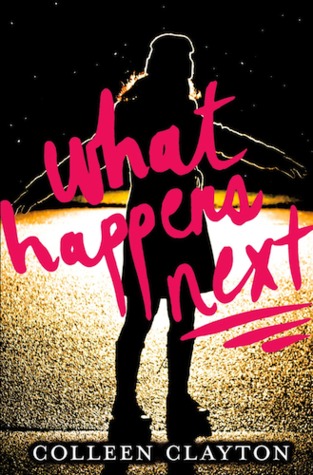
What Happens Next – Colleen Clayton

whathappensnextColleen Clayton’s debut YA novel, What Happens Next, follows sixteen year old Cassidy ‘Sid’ Murphy after she’s drugged and raped while on a school ski trip. That seems like a pretty big spoiler, I know, but it’s not. The book pretty much spoils it with the tag line “How can you talk about something you can’t remember?” Besides, it’s not the most dramatic thing that happens in this book, even though it is the impetus for Sid’s journey.

Sid and her best friends Kirsten and Paige are pretty excited about this ski trip, but of the three Sid is the amateur and so after a few hours at the bunny hill she sends her friends off to do some real skiing. While on her own, she meets Dax Windsor, “a hot specimen.” Sid can’t quite believe he’s looking at her. He’s

… the best-looking guy I have ever seen up close and he is interested in me – goofy, loud-mouthed Sid Murphy, with my crazy red hair, bubble butt and obnoxious laugh.

Dax is all slippery charm, though, and when he invites Sid to a party the next night Sid seems powerless to refuse, even though it will mean sneaking out of her chalet. But sneak she does and when she wakes up the next morning in a strange bed with no memory of what happened the night before, Sid’s world is shattered.

Instead of telling anyone – her friends, mother, police – what happened, Sid isolates herself. Her relationship with her besties fractures; she’s kicked off the cheerleading squad, her reputation is sullied, despite the fact that no one actually knows what happened.

This is where things get tricky for the reader (and mother) in me. Although Sid has no control over what has happened to her and is powerless to undo what has been done, she finds a way to quell the panic and shock she feels. First she starts running. A lot, like hours. Then she starts eating and purging. And no one notices. Is it a case of, we see what we want to see?  I don’t know. I would like to think if something this horrific happened to my daughter, I would sense that something was wrong, but all Mrs. Murphy seems to want to do is serve starch-heavy meals.

Then, into the mix, comes Corey Livingston: slacker, stoner, degenerate. Sid judges him  in exactly the same way as everyone is judging her – without knowing all the facts. As the two start spending time together, though, Sid feels herself starting to trust Corey, not enough to tell him her darkest secret, mind, but enough to at least feel like she has one friend. Their relationship is one of the nicest things about What Happens Next.

Despite a few things that didn’t quite work for me – that last 20 pages or so just seemed rushed – Clayton’s book will appeal to any teenager who has ever felt that they have a burden too insurmountable to overcome. Sid is a likeable character, but I think the real prize here is Corey.