Complicit – Stephanie Kuehn

Kuehn-Stephanie-COMPLICITA few months ago I read Stephanie Kuehn’s riveting and devastating YA novel Charm & Strange so I was pretty excited to read Complicit. Also YA, Complicit is the story of siblings Jamie and Cate Henry, who have lived for a decade with their foster parents after their young mother is killed in mysterious drug-related circumstances. As a teen, Cate did some pretty bad things and she’s spent the last couple of years in juvie. To say Jamie and Cate are estranged would be an understatement.

Jamie is now sixteen. He’s an awesome piano player; he’s got a thing for a girl at school which seems to be reciprocated; he has a pretty good life. It’s not all sunshine and roses though: he has huge gaps in his memory, he sometimes blacks out and out of nowhere he loses all feeling in his hands, a condition for which there seems to be no explanation. Then Cate gets out of jail and starts calling him.

I have no proof it was Cate who called, but what if?…I can definitely see her calling me on a throwaway phone in the dead of night. That’d be Cate all the way.

Complicit reads like a psychological thriller where you’re just waiting for all the pieces to click into place. Told in Jamie’s anxious, confused voice, the reader is given a glimpse into his past when his relationship with Cate wasn’t quite so hostile. As kids, Cate was “precocious. Outgoing. Spunky.”  As a teenager, though, she seemed angry and wild, “her jeans too tight. Her shirt too low. her mood too black.”

Jamie is not really interested in a reunion, but Cate is persistent. The more she calls him, the more Jamie feels compelled to follow the bread crumb trail she leaves about their mother’s death and what really happened the night that the Ramirez barn was burned to the ground, the crime for which she spent time in juvenile detention.

Although he is desperate to “forget the empty ache where my mother should be, my sister’s madness, my own rotten feelings of guilt,” he can’t help but somehow feel complicit in Cate’s crimes. And Cate doesn’t seem to want to let Jamie forget anything.

Fortunately for the reader, Jamie’s story isn’t quite as straightforward as it seems. Kuehn paces her twists perfectly and although careful readers might think they’ve got it all sorted out by the time they’ve reached the novel’s shocking conclusion, I’m guessing not so much.

Another winner by Kuehn.
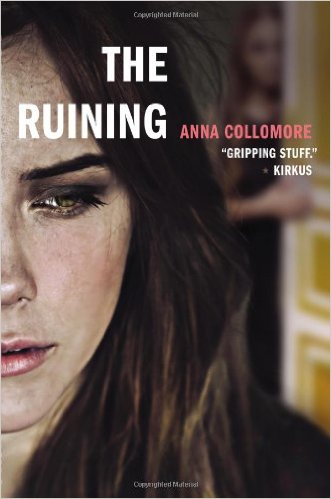
The Ruining – Anna Collomore

ruiningEighteen-year-old Annie Phillips, the first person narrator of Anna Collomore’s YA novel The Ruining,  is desperate to escape her trailer trash world outside of Detroit, Michigan and begin a new life. When she’s offered the opportunity to become a nanny on Belvedere Island, located about six kilometers north of San Francisco, she jumps at a chance. The gig sounds perfect: she’ll care for three-year-old Zoe and baby Jackson and take classes at San Francisco State University.

Libby and Walker Cohen are not like anyone Annie has ever met and it doesn’t take very long before Annie feels “a sudden, desperate urge to please Libby, to do everything right, to be the most exemplary nanny the Cohen family had ever had.”

In the beginning, life seems too good to be true. The Cohen’s house is “more like an estate or a castle” and  Libby seems more like a girlfriend than an employer, offering Annie wine, shared confidences and a chance to raid her closet. It’s heady stuff for Annie, who comes from nothing and is dragging the baggage of a personal tragedy from her past.

The reality of my life in Detroit, a reality I’d spent almost every day wishing to escape, was gone. Disappeared, like I’d never been a part of it at all. And in order to leave it in the past, I couldn’t let myself worry about leaving my mother behind.

It won’t take the reader long to see the cracks, though, even if Annie is a little bit slow on the uptake. I cut her some slack because she’s young and damaged and trying so hard to make something of her life. However, Annie seems determined to ignore the signs that something is not quite right in the Cohen house. Libby is like Dr. Jekyll and Mr. Hyde: solicitous and kind one day, passive aggressive the next.  Walker is gregarious and friendly, but  mostly absent. There are no grandparents, no extended family — Annie is isolated until she meets Owen, the literal boy next door.

The Ruining races along at a good pace, traversing the line between suspenseful and ridiculous with aplomb. Collomore manages to make it just possible for the reader to believe that Annie might be more damaged from her past than even she realizes; however, there can be no mistaking who the villain of the piece is.

The Ruining was fun to read, well-written and definitely recommendable; I know my students will gobble it up. Can’t say I was a huge fan of the ending, though. For me it was contrived and way too tidy given the complicated nature of Annie’s circumstances.

The Little Woods – McCormick Templeman

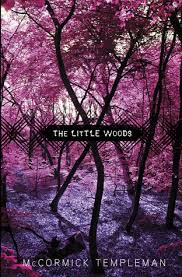
littlewoodsTen years after the death of her older sister, Clare,  Cally Woods gets accepted at St. Bede’s Academy, a boarding school in the Sierra region of California. It’s a big deal for Cally: her father is dead, her mother is a mostly absent drunk and Cally’s been offered a full-ride scholarship to St. Bede’s because of what happened to her sister. Seems that as a kid, Clare had visited St. Bede’s with a friend whose mother taught there and “on the third night of her visit, she and her friend had vanished from their beds. Their bodies were never found.” That’s pretty much the premise of  McCormick Templeman’s debut novel, The Little Woods.

There’s a lot going on in this novel, making it difficult to decide whether or not it’s a straight up mystery.  (There are definitely some mystery elements; Cally is there, after all, to figure out exactly what happened to her sister. Although as the police never have it’s ridiculous to think she’ll be able to solve the whodunit on her own. Still.) Is it a coming of age stor? (It’s certainly got all the bells and whistles: mean girls and first love.) It’s peopled with a wide variety of teenage characters: the beautiful jock (“he was black with vaguely Asian features, bright eyes and the most incredible body I’d ever seen); the student body president (whom Cally catches going through her underwear drawer) and Jack (“one of those boys who make you dizzy when you look at them). You’ll recognize all the players well enough.

Cally finds it relatively easy to infiltrate the inner-circle and soon enough learns that St. Bede’s is a hot-bed of rumours and disappearances. In fact, she’s moved into the room of a girl who disappeared only a few months ago. There’s also talk about the “little woods.” Hunky Alex explains at a party:

“All due respect, but everyone knows these woods are straight-up haunted. We do this walk all the time, and there’s always some scary fucking noise that can’t be explained. Ask anyone.

I’ll tell you what we’re hearing…We’re hearing the lost girls.”

It is at this party that Cally discovers that her sister’s death is legend: “The woods are haunted. These two little girls were murdered out there….Seriously, you guys. They wandered off into the woods or whatever, but they were totally murdered.”

Although Cally doesn’t expose her connection to Clare, she watches and listens for any clue that will help her uncover the truth.

As far as mysteries go, The Little Woods is decent enough. The problem I had with it is that the story is bogged down by so many other things – side-plots and intrigues, that it was hard to keep the whole convoluted story straight. Doesn’t mean avid YA readers won’t eat it up, though.

Roomies by Sara Zarr & Tara Altebrando

roomiesMaybe it’s because my daughter is graduating from high school in a few weeks and heading off to university or maybe it’s because, just lately, I have been feeling unsettled and nostalgic, but whatever the reason: I LOVED Roomies. Co-written by Sara Zarr (Story of a Girl) and Tara Altebrando, Roomies‘ narrative is comprised of the back and forth e-mail communication between Elizabeth (EB) and Lauren (Lo), who have been assigned a room together at UC Berkley, as well as their first person narrative of events during that pivotal summer between high school and what comes next.

EB lives with her single mother in a condo on the Jersey Shore (but she doesn’t sound like a character from the reality show of the same name.) Her first e-mail to Lauren is a rant of epic proportions: she’s just had a fight with her mother and she’s already counting the days until she can leave the nest and fly across country.

Lauren has five younger siblings. They are so much younger, in fact, that she’s more like another mother than an older sister. She loves her family, but she has been dreaming about a single room for a while and so the first note from EB comes as something of a disappointment. She imagines writing a reply to EB that says:

I requested a single. All I’ve wanted for the last decade is a room of my own. Some privacy. A place to be alone with my thoughts where they are not constantly interrupted by someone else making some kind of racket, or even just someone else just quietly trying to exist in the same space as me…A “roomie” is really not what I had in mind. Really not what I had in mind at all.

Of course, this is not the note Lauren sends. Her actual reply is much less personal and honest. Nevertheless, despite the awkward beginning, the email exchange between EB and Lauren slowly morphs into something special as each girl tries to navigate that tricky period between “childhood” and “adulthood”.

I remember that summer between high school and university as a very transitional time. I wasn’t actually going away to school; my parents couldn’t afford it. Most of my best friends did go away, though. And so did the boy I fell in love with that summer. I wanted to be someone different – desperately. (Funny, that – almost forty years later, I still often want to be someone different.) Zarr and Altebrando capture that yearning ache so perfectly that I felt myself magically transported back to that long ago summer. Everything was funnier or sadder or profoundly important then.

When you go off to university (which I did the following year) you get to reinvent yourself. The person you were in high school can be magically shed like an old skin; there is no one around who “knew you when” and there’s something pretty amazing (albeit terrifying) in that. But there is also something pretty amazing about being with the people who have known you through all those formative years – people who know your flaws and love you anyway.  I appreciated the way Zarr and Altebrando handled those high school relationships – the push and pull that comes from preparing to make the break and also desperately holding on to something that is important.

Lauren writes:  “There’s this party on Saturday with kids from our high school and she (Lauren’s best friend, Zoe) wants to go and wants me to go with her. I don’t know. I just feel like high school is over…”

EB writes: “Lately my friends don’t talk about anything I find interesting. I’m not sure when that started.”

Over the course of the summer, the correspondence between EB and Lauren becomes more personal as they share details about their last summer at home. I loved each girl’s voice and story. I loved the secondary characters: parents and boyfriends. I loved how EB in particular comes to a deeper understanding of her mother. Perhaps some day my own daughter will understand me a little bit better, too.

Although I would love to follow EB and Lauren through their first year as roomies, I am glad that Zarr and Altebrando decided to end their story where they did. I haven’t read a YA book I have loved as much as this one in a long time.

As my daughter prepares to embark on her own journey I am both elated and terrified. I hope she makes friends like EB and Lauren. I hope she becomes the person she wants to be.

Highly recommended.

Pushing the Limits – Katie McGarry

pushingThe only limit Katie McGarry’s YA novel Pushing the Limits pushed was my patience. It took me forever to get through this brick of a novel which was, by my estimation, about 200 pages too long. And it pains me to say this because if there’s one thing I love it’s a bad boy/good girl.

Pushing the Limits is told in the alternating voices of high school seniors Noah and Echo (and oh, how her name grated). We meet them (separately) in the office of Mrs Collins, “Eastwood High’s new clinical social worker.” We meet Echo first. She’s in the office with her father and pregnant stepmother (slash former babysitter, that’s right, the dad married the babysitter). She’s there because “after the incident, Child Protective Services had “strongly encouraged” therapy.” Echo is reluctant to talk and desperate to know more about “the incident”, an event that left her with horrible scars on her arms.

Noah doesn’t want to spend any time with Mrs. Collins, either. “Look,” he tells her at their first meeting, “I already have a social worker and she’s enough of a pain in my ass. Tell your bosses you don’t need to waste your time on me.” Of course, Mrs. Collins sees straight through the tough-guy façade to the cream puff that lives underneath. No question, Noah is a “bad boy” but he’s been dealt a crap hand: his parents were killed in a house fire and his two younger brothers are in foster care, but not in the same foster home as he is. He’s barely allowed to see them because of his “anger” issues.

Mrs. Collins figures that Echo and Noah would make good study partners and it doesn’t take long before the two of them are concentrating more on each other than on calculus.

And seriously, this exchange (before they are even ‘dating’) just made me cringe:

I smacked my lips like a cartoon character and bit into the succulent burger. When the juicy meat touched my tongue, I closed my eyes and moaned.

“I thought girls only looked like that when they orgasmed.”

Trust me, there’s more where that came from.

I can’t quite decide why Pushing the Limits didn’t work for me.  I started to get irritated by the number of times Noah called Echo “baby” or reminded me of her silken red curls and cinnamon smell. The central mystery (if you can even call it that) of what happened to Echo is revealed ever…so…slowly and when the truth finally makes its way into the light, it’s a bit of a bummer. There was something shrill about these characters and the way they fumbled through their story towards their happily ever after.

Off the Shelf – LGBT Fiction for Young Adults

Listen here.

May 17 is the International Day Against Homophobia, Transphobia and Biphobia so I thought this was the perfect time to talk about books that feature LGBT (Lesbian, Gay, Bisexual, Transgendered) characters.

First off – I’m no expert so if you are wondering what it all means there’s a great glossary at the UC Davis Resource Centre.

I’ve often talked about how important it is for young readers to recognize themselves in the books that they read, and for that reason it’s obviously important for LGBT characters to have access to books with characters that reflect their own experiences. I don’t know whether those books existed when I was a teen – although that was a million years ago.

I spend a lot of time choosing books for my classroom library. I’d love to have a little bookstore someday, but stocking the shelves in my classroom is almost as much fun. But I digress. When I’m buying books for my class I try to keep in mind all my students – so I have to buy books about hockey and skateboarding and kids from other countries. I have to buy non-fiction.I have to buy easy books and challenging books.  I have to appeal to all my readers and, more importantly, I have to give my kids an opportunity to read books that will expand their worlds. Books have done that for me; I want books to do that for them.

Having the opportunity to read about someone’s journey – regardless of what that journey is – goes a long way to developing understanding, acceptance and the most important human quality – empathy. We seem to be inching our way towards a world of acceptance – lots of positive things happening out there – the straight guy who asked his gay friend to the prom, for example…but the world that I dream of for my own kids is one where people are just people and that kindness extends to everyone and that a story like that is the norm…and therefore, not news, really.

So I have some book suggestions.

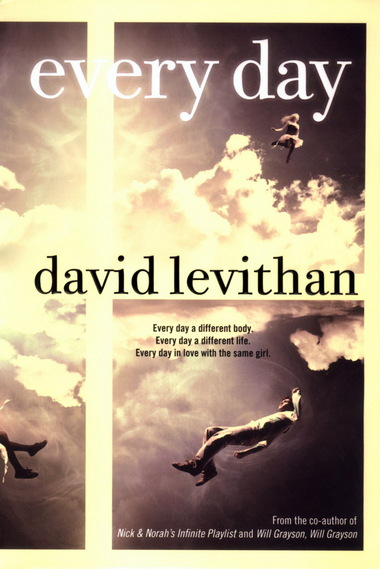
16BLEVITHANEvery Day – David Levithan

So every day the main character ‘A’ wakes up in a different body. He spends 24 hours in that body and he is essentially that person. This is a strange way to live, but it gets even stranger when A falls in love with Rhiannon, the girlfriend of one of his ‘host’ bodies. This book really blurs those gender lines and asks its readers to consider what love is and, more importantly, what it is not. I recommend this book a lot in my classroom.

morethanthisMore Than This – Patrick Ness

So everyone knows I am a huge Ness fan and I loved this book, too. The fact that Seth, the main character in this confounding novel is gay is only incidental, really. The novel starts with Seth drowning and then waking up in a bizarre sort of post-apocalyptic world. More Than This is a page turner, for sure. It’s philosophical and difficult and profoundly moving.

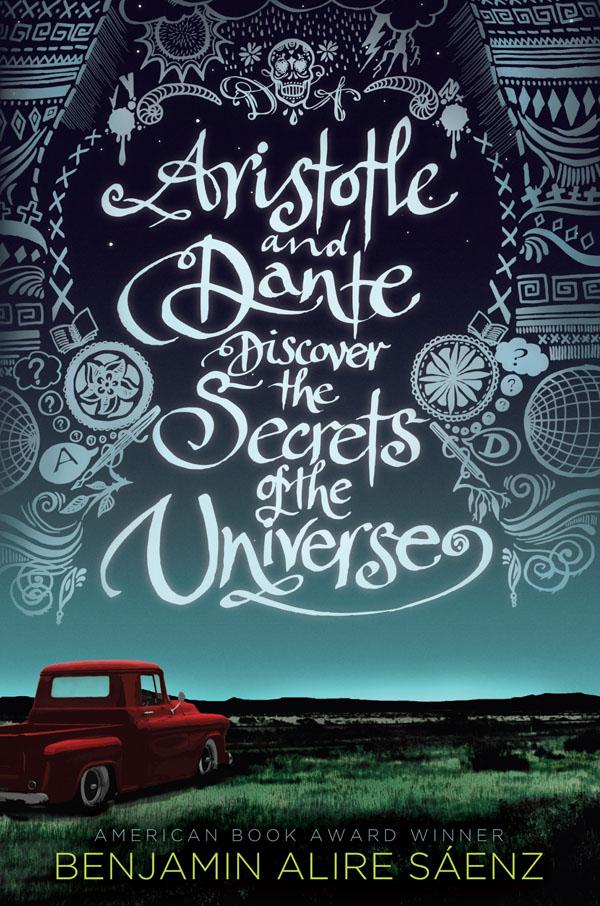
aristotle_and_danteAristotle and Dante Discover the Secrets of the Universe – Bejamin Alire Saenz

I just finished this book and I loved it. Aristotle is a 15 year old Mexican American and lives with his parents in Texas. It’s 1987. He’s angry and sort of depressed, too. He meets Dante at the pool and they become friends when Dante (also Mexican-American) offers to teach Ari to swim. This is a coming-of-age story and a story about family and community and it’s a love story. I may have teared a few times reading it. So good.

Here are some other books featuring LGBT characters and I encourage everyone to expand their reading horizons to mark May 17th, sure, but beyond that – let’s make every day a day of acceptance.

Beautyqueens-670x1024 ifilie luna miseducation totally joeadambeyondloveglobalrainbow

Aristotle and Dante Discover the Secrets of the Universe – Benjamin Alire Sáenz

aristotle_and_dante Aristotle (Ari for short) is a 15-year-old Mexican American living in Texas in 1987. He’s bored and miserable and pretty much hates his life.

Dante is also 15, and also Mexican-American, but he’s “funny and focused and fierce.” Ari says “there wasn’t anything mean about him. I didn’t understand how you could live in a mean world and not have any of that meanness rub off on you. How could a guy live without some meanness?”

Aristotle and Dante meet at the local pool where Dante offers to teach Ari how to swim. “All that summer, we swam and read comics and read books and argued about them.” It’s the beginning of beautiful friendship, something that Ari seems to desperately need.

Feeling sorry for myself was an art. I think a part of me liked doing that. Maybe it had something to do with my birth order. You know, I think that was part of it. I didn’t like the fact that I was a pseudo only child. I didn’t know how else to think of myself. I was an only child without actually being one. That sucked.

Ari has older twin sisters and an older brother who is in prison. He was born after his father returned from serving in Vietnam.

Sometimes I think my father has all these scars. On his heart. In his head. All over. It’s not such an easy thing to be the son of a man who’s been to war.

Aristotle and Dante Discover the Secrets of the Universe is a coming of age story. It’s a story about fathers and sons and mothers and sons. It’s about sacrifice and loyalty. It’s a story about friendship.

I wanted to tell them that I’d never had a friend, not ever, not a real one. Until Dante. I wanted to tell them that I never knew that people like Dante existed in the world, people who looked at the stars, and knew the mysteries of water, and knew enough to know that birds belonged to the heavens and weren’t meant to be shot down from their graceful flights by mean and stupid boys. I wanted to tell them that he had changed my life and that I would never be the same, not ever. And that somehow it felt like it was Dante who had saved my life and not the other way around. I wanted to tell them that he was the first human being aside from my mother who had ever made me want to talk about the things that scared me. I wanted to tell them so many things and yet I didn’t have the words. So I just stupidly repeated myself. “Dante’s my friend.

It’s a love story.

I was the age of these characters somewhere around 1976. I didn’t know anyone who was gay. Okay, looking back – of course I did, but we didn’t talk about it. It wasn’t acknowledged. As far as I know, they weren’t out. I am profoundly grateful as a teacher and a parent, just as a human being, that books like this exist. Alire Sáenz has written a story about boys who are smart and fragile and flawed. I admit it – I got teary a few times reading this book.

What are the secrets of the universe? As Ari discovers “we all fight our own private wars.”

This is a beautiful book and I highly recommend it.

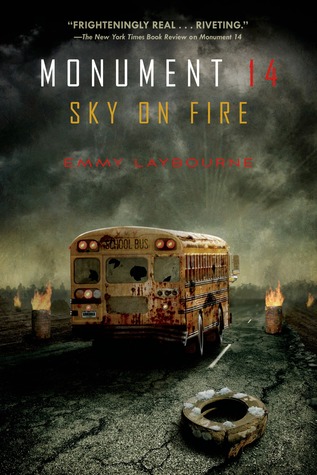
Monument 14: Sky on Fire – Emmy Laybourne

monumentskyOkay, Ms. Laybourne, you should totally take it as a compliment that I bought the second book in your Monument 14 series before I had even finished the first book. And then, without delay, I read the second book. Geesh, I haven’t even read Catching Fire yet. I should also point out that I don’t traditionally like post apocalyptic  fiction and sequels almost always irritate me. (Patrick Ness, you are totally excluded from this; you know how much I loved The Knife of Never Letting Go and the other books in the Chaos Walking trilogy.)

That said, I read Monument 14  in one breathless gulp and I read Sky on Fire just as quickly. I mean, come on, I couldn’t NOT find out what happened. But it’s going to be difficult to talk about any of it because – hello, spoilers.

Let’s just say this.

Dean goes from zero (he’s not really a zero, he just doesn’t have any confidence) to hero. His little brother, Alex, continues to act far older than his years. Niko is braver than any sixteen-year-old should have to be. Astrid turns out to be a lot more than a pretty face.  Oh, yeah, and the world has gone to hell in a hand basket.

The world outside the Greenway proves to be a lot more dangerous than any of the kids imagined and their mettle is tested on more than one occasion. Often the dangers aren’t environmental and there are plenty of creepy encounters with people who prove to be willing to kill to get what they want.

Kids in peril. A toxic wasteland. Crazy people on the loose. What’s not to love? And because Laybourne wisely decides to leave the confines of the Greenway, the reader gets to follow one group of kids as they try to make their way to the Denver Airport (and potential help) and one group who decides to stay in the superstore (and hope help finds them). It’s all pretty exciting stuff.

Okay, but then….the ending. (Which is not an ending because there’s a third book, Savage Drift) Can’t say I was a fan for a whole variety of reasons. Still, my issues are minor and even though I wasn’t as in love with Sky on Fire, I am totally in love with these kids and I will no doubt be joining them on the next leg of their journey.

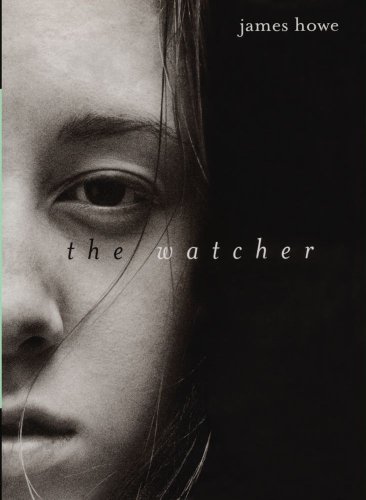
The Watcher – James Howe

watcherThe Watcher was published in 1999 to much critical acclaim. James Howe is the well-known author of the over 90 juvenile and YA books including Bunnicula and The Misfits series. ( I read Totally Joe and was a big fan.)

There are three main characters in The Watcher: Chris, the golden-boy lifeguard, Evan, the fourteen-year-old on vacation with his younger sister and parents, and the girl who sits at the top of the steps leading down to the beach, watching.

The truth is, though, that they are all watching each other. For example, Chris notes that “he didn’t know how he knew she was watching only him and not them. He could just feel it.” She’s watching him; he’s watching her.  Evan thought Chris was “the coolest guy on the beach” and secretly wished he could be just like him. The girl watched the families, “not pieces of families with only a mother or a nanny, but what she thought of as complete families with two parents and at least two children, preferably a girl and a boy.”

All three of these characters are on Fire Island, a popular beach resort near New York City. There is no reason to think they will ever cross paths, but they eventually do.

Howe is a straightforward wordsmith, and he creates compelling back stories for Chris and Evan. We know that Chris is at a crossroads, unsure of what to do now that he has graduated from high school. He feels the weight of his parents’ expectations, although we don’t understand exactly how much pressure he feels until much later in the book. As for Evan, he adores his little sister Callie and is doing his best to be a good big brother because he senses that there are things going on behind the scenes which might spell the end of his happy family.

As for the girl, we know nothing at all about her except that as she sits on the steps surveying the beach. She is imagining a much different life for herself, one where she is a princess who has been separated from her true family.

I read The Watcher in one sitting. I can only imagine that when it was first published it would have caused quite a sensation. It’s easy to see why. Each of these characters is called upon to do something brave and Howe handles their stories without sensationalism or preaching. Young readers would certainly recognize themselves in these pages.

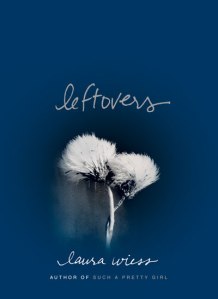
Leftovers – Laura Wiess

leftovers-coverBy the time you hit fifteen, there are certain survival lessons you’d better have learned.

That’s the world-weary voice of Blair Brost. She’s one of the two teenage narrators of Laura Wiess’s compelling YA novel, Leftovers. Blair’s co-narrator is Ardith. Although they are fifteen when they begin to tell their story, Ardith says they must “go back to eighth grade, which is when it all began.”

Blair is an only child. Her parents are lawyers; her mother is particularly ambitious and when she makes partner “she decides it’s time to buy  one of the big new, McMansions across town.” Blair isn’t interested in moving. She also doesn’t understand why her dog, Wendy, isn’t allowed to come. The dog is old and incontinent and Mrs. Brost says they’ve found her a new home, which isn’t exactly true.

Ardith lives with her alcoholic parents and older brother, a good-looking, charming snake.

You call your parents Connie and Gil, because they hate the heavy tags of Mom and Dad, and buy baggy, boring clothing so your mother won’t borrow them. Your hair is short because the guys like it long…

Blair and Ardith are trying to navigate the slippery terrain between childhood and adulthood and they don’t really have any positive role models. In fact, the only adult who takes any real interest in them is Officer Dave Finderne, a cop who finds them wandering home after a night at the pool.

Leftovers has elements of suspense. There are questions that need to be answered and readers will turn the pages quickly to find them. But this novel also cracks open the lives of adolescent girls, where the only way to survive is to know the rules:

Never bow before your tormentors.

Never let them know you’re vulnerable, especially when you are.

Never trust someone else to protect you, and never forget that every choice you make is on you.

Ardith and Blair are compelling narrators and their story is both heart-breaking and authentic. As both a mom and a high school teacher, I found Leftovers difficult to read (I just wanted to bring these girls home with me), but I think it has important things to say and it says them beautifully.

Highly recommended.