I’ll Be There – Holly Goldberg Sloan

Holly Goldberg Sloan is a screenwriter/director (Angels in the Outfield, Made in America) and maybe that’s the problem with her debut novel, I’ll Be There. It’s the story of Emily and Sam who lock eyes in a church where Emily is singing, badly, her first solo, The Jackson Five’s hit I’ll Be There.

Emily is the daughter of Tim, a music professor, and Debbie, an ER nurse. Her younger brother is Jared. She leads a nice life. She believes in order and destiny.

Emily’s interest in personal histories made her accessible to people’s deepest emotions. It was as if she had some kind of magnet that pulled at someone’s soul, often when he or she least expected it.

And that same magnet, which had to have been shaped like a horseshoe, allowed someone to look at her and feel the need to share a burden.

Hers was a gift that didn’t have a name.

Even she didn’t understand what it all meant.

Emily just knew that the grocery store clerk’s cousin had slipped on a bathmat and fallen out a second-story window only to be saved because the woman landed on a discarded mattress.

But what interested Emily the most about the incident was how the cousin had subsequently met a man in physical therapy who introduced her to his half brother who she ended up marrying and then running over with her car a year later after a heated argument. And that man, it was discovered, had been the one to dump the mattress in her yard.

He’d saved her so that she could later cripple him.

Emily found that not ironic but intriguing.

Because everything, she believed, was connected.

I quote this passage because it’s a great example of how Sloan’s omnipotent narrator does the work for the reader. This character is like this; here is a story to illustrate that.

Sam is the son of Clarence,  a  psychotic criminal. Sam’s brother, Riddle, is somewhere on the autism  spectrum. He is also plagued with constant colds. Sam and Riddle have been on the run with their father for the last ten years. They sleep in their truck or in run-down houses. Sam looks after Riddle as best he can. They don’t go to school; they don’t eat properly. Everything they know they’ve learned from books they’ve found. Riddle is artistic. He draws intricate mechanical drawings in a phone book. Sam is a self-taught musical genius. He’s also beautiful, selfless and perfect.

So, Emily and Sam’s eyes meet and that sets off a chain of events which propels the novel forward. Not everyone gets what Emily sees in Sam. Yes, he’s good-looking and polite, but he’s not forthcoming with details about his life and that’s worrying to Emily’s parents. Until Tim hears Sam play the guitar and then all bets are off. Suddenly Sam and Riddle are pulled into the Bell’s warm and welcoming circle and it’s unlike anything they’ve ever experienced. So, clearly, it can’t last.

There are reasons to like I’ll Be there. Riddle is a terrific character and the relationship between the brothers is lovely. The narrative moves along quickly, perhaps because it’s written in short little scenes. But that happens to be one of the book’s weaknesses for me. The omniscient narrator doesn’t take the trouble to develop any one character particularly well. The novel is like a bunch of soundbites strung together. Worse, even minor characters (the hairdresser who cuts Sam’s hair; an old lady who finds Clarence’s stash of stolen goods; the guy who buys his stolen penny collection) get their moment in the sun. Do I really need to know how their stories pan out? I guess I do if I want to wholeheartedly buy into Ms. Sloan’s over-arching theme of destiny.

The tone of the novel is off-kilter for me, too. It careens from swoony romanticism to lives-in-peril to  slap-stick comedy.

Will young adults enjoy this novel? Probably. It’s easy to read and Sloan does most of the work for you – right down to putting white hats on the heroes and tying the whole thing with a pink bow.

Oh, wait, that’s just destiny.


Divergent – Veronica Roth

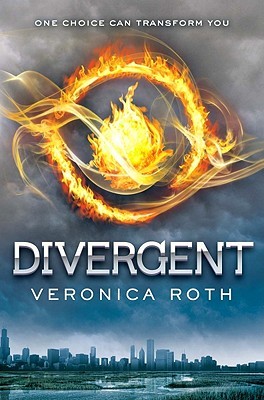
The dystopian landscape is popular in young adult fiction. If it’s not vampires and werewolves, angels or fairies – it’s likely some future version of our world where society has run amok and children are often left to fend for themselves. The most famous recent example is likely Suzanne Collins’ beloved book,  The Hunger Games. Veronica Roth’s popular novel Divergent has gained its own rabid fans and while I understand the book’s appeal, I didn’t like it as much as The Hunger Games.

Beatrice is sixteen. When you turn sixteen you must choose a faction: Abnegation (selflessness), Amity (peaceful harmony), Candor (frankness, honesty), Erudite (seeking knowledge) or Dauntless( fearless). Beatrice has grown up in an Abnegation household with her parents and older brother (by just a few months, so  her brother, Caleb, must also choose a faction), but she has never felt like she belonged. Selflessness doesn’t come easily to Beatrice.

When I look at the Abnegation lifestyle as an outsider, I think it’s beautiful. When I watch my family move in harmony; when we go to dinner parties and everyone cleans together afterward without having to be asked; when I see Caleb help strangers carry their groceries, I fall in love with this life all over again. It’s only when I try to live it myself that I have trouble. It never feels genuine.

So when it comes time to choose a faction, Beatrice chooses Dauntless. Most of Divergent is concerned with Beatrice’s (renamed Tris) training at the Dauntless compound. It’s a bit like a reality show: candidates are put through a series of tests and the best man (or woman) wins. Those who don’t make it – because they either quit or fail – suffer worse fates. You can’t go home again so you’re factionless, left to scrounge for food or do the most menial jobs available.

Tris is smart, no question, but what was missing for me was the back story which Katniss Everdeen had in spades. Katniss is a beautifully written character, someone I rooted for and understood. Tris, despite her upbringing, adapts relatively easily to her new faction – learning how to fight and lie with relative ease. Perhaps Roth was thinking of the nature versus nurture debate: how much of what we are is because of environment and how much is because of biology?

My issues with the book are minor quibbles, though. Despite being almost 500 pages long, I breezed through it. Sometimes I felt like the plot was being served rather than unraveled in a meaningful and organic way. Characters turned up conveniently and were dispensed with equally trouble-free. I know many will argue that Divergent offers lots of talking points, but I didn’t leave that shattered Chicago landscape feeling all that inclined to revisit.

All that said, I know there will be students in my class who will enjoy the novel and I would have no trouble recommending it – even if only as a way to talk about characterization: it’s difficult to mourn for people you don’t feel you know.

Nothing But Ghosts – Beth Kephart

For anyone who has lost their mother, Beth Kephart’s YA novel, Nothing But Ghosts is a gift. In it, 16 year-old Katie navigates the lonely and traumatic days after her mother dies of cancer by solving the mystery of what happened to Miss Martine, the shut-in who lives in the estate down the road. When Katie is hired to help dig a spot for a new gazebo at the estate, the experience draws her out in the present – even as she investigates the past.

Kephart’s novel is beautifully written and Katie is a thoughtful and likeable character. Kephart expertly weaves a story that casts a light on several characters who have been broken by  events in the past. Katie’s own story, and that of her parents, is told through her memories of a family trip to Spain. In remembering she thinks:

She’d kept her secret the whole trip long. She stood in the strange, chill mist, alone, alive, but knowing what would come. History is never absolute truth. It isn’t just the thing that was. It’s the thing that could have been.

Her father, a brilliant art restorer, is drowning in his own grief. The librarian who helps Katie dig into the history of Miss Martine’s life has had her own heartache. Even Sammy, the little boy who lives across the street has had his share of disappointments.

Nothing But Ghosts is a story about loss, but it is also a story about love and rebirth and hope. Katie must travel the road to acceptance on her own, but she does it with a grace that belies her age.

I very much enjoyed this book.

Things You Either Hate or Love – Brigid Lowry

Georgia is the 15-year-old narrator of New Zealand  novelist Brigid Lowry’s YA book, Things You Either Hate or Love. I was smitten with her almost as soon as she opened her mouth to announce:

I like to think of myself as a brilliant creative person, but sometimes I just feel like a sad lonely girl with a big bum.

Georgia is madly in love with Jakob, the lead singer of a funk band called Natural Affinity. She spends long hours talking to his poster – free therapy – and plotting ways to earn money so she can fly off to Brisbane to see his band in concert.

In an effort to make some money, Georgia tries (and fails) at babysitting, working in a video store and then a bakery, before finally landing as a cashier at the local supermarket. When she isn’t moaning about regular teenage stuff (her mother, school, friends) she’s trying to navigate the fraught path from childhood to adulthood.

Georgia is charming and funny, but lacks any real confidence. She is a character that would definitely speak to a lot of girls. She certainly spoke to my former self. When she ends up working with Hunter, the gorgeous boy who used to come into the bakery, she can’t help but develop a bit of a crush. But she’s sure Hunter could never be interested in a girl like her.

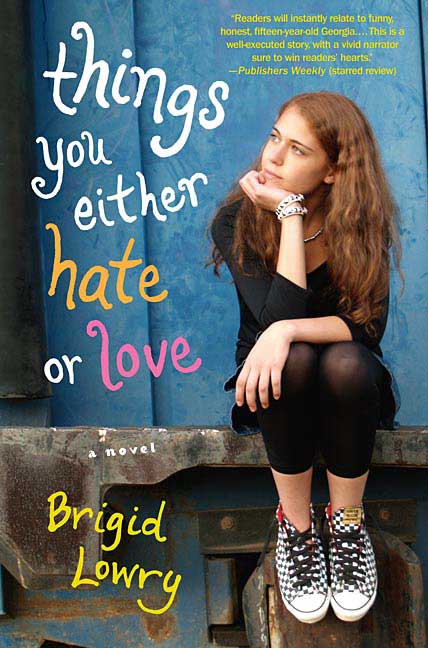
If I have any complaints about the book it’s that the girl on the cover is a misrepresentation of the Georgia in the book  – although I have no doubt that Georgia is nowhere near as plain as she thinks she is. Also, Georgia contracts glandular fever and loses a lot of weight…just in time for the book’s happy ending.

That said, I really enjoyed Things You Either Hate or Love. Georgia is lovely and her trials are relate-able without being overwrought. It is a skilled writer who can make a book without an overabundance of teenage drama compelling and entertaining.

Monsters of Men – Patrick Ness

My love affair with Patrick Ness’s Chaos Walking trilogy began with The Knife of Never Letting Go. The next book, The Ask and the Answer was also fabulous. Last night I finished the third book, Monsters of Men. I am not ashamed to say that I cried.

Monsters of Men begins on the eve of war. Todd and the Mayor, and  Viola and Mistress Coyle are not only at a stand-off with each other, The Spackle (the indigenous people of New World) have risen up to annihilate them. War proves to be frightening and messy and dangerous.

The flames spill out from the top of the horned creacher and cut thru the middle of soldiers and men are screaming  and burning and screaming and burning and soldiers are turning back and running and the line is breaking and Angharrad is bucking and bleeding and squealing and we’re slammed by a wave of men retreating and she bucks up again and–

The lines between hero and villain, good and evil, are  blurred in Monsters of Men. I found my feelings about the Mayor constantly changing. Is he a decent man caught up in extraordinary times? Is he a master manipulator? Is he a monster? Mistress Coyle didn’t fair much better in my estimation. Viola and Todd ask the same questions about the adults nearest them and as they aren’t physically together for much of this book, they also ask it of each other. How have circumstances changed them?

There’s also a new point of view to consider in Monsters of Men: the Spackle. For the first time we get to hear their noise. Truthfully, I found some of this bothersome because of the names they ascribed to things: the Burden, the Clearing, the Knife, the Sky, the Source. I was caught up in the narrative and it slowed me down trying to figure out who or what  they were talking about. Nevertheless, the Spackle are no longer a faceless enemy — if they ever were the enemy at all.

There are big questions to be considered in this novel, in the series as a whole. Despite the fact that Chaos Walking is marketed as a Young Adult series, Ness doesn’t shy away from asking them. Why do we fight? What does it mean to be human? I even think there is something in the books about this information age — the constant bombardment of data and noise we endure every day. With no quiet space to think, don’t we all have the potential to be driven a little mad? Alternatively, can’t we use this information to better understand and empathize with each other?

As the Mayor says to Todd near the end of the book, “War makes monsters of me, you once reminded me.” It is messy business, to be sure. But there is great humanity in these books. And Todd and Viola, as characters, will be with me for a long, long time.

A Must Read series!

Gone – Kathleen Jeffrie Johnson

Connor, the 17-year-old protagonist of Kathleen Jeffrie Johnson’s YA novel, Gone, is straddling the  fence between innocence and experience. He has just graduated from high school, lives with his Aunt Syl, and visits his father in a nursing home where he has been living ever since he crashed his car while driving drunk. His mother is also a recovering alcoholic.  He is certainly vulnerable to the advances of Corinna Timms.

Ms. Timms was one of Connor’s high school teachers.

Zach…called Ms. Timms serious babe material – too bad she was their teacher. Connor called her, just to himself, beautiful. Half the time in her class had been spent trying not to stare at her, then failing his resolve, ducking his head when she turned around from the blackboard and caught him.

For the nanosecond that their eyes locked – what?

It’s this what that drives the narrative of Gone. As Connor moves through his days, avoiding his mother, working at Chow Line, hanging with his friend, Zach – he does his best to avoid thinking about his growing feelings for Ms. Timms. But it is clear to the reader (and Connor’s closest friends) that something is happening. And make no mistake – the fuel for Connor’s growing obsession is hormones.

Connor’s feelings for Ms. Timms are, in part, exacerbated by his parental issues. When his father dies and his mother, newly sober, comes to town, Connor is forced to confront some of his painful family problems. By then, though, things with Ms. Timms have crossed the platonic line and his world spins off its axis.

Gone is not a love story. Ms. Timms has her own demons. In the end, she comes across more as predator than genuine friend. And while Connor’s world does shift dangerously off track, he is a smart kid and I suspect that he’ll be okay in the end.

This book won’t be everyone’s cup of YA tea. But it’s intelligent and well-written, although there is some strong language. Obviously.

Right Behind You – Gail Giles

On the afternoon on his seventh birthday, I set Bobby Clarke on fire.

I was nine.

It was all about Bobby’s birthday present.

A baseball glove.

Gail Giles YA novel Right Behind You grabbed me from the start. It’s the story of Kip McFarland who lives a hardscrabble life with his father in the Alaskan wilderness. Kip’s mom has recently died of cancer, and you get the impression that Kip and his father aren’t coping too well.

When Bobby Clarke shows up to gloat about his new baseball glove, Kip overreacts and douses him with gasoline. What happens next is shocking and tragic and changes Kip’s life forever.

Kip spends the next five years of his life in a locked down psychiatric facility. The reader has a front row seat to Kip’s therapy, and his own attempts to sabotage his recovery. But life does go on for Kip and his father once Kip is released. Right Behind You drags the reader along with Kip as he struggles to reinvent himself.

This story is successful on a couple fronts. For one thing, the writing is interesting. I loved the line: The hollow inside me filled up with red mean. I liked it so much, I stopped to copy it down when I read it. I also loved Kip and that’s saying something because, let’s face it, what he does to Bobby is inexcusable even if he was only nine. He’s smart and he has the ability to scratch beneath the surface of his own psyche. He doesn’t always like what he finds, but that’s what makes him human.

The story takes us from Alaska to the Texan coast and even though several years transpire, I never felt as though Giles was rushing to the conclusion. And when Kip gets there – to the next part of his story – readers will wish him peace because he’s earned it.

14/365