When Silla and Nori arrive at La Baume, their mother’s ancestral home, they are tired, hungry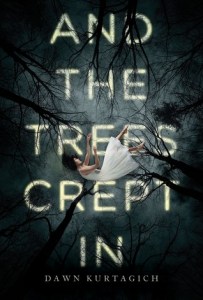 and afraid. They’ve run away from home and come to the only place they thought they might be safe. But La Baume is not safe.
“You must never, never go into Python Wood” their Aunt Cath tells them.
You need to hear this as well, Silla. A monster of sorts. He did terrible things. And then he returned to the woods. He’s still in there, waiting for young girls to go wandering so he can capture them. So he can tear them up and eat their flesh from their – “
Dawn Kurtagich’s YA novel And the Trees Crept In is a nightmarish tale of impending doom. Silla is just 14 when she and Nori, 4, arrive from London. They’ve run away from home, specifically from their father who is a violent drunk. La Baume seems magical, if a little dilapidated, at first. There was a garden, plenty of food and “It was paradise. It was almost a home.”
But Aunt Cath wasn’t joking about the woods or The Creeper Man, and soon the girls, particularly Silla, are feeling isolated. The post man stops coming, there’s news of an impending war, and then, after months of not seeing a living soul, Gowan appears.
And the Trees Crept In is a page-turning puzzle of a book. Kurtagich includes diary entries, pages ripped from books, lists, and odd typography. If you’ve read Kurtagich’s novel The Dead House you will be familiar with some of these literary bells and whistles. It makes for an immersive reading experience.
Life becomes increasingly more claustrophobic for Silla and Nori, particularly once Cath seems to suffer from some sort of breakdown and cloisters herself in the attic. There’s no food. A terrifying trip through the woods to the local village reveals boarded up businesses and houses. If not for Gowan arriving from somewhere with apples, Silla and Nori would starve. Worse than that, though, there seems to be someone in the house with the girls, and even more horrifying, the trees seem to be closing in on them.
And the Trees Crept In is like a horrifying fairy tale. The boogey man is right outside their door, and there is no escape for the sisters. Even Gowan seems helpless. I changed my mind several times about what was happening, and I was wrong. When the narrative resolved itself, and I am happy to say that it’s a terrific ending, I felt utterly wrung out and 100% satisfied (although a little gutted, too.)
If you’re looking for a creepy, compelling, well-written read-past-your-bedtime book, I highly recommend this one.
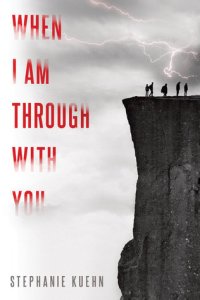 Charm & Strange
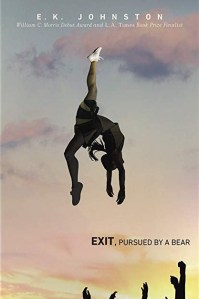 cheerleading team, she is looking forward to one last cheerleading camp, one last year of school and then the freedom her future offers her. She is smart, fun-loving and although she loves cheerleading and takes it seriously, she is not the stereotypical cheerleader. To be honest, there isn’t actually a mean or petty girl in E.K. Johnston’s YA novel Exit, Pursued by a Bear.
  I could NOT put this book down. From the moment I met Julian and Adam, the two narrators of Robin Roe’s debut novel A List of Cages, I was immediately invested. This is a book with so much to say, but its messages are never didactic. It’s horrifying and heart-warming in equal measure.
 One of my favourite YA tropes is bad boy/good girl. I can’t seem to get enough of it, really, and if there’s a heaping helping of angst thrown in, well, it doesn’t really get much better than that. Allison Van Diepen’s novel On the Edge seemed like it might have the goods, but it was only just okay.
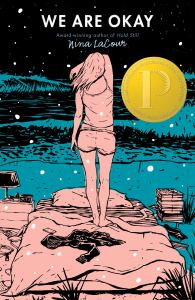 nature of grief. This is a quiet novel, and so I would caution readers not to expect histrionics or very much action. Instead, LaCour focuses on the protagonist’s interior life, which has been altered by loss.
 In a not-too-distant future universe- or I don’t know, maybe it’s way in the distance – Mateo Torrez gets the call everyone dreads:
 It’s amazing how sheltered I am. I remember reading The Kite Runner years ago and being shocked how little I knew about that conflict. And I know next to nothing about the conflicts in Africa. Michael Williams’ YA novel Now is the Time For Running doesn’t spend too much time talking about the politics of the conflict, but readers will soon understand the chaos and devastation it causes.
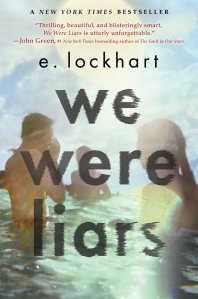 Cadence Sinclair, the narrator of E. Lockhart’s riveting YA novel We Were Liars, lives a seemingly charmed life. The eldest of the Sinclair grandchildren, she summers with her cousins Johnny, Mirren, Liberty, Bonnie, Will and Taft on Beechwood Island, a private island off the coast of Massachusetts, somewhere near Martha’s Vineyard. Her grandparents, Harris and Tipper, have a created a sort of kingdom on Beechwood. Each of their three daughters has their own house on the island, but everything revolves around the patriarch. There is a lot of drinking and in-fighting, all of it held together by Tipper. When she dies, the daughters and their children, who are used as pawns to secure Harris’s favour, go a little off the rails.
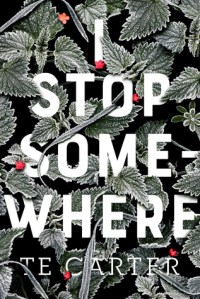 teenager who wants to make a good impression when she starts high school. Ellie understands that “Pretty is power.” She’s never really fit in, but she is determined that when she starts high school, things will be different.
 The Ludic Reader