Ruta Sepetys has a gift. Well, she has many gifts, to be fair, but I particularly admire her ability to write characters that absolutely lift off the page and linger in your imagination long after the last page has been turned.
At my high school, we introduce readers to Sepetys in grade nine, when we read Between Shades of Gray. I have yet to encounter a student, even those who identify as non-readers, who doesn’t rip through that book, many reading way ahead of the class. In grade ten, when we introduce Salt to the Sea there are very few groans. Again, students quickly become wholly invested in the stories of the characters. When I read the final few pages out loud to my grade ten classes in the fall, I had to stop several times because I was so close to tears I couldn’t get the words out. That’s how you know these characters have become real to you, I guess: you care about their fate.
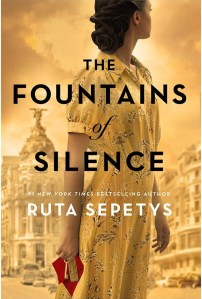 I was very excited to read Sepetys’s latest book, The Fountains of Silence, because I just knew that I was going to meet a new cast of characters to fall in love with, and I wasn’t wrong.
Daniel Matheson is almost nineteen when he travels to Madrid with his parents during the summer of 1957. His father is an oil tycoon from Texas, and his mother is originally from Spain. Daniel’s dream is to become a photo journalist, but his father disapproves. While Mr. Matheson does business, Daniel takes pictures, and in doing so he starts to see that sunny Madrid is one city to tourists and another to people who struggle beneath Francisco Franco’s yoke.
Ana works in the hotel and is assigned to help the Mathesons. Her story is one of poverty and struggle. Her father was executed and her mother imprisoned and “Her parents’ offense has left Ana rowing dark waters of dead secrets. Born into a long shadow of shame, she must never speak publicly of her parents. She must live in silence.”
Ana and Daniel feel an instant attraction to each other, but it’s the classic case of being from opposite sides of the social spectrum. There is so much Ana wants to say and can’t, and so much that Daniel doesn’t understand, but certainly will.
Although Ana and Daniel’s story is central to the plot, there are other compelling characters in this book, including Ana’s older brother Rafa and his childhood friend, Fuga; Ben, a seasoned journalist who takes Daniel under his wing, and Puri, Ana’s cousin who works at a local orphanage. Although Ana and Daniel will take up most of the space in your heart, all the characters you’ll encounter are compelling and interesting.
Once again, Sepetys has mined history to find her story. This one concerns the thousands of children who were stolen from their parents and adopted by more ‘suitable’ families. It also provides a window into the period of the Spanish Civil War and the years immediately following, when “Helpless children and teenagers became innocent victims of wretched violence and ideological pressure.”
Their stories deserve to be told and Sepetys does them, and us, a great service by telling them.
Highly recommended.
 It’s hard to wrap my head around gun violence as it exists in the U.S. My dad had a couple hunting rifles when I was a kid, but I don’t recall ever seeing them. No one I know has a gun in their bedside drawer…just in case. When I wrote a review for
  Rufus Holt is having a really fucking bad day. I use the expletive because, well, there’s a lot of F-bombs in Caleb Roehrig’s YA mystery White Rabbit. I’m not a prude by any stretch, but I have to admit that by the end of the novel I was getting a little tired of all the swearing. Surely teenagers as smart as the ones who populate Roehrig’s world would have the vocabularies to match.
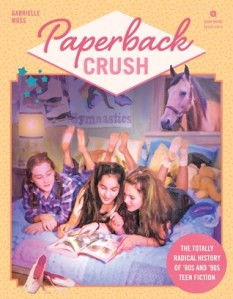 I couldn’t resist picking up Paperback Crush, a colourful, sometimes snarky look at the Young Adult fiction published in the 1980s and 90s. Author Gabrielle Moss say that the book is “here to honor the young adult lit published after Judy Blume but before J.K. Rowling.” Those decades produced more YA than the previous decades, but the quality, I suspect, wasn’t what we’ve come to expect from modern YA. And I read a lot of YA.
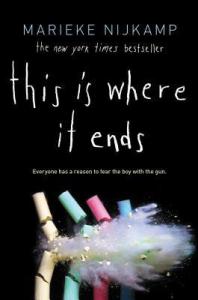 Marieke Nijkamp tackles gun violence in her compelling (and heartbreaking) YA novel this is where it ends.
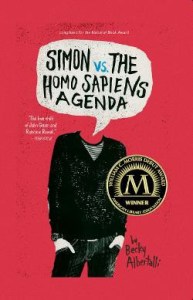 Becky Albertalli’s YA novel Simon vs. The Homo Sapiens Agenda won the William C. Morris Debut Award, but the accolades don’t stop there. The book has been praised or recognized by everyone from ALA, Carnegie, Oprah and Lambda. Although this book has been on my shelf for a couple years, as soon as I knew the movie was coming out – I knew I had to read it…and I am soooo sorry I waited so long.
 In Jolene Perry’s novel Stronger Than You Know, fifteen-year-old Joy Neilsons has come to live with her aunt and uncle after having been removed from the trailer home she was living in with her mother. The Child Services Summary Report indicates that she wasn’t allowed out of the 750 sq. ft. mobile home, did not attend school and was dehydrated and malnourished when authorities removed her.
 Back in the day, there probably wasn’t a teenager alive who hadn’t read The Outsiders, S.E. Hinton’s first novel. Written when Hinton was just sixteen and published around the time she graduated from high school, The Outsiders tells the story of the Curtis brothers Darry, Soda, and Ponyboy. It’s considered the seminal young adult novel and remains a classroom favourite almost 50 years after its publication.
 The Ludic Reader