
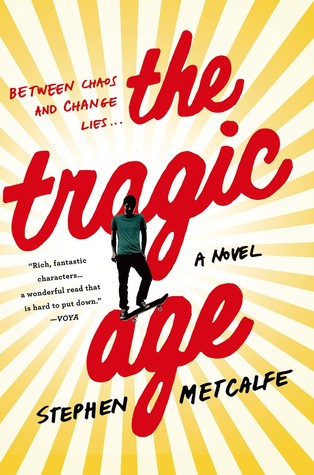
Billy Kinsey is an outsider. It’s not just the port-wine hemangioma on the right side of his face. It’s not just the fact that he’s moved to L.A. suburb from the San Joaquin Valley, where he lived a slightly more normal life. It’s not just that he’s an insomniac. It’s not just that his father won 37 million dollars in the lottery and now his mother lunches and plays tennis and his father drinks. It’s not even just that when he was 11, his twin sister Dorrie died of cancer. Well, actually, it’s all of these things.
Stephen Metcalfe’s debut novel, The Tragic Age, is laugh-out-loud funny, tender and wry. Billy, 17, is adrift. He wants to do the right thing, but he’s not exactly sure what the right thing is. It isn’t until Willard “Twom” Twomey comes into his life, followed by the re-entrance of his sister’s childhood bestie, Gretchen, that the fog starts to lift for Billy.
Twom is a larger-than-life character. He doesn’t back down from anyone. When the school’s meathead starts teasing Twom about his name, Twom lets him have it with the back of his dinner tray.
I also soon discover that despite his revolutionary’s attitude towards rules and authority, Twom has his own highly evolved sense of right or wrong. He dislikes what he calls the “dickhead club” and he has complete empathy for the underdog.
Although I wouldn’t necessarily say that Billy’s an underdog, he sure could use a friend or two and Twom comes along at the right time.
So does Gretchen. Although Billy of course knows her, she and her family have been, until recently, living in Africa, where Gretchen’s father “was a hotshot doctor of infectious diseases.” Her arrival back in Billy’s orbit is problematic.
It goes without saying that girls can make you do insane things. One minute a guy can be, if there is such a thing, normal, the next, he’s cracking stupid jokes and running and dancing in place like a babbling, mindless idiot. Another word for this is “dating.”
The Tragic Age follows Billy as he navigates his final year of high school, falls in love and tries to figure out what anything means…and whether anything is worth it, after all. The grief he feels over Dorrie’s death is clearly unresolved; in fact, he and his parents never even talk about Dorrie. They don’t really talk about much of anything, and that’s part of Billy’s problem.
Billy is on a slippery slope and the novel’s final pages are made for the big screen. That makes sense, since Metcalfe has worked in the film biz. I’m not sure the frenetic pace suits the rest of the book, but I still really enjoyed it. Billy is a memorable character and his experience of disillusioned, navel-gazing, teenagedom will be recognizable to anyone who has ever struggled to fit in or figure out how to simply survive.


 her. The money she’s saved for a trip to Paris will instead pay for her funeral. She’s already booked cleaners to come in the day after. This is the scenario in Erica M. Chapman’s YA novel Teach Me To Forget.
 Seventeen-year-old Eddie and her mother have recently suffered a tremendous loss. Eddie’s father, a once-renowned photographer, has taken his own life and neither of the Reeves women are coping very well. Eddie’s mother drifts, ghost-like, around the house wearing her father’s housecoat being fussed over by her best friend, Beth, who drives Eddie “fucking crazy.” Eddie avoids her house as much as possible, choosing instead to hang with her best friend, Milo.
 who lives in Harlem with her twin brother, whom she calls ‘Twin’) and her Dominican immigrant parents. She’s a good girl; she has no choice. Mami’s rules are law, and Xiomara wouldn’t dream of breaking them. But there are some things Xiomara can’t control. For example, she is “unhide-able”
 The Ludic Reader