High school junior Ellery has a plan. The plan involves a gun. Nothing is going to stop 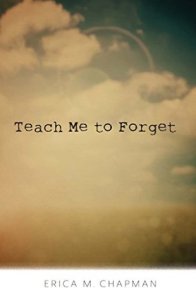 her. The money she’s saved for a trip to Paris will instead pay for her funeral. She’s already booked cleaners to come in the day after. This is the scenario in Erica M. Chapman’s YA novel Teach Me To Forget.
There are, she understands, a couple flaws in her plan. Her bestie Jackson is one of them.
Jackson will hurt. We’ve been best friends since he climbed my tree and broke his leg in second grade. He’ll get over it. He’ll find another friend. Someone who deserves him more than me.
Her mother is another one; “…there’s a sadness in her eyes” that Ellery feels responsible for. And then there’s Colter Sawyer, the high school senior who just happens to be working at the K-Mart when she tries to return the gun (which turns out to be defective).
Colter is in Ellery’s AP English class, but the two are not friends. He is immediately suspicious of Ellery telling her “There’s no way anyone sold that gun to you.” Colter recognizes in Ellery something he has seen before and he makes it his mission to “save” her.
I don’t really know how to feel about this book. On the one hand, it highlights the helplessness and hopelessness of a suicidal person. It also tries to illustrate the importance of having people in your life, connections that you can count on. There are moments of surprising humour and the relationship between Jackson and Ellery is lovely. Jackson was my favourite character, but as things heat up between Ellery and Colter, he seems to drop off the page.
There was also something sort of shrill about the book, though. Ellery was constantly screaming and running away from situations. I get that she is unwell and I had a great deal of sympathy for her. I also wondered why her mother, a nurse of all things, didn’t notice that her daughter seemed to be going off the rails. Yeah, I know, she was dealing with her own grief, but still. Not even a little bit suspicious? And then there’s Colter, whose own backstory, while tragic, makes him wayyyy too patient with Ellery. Given his circumstances, and knowing what he knows, you’d think he’d be a little bit more aggressive with getting Ellery professional help. “I love you” doesn’t necessarily save the day.
I appreciated what the book was attempting to do. It worked on some levels, but some of the characterization was a miss for me.
 Emily Chenoweth’s debut novel Hello Goodbye was inspired by the author’s life. Her mother was diagnosed with a brain tumour when Chenoweth was in her first year of college. Instead of writing a memoir, though, the author decided to use her experiences as fodder for a work of fiction because she could “explore the feelings and experiences that I did remember, but I could also craft a story that had a different arc than my own.”
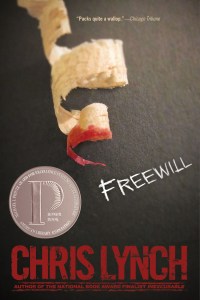 a horrible tragedy. Now he lives with his grandparents who are “Kind people. They didn’t have to take you in. Or did they? Love? Is it love? Charity.”
 Seventeen-year-old Eddie and her mother have recently suffered a tremendous loss. Eddie’s father, a once-renowned photographer, has taken his own life and neither of the Reeves women are coping very well. Eddie’s mother drifts, ghost-like, around the house wearing her father’s housecoat being fussed over by her best friend, Beth, who drives Eddie “fucking crazy.” Eddie avoids her house as much as possible, choosing instead to hang with her best friend, Milo.
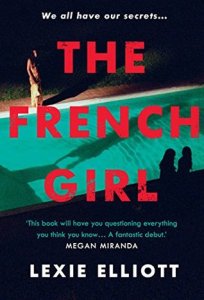 Oxford. That’s where they meet Severine, the girl next door.
 There’s no nuance in Karen Hamilton’s debut novel The Perfect Girlfriend. The narrator, Juliette (aka Lily. aka Elizabeth) is crazy. For reasons. She’s on a mission: to reclaim Nate, the man who dumped her seven months ago, unceremoniously kicking her out of his swanky Richmond (near London) flat.

 trying to control the scene, aka control the top (dominant person). That’s exactly what Nora Tibbs is attempting when she pursues a relationship with Michael (referred to as M.) the music professor she’s convinced murdered her younger sister, Franny, in Laura Reese’s novel Topping From Below.
 I don’t know how much readers actually care about the awards books win, but Elizabeth Strout’s novel Olive Kitteridge won the Pulitzer in 2009 and the book has been languishing on my tbr shelf since about then. It was June’s #bookspin choice on
  it was too cute to pass up. And, let’s face it, I probably do judge people by their bookshelves – well, I am more likely to judge people who don’t have any.
 The Ludic Reader