The Comfort of Monsters – Willa C. Richards

Hot on the heels of my last novel about sisters, False Witness, comes another book about sisters: The Comfort of Monsters by Willa C. Richards.
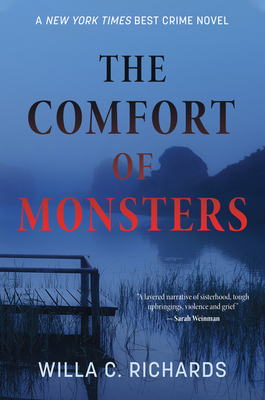
In this story, Peg McBride recalls the summer of 1991 when her younger sister, Dee, disappears. Dee’s disappearance barely causes a ripple in the crime landscape because she goes missing in Milwaukee in 1991, the same time as Jeffrey Dahmer was arrested.

Peg narrates the story of her relationship with her sister as children and young adults up until Dee’s disappearance, and then thirty years in the future when her ailing mother hires an internet-famous psychic in a last-ditch effort to find out what happened to Dee. It’s this development that causes Peg to reminisce about her sister, although I think Dee has informed every single decision Peg has made over the past 30 years.

Peg has always been convinced that Dee’s much older boyfriend, Frank, was responsible for Dee’s disappearance. She hadn’t liked him pretty much on sight.

Frank hugged me when we met. I didn’t like the feeling of his body against mine. I kept my arms awkwardly by my sides. When he pulled away, I felt like he was looking through my clothes. Some men seem to be able to do that–to make you feel totally naked.

After Dee’s disappearance, Frank vanishes into the ether and the case languishes. But despite being billed as a crime novel, the mystery of what happens to Dee isn’t really what this book is about. Sure, it informs Peg’s character (which isn’t particularly likable), but readers looking for a fast-paced mystery are not going to find that in The Comfort of Monsters.

Instead, the novel is a slow-moving, meandering character study of family dynamics, romantic entanglements, our fascination with true crime, race and memory.

Memory, of course, is also a story. It feels like the truth, especially when there is no one to dispute your recollection of events. But it is a story nonetheless–some moments have been elided, and others have been emphasized and made either luminous or horrific or both. […] And because now, more than ever, my sister’s case depends on these memories, I am terrified that crucial pieces of evidence have been lost along the way.

I liked it, but didn’t love it.
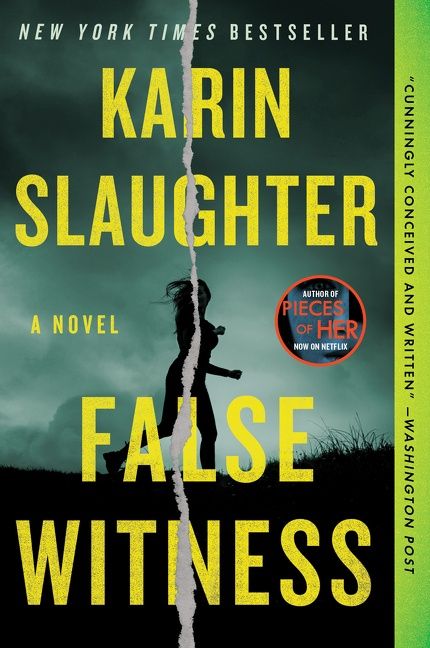
False Witness – Karin Slaughter

I know that American crime writer Karin Slaughter has legions of rabid fans, but I don’t think that I am one of them. I mean, maybe I am throwing in the towel too early because I have only read one other book, Pretty Girls, besides this one. Like that one, this is a propulsive read about estranged sisters, and horrible crimes against women.

Leigh Collier is a lawyer working her way up the food chain. Her younger sister, Callie, is a hard core drug addict living mostly on the streets. Their lives rarely intersect until Leigh is assigned a new case that sends her hurtling back to her teen years.

Andrew Tenant has been accused of brutally raping a woman and leaving her handcuffed to a table in a park. He’s fired his lawyer and hired Leigh. Turns out, he’s not a stranger.

She would never forget him. Trevor Waleski had been a sweet kid. A little awkward. A lot clingy. The last time Leigh had seen him, he was drugged into oblivion. She had watched her sister gently kiss the top of his head.

Trevor aka Andrew hired Leigh because he knows something devastating about Leigh and her sister and he won’t stop until he gets exactly what he wants. The book spends 600+ pages with the sisters as they try to outmaneuver Andrew who, as it turns out, is pretty dang smart. And also a psychopath.

The book has all the requisite twists and turns. Callie was my favourite sister and her relationship with Dr. Jerry, the memory-impaired veterinarian for whom she sometimes works (and steals drugs from) is my favourite relationship in the book. Leigh’s husband, Walter, is also a great guy. He is kind to Callie and supportive of Leigh even though they are currently separated.

The book takes place during the height of Covid – so there’s social distancing and masks. Not sure it adds anything in particular to the story, but Slaughter herself said “Covid has exposed the ever-widening chasm between the haves and have-nots, spotlighted the housing crisis and food insecurity, focused attention on the lack of proper funding for schools, hospitals, and elder care, exposed a bankruptcy of trust in our government institutions, exacerbated the horrendous treatment of inmates in our jails and prisons, exponentially worsened xenophobic, misogynistic, and racist hate speech, heightened racial inequalities, and as usual, has grossly overburdened the lives of women; all topics I have attempted to touch on within the pages of [this] book”.

None of the Covid stuff did any of that for me, really, but perhaps other people will find that it added another layer to the story. I don’t know that I would have kept reading except that I wanted to find out how Callie and Leigh were going to get out of the bind they were in. Was the ending satisfying? Believable? Not sure. Lots of people will love this book, but I think my journey with Slaughter ends here.

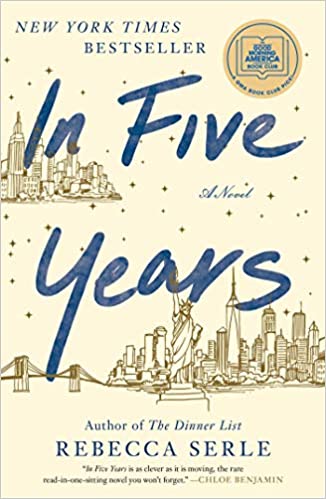
In Five Years – Rebecca Serle

I don’t think that I got the book I thought I was going to be getting with Rebecca Serle’s novel In Five Years. That’s not the fault of the book.

Dannie Kohan is living her best life as a lawyer in NYC. She has a fabulous apartment, a fabulous boyfriend and a bestie, Bella, who completes the fabulous circle of her life. One morning, after David proposes, she wakes up in a bed that is not hers with a man who is not David. It would seem five years have passed, but Dannie doesn’t remember any of it. When she wakes up, her world seems to have righted itself again.

Then, Bella introduces Dannie to her boyfriend, and it’s the hunky dude from Dannie’s dream. What does it all mean?

It would be a mistake to think that In Five Years is a romance in the traditional sense, and honestly, that’s what I thought I was going to get. Nevertheless, it is a love story.

Bella and I have been best friends since we were seven years old. Me, Nice Jewish Girl from the Main Line of Philadelphia. Her, French-Italian Princess whose parents threw her a thirteenth party big enough to stop any bat mitzvah in its tracks. Bella is spoiled, mercurial, and more than a little bit magical. It’s not just me. Everywhere she goes people fall at her feet. She is the easiest to love, and gives love freely. But she’s fragile, too. A membrane of skin stretches so thinly over her emotions it’s always threatening to burst.

So, these two women love each other and anyone who has a bestie will certainly relate to their friendship. But like any love story, it’s not all smooth sailing. I wish I could say it was as simple as Dannie’s dream and then meeting her dream guy in the flesh. But Serle goes a different route and your appetite for the story she tells will depend on whether or not you have a tolerance for …well, no spoilers.

I liked One Italian Summer better.

Auto Buy Authors: Lisa Reardon

In my continuing series on the authors whose books I will always buy, this month’s featured auto buy author is Lisa Reardon. There is very little updated info about Reardon on the internet and that’s because she pretty much dropped off the face of the map in 2010 when she was incarcerated for the assault with the intent to commit murder of her father. Her sentence was four – seventeen years. There is very little information to be had about Reardon, but here is another account of the events surrounding this incident. I believe she only served a couple of years of that time and once she was released she sort of disappeared from the spotlight. As far as I know, she only wrote three novels and I have read all three. If by some miracle she wrote something else, I would hand over my money in a nanosecond.

I read Reardon’s novel Billy Dead at least 20 years ago and it is a book that has lodged itself in my heart for many years. My read of it predates this blog, but I reposted the NY Times review of it here.

“People lose people. I don’t know why we’re all so damned careless. Folks lose their kids, men lose their women, even friends get lost if you don’t keep an eye out.”

No question, Billy Dead is not going to be everyone’s cup of tea, but I am a fan of gritty fiction and in Reardon’s capable hands, the story of siblings Ray, Jean, and Billy is a gut punch of a book. The dysfunction is a deep, dark well in this book and so is the abuse, but then so is the love. I think I really do need to read it again. I definitely became a fan of Reardon.

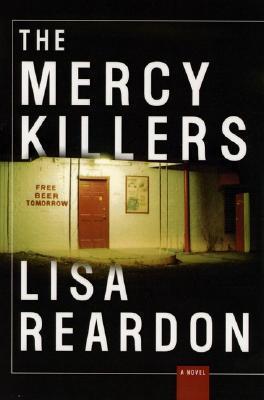
Next I read The Mercy Killers.

“It’s hard to think how different their lives would have been if it weren’t for the mess they got themselves into, if it weren’t for that war, if they hadn’t all been so young and stupid and scared.”

In my review of this book I said “Lisa Reardon writes about characters who live in a world vastly different from my own. They are broken-down people whose lives are messy – filled with violence and alcohol and drugs and hopelessness.”

Although I wouldn’t have thought that I would like The Mercy Killers based on its synopsis, I did like it.

Then I read Blameless.

I said: “Blameless is a quiet novel where nothing much happens. Mary is often her own worst enemy, but as her story is pulled back layer by layer and you come to understand all the ways life has kicked her in the teeth, you just want something, anything, good to happen for her. Reardon has a particular gift when it comes to writing broken characters and I really enjoyed my time with Mary, even though, like her previous novels, the story is pretty grim.”

“Oh my God,” she cried. “Oh my God,” with heaving, gasping, snot-filled sobs.

“It’s all right, Sharon.” I pulled my visor down low over my face. People up and down the beach were looking at us. “It has a happy ending.”

Across the board, Reardon’s novels are compelling, dark, potentially triggering and definitely ‘go there’ in ways that might make many readers uncomfortable. But they are also really well-written, heart-wrenching, and compelling. Therefore, although I suspect I will never have the opportunity to buy another book by her, Lisa Reardon is an auto buy author.

Carmilla – Sheridan Le Fanu

According to Encyclopedia Britannica, “Jure Grando Alilović or Giure Grando (1578–1656) was a villager from the region of Istria (in modern-day Croatia) who may have been the first real person described as a vampire in historical records.” John Polidori’s 1918 short story The Vampyre is the first modern literature to feature the bloodsucking creature of the night, Lord Ruthven, who was famously inspired by Polidori’s employer, Lord Byron.

Sheridan Le Fanu’s 1872 novella Carmilla predates Bram Stoker’s far more famous Dracula by 25 years. Le Fanu was a well-known writer of horror and mystery fiction during the Victorian period, and the author of fourteen novels and many short stories. And yet, he’s not nearly so well known as Bram Stoker, who is often credited with creating the archetypical vampiric character. (I don’t mean to say that Le Fanu is not well known, but I read Dracula as a teenager and I only heard of Carmilla a decade or so ago.)

Carmilla is the first person account of Laura who lives with her widowed father in Styria, Austria. The pair and their servants live in an isolated schloss (castle), the nearest village seven miles away. Laura is telling the story of what happened to her when she was nineteen from a point eight years in the future.

I am now going to tell you something so strange that it will require all your faith in my veracity to believe my story. It is not only true, nevertheless, but truth of which I have been an eyewitness.

A chance carriage accident brings a young lady, Carmilla, to the schloss. Her mother must attend to urgent business, but Carmilla must rest after this accident, and Laura’s father graciously agrees to welcome her into his home. After all, Laura could use a companion. Soon, though, Laura begins to feel unwell.

I felt myself a changed girl. A strange melancholy was stealing over me, a melancholy that I would not have interrupted. Dim thoughts of death began to open, and an idea that I was sinking took gentle, and, somehow, not unwelcome possession of me.

Of course, modern readers will know immediately what’s happening. Carmilla is SPOILER ALERT the undead. And, of course, the supernatural shenanigans in Le Fanu’s novel will seem pretty tame by modern standards, but I can only imagine that Victorian audiences would have been shaking in their boots to read of some of the images that plagued poor Laura.

For a vampire literature completist, Carmilla is a must read.

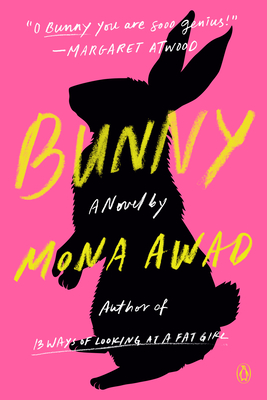
Bunny – Mona Awad

For a while, Bunny was everywhere and so I bought it and shelved it and, finally, I’ve read it. Canadian writer Mona Awad’s story of academia, writing, and mental health (??) is a masterclass of a fever dream and more than once I was scratching my head and asking myself just what in the heck is going on. When I turned the last page, I still can’t say for sure what I read.

Samantha Mackey is in the graduate writing program at an elite New England college, Warren University. In her writing class of five, she is the outlier; the other four women in the class, The Duchess, Cupcake, Creepy Doll, and Vignette, are an insular group who affectionately call each other Bunny. Their affectation drives Samantha crazy and she and her bestie, Ava, spend most of their time mocking the other women.

How fiercely they gripped each other’s pink-and-white bodies. forming a hot little circle of such rib-crushing love and understanding it took my break away.

[…]

I quietly prayed for the hug implosion all last year. That their ardent squeezing might cause the flesh to ooze from the sleeves, neckholes and A-line hems of their cupcake dresses like so much inane frosting.

But then, one day, Samantha gets invited to Smut Salon, a gathering of the bunnies where they share their “Absolute Truth” and drink a “bile-green concoction in which what looks like a small black turd floats.” Suddenly Samantha finds herself one of the members of this strange sisterhood and losing, it seems, her grip on reality.

This is a crazy novel, honestly, but I gobbled it up in a couple sittings without complaint. I think much of what happens is deliberately ambiguous. Is Samantha going crazy? Are the student bunnies really turning actual bunnies into subservient men (although men without penises and who have to wear gloves because their hands are deformed)? Is the whole thing a metaphor for the creative process? Why can’t Samantha write anything? Why does Ava disappear? Who is Max? So many questions and although none of them are answered in a specific way, I think I am satisfied with my own interpretation of the the book. Which I am not going to share here because you’ll want your own.

Definitely worth a read.