The Finishing School – Joanna Goodman

An invitation novelist Kersti Kuusk receives to attend the 100th anniversary of the boarding school she went to in Switzerland coincides with the news that one of her former classmates has died after a battle with cancer. In her last letter to Kersti, Lille reasserts that their mutual friend Cressida had not fallen by accident and that incriminating evidence to prove this might be found in the Helvetians ledger.

Canadian novelist Joanne Goodman’s novel The Finishing School toggles between the present, where Kersti and her husband Jay are struggling to conceive and Kersti is also out of ideas for her next novel, and the past, where Kersti’s time at the Lycee International Suisse is unspooled.

Born to Estonian immigrants, Kersti is the youngest of four sisters. The honour of attending the Lycee had fallen to Kersti because “her sisters didn’t have the grades to earn the Legacy Scholarship,” but Kersti also suspected that “her parents are sending her away because they’re exhausted.”

Kersti’s new roommate is the beyond beautiful Cressida.

…she’s far from ordinary. She has a beautiful, unruly mane of hair, spiraling out in all directions. Her head is just slightly to big for her slender body, but she’s dazzling, with pale green eyes, exquisitely long lashes, and a prominent, arched brow […] all of it together a masterpiece of teenage magnificence.

Kersti spends the next few years of high school loving and loathing Cressida in equal measure. Cressida can be a lot, but she is also fiercely loyal and generous and her friendship affords Kersti a life she would never have had access to otherwise.

We learn early on that Cressida had fallen from the balcony of her dorm room, and Lille’s letter many years later dredges up all those old memories. When Jay suggests that there might be a new novel in this story, it is both a distraction from Kersti’s failed attempts to get pregnant (which is causing a lot of strife in her otherwise happy marriage) and also sends her down a rabbit hole in an attempt to figure out what really did happen almost 20 years ago.

The Finishing School is a real page turner and also a book about friendship, motherhood and loyalty. I could barely put it down.


None of This is True – Lisa Jewell

Lisa Jewell’s most recent novel, None of This is True, could have been ripped straight from the true-crime headlines. And just like a true-crime podcast or documentary, Jewell’s book is totally binge-able.

Alix Summer, a successful podcaster who lives a polished life with her successful husband, Nathan, and her two young children in a tony London neighbourhood, meets Josie Fair, a part-time seamstress with two adult children and a husband, Walter, who is old enough to be her father. Their meet cute happens at a local gastropub, not the sort of place Josie would normally be dining, but it is her 45th birthday and she wanted, for once, to do something special. Turns out, it is also Alix’s 45th birthday.

This incidental meeting seems momentous to Josie, so when she accidentally on purpose runs into Alix again she confesses that she doesn’t “break free of the past now, then when will [she]?” She wants to tell her story and Alix is looking for another project. Josie and her messed up life seems like the answer to her creative prayers.

It doesn’t take long for Josie to start becoming full-on obsessed with Alix’s house and the casual elegance of her life. She asks Alix to help her buy new clothes. She takes small, inconsequential things from the Summers’ home, which she visits regularly because Alix’s podcast studio is in the back garden. She captivates Alix with the story her relationship with Walter, which began when she was 13 and he was 42, and of a daughter who ran off at 16. Another daughter, Erin, never comes out of her bedroom. It is clear that Josie’s life is messed up.

Or is it?

As with all of Jewell’s really great books – you really won’t know what to believe…or in this case – who to believe. The book’s structure is comprised of podcast recordings, Netflix documentary transcripts and chapters told from both Josie and Alix’s point of view. It makes for easy reading; I read it in two days. Like the media it mimics, None of This is True is easily consumable, a big bowl of buttered popcorn that’s fun to eat but not exactly life-sustaining.

Tender is the Flesh – Augustina Bazterrica

I mean, there are dystopian novels and then there’s Tender is the Flesh.

Marcos Tejo’s life has fallen apart. His father has dementia and is existing in assisted living. His wife has had an emotional breakdown and has left to stay with her mother after the death of their infant son. Oh, yeah, and a deadly virus – well, that’s what the government claims anyway – has made it impossible to eat animals, so everyone now eats humans. That, of course, helps with population growth too, so it’s a win win.

People are specially bred as meat and Marcos works at one of the country’s best slaughterhouses.

No one can call them human because that would mean giving them an identity. They call them product, or meat, or food. Except for him; he would prefer not to have to call them by any name.

Bazterrica’s book is all kinds of ick. In scene after scene, we are treated to graphic descriptions of how this “special meat” is treated. And trust me when I say, it’s not good. It will be impossible not to imagine how the animals we eat every day are treated, and if there ever was a case for veganism, this book would be it. But, according to the scientists in Tender is the Flesh,

animal protein [is] necessary to live [and] doctors confirmed that plant protein didn’t contain all the essential amino acids, [and] experts assured that methane emissions from cattle had been reduced but malnutrition was on the rise, [and] magazines published articles on the dark side of vegetables.

When Marcos is gifted an F.G.P. (First Generation Pure) “head” to consume, his ambivalent feelings – which he mostly keeps buried – come to the surface. Once he cleans her up and discovers she’s beautiful he moves her from the barn to the house and one thing leads to another. The head can’t talk, of course; their vocal chords are removed – the killing is less noisy that way – so I guess their relationship is based on a needs must basis.

I mean, sure, I guess Tender is the Flesh has stuff to say, but Marcos is a hard character to warm up to. And you have to wade through a bucket of entrails and other gruesome stuff to get there. You’d kind of hope that Marcos would have some sort of epiphany or something, but this book is bleak start to finish.

And also. Yuck.

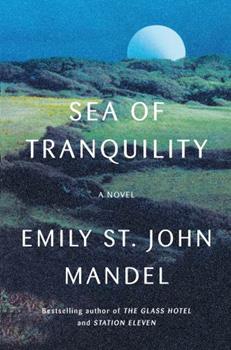
Sea of Tranquility – Emily St. John Mandel

It’s funny how some time travel books work for me and some don’t. Earlier this year I read This Time Tomorrow and I think that is probably my favourite book of the year. Years ago – before I started this blog – I read The Time Traveler’s Wife and cried so hard at the end, I couldn’t see the pages. So, I definitely went into Emily St. John Mandel’s Sea of Tranquility with an open mind, plus I loved Station Eleven.

The novel opens when Edward St. John St. Andrew is exiled from his home in England to the wilds of Canada, landing first Halifax before heading to the West Coast. It is 1912. While walking in the woods near the remote coastal community where he is staying, Edward has a strange experience

like a sudden blindness or an eclipse. He has an impression of being in some vast interior, something like a train station or a cathedral, and there are notes of violin music, there are other people around him, and then an incomprehensible sound–

Flashforward to 2020, where we are introduced to Mirella and Vincent – well to Mirella because Vincent is dead. The two women (yes, Vincent is a woman) had lost touch after Mirella’s husband had lost all his money in a Ponzi scheme orchestrated by Vincent’s husband and “how could Vincent not have known.” Now Mirella is at a concert waiting to talk to the composer, who is Vincent’s brother. It is here that we also are also introduced to Gaspery Roberts and the imminence of Covid-19.

Finally, in 2203, we meet Olive Lewellyn, who has come to Earth from the moon colonies to promote her latest novel, Marienbad, which is about “a scientifically implausible flu.” She has left her husband and daughter in Colony Two, “a city of white stone, spired towers, tree-lined streets and small parks.”

These three timelines are connected by Gaspery, but readers won’t really know it straight away. I am not a person who really digs into – or digs – the science of time travel: I enjoyed This Time Tomorrow and The Time Traveler’s Wife without spending too much time trying to figure out how all the pieces fit together. I found all the metaphysical stuff in St. John Mandel’s book a bit above my pay grade, honestly. And while Sea of Tranquility was easy enough to read, I didn’t really care too much about any of the characters so when it got to the end, and the discussion of life’s meaning – well, honestly…I just wasn’t invested.

I think my ambivalence is more about me than the book’s quality, though.

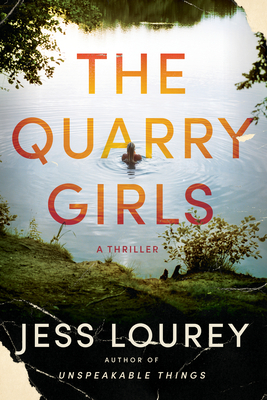
The Quarry Girls – Jess Lourey

Jess Lourey (Unspeakable Things, Bloodline) has written another fast-paced thriller ripped straight from the headlines. Literally. In her Author’s Note, Lourey says of her childhood home in Minnesota: “Three killers were on the loose in Saint Cloud when I was growing up. Only two have been caught.”

In The Quarry Girls, best friends Maureen, Brenda and our narrator, Heather, are coming of age in Pantown, a suburb of Saint Cloud, in 1977. Pantown was

built by Samuel Pandolfo, an insurance salesman who in 1917 decided he was going to construct the next great car manufacturing plant in good old Saint Cloud, Minnesota. His twenty-two-acre factory included fifty-eight houses, a hotel, and even a fire department for his workers. And to be sure they made it to work come sleet or snow, he ordered tunnels dug linking the factories and the houses.

One day, while playing hide and go seek in the tunnels, Heather and Brenda see something they aren’t supposed to see. When a local girl who is just a little bit older than they are goes missing, the teens begin some sleuthing of their own. It turns out that not everyone in Pantown is to be trusted.

There are all sorts of nefarious characters in this book including local boys Ricky and Ant and a new guy, Ed who

was way too old to be hanging out with high school kids, even a brain-fry like Ricky. […] Ed was exciting and terrifying and so out of place. His greased black hair and leather jacket against the soft, pastel Pantowners shopping behind him reminded me of a sleek jungle cat let loose in a petting zoo.

Even Heather’s parents, a mother who spends most of her time in bed and whose moods are unpredictable and a father, the local D.A. who is hardly never home, don’t seem all that reliable. Heather’s story is as much about the journey to adulthood as it is about what dark deeds are happening in Pantown.

And – an added bonus – so many references to the 1970s, the period of time in which I was coming of age. Heather’s friend Claude looks like Robby Benson. Getting dolled up meant an extra slick of Kissing Potion. Phones operated on a party line. Smokey and the Bandit was on the big screen. All these little nods to the period were just so much fun.

The story itself is fast-paced, well-written and I couldn’t put it down.

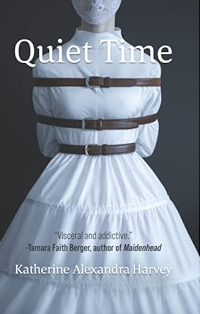
Quiet Time – Katherine Alexandra Harvey

Katherine Alexandra Harvey’s debut novel Quiet Time tells the (non-linear) story of Grace, the wild middle child of artist parents who (mostly) neglect and (sometimes) coddle their children.

My parents bought our house when my mother was pregnant. She was beautiful in a way that caused men to fall in love at first sight. Suiters would write poems about her, moaning Jayde, Jayde, Jayde, swearing they would die if she didn’t return their affection. She was often silent, lost in a daydream, didn’t return their affections.

Grace meets Jack when she is seventeen at a party hosted by her mother “for one of her new, young friends.”

He was tall, just over six feet, with dark curls piled on top of his head. He had sharp, high cheekbones that protruded just below his eye sockets. His lips were uneven, the bottom much fuller than the top.

Soon enough, Grace is hanging out with Jack, ostensibly to buy the weed that he sells. Jack is a few years older and a painter; Grace wants to be a writer. Their dynamic is not so dissimilar from her parents and it doesn’t take too long before it’s equally as dysfunctional.

I think if I had read this novel in my twenties I would have enjoyed it a lot more. There wasn’t anything wrong with it, but I just found the characters frustrating. Well, to be honest, young and stupid. Even the supposed adults, like Grace’s parents, behave like kids. The elliptical nature of the narrative made it virtually impossible to really settle into Grace’s story, which is told in vignettes. Perhaps that’s the point. Being a young adult isn’t pretty, I know, but it was hard, as a person in my 60s to really relate to any of these characters or their decisions.

The Handyman Method – Nick Cutter & Andrew F. Sullivan

I hadn’t heard anything about The Handman Method when I picked it up at the bookstore a couple weeks ago. I have an endless tbr list and so usually when I am buying books, I am choosing from that list. It’s very rare these days for me to buy books based on a cover or a blurb – unless I am familiar with the author. Nick Cutter (The Troop) aka Craig Davidson (Cascade, Cataract City, The Saturday Night Ghost Club) is a writer I really like, so when I saw this book, I bought it.

In this haunted house story, Trent and his wife, Rita, and their nine-year-old son, Milo, buy a new house in an unfinished subdivision. The house is spectacular but it “sat in moody isolation, a single unit in an otherwise uninhabited vista.” Still, it’s a dream house, the rooms “pristine, as if they had been finished with a jeweler’s attention to detail.”

It’s not perfect, though. Nick finds a crack in the master bedroom closet and it doesn’t take very long for things to start to get very weird.

Nick, a former lawyer (former because he’s on leave from his law firm after a strange incident), decides to tackle the crack on his own and that leads him to The Handyman Method, a YouTube channel where a man called Hank Trent offers his two subscribers advice on how to fix a crack in a wall and “Trent was immediately comfortable with Hank; the video was the equivalent of slipping into a comfy wool sweater.”

But Hank soon becomes an insidious force in Trent’s life and he’s not the only Internet personality who infiltrates the Saban household. Milo has his own YouTube obsession, Little Boy Blue, “a felt-limbed, Muppet-y creature [with a] toolbelt strung around its furry blue waist.”

The house starts to reveal its sinister underbelly, and I won’t spoil that for you. In many ways, it works as a haunted house story – and the backstory is …interesting. It’s hard to read a book with two authors and although Cutter explains in the notes the trajectory of the story, I’m still not quite sure how the whole thing went down.

I will say this, though: The Handyman Method didn’t really have the same emotional heft as Cutter’s other books (I am lumping all the books by Cutter/Davidson into this category.) I didn’t really care about this family as I probably should have and I am not sure if that is a flaw in the story or a flaw in me. There’s definitely some ick and some creepy moments, but I wasn’t blown away.

Strange Sally Diamond – Liz Nugent

Sally Diamond’s father always told her that when he died that she should put him out with the trash, so

When the time came, on Wednesday, 29th November 2017, I followed his instructions. He was small and frail and eighty-two years old by then, so it was easy to get him into one large garden garbage bag.

The first fifty pages of Liz Nugent’s novel Strange Sally Diamond flew by. I was wholly invested in Sally’s story and her peculiar personality. Her awkward interactions with the people who live in her small Irish town, the fact that she seemed so out of step with the world, her appearance — all of these things would have been interesting enough on their own. But there is so much more to her story and when a teddy bear arrives in the mail from New Zealand, Sally’s insular life explodes. Although she has always known that she was adopted, she didn’t know any of the details of the origins of her birth. Her father’s death and the arrival of this teddy bear exposes her dark past.

I don’t want to spoil the story – hers, or that of the novel’s secondary narrator, Peter – so it’s hard to really talk about without giving things away. In any case, my problems aren’t with the story itself, which certainly had lots of potential. And my problem wasn’t with Sally, either. Despite her idiosyncrasies, I quite liked her. And my problem wasn’t even with the writing itself, which was straightforward and easy to read.

Strange Sally Diamond is another case of a book that tells you things, sometimes at convenient times. The truth of Sally’s pre-adoption life is revealed to her in a series of letters. Despite Sally’s warm feelings about her father, his less-than-altruistic motives are revealed to us by her aunt, her mother’s sister. As Sally becomes less a fish out of water and more of an active member in her community, all too quickly (given the 40 years of isolation and trauma) she has a circle of friends, a social life, people looking out for her. I mean, I guess we can believe that the reason she never had any of those things is because her father was over-protective…

All the pieces fit neatly into place and perhaps that is the sign of a well-crafted novel, but for me, it was just okay.

Hello Beautiful – Ann Napolitano

Ann Napolitano’s novel Hello Beautiful is the story of the Padavano sisters, Julia, Sylvie and twins Emeline and Cecelia, who live with their parents, Ruth and Charlie in a Chicago suburb. Because she got pregnant with Julia very young, all Rose wants is for her daughters to get college degrees. Charlie, their dreamy, alcoholic, Whitman-quoting father, just wants them to be happy. And it seems they might be because they have each other.

Enter William Waters who ends up at Northwestern University on a basketball scholarship and meets Julia.

…Julia Padavano stood out in his European history seminar because her face appeared to be lit up with indignation and because she drove the professor – an elderly Englishman who held an oversized handkerchief balled in one fist – crazy with her questions.

Julia takes control of their relationship and draws him into her family life, introducing him to her younger sisters. Over the course of several decades, the sisters shift allegiances, but William is in the middle of it all.

Lots and lots of people loved this book, but I found it long and I found the characters sort of one dimensional. It takes a deft hand to traverse a rocky lifetime of family feuds and secrets, break ups and make ups. Ann Patchett always manages it. (Commonwealth, The Dutch House) I just found myself not caring too much about any of these people.

For example, Rose, the mother. After one of her daughters gives birth, she refuses to speak to her or meet the baby. When Julia gives birth, she flies off to Florida and speaks to Julia only rarely. At the novel’s conclusion — it’s happy families again. I just couldn’t quite figure out why her panties were in such a twist to begin with and this is how I felt through most of the story’s twists and turns. Are we really meant to believe that you are going to stop speaking to the people you love the most in the world for years, decades?

The novel is meant to be an homage to Little Women, with each of the sisters as one of Alcott’s famous siblings. I cared about those sisters; I didn’t care one bit about the Padavanos. There’s a lot of characters in this novel and a lot of telling too. It just wasn’t my cup of tea.

Go As A River – Shelley Read

While perhaps not as flashy as its set-in-the-natural-world predecessor Where the Crawdads Sing, Shelley Read’s debut Go As A River is start to finish even more satisfying. (I hated the ending of Owens’s book.)

Victoria ‘Torie’ Nash is just seventeen when her story begins. She lives with her mostly silent father, mean-spirited and trouble-making 15-year-old brother, Seth, and Uncle Og, a wheel-chair bound war veteran, on a peach farm in Colorado . Yes, you heard that right: a peach farm in Colorado.

Our farm was nothing special, nor was it very big, just forty-seven acres including the barns and the house and a gravel driveway as long as a wolf’s howl. But from the barn to the back fence line our land produced the only peach grove in all Gunnison County, where the fruit grew fat and rosy and sweet.

Torie has already experienced tragedy and her life is relatively sheltered – consisting of tending to the house and garden, preparing meals for her family and farmhands, and working in the orchard. Then, one day, she meets Wilson Moon and that “was a fateful moment.” Anyone who has ever fallen in love at that age will recognize the signs.

…I knew nothing, especially not of love’s beginnings, of that inexplicable draw to another, why some boys could pass you by without notice but the next has a pull on you as undeniable as gravity, and from that moment forward, longing is all you know.

Soon Torie and Wil are meeting every chance they get and for the first time in her life, Torie feels seen and understood. But, of course, their relationship is not without its difficulties. For one thing – it’s 1948. For another, Wil is Indian and a drifter. But with Wil, Torie feels “beautiful and desirable and even a little dangerous […] a woman making choices and taking risks rather than an obedient and timid girl.”

Torie becomes Victoria through a variety of heartbreaking trials. The novel spans 20 years, but it never feels rushed or over-stuffed. For a quiet novel, I couldn’t turn the pages fast enough. I was so invested in Victoria’s story and her tenacity. She is a fully realized character whose journey is so beautifully rendered –well, I won’t be forgetting her any time soon.

Read captures the landscape, small-town life, first love, and what it is to be misunderstood and ‘other’ with a deft hand. It is clear she has a deep and abiding love for the natural world: I could smell and taste those peaches. The story was inspired, in part, by a true event–the flooding of a town in the 1960s to facilitate the building of a dam. (Another great book — and one that takes place in my neck of the woods — that turns on an event like this is The Town That Drowned by Riel Nason).

I highly recommend this book; it’s definitely in my Top 5 reads of the year.