Alone – Cyn Balog

Cyn Balog’s YA novel Alone is the story of sixteen-year-old Seda who lives with her mother and four younger siblings in Bismarck-Chisholm House or, as she calls it, Bug House. Seda’s mother is a former Boston College professor who is currently writing a book, her father is MIA and her siblings are two sets of twins aged six and four. Seda was a twin, too, but her brother Sawyer was absorbed into her own body in the womb, or so says family lore.

For years Bug House was run as a “Murder” house, where patrons could stay in one of eighteen guest rooms and had the daylights scared out of them. It’s an isolated spot; the nearest store is twenty miles down the mountain. Seda, our narrator, laments the isolation, the loss of her life in Boston, her father’s disappearance from her life, her mother’s kookiness, the fact that there’s no cell service, and just the general creepiness of Bug House.

All that changes though when a freak snow storm ushers in a handful of strangers, three boys and two girls.

The other members of his group are beautiful, yes, but he – with his thick mop of hair spilling out of the openings of the hockey mask and big heavily-lidded brown eyes – is godly. He’s the kind that always gets it last and worst in slasher films, just before his smart and sassy girlfriend-heroine saves the day.

Alone amps up the creepy house narrative with an unreliable narrator, a house full of secrets and a scavenger hunt game that quickly goes off the rails. There’s enough twists and turns and things that go bump in the night to make any fan of horror movies or scary stories happy. I did find that it got off to a slow start, but once it got going it was an enjoyable page-turner.

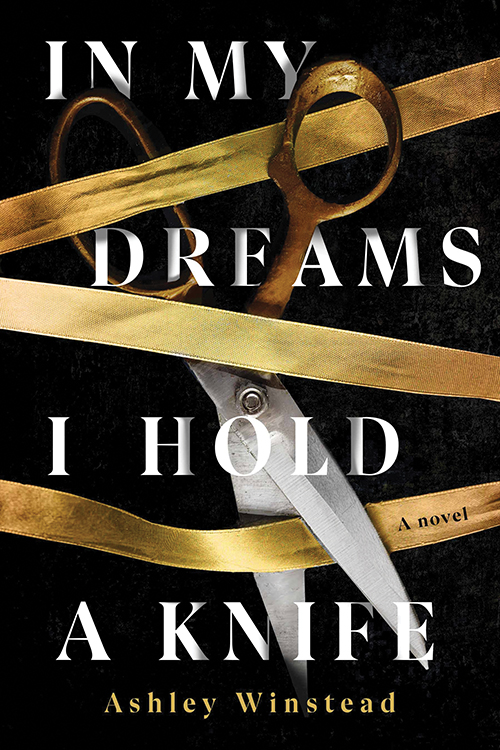
In My Dreams I Hold a Knife – Ashley Winstead

There seems to be a lot of novels out there about college reunions these days. Must be a millennial thing. I was excited to read Ashley Winstead’s debut In My Dreams I Hold a Knife because I love the title and that cover. Sadly, I am ambivalent about the book as a whole. I am not going to say I didn’t like it because I was wholly invested for the first third and still hanging in there for the second, but by the last third I was just….nope.

Jessica Miller is headed back to Duquette University to attend her ten-year class reunion. She is keen to show her former gang, collectively known as the East House Seven, that she has made it.

I wanted them to see perfection. I ached for it in the deep, dark core of me: to be so good I left other people in the dust.

The East Coast Seven are “the people responsible for the best days of [Jessica’s] life, and the worst.” She’d met them all early in freshman year, and they’d bonded instantly. There’s Jack (“an eighteen-year-old Mr. Rogers”), Heather ( “the confident blonde”), Coop (hot in a “one-time, get-the-bad-boy-out-of-your-system kind of way”), Mint (“the most beautiful boy” Jess had ever seen) , Frankie (“tall and broad…in a way that screamed athlete”), and Caro (“small and olive-skinned and pretty”).

Fast-forward a decade though and she’s really only speaking to Caro, her bestie, and Jack. Going back to Duquette means seeing Mint (her boyfriend through college) and Coop (the boy she actually loved) again. One is married to another girl, and one is engaged to Caro. As if this drama isn’t enough, this reunion has the potential to stir up the unsolved murder of Heather, who was savagely stabbed to death senior year.

So – there are lots of things I did like about this book. First of all, I am all about angst and the relationship between Jessica and Coop has that in spades. Although I am long past my university days, I do enjoy books set on college campuses. Heather’s unsolved murder has lots of potential for red herrings and such and, of course, who doesn’t love a story where people are reunited after a trauma? I also thought the writing was quite good – no quibbles with that.

The novel flips back and forth between then and now. We get glimpses of the East House Seven at various points during the four years of college, but mostly through Jess’s eyes. Towards the end, we do see certain events from the 3rd person perspective of some of the other characters. These sections felt mostly expository because they were things Jess couldn’t possibly have known, but the reader had to be told in order for the narrative to make sense.

I was wholly invested at the start. It started to unravel, though, when Eric Shelby, Heather’s younger brother, confronts the group at the reunion. He’s determined to reveal who is responsible for his sister’s death – something the police hadn’t been able to do. As each character is accused and their closely-held secrets start spilling out, the book started to lose momentum for me. I think part of the issue might have been that Winstead just tried to cram way too much into the book, and none of these “secrets” had any room to breathe. Part of the problem might have been the first person narration. It’s limiting because we only know that character’s perspective and of course, in a book like this, you have to wonder how reliable the narrator actually is. The denouement just felt sort of ridiculous – lots of shouting, and running.

All of that said, though, I would 100% read something else by Winstead. Despite the fact that In My Dreams I Hold a Knife didn’t quite work for me, it was brimming with potential and I suspect that her next offering will be awesome.

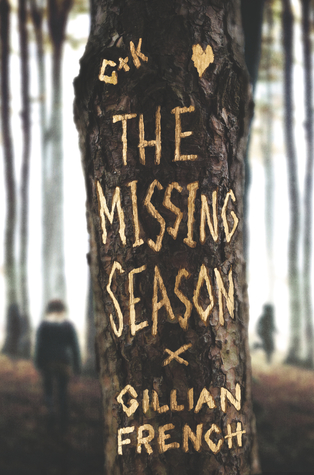
The Missing Season – Gillian French

My first novel by YA writer Gillian French was The Lies They Tell and I loved it. The Missing Season was also a great read, especially the last third or so when the action ramped up.

Clara and her parents move to Pender, Maine, where her father has been hired to help with the demolition of the town’s paper mill. Clara is used to being the new girl, but she’s a senior now and hoping that maybe they could stay put.

Pender is a hick town, but it’s also a town with a seam of darkness running through it. For one, several teens have gone missing. Then, there’s the “Mumbler” a legendary boogey man.

Clara meets Bree and Sage, who introduce her to some other people who hang out at the local skate park including Sage’s boyfriend, the larger-than-life, Trace, and Kincaid, who has “the most incredible face.” It seems that life in Pender might be okay, until the attraction she feels for Kincaid turns out to be mutual and Bree’s feelings get hurt.

The Missing Season is really a teen drama wrapped up in a creepy All Hallows’ Eve package. Clara and her new friends get up to no good, but these are mostly harmless pranks. Clara tries to navigate the tricky waters of being the new girl, wanting desperately to be a part of something bigger than herself. Kincaid is secretive and despite their attraction, Clara never really knows what he’s really thinking. Ahhh, high school relationships.

When a girl on the periphery of their group goes missing, though, things start to get real. Maybe the warnings to “Fear Him” actually have some validity. About two thirds of the way in, when Clara suddenly finds herself in danger and another girl goes missing, The Missing Season really takes off. Clara is a likable heroine who demonstrates grit when needed, making her someone readers will surely root for.

The Night She Disappeared – Lisa Jewell

It takes a skilled writer to successfully plot a novel with a million moving parts and Lisa Jewell (The Girls in the Garden, I Found You, Watching You, The Family Upstairs, Invisible Girl ) always makes it seem so easy. Her latest novel, The Night She Disappeared flips back and forth in time, and between characters and tells the riveting tale of one mother’s desperate search for her nineteen-year-old daughter, Tallulah.

Tallulah and her boyfriend, Zach, and their baby son, Noah, live with Tallulah’s mom, Kim. Zach has only recently become a part of the family again; when Tallulah told him she was pregnant he didn’t believe her, but now they are trying to make a go of it. When the novel opens, Zach and Tallulah are heading out for a much-deserved break to celebrate the end of term for Tallulah’s college course and, unbeknownst to her, a surprise proposal. But they don’t come home.

A year later, Sophie Beck and her partner, Shaun Gray, move into a little cottage on the grounds of Maypole House, the private school where Gray is to be the new headmaster. They’ve given up their London lives, but Sophie hopes that this change will suit them. She’s a writer of cozy crime novels and the last thing she is expecting is to discover a mystery in her own back garden, but that’s what happens. Someone has left a sign “Dig Here” and when she does, Sophie finds an engagement ring and, putting her detective skills to work, she discovers that the ring was purchased by Zach.

Then there’s Scarlett Jacques, the enigmatic girl from Tallulah’s school. She was the last person to see Tallulah and Zach alive. They’d been with her and some other friends at Dark Place, her family’s home. The house is

a hodgepodge of disparate architectural styles, blended almost seamlessly together across three wings, set around a central courtyard. The sun sparkles off the diamonds of leaded windows on the left wing and larger Victorian casement of sash windows on the right. It should be a mess, but it’s not; it is exquisitely beautiful.

It seems as though Tallulah and Zach have vanished into thin air, a notion Kim simply cannot accept. They would never leave their son, but it isn’t until Sophie discovers the ring that some new information shakes loose. All the while, Jewell reveals the secrets characters have been keeping, revealing complex interior lives.

Like all Jewell’s novels, The Night She Disappeared is twisty-turny, well-written and loads of fun to read. I always keep a stock of unread novels by her on my shelf because nothing beats a book slump like Lisa Jewell.

It Sounded Better in My Head – Nina Kenwood

Nina Kenwood’s YA debut It Sounded Better in My Head wasn’t even on my radar when I recently picked it up at the bookstore. It was a William C. Morris Debut finalist and had excellent reviews from School Library Journal and Bookpage (I trust those sort of endorsements over author plugs, tbh) so I bought it. It might have languished with all the other unread books in my class library, but I picked it up to read and honestly couldn’t put it down.

Eighteen-year-old Australian, Natalie, is waiting for her university admission results and planning her future with her besties Zach and Lucy, when her parents announce that they are separating. Worse, they knew this was coming and had neglected to tell her for ten months. Some almost-adults might take this in their stride, but it knocks Natalie sideways because she likes solid plans and the status quo. That’s how her world works.

Or that’s how it has worked ever since she hit puberty and her body betrayed her.

I went from being a straight up-and-down stick figure to a scribble of hips, stomach, breasts, thighs and stretch marks. I didn’t even know stretch marks were a thing.

[…]

But the stretch marks were nothing compared with the pimples. A regular scattering of pimples at first, and then more, and more. Then pimples that turned, almost overnight, into deep, cystic acne. […] It’s gross. I was gross. I woke up thinking that every day for a long time.

I suspect we can all remember the awkwardness of being a teenager, of comparing yourself to others, and Natalie spends most of her early teens friendless and hiding out. At thirteen, she becomes “Reluctant Natalie. Anxious Natalie. Bitter Natalie. Neurotic Natalie.” At fifteen, though, after medication clears up her skin a little and her mother convinces her to attend a creative writing camp, she meets Lucy and Zach.

It’s still hard for Natalie to put herself out there, but all that is about to change when Zach’s older brother, Alex, and his friend, Owen, invite her to a party and Natalie surprises herself by accepting. When Alex and Natalie find themselves in a dark alley because of a game of Spin the Bottle, Natalie finds herself in uncharted water.

And the whole thing is sheer delight. Honestly, I loved Natalie. Let’s face it, it’s only as an adult looking back that your teen years seem even mildly awesome. The best years of your life, my ass. I suspect Natalie speaks for a whole bunch of teens who breathe a sigh of relief when Friday night rolls around. For Natalie it meant that she didn’t “have to go outside or see anyone other than [her] parents for the next two whole days.”

Over the course of just a few days, Natalie’s life is upended, but sometimes that’s what needs to happen in order to get the life you want.

Highly recommended.

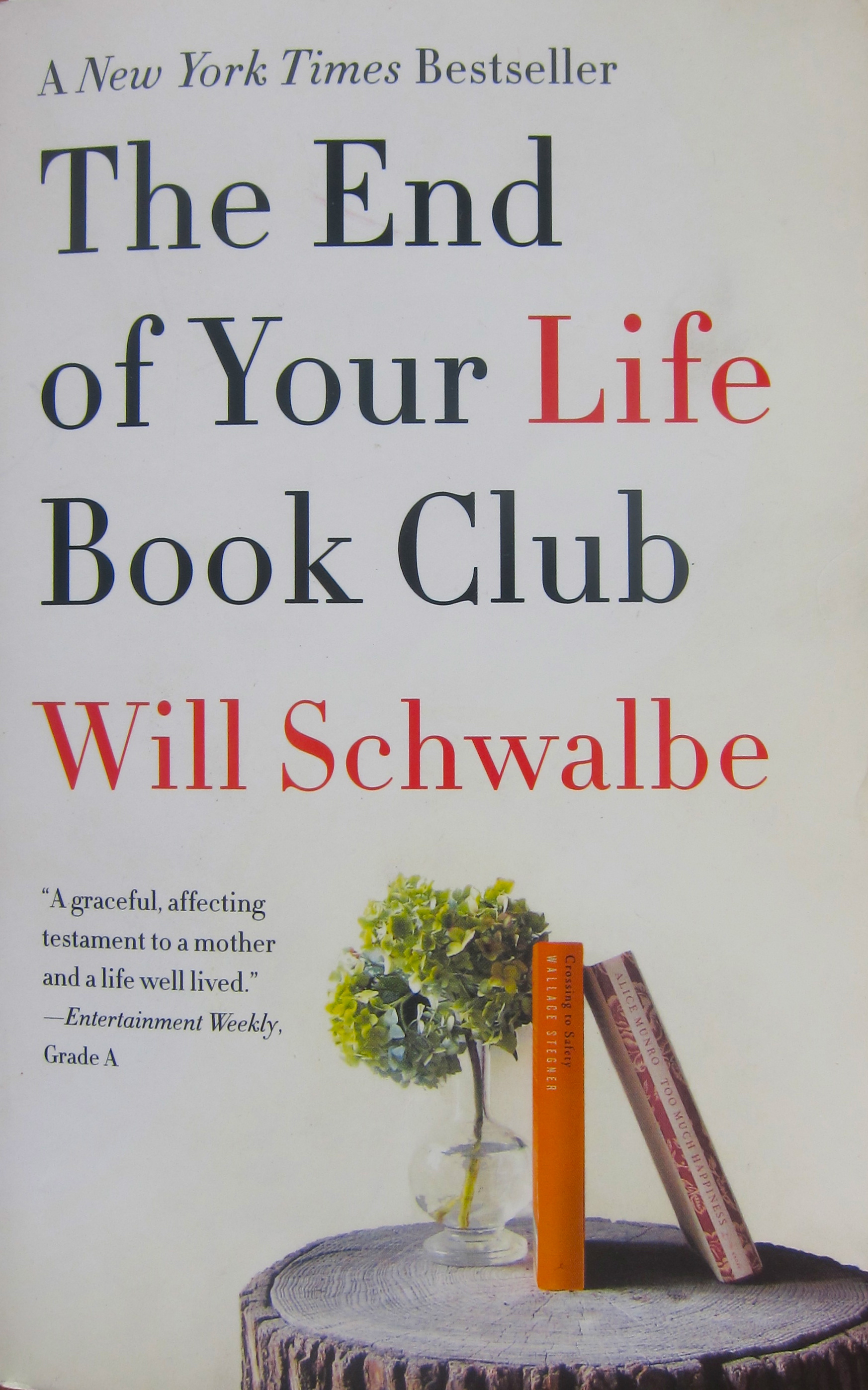
The End of Your Life Book Club – Will Schwalbe

Will Schwalbe’s memoir, The End of Your Life Book Club, is about the last couple of years before his mother’s death from pancreatic cancer and it is a beautiful tribute to family, faith, hope, and books. Always books. This book has been languishing on my tbr shelf for ages and it’s one of those books that when I finished, with a satisfied sigh and perhaps a tear or two, I thought I wish I’d picked you up sooner. I guess Schwalbe and his mom, Mary Anne, might say that the book found me at the right time.

I imagine Schwalbe’s family as sort of East Coast aristocracy, without the snobbish bits. His parents both worked in academia, and then his father got into concert management. Schwalbe describes his mother as “the hub” of the family.

Mom didn’t confine herself to coordinating our lives. She was also helping to coordinate, almost always at their request, the lives of hundreds of others: at her church at The Woman’s Commission for Refugee Women and Children (she’d been the founding director), at the International Rescue Committee (she’d been board staff liaison and founded the IRC’s UK branch), and at all the other myriad organizations where she’d worked or served on boards.

Mary Anne is clearly a force to be reckoned with and her cancer diagnosis is a setback not a death sentence. She’s diagnosed in 2007, first with hepatitis, and then eventually with pancreatic cancer. Mary Anne’s oncologist calls her cancer “treatable but not curable”, and these words offer Mary Anne and her family (her husband, and Schwalbe’s brother and sister) hope.

The Schwalbe family have always been readers and soon Will and his mother have formed a book club of two, reading and discussing a variety of books over the long hours at Memorial Sloan-Kettering in NYC, where Mary Anne gets her hope by way of chemotherapy.

Our book club got its formal start with the mocha and one of the most casual questions two people can ask each other: What are you reading?

Beginning with Wallace Stegner’s 1987 novel Crossing to Safety, a book which I read many years ago, the mother and son read their way through classics, non-fiction, popular fiction and do what any book lovers do — debate, deconstruct and discuss. They don’t always agree, but they appreciate each other’s choices, and as any reader knows many a great discussion can be had even if you didn’t necessarily love the book. These discussions also allow them to share their lives with each other in a meaningful way. Schwalbe is hyper aware that he knows his mother as ‘mom’, the person who kept his world on its axis, but perhaps he doesn’t know her quite so well as Mary Anne, the woman. This is his opportunity.

Mary Anne’s faith is the constant in her journey, and although Schwalbe doesn’t share her certainty about God and the afterlife, he is buoyed by hers. Mary Anne constantly sees the upside. When hearing of a friend’s Alzheimer’s diagnosis she says “I feel so lucky […] I can’t imagine what it would be like not to be able to know the people I love, or to read, or to remember books I’ve read or to visit my favorite places and remember everything that happened there, all the wonderful times. “

The End of Your Life Book Club is not as maudlin as it might sound. It’s a beautiful book that reminds us of the value and irreplaceable nature of family, and reminds us how important it is to cultivate relations with the people in our lives. Mary Anne struck me as the kind of woman who looked you in the eye when she talked to you. As Schwalbe reminds us “we’re all in the end-of-our-life book club, whether we acknowledge it or not; each book we read may well be our last, each conversation the final one.”

Highly recommended.

Hamnet & Judith – Maggie O’Farrell

Very little is actually known about William Shakespeare, the man (I believe is) responsible for writing some of the most beautiful poetry ever committed to paper. His plays are still produced some 400 years after his death. He is a mainstay of English Language Arts curriculums the world over. In fact, I am just beginning to look at Romeo and Juliet with my Grade 10 classes. It is a play I love to talk about and I can totally trace my love of angst back to my first exposure to it in 1977.

Maggie O’Farrell’s novel Hamnet & Judith tells the story of an unnamed man (clearly Shakespeare) and his wife, Agnes (more commonly known to us as Anne) from their first meeting, through the birth of their first daughter, Susanna, followed by the arrival of their twins, Hamnet and Judith. The novel bounces forwards and backwards in time, but somehow still manages to move forward to its perfect (yet heartbreaking) conclusion.

Agnes is really the central character in O’Farrell’s novel. She and her brother Bartholomew (loved him!), have been orphaned by the death of first their mother, and then years later their father. Now they live with their unkind stepmother, Joan, and a gaggle of step siblings. The tutor who is teaching Agnes’s younger brothers, becomes enamoured with Agnes when he sees a figure out walking in the fields with a hawk on her arm.

She has a certain notoriety in these parts. It is said that she is strange, touched, peculiar, perhaps mad. He has heard that she wanders the back roads and forests at will, unaccompanied, collecting plants to make dubious potions.

It is said that the stepmother lives in terror of the girl putting hexes on her, especially now the yeoman is dead. Her father must have loved her, though, because he left her a sizable dowry in his will. Not that anyone, of course, would want to wed her. She is said to be too wild for any man.

Hamnet & Judith concerns the relationship between Agnes and the tutor, a relationship that seems quite modern, actually. Agnes soon learns that the tutor needs out from under his father’s controlling hand and she finds a way to give him his freedom, although I think it does come at great personal cost to her. The way they are portrayed in this novel, one could never doubt their love for one another.

It also concerns the relationship between Judith and Hamnet. The novel actually begins when Hamnet, 11, discovers his sister very ill. It is plague times, of course, and O’Farrell even includes a chapter in the book that explains how Judith came to be ill – from a flea that traveled in a container of glass beads all the way from Murano, Italy. Of course, it is not Judith who dies – I hope that’s not a spoiler – and four years after Hamnet’s death, his father writes, perhaps, his most famous play, Hamlet.

Ultimately, this is a novel about family. It’s about grief, and watching Agnes mourn the loss of her son is absolutely heart-wrenching. It is about the minutiae of daily life. Given that we are experiencing a global pandemic, it’s difficult not to see the parallels despite the 400 years that separate our story from this one. Let’s not forget, although O’Farrell’s story is fiction, Shakespeare and his family were very real.

I loved this book. It’s more than worthy of the praise.

Corrupt – Penelope Douglas

If you are a fan of Penelope Douglas, I suggest you skip this review as you won’t be happy. Kind of like I wasn’t happy that I paid $30 for this brick of utter shite.

Some context.

I occasionally watch book tubers to see what they are recommending. One night I watched this girl talk passionately about the enemies to lovers trope and even though she was WAYYYYY younger than me, it is a trope I enjoy, although I guess my kink is more specifically bad boy/good girl. Still, I like a well-written, smutty book. If it’s a little on the dark side: bonus. So I went looking for the book she really liked: Corrupt by Penelope Douglas (apparently a NY Times best selling author, although Corrupt was clearly self-published.) I couldn’t find it on Amazon or Indigo, but I was able to order it from Book Depository, so I did. (This is how impressive this book tuber’s sales pitch was; I felt as though I MUST read this book.)

So the book arrives. I knew then. The same way that I knew Colleen Hoover’s much-loved-by-anyone-that-is-not-me book Verity was going to suck when it arrived. Just a feeling based on the physical object alone.

So, what is Corrupt about? Please know that there will be spoilers galore in this review so if you really think you want to read this book – and I implore you not to waste your time as I will provide, at the end of this review, a list of MUCH better books to read – you have been warned.

SUMMARY: Erika Fane is in love with Michael Crist, her ex-boyfriend Trevor’s older brother. Michael was a big deal when he was at school, and now he’s a professional basketball player. Erika is about to go off to her second year of college in another city and she can’t wait to get away from her mother, who has been in a drug-induced lethargy since Erika’s father died, and Trevor, who irritates her. Trevor and Michael’s family are loaded. So is Erika’s family. Michael is HOTHOTHOT. So is Erika – who for some reason that makes no sense, is called Rika. So, how old are these people? Erika is 19 and Michael is 23 or 24…making Corrupt New Adult. Anyway, Erika has always believed that Michael hates her, especially after what happened when she was sixteen and she ended up hanging out with Michael and his three besties Kai, Will and Damon, collectively known as The Four Horseman. Their Devil’s Night pranks landed Kai, Damon and Will in jail for three years, but now they’re out and they’re looking for revenge. That’s where Michael comes in: he’s going to help them because, after all, he hates Rika, too. Only not so much.

WHY IT’S GAWDAWFUL:

  1. No one behaves the way these people do. Seriously. No one. Can we just have some sensical character development, please? Here’s my best example of crazy town. Once everyone but Damon realizes that Rika is NOT the reason three of the four horsemen ended up in the clink, Michael and Erika settle into the relationship we’re all supposed to be rooting for. They start to make out in a steam room, only to discover that Kai is also in the steam room. So, what’s a girl to do?

He looked so alone all the time, and tears lodged in my throat, because we’d all been changed forever. Michael had hated, because he couldn’t take being helpless. Kai had suffered, because his limits had been pushed, I’d gathered. And I had struggled to find out who I was and where I belonged for so long.

“Touch me,” I whispered. “Please.”

Yep – Rika’s road to healing for the three of them is hot three-way sex in a steam room. Is Michael jealous? No, he’s woke. “You’re fucking perfect,” he tells her before encouraging her to “Show me how much you like my friend eating your pussy.” This is the road to a perfect, healthy relationship.

And before you accuse me of being a puritan, I am most definitely not. Get it on, I don’t care. My problem is that a New York minute ago, Michael and his friends were trying to make Erika’s life a living hell by standing outside her bedroom window at night wearing their ridiculous masks, by cutting her off financially (Michael can do this because his father looks after the Fane estate), by making her mother disappear, by threatening her with bodily harm. All is forgiven, though, if you can make a girl come. Am I right?

2. Douglas is a fan of repeating herself. One of the irritating ways she does this is by telling us what song is on the car radio, the CD player, the wherever music comes from

  • “Starting the car, 37 Stitches by Drowning Pool poured out of the speakers…” p 11
  • “Slipknot’s The Devil in I blared through the classroom…” p 20
  • “Like a Storm’s Love the Way You Hate Me echoed all around me…” p 72
  • The Vengeful One by Disturbed echoed through the house…” p. 110

I could go on (and on), but you get the point. Yes, Ms. Douglas, you clearly have a playlist.

Douglas has other little writing ticks. For instance, Michael often fists Rika’s hair – straight out of the porn handbook. Rika often folds her lips between her teeth. Michael is always pulling Rika back by the front of her neck, which I believe is called the throat. When I start to notice clunkiness, that’s all I notice.

3. It’s borderline misogynistic. We’re supposed to believe that Michael’s feelings for Rika are just as powerful as Rika’s feelings for Michael, yet he often treats her like shit.

He ignored me, condescended, and insulted on occasion, but the cruelty hurt beyond words.

“That was English, Rika,” he barked, making me jump. “A dog listens better than you.”

OR

She was only a floor away, and I had the key to her apartment burning a hole in my pocket. I needed her on her hands and knees as I took whatever I wanted, whenever and however hard I wanted it.

OR

He let out an aggravated sigh. “Your fucking mouth never stops, does it?”

And let’s not forget the time when the Four Horsemen tell Rika about the girl who was drugged and raped in an old church basement where everyone hangs out at to party. They didn’t catch all the guys who had a go at her. There’s still at least four running around, Michael makes a point to tell her. Good times.

This is the guy Rika can’t stop thinking about? We’re supposed to be all in? Dear Lord. Girls, just because a guy is hot and makes your panties moist doesn’t mean he’s a good guy. And we’re supposed to understand Michael because he’s just trying to help his buddies out? His number one rule regarding Rika is “Don’t be alone with her” because he wants her and the heart dick wants what it wants.

There was nothing redeeming about this story. The characters were one dimensional. The plot, nonsensical. The writing – well, I’ve read wayyyy better fanfiction. So why in the hell did I keep reading it? Maybe because I paid $30. Maybe because it has loads of positive reviews. Maybe because I’m a masochist. I dunno, but if you want to read books of the same ilk that are worth your time and effort (New Adult/YA/and Adult), here are some titles for your consideration.

  1. Easy – Tammara Webber (NA)
  2. Breakable – Tammara Webber (NA, companion to Easy)
  3. Perfect Chemistry – Simone Elkeles (YA)
  4. Topping From Below – Laura Reese (Adult/graphic)
  5. How Not to Fall – Emily Foster (Adult, not bad boy/good girl, but smutty fun)
  6. Velocity – Kristin McCloy

The Cousins – Karen M McManus

Milly, Aubrey and Jonah Story have been invited to spend the summer on Gull Cove Island by their grandmother, Mildred. That might not be an out-of-the-ordinary invitation for some people, but it is for these three teens. For one thing, they’ve never met their grandmother. For another, they haven’t seen each other for years and their parents (Milly’s mom and Aubrey and Jonah’s dads) are also estranged. So, it’s a weird request all-around.

Gull Cove Island was a little-known haven for artists and hippies when Abraham Story turned it into what it is today: a place where rich and semifamous people spend ridiculous amounts of money pretending they’re getting back to nature.

Milly’s mother, Allison, is anxious for her daughter to go. Twenty four years ago, she and her brothers (Adam, Anders and Archer) had each received a letter from their mother which said “You know what you did.” With that, they were cut out of their mother’s life both personally and financially and none of them really understood why. Milly’s mom thinks this invitation may be the opportunity to mend fences and for the cousins to get to know each other.

This is the set up for Karen M. McManus (One of Us is Lying, One of Us is Next) latest novel The Cousins. The novel is told from multiple perspectives during two different time-lines, so you get to see the parents as young adults and then their offspring who arrive on Gull Cove Island to a less-than-warm reception. Clearly there is something strange going on, and Milly is determined to figure it out, with or without her cousins’ help.

Like her previous novels, McManus manages to keep all the plates of a compelling mystery spinning. Each of the three teens are intelligent and likeable. The real mystery is rooted deep in their parents’ past and some of those characters aren’t so nice, particularly Jonah and Aubrey’s dads. Readers will have a lot of fun trying to figure out what the heck is going on, but like with her previous novels, McManus will always be one step ahead of you.

The Night Inside – Nancy Baker

I have a vague memory of reading Nancy Baker’s novel The Night Inside years ago – perhaps closer to the time it was first published in 1993. I am not going to classify this as a re-read, though, because most of it was so unfamiliar it felt like I was reading it for the first time.

Ardeth Alexander is a grad student who is just about ready to graduate, leave academia behind and step into the real world. She’s the dependable one; her younger sister, Sara, is the wild one. She can’t shake this feeling that she’s being followed, though, and one morning on a run near Casa Loma, she’s grabbed by two thugs and whisked off to parts unknown, where she ends up in a basement cell.

The guy in the cell next to her is Dimitri Rozokov. He’s a vampire, and an old one. He’s lived as long as he has by being extremely careful. Even though Ardeth is sure there is no way he can exist because, after all, “Vampires do not exist, except as metaphors,” Ardeth’s captors prove that he’s deadly by showing Ardeth why he’s in a cell.

Turns out, they’re making movies. Roias, one of the men who nabbed her, gives her a private show and what she witnesses horrifies her.

The vampire was hungry and not particularly neat. When he was done, he dropped Suzy’s body over the table. Blood was smeared across her breasts and shoulders, painted across her face in a parody of cosmetics. Her blonde hair was dark with it, but not as dark as the gaping hole in her throat. When he let her fall, one limp arm knocked over the wedding cake and left its remains decorated with red icing.

It turns out, though, that Rozokov is a civilized being, and in their time chained in cells next to each other, the two captives talk. When it becomes clear that their days are numbered, they devise a plan to escape, but the plan comes at a cost.

I have long been fascinated with vampires. When I was a kid, I can remember going to old black and white movies starring Peter Cushing and Christopher Lee and being terrified. What was my mother thinking?! I’ve read Dracula and devoured ‘salem’s Lot. Then, right around the time my kids were born, I discovered Buffy the Vampire Slayer and that sent me down a rabbit hole.

I didn’t hate The Night Inside, but I didn’t love it, either. Part of the problem is that there was a lot going on. Rozokov’s back story and the people chasing him might have been enough to sustain a novel. There needed to be a meet cute, or a meet ick in this case, though. Ardeth and Rozokov’s time as captives only makes up a small portion of the story, though, and then the pair are separated. Oddly enough, the novel felt dated to me, which is weird considering Rozokov is 500 years old.