Out of Sight, by British writer Isabelle Grey, is the story of Patrick Hinde, a homeopath who, when the novel opens, lives with his wife, Belinda, and young son, Daniel, in Brighton. He has a happy life, for the most part, except for the stress brought on when his parents visit. He seems to be a bottled up sort of fellow and although he is capable of offering impartial advice to his patients, I wonder if he wouldn’t benefit from his own advice. As the novel goes on, readers will become aware of Patrick’s own emotional trauma, a condition he describes as “An inherited predisposition…something that leaves a residue which has a negative impact on the vital force.”
Flash forward five years and meet Patrice (aka Patrick) who is now living in the house his grandmother Josette left him in France. Leonie, another Brit who is working in the same small town as a letting agent for holiday properties, meets Patrice and is immediately smitten. Patrice proves to be a bit cagey, but despite his reticence to share feelings or disclose too much about his life, Leonie sets her romantic sights on him.
Leonie, for her part, is still recovering from a recent break-up. You’d think she’d know better than to put all her romantic eggs into Patrice’s clearly flawed basket, but she’s keen on him. The heart wants what it wants, that sort of thing, even though Patrice tells her he doesn’t “want [her] thinking he’s a good bet when [he’s] not.”
Patrice’s reluctance to get too involved with Leonie is legitimate. There’s nothing sinister about it, though, although you might be mislead by the novel’s tagline “A moment of madness. A family changed forever.” For some reason I was under the impression that Out of Sight was going to be sort of a thriller and it’s really not.
I didn’t dislike Out of Sight, but I didn’t love it either. I found Leonie tiresome and although I don’t dispute the fact that Patrick’s trauma is worthy of sympathy, at the end of the day the book lacked any real emotional heft for me.
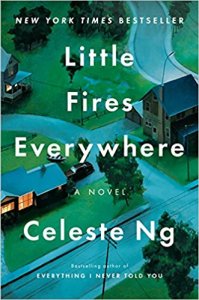 “Sometimes you need to scorch everything to the ground and start over,” Mia tells Izzy in Celeste Ng’s second novel Little Fires Everywhere.
  decided to have a detoxifying sauna. After only eight minutes, she recalls in Design Your Next Chapter, she was “deathly bored with my own company.” In an effort to distract herself, she started reading a paperback someone had left behind. It was about finding personal happiness.
 You, by new-to-me author Joanna Briscoe, is the elliptical story of two families, the Bannans and the Dahls, whose lives first intersect in Dartmoor, England in the 1970s.
 ghosts. The ghosts haunting 1980s Niagara Falls (and man, did I love this novel’s setting – from the actual seedy city itself to the allusions to super specific Canadian touchstones like The Beachcombers) are personal.
 I am SO glad I am not in my 20s anymore. That’s the takeaway from Carola Lovering’s novel Tell Me Lies. This is the story of Lucy Albright and Stephen DeMarco, East coasters who are both on the West Coast attending Baird, a small college in Southern California.
 meaning that women are afforded the same privileges as men: personal, economic, social, and political equality. It’s hard to look at the state of the world and think that we’re actually there, though.
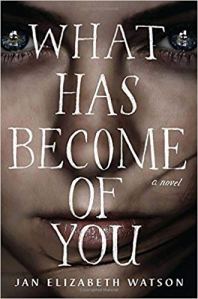 the protagonist of Jan Elizabeth’s compelling thriller What Has Become of You. She’s pushing forty and has just accepted a maternity leave position at a private school in Dorset, Maine. Although Vera is well educated – she earned her master’s degree at Princeton – she is also somewhat awkward, and although being at the front of a classroom doesn’t come naturally to her she has “come to appreciate certain aspects of teaching.”
 It’s hard to wrap my head around gun violence as it exists in the U.S. My dad had a couple hunting rifles when I was a kid, but I don’t recall ever seeing them. No one I know has a gun in their bedside drawer…just in case. When I wrote a review for
 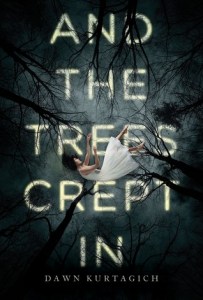 and afraid. They’ve run away from home and come to the only place they thought they might be safe. But La Baume is not safe.
