Delicate Monsters – Stephanie Kuehn

The three central characters in Stephanie Kuehn’s darkdarkdark YA novel Delicatedelicate Monsters are hard to spend time with. From the moment we meet  Sadie, and Emerson  and his  brother, Miles, we embark on a journey that is both awful and strangely – redemptive. In any case, these train-wreck teens are hard to look away from.
Sadie has just returned to her home from a camp where the girls were “all supposed to be “troubled”” Sadie’s far tougher than these girls who are “wide-eyed and tragic, fragile herd-like things, brimming with stories of Painful Childhoods.” Sadie can’t relate because she is not like them. She has “no interest in introspection” and “she found threats a curious thing because she didn’t respond to them the way she was meant to…threats made Sadie’s skin grow cold and her brain grow mean.” Mean is exactly what Sadie is, too.

At first eighteen-year-old Emerson seems like an uncomplicated lug of a guy. He lives with his widowed mother and younger brother, Miles, 15. Miles is sickly and has been diagnosed – or misdiagnosed –  with a variety of ailments: night terrors, separation anxiety, rashes, fever, celiac. Despite his health concerns and the fact that Miles “didn’t like other people,” Emerson was convinced that his younger brother is “destined for…something. Greatness?” Miles is peculiar and although Emerson seems to care about Miles, he doesn’t defend him against the constant barrage of abuse – both physical and verbal – Miles takes from the thugs at school.

Kuehn dances these three teens together when Sadie returns to her hometown. She’s been expelled from boarding school (again) for almost getting someone killed. (The details of that are revealed through email exchanges between Sadie and her ‘victim’, Roman Bender.) The aforementioned camp was clearly a placeholder because her father is M.I.A. and her mother seems to have no real interest in her daughter. She’s been out of the hometown loop for a while, but she remembers Emerson. She specifically remembers the things they used to do together when they were kids and his mother, a nurse, would bring them out to Sadie’s family’s vineyard to care for Sadie’s grandfather.

Sadie doesn’t remember Miles, though. They meet during fencing and if she has any redeeming qualities, she shows them in her interactions with him. For a kid who tries to blend into the shadows, Miles seems to respond to Sadie’s “I don’t give a shit, but here, eat this sandwich” approach to friendship.

I love the way Kuehn writes her characters. This is my third book by her and although I didn’t love it as much as I loved Charm & Strange, I still couldn’t stop turning the pages. We’d be naïve to think there aren’t lost, damaged kids like Sadie, Emerson and Miles in the world. Kuehn doesn’t mince words or tread lightly in Delicate Monsters, and as prickly as these three are – the mother in me just wanted to hug them and try to right their scarily off-kilter worlds.
Juliet’s Answer – Glenn Dixon

juliets-answer-9781501135484Glenn Dixon’s memoir Juliet’s Answer has a lot going for it especially if you a) love Italy b) teach high school English and are intimately familiar with Romeo and Juliet and c) have ever been unlucky in affairs of the heart.

Dixon started out to write a book about love – all different types, all over the world. He landed in Verona and became one of Juliet’s secretaries. These are the women of Club  di Giulietta, an organization founded by Giulio Tamassia. Tamassia, a baker  by trade, took over the task of responding to the hundreds of letters which arrive in Verona yearly. Beginning in 1937,  the letters were  answered  by the groundskeeper who tended the gravestones at the Monastery of San Francesco where Juliet is said to have been buried and where the letters were first left, propped against the gravestones, and then by a poet in the 50s and finally by Tamassia and his daughter, Giovanna. Dixon was on holiday from his day job as a high school English teacher when he volunteered to help answer the letters, the only man in the group of volunteers.

Dixon admits that he’d had his own problems with love and “part of the reason I’d come to Verona was to learn something more about this all-encompassing force in our lives. To learn something, anything, that would help me understand my own heartbreak and help me, maybe, trust in love once more.”

See – there’s this girl. She’s the one; at least that’s what Dixon thinks. They’ve known each other since university and “I guess you could say that I fell in love with her right from the start. She was pretty and smart, but it was more than that. She seemed to “get” me, just as I seemed to “get” her.” But in the 20 years since university,  Dixon has never managed to get past the friend-zone. He’s watched as the woman, he calls her Claire, falls in and out of love with other men and he doesn’t disagree when she says “you can’t choose who you fall in love with.” Ain’t that the truth. So he pines.

Dixon teaches high school English. It’s probably not a coincidence that the time we spend with him in the classroom is shared with literature’s most famous lovers – Romeo and Juliet. I admit it: I am a card-carrying member of the club. It’s amazing how many of my colleagues don’t like Romeo and Juliet, but I love the play. I love teaching it. I never get sick of Shakespeare’s language or the gut-wrenching, sob-inducing, star-defying story of those two crazy kids. What can I say? I’m a romantic.

And Italy – that’s my place. I’ve only been twice, but I dream of spending an extended period of time there. I’m not sure what it is: the heat, the wine, the shuttered windows and amazing vistas, the pasta. Did I mention the wine?  I just know that I love it.

So it was a no-brainer that I was going to like Juliet’s Answer. I related to Dixon’s quest to understand the nature of love. He’s my people aka fellow English teacher. And, hey, love found him. How’s that for a happy ending?


.

The Girl in the Red Coat – Kate Hamer

Until about the midway point, I couldn’t put Kate Hamer’s novel The Girl in the Red Coat down. When eight-year-old Carmel Wakefield disappears, her mother, Beth,  is unhinged by her grief. Hamer’s novel follows Beth’s narrative as well as Carmel’s and until the reader understands the reasons for Carmel’s abduction, the novel is propulsive and riveting.

red coatBeth is sort of a hippie. She and her ex-husband, Paul, had “run a business together buying and selling ginseng and specialty teas.” Paul, after leaving the marriage, has been a relatively absent father and his relationship with Beth is strained mostly because he has a new, much-younger girlfriend.
Carmel is a precocious child. At a parent teacher meeting, the headmaster  explains to Beth that Carmel’s “vocabulary is extremely advanced. Her imagination is amazing, I don’t think she quite sees the world like the rest of us.”

On the fateful day that Carmel disappears, Beth has taken her to children’s story festival. She has decided that she needs to set aside the grief of her crumbled marriage and “start afresh.”

The festival is a treat and Carmel “can feel words come shooting out of the tent doors and [she] just want[s] to stand there at the openings and let them fizz on [her] brain.” It’s a hot, crowded day and pretty soon Beth is getting cross and Carmel, in an act of defiance, ducks under a table to read a book. When she reappears, ages later, the fog has rolled in and her mother is gone. That’s when the man appears. He tells her that he is her grandfather and that her mother has been in a terrible accident.

Carmel has no reason to doubt the man. Her mother has been estranged from her parents for her whole life – it’s one of the things that has plagued Carmel’s young mind. Why doesn’t she have grandparents to bring her treats like her friends do?  So, fearful and clearly alone, Carmel goes with the man who promises to take her to the hospital to see her mother. Of course, that’s not what happens.

The Girl in the Red Coat is suspenseful until Granddad’s motives are revealed and then it started to feel like a different book to me. In the first part, when Carmel is taken to a strange house where she meets her grandfather’s partner, Dorothy, Hamer does a wonderful job of stringing the reader (and Carmel) along. Why can’t she see her mom? Why can’t they contact her dad? Where are they?

Beth’s journey is also heart-wrenching. She counts the days Carmel has been gone. She searches for her daughter. She goes through the motions. But the time goes by and it’s like Carmel has dropped off the face of the earth.

Those early days are compelling for Beth, Carmel, and the reader. For me, though, the novel’s suspense is spoiled by its key secret — and once that’s out I found myself caring less about all the players, which is too bad, because the book is beautifully written and had a lot of potential.

The Truth About Alice – Jennifer Mathieu

The-Truth-About-Alice-Jennifer-MathieuThe truth we probably don’t want to acknowledge is that high school is hell for loads of kids. I teach high school and even though I would like to think that my school is perfect and inclusive and bully-free, I know that isn’t actually the case. I suspect Jennifer Mathieu knows that, too. She is also a teacher, which is why her novel The Truth About Alice rings true on so many levels.

There is something about Alice Franklin that gets everyone talking. Everyone has an opinion and the four main narrators in Mathieu’s novel are happy to share their thoughts.

Elaine O’Dea, possibly the most popular girl in school (by her own estimation) remarks “She’s never been super crazy popular like me…I guess Alice Franklin has spent most of her life on the middle floor somewhere, but on the top of the middle. So she was cool enough to come to my party.” Kurt Morelli, brilliant nerd, describes her as “Alice Franklin with the raspberry lips and the bad reputation and the faraway eyes. Alice Franklin with the short hair not like any other girl’s and the gloriously loud laugh and the body that curves like an alpha wave. Alice Alice Alice Alice Franklin.”

Then, after a party at Elaine’s house, the rumour that Alice slept with two guys – one after the other – erupts. One boy, Tommy Cray, is in college and one boy, Brandon Fitzsimmons (Elaine’s on-again, off-again, on-again boyfriend) is the best quarterback Healy High has ever seen. Shortly after the party, Brandon is killed in a car accident and Alice is, apparently, to blame for that, too.

Kelsie, Alice’s supposed best friend, abandons her and aligns herself with Elaine and her crew. She adds fuel to the rumour fire by adding a few juicy tidbits. Josh, Brandon’s best friend, does his own part to fan the flames. Alice soon finds herself a pariah at school.

It would be easy to hate all the people involved with ostracizing Alice, but the truth is that these teens all have their own issues: parental expectations, sexuality, religion, weight and Mathieu does a pretty good job of allowing the reader to see their motivations and vulnerabilities.

This is a novel about the damage rumours can do. Healy is a small town and even the adults know the stories, but no one intervenes. Alice’s single mother is non-existent in a parental role, leaving Alice to fend for herself. We don’t hear from Alice until the very end – which I actually think was a smart choice on Mathieu’s part. Instead, we watch her navigate the steady stream of vitriol and slowly start to find her path due to her unexpected friendship with Kurt, a character you can only imagine has suffered his fair share of bullying.

The truth will out and when it does, some of the machinations didn’t ring quite true to me, particularly Alice and Elaine’s conversation in the hair salon, but that’s only a small niggle. I thought The Truth About Alice tackled a timely subject with a lot of honesty and many teens will certainly see themselves in the story.

Dancing With Myself – Billy Idol

Back in the 80s, I had tickets to see Billy Idol at Madison Square Garden. A guy I was dating at the time had scored the tickets for my birthday and I was so excited because, hello, Billy freakin’ Idol. Alas, it was not to be. As I recall, there was some sort of issue with asbestos or something and the concert was cancelled.

“White Wedding” was one of the very first videos I ever remember watching. Canada’s version of MTV, MuchMusic launched in 1984 and Idol’s song came out in 1982. I think Idol was one of the first video stars ever because he’s so pretty. (And I don’t mean to imply that was the only reason he was a huge video hit – there’s no denying Idol’s charisma or talent.)  He made a lot of videos in the 80s and was a huge star, so I was really sad that I didn’t get a chance to see him live.

Of course, I didn’t really know much about Idol and although I am not in the habit of reading rock star memoirs, I kind of had to read Dancing With Myself. Idol wrote the book himself and his straight-ahead style serves his story well. billy_idol_dancing_with_myself_final_cover-1

Billy Idol was born William Broad in 1955 in North London. When he was four, he and his parents moved to Long Island, NY where he lived until he was eight and the Broads returned to the UK. At that point, Idol considered himself an American and so often felt like a fish out of water.

“Music always pulled me through,” he said, “voices laying out a tale of their lives, musicians riding the wave.” He was also a voracious reader, reading everything from Enid Blyton to every history book he could get his hands on. Like lots of other smart kids, school wasn’t his bag and although he did one year of college, he dropped out. Still, Idol and his younger sister, Jane, enjoyed a happy, middle-class life with parents who loved and supported him – even when they didn’t always understand him.

But the times, they were a changin’. In 1976, Idol saw The Sex Pistols play for the first time.

On that night, the Pistols onstage were unlike anything we’d ever seen before. Johnny Rotten, with orange, razor-cropped hair, was hunched over, holding a beer and staring bug-eyed out at the crowd through tiny, tinted square glasses….While hardly moving, John radiated a defiant intensity that demanded your attention….It made a strong impression on me.

The punk scene blossomed out of what was happening in England at the time. “In mid-’70s England, you couldn’t get a shit job, let alone have a career,” Idol recalls. The punk movement was part political statement and part fashion statement and Idol was in the right place at the right time. The punk scene was “a reaction to everyone who was telling people our age what we should do to succeed.”

I don’t think even I realized how connected to the British punk scene Idol was. His first band, Generation x actually experienced some success and launched Idol’s successful solo career.

When things began to disintegrate with Gen X, and Idol no longer felt there was a future in punk, he decided to go the States and the rest, as they say, is history.

Dancing With Myself is filled with the requisite name-dropping and behind-the-scenes stuff relating to the music business, but mostly it’s a straight up tale of sex, drugs and rock ‘n’ roll. Idol is very candid about his drug use – which was copious and scary, really. He also had more than his fair share of sexual encounters. The love of his life, Perri Lister, a dancer he met during his punk days and the mother of his son, Willem, is clearly an important person in his life although they haven’t been together in years. Idol also has a daughter, Bonnie, from another relationship.

I enjoyed reading this book, actually. I am not a music aficionado by any stretch and so the music biz stuff would likely be more interesting to someone who is plugged into that. I was interested in Idol the man, though. The guy trying to make good choices for his kids; the son who cared for his dying father; the big brother and uncle; the friend. Idol probably shouldn’t have made it through all those crazy drug-filled days, or survived the horrific motorcycle accident he had in 1990. But he did. His memoir proves his resilience and his relevance and although not always a nice guy, he owns his mistakes and that makes him pretty awesome in my book.


Behind Her Eyes – Sarah Pinborough

Louise is a single mom to six-year-old Adam. She has a penchant for wine, smokes (although not in front of her son) and could stand to lose a few pounds.

My life is a blur of endless routine. I get Adam up and get him to school. If I’m working and want to get in early, he goes to breakfast club. If I’m not working, I may spend an hour or so browsing charity shops for designer castoffs that will fit the clinic’s subtly expensive look. Then it’s just cooking, cleaning, shopping until Adam comes home and then it’s homework, tea, bath, story, bed for him, and wine and bad sleep for me.

Adele is the wife of David, a doctor. Their marriage is clearly rocky, The new house, David’s new practice, the fact that Adele is beautiful, none of it seems to make any difference.

Why can’t he still love me? Why can’t our life been as I’d hoped, as I’d wanted, after everything I’ve done for him? We have plenty of money. He has the career he’d dreamed of. I have only ever tried to be the perfect wife and give him the perfect life.

Adele and Louise take turns narrating in Sarah Pinborough’s novel Behind Her Eyes. behindTheir lives intersect when Louise meets David at a bar and they share a ‘moment’ and then she discovers he’s her new boss and then she bumps into Adele (literally) in the street. Louise is charmed by Adele who seems wholly glamorous and somehow innocent. Adele takes Louise on as a project, encouraging her to quit smoking and join the gym. Soon the women are sharing a close friendship which is complicated by the fact that Louise is in love with David and pretty soon the two have moved from the ‘moment’ to a full-on relationship.
Behind Her Eyes is full of conveniences. Louise’s ex-husband takes Adam away to France for a month leaving Louise the freedom to sleep with David and have coffee with Adele. She is bereft of friends except for Sophie, an unemployed actress married to a music exec. Despite the fact that Sophie continually sleeps around on her husband, she turns sanctimonious when discussing Louise’s affair with David, telling her that “having an affair is a big enough secret and not one you’re really cut out for.” Louise and Adele bond over the fact that they both suffer from night terrors.

The novel drops a breadcrumb trail of then, which allows the reader a glimpse into Adele’s murky past — parents killed a fire that destroyed part of the estate where she grew up, a stint in some sort of care facility, a close friendship with a fellow patient, Rob. In the now, Adele is less transparent. She is clearly duplicitous, we’re just not sure how or why.

Behind Her Eyes was a book club pick and although some of the women in my group enjoyed reading the book –even I did to a point — I don’t think any of us would say we loved it. I definitely didn’t. Perhaps you could argue that the clues were there all along and I know all the BIG NAME  readers out there loved the novel’s twist, but for me – I just felt cheated. Way too deus ex machina for me.

That said — I am in the minority for sure and if nothing else, Behind Her Eyes will get you turning the pages.

Monsters – Emerald Fennell

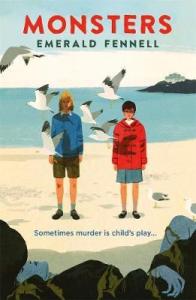
monstersWhat would you get if you mixed Enid Blyton with Stephen King? I think you’d probably get Monsters by Emerald Fennell.

Monsters is the story of a twelve-year-old girl who has spent the last three summers at her Aunt Maria and Uncle Frederick’s crumbling seaside hotel because her “parents got smushed to death in a boating accident.”  The unnamed narrator now resides with her maternal grandmother and “During the summer holidays, Granny always decides she has enough of me…” That’s how she ends up in Fowery, somewhere on the Cornish coast of England.

The town of Fowery is as eccentric as its residents, a “tiny multicoloured town…built up the side of a green, green hill” and ruled by William Podmore, a recluse who is rarely seen.

Everyone in town knows our narrator – she’s a regular visitor to the candy store and book shop. She knows they think she’s peculiar. And she is. She’s fascinated with murderers and she and her grandmother often watch gory films together. She’s practically memorized The Murderers’ Who’s Who. So she hits the creepy jackpot when the body of a woman is found caught in a fisherman’s net. Suddenly, the summer is starting to look up.

Then thirteen-year-old Miles arrives with his over-bearing mother. Turns out  Miles has a lot in common with our narrator:  he’s fascinated with true crime, a little on the eccentric side and he’s smart.

I really enjoyed Monsters. It’s quite unlike any recent YA book I’ve read.  I was a big reader of Enid Blyton’s books when I was a kid. I loved solving the mysteries in the Adventure series. Fennell’s book is certainly more subversive than Blyton’s books – which were straight up mysteries a la The Bobbsey Twins. Monsters is decidedly darker.

Miles and our narrator spend the summer trying to figure out who murdered the young woman and when another body turns up, they try to figure out who might be next on the killer’s list. They also play their own murder game.

This time instead of being strangled, the victim was drowned. Miles would push me under the water, and I would have to thrash around, yelling and screaming, begging for my life.

If this sounds a little twisted, it is. Monsters is a page-turner with an extended cast of characters ripped straight from a Tim Burton movie. It is odd and oddly fun.

Highly recommended.


This Gorgeous Game – Donna Freitas

Olivia Peters, the protagonist in Donna Freitas’ YA novel This Gorgeous Game,  is a seventeen-year-old aspiring writer who lives with her single mom and older sister in a close knit Catholic community in Boston. How Catholic? Let’s just say that the Peters’ have lots of priests and nuns for dinner and Olivia attends a high school where the principal is a nun.

gorgeousOlivia is beautiful and outgoing, but she’s one of those girls who doesn’t really know it – or, if she knows it, she doesn’t flaunt it. She’s a good girl. She’s obedient. All she wants-  all she can ever remember wanting – is to be a writer. When she wins the first annual Emerging Writers High School Fiction Prize  she admits “I’ve always loved writing but I didn’t really think it would amount to anything.” The prize is substantial: a ten thousand dollar scholarship towards the college of Olivia’s choice, publication of her story and a spot in Father Mark Brendan’s prestigious summer fiction seminar.
Yeah, that  Mark Brendan. Olivia knows him – by reputation, at least.

I am struck by the tiny lines that web from his smiling eyes, the gleam from his perfect white teeth, his thick salt-and-pepper hair, the size of his hands, so large, the hands of a strong man. Everything about him seems to glow from within and soon I am aware that I am not the only person in the room who finds this visitor striking.

This priest is a celebrity, and also super-creepy. I mean, c’mon, the first thing he does is invite Olivia for a drink. She shows up in her school uniform and drinks hot chocolate while he drinks scotch and holds court.

I probably shouldn’t say this, but the moment I first saw you, I wondered to myself: how did so much talent, such insight and imagination, come from a girl so young, and with such startling beauty? What a beauty! I thought. God must have such extraordinary plans for such a creation as this.

In the beginning, Olivia basks in the glow of Father Mark’s attention: the private meetings to (ostensibly, at least) work on editing her story, the notes he leaves for her, the packages he sends. But soon Olivia is feeling isolated from her friends and family and Mark’s enthusiasm for her talent starts to feel like a yoke around her neck. He turns up unexpectedly in places he shouldn’t be, waits for her outside the school, gives her inappropriate gifts, calls her incessantly.

Turns out, Father Mark is not only a talented writer, but a talented stalker, too. Is it because of his celebrity status that the adults in Olivia’s life don’t see the change in her demeanor: she stops eating, her hair is listless, the spark is gone. She makes excuses until she can’t anymore, but I was really disappointed in her mother and in Sister June, the school principal, who seemed to have some misgivings early on, but didn’t intervene.

This Gorgeous Game is a page-turner that highlights the ways  in which someone in a position of power takes advantage of someone vulnerable. There is nothing graphic here and Olivia is a likeable narrator, if a little sheltered and naïve – which is, of course, completely understandable given her upbringing.


Modern Monsters – Kelley York

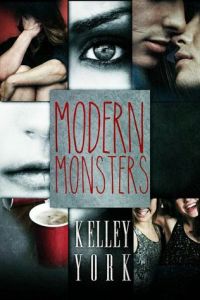
Kelley York’s YA novel Modern Monsters is a relatively straight-forward story about the modernmonstersaftermath of a sexual assault. This is my second novel by York and while there is certainly nothing wrong with it, I preferred Made of Stars, which I found to be beautifully written and nuanced. Modern Monsters suffers (but only slightly) by comparison.

Vic Howard is a senior at high school. He’s a slightly awkward loner with a stutter who knows his place on the social ladder.

I am not important. I am tolerated by association. I am Vic Howard, Brett Mason’s Best Friend, so while people don’t always care to learn anything about me, they do recognize my face. Being cool to me, they seem to think, is a way to stay cool with Brett.

Vic and Brett have been friends since they were kids. Sometimes when Vic looks at Brett he sees “the chubby pimple-faced kid with braces and glasses.” This long-standing relationship is why Brett doesn’t impress or intimidate Vic. It’s also the reason why Vic does anything even remotely sociable: he is often Brett’s plus one.

That’s how he ends up at a huge party out at a cabin by a lake. He doesn’t want to go, but Brett insists. And that’s how he happens upon Callie Wheeler throwing up in the bushes. Vic deliberates leaving her alone – but only for a moment. Vic helps Callie to a bedroom, places a waste bucket beside the bed, and acknowledges that he’s done his part.

Except a day or two later the police arrive at Vic’s house to question him. Callie was raped at the party and Vic was the last person seen with her.

Modern Monsters tackles a tricky  and timely subject with a great deal of care.  The horror of being accused of something is bad enough, but Vic’s mother doesn’t seem to believe Vic when he vehemently denies the accusation. She can’t even seem to look him in the eye. He takes refuge at Brett’s house. Brett’s parents have always been like a surrogate family and Brett’s father is a lawyer who agrees to help him.

The kids at school are less forgiving and when the rumours start to spread Vic finds himself in some pretty dicey situations. It is Callie’s best friend, Autumn, who first believes Vic’s innocence and together the two begin to try to figure out who the real rapist is. Their sleuthing also leads to a relationship, Vic’s first.

Vic is a likeable character. He’s not perfect, but he’s decent. He’s a hard-working, honest and sympathetic character and it’s impossible not to like him. Autumn is feisty and smart. Even Caillie, although her role is peripheral, reveals herself to be forgiving and human.

This book is as much about standing up for yourself as it is about the horrors of sexual assault. Vic must navigate tricky family dynamics, the first stirrings of romance, and people’s mistrust of him. Whatever his perceived shortcomings, Vic is a good guy and readers will be rooting for him.

The Possessions – Sara Flannery Murphy

Eurydice (Edie) is a “body” for the Elysian Society. As a body, she works with clients who possessions1seek to speak with loved ones they have lost. Dressed in a simple white dress, she sits in Room 12 and once in possession of an item belonging to the deceased, she swallows a lotus – a pill that  summons the spirits of the deceased – and the living communes with the dead. That’s the general principle of Sara Flannery Murphy’s debut novel The Possessions.

Edie has been working at the Elysian Society for five years, a long time for a body. She leads a very quiet, private life. “Since I joined the Elysian Society,” she says, “my emotions have evolved. They’ve gone from unwieldy to finely attuned. ready to snap into nothingness.”

That ability, to become a blank slate, is perhaps one of the reasons that Edie has been able to do this job for as long as she has. But then Patrick Braddock walks into her life. Patrick wants to speak with his wife, Sylvia. She drowned in a lake. The circumstances of Sylvia’s death are part of what propels the plot forward, but the relationship between Patrick and Edie is definitely the driving force.

Although Edie tells Patrick that she is not privy to the conversations that take place between a client and their loved ones, the line between Edie and Sylvia definitely blurs.

I was evasive with Patrick in Room 12 today. The truth is that Sylvia’s memories have lingered. One image in particular, clear and deep. I remember Patrick’s hand against me, at my waist. The golden hairs at his wrist, his long fingers holding the ghost of a summer tan. One or two fingernails endearingly frayed, as if he bites them when no one is watching. I could reach right into the memory, interlace my fingers with his. Feel the light calluses of his fingertips.

Before long, Edie and Patrick’s professional relationship crosses a line and Edie experiences the burgeoning weight of desire. As it often does, it clouds her judgment and drives her to find out what really happened to Sylvia.

The Possessions is a well-written literary hybrid: part mystery, part sci fi (the world seemed slightly off-kilter to me, not the far future but certainly not present day), part love story. It is certainly intriguing and yet…I found it slow going.

Edie’s past is a mystery. Her past is certainly alluded to, but we don’t learn much about her until the very end of the novel and by then it feels more like expository backfill. She’s really a non-entity and that makes it difficult to feel any empathy for her.

Patrick fares only a little bit better. As the grief-stricken husband trying to move on, he’s serviceable enough. Ultimately, neither he nor Edie are well-rounded enough to make me root for their relationship.

So in the plus column: great writing, intriguing plot, lots of potential. In the minus column: slow-moving, lackluster characters, some clunky plot machinations.

That said, Sara Flannery Murphy is definitely an author to keep your eye on.

Thanks to Harper Collins for my review copy and to TLC Book Tours for the chance to participate in this tour.