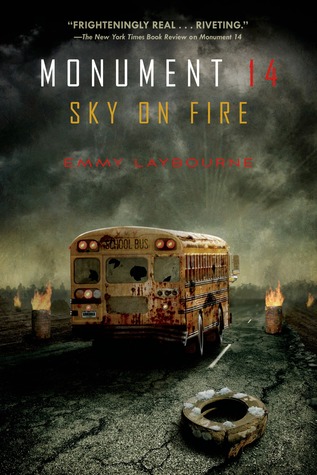
Monument 14: Sky on Fire – Emmy Laybourne

monumentskyOkay, Ms. Laybourne, you should totally take it as a compliment that I bought the second book in your Monument 14 series before I had even finished the first book. And then, without delay, I read the second book. Geesh, I haven’t even read Catching Fire yet. I should also point out that I don’t traditionally like post apocalyptic  fiction and sequels almost always irritate me. (Patrick Ness, you are totally excluded from this; you know how much I loved The Knife of Never Letting Go and the other books in the Chaos Walking trilogy.)

That said, I read Monument 14  in one breathless gulp and I read Sky on Fire just as quickly. I mean, come on, I couldn’t NOT find out what happened. But it’s going to be difficult to talk about any of it because – hello, spoilers.

Let’s just say this.

Dean goes from zero (he’s not really a zero, he just doesn’t have any confidence) to hero. His little brother, Alex, continues to act far older than his years. Niko is braver than any sixteen-year-old should have to be. Astrid turns out to be a lot more than a pretty face.  Oh, yeah, and the world has gone to hell in a hand basket.

The world outside the Greenway proves to be a lot more dangerous than any of the kids imagined and their mettle is tested on more than one occasion. Often the dangers aren’t environmental and there are plenty of creepy encounters with people who prove to be willing to kill to get what they want.

Kids in peril. A toxic wasteland. Crazy people on the loose. What’s not to love? And because Laybourne wisely decides to leave the confines of the Greenway, the reader gets to follow one group of kids as they try to make their way to the Denver Airport (and potential help) and one group who decides to stay in the superstore (and hope help finds them). It’s all pretty exciting stuff.

Okay, but then….the ending. (Which is not an ending because there’s a third book, Savage Drift) Can’t say I was a fan for a whole variety of reasons. Still, my issues are minor and even though I wasn’t as in love with Sky on Fire, I am totally in love with these kids and I will no doubt be joining them on the next leg of their journey.

Monument 14 – Emmy Laybourne

monumentEmmy Laybourne doesn’t waste any time dumping her characters (or the reader) into the middle of it in her post-apocalyptic YA novel, Monument 14. Sixteen-year-old Dean and his thirteen-year-old brother, Alex are going to miss their respective school buses and they’re so frantic not to be late, they don’t even bother  to “stop and hug [their mother] and tell her [they] love her.” Of course, neither of them realizes that it might be the last time they will ever see their mother.

Dean’s ride to school is pretty much the same every day. He hopes that Jake, the high school football captain, and Braydon, the school bully, won’t notice him and he hopes, Astrid, Jake’s girlfriend, champion diver, scornful goddess, and girl of Dean’s dreams, will.  As he slinks down in his seat, Dean tunes into his minitab (I’m thinking like an iPod shuffle) and tries to make himself as inconspicuous as possible.

That’s when things go from the ordinary to the extraordinary. It starts to hail. Hard.

…suddenly the roof of the bus started denting – BAM, BAM, BAM – and a cobweb crack spread over the windshield. …Hail in all different sizes from little to that-can’t-be-hail was pelting the street.

Dean’s bus ends up on its side. He can see that his brother’s bus is still going and in fact the driver, Mrs. Woolly, has smashed right through the entrance of Greenway, a huge superstore. Dean is relieved that his brother is safe, but he’s also aware that things aren’t so good on his bus. His driver, Mr. Reed, “was pinned behind the wheel and blood was spilling out of his head like milk out of a carton.”

The students on Dean’s bus make it into the Greenway. In total, there are fourteen students who take shelter there, some as young as five. Mrs. Wooly sets out to find help, leaving the kids to fend for themselves, which they do by barricading themselves into the superstore.

At first it seems like fun. Astrid used to work in the superstore’s pizza place and she knows how to use the equipment. The kids can have any flavor of slushie they want. Then they watch the news. Seems like the hailstorm in Monument, Colorado is actually just a byproduct of a much more serious natural event. And to make matters worse, that event had caused a problem at the nearby NORAD facility which has leaked toxic chemical warfare compounds into the atmosphere. Scary things can happen if you breathe in the air.

Monument 14 steams along without wasting too much time. I don’t mean to imply that you don’t get to know or care for the characters, you do, but Laybourne doesn’t let the prose slow down the plot. This novel is driven by the kids’ and their need to survive. They’ve got it slightly easier than most, as they have supplies at their disposal – but they are also just kids. They are cut off from the outside world with no real idea what is going on or what has happened to their parents.

I couldn’t put the book down and I started the sequel, Monument 14: Sky on Fire  this morning.

The Watcher – James Howe

watcherThe Watcher was published in 1999 to much critical acclaim. James Howe is the well-known author of the over 90 juvenile and YA books including Bunnicula and The Misfits series. ( I read Totally Joe and was a big fan.)

There are three main characters in The Watcher: Chris, the golden-boy lifeguard, Evan, the fourteen-year-old on vacation with his younger sister and parents, and the girl who sits at the top of the steps leading down to the beach, watching.

The truth is, though, that they are all watching each other. For example, Chris notes that “he didn’t know how he knew she was watching only him and not them. He could just feel it.” She’s watching him; he’s watching her.  Evan thought Chris was “the coolest guy on the beach” and secretly wished he could be just like him. The girl watched the families, “not pieces of families with only a mother or a nanny, but what she thought of as complete families with two parents and at least two children, preferably a girl and a boy.”

All three of these characters are on Fire Island, a popular beach resort near New York City. There is no reason to think they will ever cross paths, but they eventually do.

Howe is a straightforward wordsmith, and he creates compelling back stories for Chris and Evan. We know that Chris is at a crossroads, unsure of what to do now that he has graduated from high school. He feels the weight of his parents’ expectations, although we don’t understand exactly how much pressure he feels until much later in the book. As for Evan, he adores his little sister Callie and is doing his best to be a good big brother because he senses that there are things going on behind the scenes which might spell the end of his happy family.

As for the girl, we know nothing at all about her except that as she sits on the steps surveying the beach. She is imagining a much different life for herself, one where she is a princess who has been separated from her true family.

I read The Watcher in one sitting. I can only imagine that when it was first published it would have caused quite a sensation. It’s easy to see why. Each of these characters is called upon to do something brave and Howe handles their stories without sensationalism or preaching. Young readers would certainly recognize themselves in these pages.

Leftovers – Laura Wiess

leftovers-coverBy the time you hit fifteen, there are certain survival lessons you’d better have learned.
That’s the world-weary voice of Blair Brost. She’s one of the two teenage narrators of Laura Wiess’s compelling YA novel, Leftovers. Blair’s co-narrator is Ardith. Although they are fifteen when they begin to tell their story, Ardith says they must “go back to eighth grade, which is when it all began.”

Blair is an only child. Her parents are lawyers; her mother is particularly ambitious and when she makes partner “she decides it’s time to buy  one of the big new, McMansions across town.” Blair isn’t interested in moving. She also doesn’t understand why her dog, Wendy, isn’t allowed to come. The dog is old and incontinent and Mrs. Brost says they’ve found her a new home, which isn’t exactly true.

Ardith lives with her alcoholic parents and older brother, a good-looking, charming snake.

You call your parents Connie and Gil, because they hate the heavy tags of Mom and Dad, and buy baggy, boring clothing so your mother won’t borrow them. Your hair is short because the guys like it long…

Blair and Ardith are trying to navigate the slippery terrain between childhood and adulthood and they don’t really have any positive role models. In fact, the only adult who takes any real interest in them is Officer Dave Finderne, a cop who finds them wandering home after a night at the pool.

Leftovers has elements of suspense. There are questions that need to be answered and readers will turn the pages quickly to find them. But this novel also cracks open the lives of adolescent girls, where the only way to survive is to know the rules:

Never bow before your tormentors.

Never let them know you’re vulnerable, especially when you are.

Never trust someone else to protect you, and never forget that every choice you make is on you.

Ardith and Blair are compelling narrators and their story is both heart-breaking and authentic. As both a mom and a high school teacher, I found Leftovers difficult to read (I just wanted to bring these girls home with me), but I think it has important things to say and it says them beautifully.

Highly recommended.

Help For The Haunted – John Searles

helpforthehauntedIn some ways, John Searles reminds me of Thomas H. Cook, an American mystery writer I greatly admire. Neither of them seem to have any interest in racing through plot points to the story’s denouement. Instead, like Cook, Searles lets us get to know the characters and takes his time layering the narrative. Help For The Haunted  is the story of Sylvie Mason and her unusual family. It is part mystery, part ghost story and part family drama.

“Whenever the phone rang late at night, I lay in my narrow bed and listened,” says 14-year-old Sylvie, the narrator of the story. Late night phone calls are a common occurrence in the Mason household. That’s because Sylvie’s parents, Sylvester and Rose, have a very unusual occupation: they help the haunted. People who feel they may be themselves, or have family members who are, possessed by demons seek them out and the Masons help with prayer. It’s not a lucrative business, people ” only occasionally enclosed a check to cover gas or airline tickets” but it is work that the Masons, particularly the father, feel strongly about.

The phone call that opens the novel is of a more personal nature, though. The Mason’s eldest daughter, also named Rose, has asked her parents to meet her at the church in town.  Rose has always been difficult and on this occasion she has been missing for three days. The Masons don’t want to miss this opportunity to reconcile with their daughter so, despite the blizzard, they head to the church, Sylvie in tow.

When Sylvie’s dad disappears inside the church Sylvie admits to “a prickly feeling of dread” and when her mother ventures inside to see what is taking so long, Sylvie drifts off to sleep only to be awoken by the sound of gun shots.

Searles manages a tricky narrative here. The present blends seamlessly with the past as Sylvie tries to unlock some of her family’s most closely guarded secrets. There is a compelling cast of secondary characters including her father’s estranged older brother, Howie; Sam Heekin, the reporter who wrote a book about her parents; Albert Lynch, the man currently sitting in jail for the murder of her parents.

Sylvie herself, despite her young age, is tenacious and resourceful. A year after the death of her parents, as the police put the finishing touches on their case against Albert Lynch, Sylvie starts to doubt what she saw in the church on that fateful night. New evidence shows that Lynch might, in fact, be innocent and it makes Sylvie question her earlier statement. But if Lynch isn’t the killer, who is?

Help For The Haunted is a literary page-turner. The whodunit isn’t actually as important as Sylvie’s journey from adolescent to adult and the demons, ultimately, are more human than you might think. Great book.

This Is Not A Test – Courtney Summers

testThis is my second book by Canadian YA writer Courtney Summers and, that’s it:  I am a fan. I previously read Some Girls Are and I was totally taken with its unflinching look at what it is to be a teenage girl. It isn’t pretty, people.

This Is Not A Test has won a slew of awards including being named a  2014 OLA White Pine Honour Book, 2013 ALA/YALSA Top Ten Quick Pick for Reluctant Readers, 2013 ALA/YALSA Best Fiction for Young Adults, and  a  Kirkus New & Notable Books for Teens: June 2012. Trust me, the book delivers on every possible level.

Sloane lives in with her father  in Cortege. Her older sister, Lily, has left home and taken a piece of Sloane with her. It won’t take the reader very long to figure out that Sloane’s father is abusive. She tells us he burns the toast because she deserves it and when he reaches out to examine her face, Sloane flinches before she can catch herself. It’s no wonder that Lily has left, but the plan was that they were supposed to go together.

Based on the first couple of pages, it would be reasonable  to think that This Is Not A Test is a story about abuse, but you’d be so wrong. As Sloane is contemplating the burnt toast and the note her father has written to explain her absence from school, their front door starts to “rattle and shake.”  Someone is screaming for help and it is such a creepy event that as Sloane’s father heads to the door to investigate Sloane notes that he hesitates and she has “never seen him hesitate” in her life.

When Sloane’s father returns to the kitchen he’s screaming that they have to leave and he’s covered in blood. And then all hell breaks loose, literally.

Seven days later Sloane finds herself barricaded in Cortege High School with five other students: student body president, Grace, and her twin brother, Trace; Rhys, a senior;  some-time drug dealer and some-time boyfriend to her sister Lily, Cary and Harrison, a freshman who can’t seem to stop crying. The high school offers the six teens sanctuary while they wait for the help the feel sure will come. Unfortunately, the only announcement on the radio proclaims that “This is not a test.”

As the days drone on, Sloane and the rest of the trapped teens struggle to stay calm. They jockey for position, alliances are formed and they wonder what has happened to the rest of the world. It all makes for a riveting psychological drama because Summers has an ear for how teens speak and she doesn’t shy away from the fact that this scenario is relentlessly grim. It’s the end of the world as we know it. Except for the feeling fine part.

Sloane narrates this story and she is a sympathetic character. Even if she could get back home, what does she have to return to? No one knows about the abuse she suffered and without Lily she feels as though she has very little to live for. Thus, she has nothing to lose.

This Is Not A Test is my very first zombie novel. I’ve pretty much avoided them until now because, truthfully, they don’t really interest me all that much. If they were all as good as this one, though, I’d be a fan.

Apparently there is an e-sequel available, but truthfully, I thought the ending to This Is Not A Test was pretty damn perfect.

Highly recommended.

Faking It – Cora Carmack

faking itOn Feb 16, I did a column for CBC about New Adult Fiction, a category of fiction which targets the 18-25 age bracket and tends to be slightly more sexually explicit than a YA novel, but nowhere near as pornographic as Fifty Shades of Grey. I’d only read a couple of books that I would consider New Adult before I did the column, one I liked (Easy), and one I did not (Ten Tiny Breaths). Cora Carmack’s NA novel, Faking It, falls into the latter category.

First we meet Cade. He’s pining over Bliss. (Yes, all the names are this bad.) Although they never actually dated she’s Cade’s best friend and Cade feels as though Bliss is the one that got away. Every time he sees her with her new boyfriend, Garrick (told you), it feels “like a rusty eggbeater to the heart.”

He’s meeting them for coffee when the novel opens. Apparently, he’s a sucker for punishment. It’s at this meeting that Garrick tells Cade that he’s going to propose and Cade’s world  falls apart.

Enter Max. And her boyfriend…wait for it…Mace. They enter the very same café where Cade has just had his heart broken. Max is on her cell phone and she’s just discovered that her parents are not calling from Oklahoma, but from across town; they’ve made an impromptu visit and that puts Max in a bind. She has to come up with a suitable boyfriend, someone to make her look sensible and subdued, when clearly she is anything but. I mean, she has red hair! And tattoos! And piercings!!! Mace, despite being “gorgeous and a killer drum player” is not mom and dad boyfriend material. Max gets rid of Mace (not all that difficult as all Max has to do is mention “parents” and Mace departs). That just leaves the problem of what to do about the boyfriend. That’s when she spots Cade. Despite the fact that he was “gorgeous, in that all-American model kind of way” Max normally wouldn’t have given him a second glance “because guys like that don’t go for girls like” Max. Thing is, he’s staring right at her.

Faking It is told in alternating first person narratives, so we get Cade’s point of view and then Max’s. That’s how we know that Cade has been watching her and how we know that he thinks she’s “bright.”(Her personality/aura/looks, not her IQ.) He also notices “no real connection between [Max and Mace].” When her eyes meet his it makes Cade’s “mouth go dry and stirred something in [his] chest. Stirred up other things, too.”  Um, wait a minute, didn’t you just have your heart-broken by that girl, Bliss, like five minutes ago? We’re only on page 20!

I am all about the slow burn and Faking It doesn’t seem to care about that. There’s an instant attraction between Cade and Max and soon they are bantering like Tracy and Hepburn, like with nicknames and everything. He agrees to be her date to Thanksgiving dinner and has no trouble playing the part of devoted boyfriend. In fact, he plays the part so well that Max’s parents invite him to Oklahoma for Christmas. Oh, what a tangled web.

Cora Carmack is a very popular, best-selling author and I have no doubt that for its intended audience Faking It hit all the right notes. For me, though, everything happened way too fast  and the over-the-top reactions to relatively minor obstacles and set-backs were just too much. I guess in that respect Faking It perfectly captures the drama of youth.

One more note: it’s biceps, people, even just in the one arm. Geesh.

Her and Me and You – Lauren Strasnick

her-and-me-and-you-366x550Alex and her mom have moved to Meadow Marsh to live in Alex’s dead grandmother’s house because “my favourite parent, Dad, had done some very bad things with a paralegal named Caroline.”

Faster than you can say trouble, with a capital T, Alex meets Fred and his twin sister, Adina. They’re  –  odd. Well, at least Adina is, but Alex is drawn to them anyway. Mostly she’s looking for an escape from the wreckage of her parents’ marriage and her mother’s subsequent nosedive into a bottle.

There’s not a lot of plot here – nothing much happens – but the triangle between Alex, Fred and Adina is almost immediately fraught with a weird and buzzing tension that Alex can’t quite get a handle on. One minute Adina is her bestie, the next she’s icing Alex out. To further complicate matters, Alex finds herself drawn to Fred, “his freckled face made [her] want to bake a batch of cookies. Down a gallon of milk.”

There’s also the problem of what Alex has left behind: her best friend, Evie, for starters has fallen in love and Alex felt “furious” about it. “Everything had changed so fast. Dad. Mom. Evie. Especially Evie.”

Her and Me and You is a relatively light-weight coming-of-age novel that is just better than average because despite the fact  that it has many of the standard YA realistic fiction hallmarks: divorced parents, absent parents, eating disorders, underage drinking, high school drama, it also has a compelling protagonist. Alex doubts herself in the way of all teenage girls, but she also has a wonderful capacity for growth and forgiveness. I liked that about her.

 Her and Me and You is a strangely compelling YA novel and I think it mostly has to do with how it navigates the tricky world of teenage relationships.

The History of Love – Nicole Krauss

historyWhen Nicole Krauss’s novel The History of Love was published in 2005 it took the literary world by storm (though not like the storm that is raging outside as I write this, cozy in bed with my cat and my tea.) Everyone loved this book: The New York Times, The Guardian, The Globe and Mail. It was also the winner of the Edward Lewis Wallant Award for Jewish fiction and BMOC’s Best Literary Fiction. The book has been on my tbr shelf forever (emphasis on the ‘ever’) and so I chose it as my pick for book club.

The History of Love is the title of the book Leo Gursky wrote for the love of his life, Alma. Alma flees Poland just before the invasion of the Nazis and when Leo finally makes his way to America, he discovers that not only does he have a son, but that Alma has married someone else.

…he stood in her living room listening to all this. He was twenty-five years old. He had changed so much since he last saw her and now part of him wanted to laugh a hard, cold laugh….She said: You stopped writing. I thought you were dead. …At last he managed three words: Come with me….Three times he asked her. She shook her head. I can’t, she said. And so he did the hardest thing he had ever done in his life: he picked up his hat and walked away.

Now Leo is at the end of his life. “When they write my obituary,” he says, “it will say LEO GURSKY IS SURVIVED BY AN APARTMENT FULL OF SHIT.” Leo just wants to be seen. “Sometimes when I’m out, I’ll buy a juice even though I’m not thirsty. If the store is crowded I’ll even go so far as dropping my change all over the floor,” he says. His voice, one part resigned, one part hopeful is one of the novel’s greatest charms.

The other charming voice belongs to fifteen-year-old Alma – not the love of Leo’s life, but that of a teenager who lives in Brooklyn, with her widowed mother (who works as a translator) and younger brother, Bird. Her name is no coincidence: she was actually named after the character in Leo’s book The History of Love. This is where things get a bit complicated and I’m not going to bother drawing the chart required to understand it all – trust me, it’ll all sort itself out.

Alma is on a mission to find her mother a boyfriend. Her father died of pancreatic cancer when Alma was just seven and Alma feels as though her mother has been sad ever since. Alma is trying to navigate adolescence, her mother’s sadness, the fact that her brother thinks he’s the Messiah and her first love, too. Then (and I’m going to say it, girls!) by a weird twist of fate, The History of Love arrives for Alma’s mother to translate and the threads of Alma and Leo’s stories start to reach towards each other.

I really enjoyed The History of Love. There were some moments in the book that literally stopped me in my tracks. For example, Leo says: “All the times I have suddenly realized that my parents are dead, even now, it still surprises me, to exist in the world while that which made me has ceased to exist.” Those of us who have lost our parents will recognize that feeling (although perhaps never articulated) all too well.

This is one of those books, I think, which needs some time to sit in your belly. It is a book about connection – lovers, siblings, friends, parent and child. Leo, at the end of his life (which some might argue he wasted by loving someone he couldn’t have and not pursuing a relationship with his son) has all the insights of a person who has made errors in judgment, but is somehow still open to the world. Ultimately, The History of Love is about the desire we all have to be seen and understood and often the smallest gesture can have the biggest impact.

Highly recommended.

The Girl in the Park – Mariah Fredericks

parkRain, the compelling narrator if Mariah Fredericks’ YA mystery, The Girl in the Park, attends the prestigious Alcott School in Manhattan’s Upper West Side. “At our school,” she says. “everybody is the child of a somebody.” Rain’s somebody is her mom, an opera singer and “if you’re into opera, you probably know her.”

Rain is a watcher, a listener. Mostly it’s because she was born with a cleft palate, and although speech therapy has smoothed out some of the T’s and S’s, Rain’s still self-conscious. She hates how she sounds, “mushmouthed and nasal.”  That is, until Wendy starts school and tells her “Big deal. Okay, maybe you sound a little funny. But you need to forget about that and speak up girl.”

Wendy is larger than life. Although she’s rich, she comes from Long Island and doesn’t have the right kind of money or pedigree. The students at Alcott are snobbish and clique-ish, but that doesn’t stop Wendy from trying to make inroads. It’s when Rain tells her that she’s approaching it all wrong that the two girls become friends.

We only ever really see Wendy through Rain’s eyes because when the novel begins, Rain discovers that her friend has been found dead in Central Park. At this point, Rain and Wendy were friendly but no longer really friends. Wendy’s blatant disregard for the prep school rules and her reputation as a “skank” have caused Rain to distance herself from the girl who once told her that “You. Other the other hand. Listen. And you think. So when you do speak? You’re brilliant. So, give up the silence, okay”

Rain can’t stand the thought that something so horrible has happened to Wendy. Worse, the night it happened Rain was at the same party as Wendy and she feels she may have seen something that could help the police — she just doesn’t know what it is.

The Girl in the Park is a fast-paced mystery with enough suspects to keep readers engaged and guessing whodunit. It’s also a story that peers into the nasty, and sometimes heartbreaking, world of teenagers. I couldn’t put it down.