Bellman & Black – Diane Setterfield

bellmanWe were all pretty excited when Marianne chose Bellman & Black as this month’s book club selection. We all loved Diane Setterfield’s first novel The Thirteenth Tale when we read it a few years back. Sadly, this novel lacked that book’s  — well, everything.

As I pointed out when we met last night: “Did you notice that all the praise on the back of the book was for The Thirteenth Tale.”  And true enough – there isn’t a single endorsement for this novel on its cover or inside its pages. Okay, maybe that doesn’t mean much in the whole scheme of things and I know I’m making it sound as though Bellman & Black is horrible and I guess I wouldn’t go so far as to say that, but it isn’t very good, either.

William Bellman is just a kid playing somewhere in the English countryside  when he decides to show off in front of his friends and uses a catapult to shoot a rook (similar to a crow) out of a tree.

It took a long time for the stone to fly along its preordained trajectory. Or so it seemed. Time enough for William to hope that the bird, flapping into life, would rise upwards from the branch. The stone would fall harmlessly to earth and the rook’s granite laughter would taunt them from the sky.

Instead, William hits and kills the bird and thus leaves innocence and childhood behind him and begins  the downward slope towards death. And yes, it’s really this heavy-handed.

Will’s life is marked with great successes and tremendous tragedies. We watch him turn his uncle’s mill into a financial success. We watch him fall in love and have a family. And we watch things start to fall apart. But the thing is — and it is a thing that we talked about last night — none of it mattered all that much because Will was a character we knew or cared little about. He was driven, sure, and haunted, certainly, but not by the rooks which made strange appearances (sort of like encyclopedia entries) throughout the book.

When William suffers a tragic personal loss, he makes a deal with a mysterious stranger, Mr. Black, and he suddenly finds himself building a one-stop funeral emporium. We’re talking Victorian England here, when people mourned for years and spent money (apparently) on all manner of funereal accoutrements. So, just as we watched him build Bellman Mill, we learn all the nooks and crannies of Bellman & Black, but none of it is interesting enough to sustain a 300 plus page narrative. And trust me, the stuff about the rooks doesn’t help.

At the end of the day, Setterfield’s book is a less schmaltzy take on, say, a book like Tuesday’s With Morrie. We’re meant to understand that life must have checks and balances, and that when we care too much about things that don’t matter (wealth, success) we miss out on those things that truly do.

Bellman & Black wasn’t hard to read, but I won’t be recommending it to anyone else.

The Absolutely True Story of a Part-Time Indian – Sherman Alexie

part time indianI can’t remember the last time I rooted for a character the way I rooted for Arnold ‘Junior’ Spirit, the fourteen-year-old narrator of Sherman Alexie’s YA novel, The Absolutely True Story of a Part-Time Indian.

Junior is a member of the Spokane Tribe and lives with his parents, grandmother and older sister on the Rez. Without a drop of self-pity, Junior tells the reader that his “head was so big that little Indian skulls orbited around it” and that “the bullies would pick me up, spin me in circles, put their finger down on my skull, and say, ‘I want to go there.'”

Skinny, born with ten extra teeth, and prone to seizures, Junior is also determined, smart, and really funny. He says, “With my big feet and pencil body, I looked like a capital L walking down the road.” He both stutters and lisps and so everyone calls him a retard. “Do you know what happens to retards on the rez?” he asks the reader. “We get beat up. Yep, I belong to the Black-Eye-of-the-Month-Club.”

As if Junior’s physical problems weren’t bad enough, Junior and his family are also very poor. They’re so poor, Junior often goes hungry. But, as he explains, “It’s not like my mother and father were born into wealth. It’s not like they gambled away their family fortunes. My parents came from poor people who came from poor people who came from poor people, all the way back to the very first poor people.”

His father is an alcoholic who often disappears on benders. His mother is slightly flakey, but also super smart. Junior is perfectly aware of the limitations that come from being an Indian on the rez.

…we reservation Indians don’t get to realize our dreams. We don’t get those chances. Or choices. We’re just poor. That’s all we are.

Strangely, none of this seems like whining coming from Junior’s mouth. It is what it is and he’s found ways to cope. For one thing, his best friend,  Rowdy, is the toughest kid on the reservation. For another thing, his parents are kind and loving and supportive. While it seems like there are too many obstacles in Junior’s way, the reader soon learns not to underestimate him.

An incident at school prompts a visit from one of his teachers and suddenly Junior has left the rez and is traveling 23 miles into a town to attend a white school where he has the chance to make something of himself. (But not without a lot of soul-searching about what it means to have to leave the rez behind and enter the white world.) But make something of himself, he does. I can’t imagine anyone reading this book and not getting a little va-klempt at Junior’s journey.

The back cover of my edition of The Absolutely True Story of a Part-Time Indian  says that the novel is inspired by Sherman Alexie’s own experiences growing up. The book has won numerous awards including the National Book Award. It’s most deserving of the praise.

This is a laugh-out-loud, tear-in-your-eye, 100% uplifting novel about the challenges of growing up and making your own way in the world. Everyone should read it.

Crazy Beautiful – Lauren Baratz-Logsted

crazyMy arm rises toward my face and the pincer touch of cold steel rubs against my jaw.

I chose hooks because they were cheaper.

I chose hooks because I wouldn’t outgrow them so quickly.

I chose hooks so that everyone would know I was different, so I would scare even myself.

That’s Lucius Wolfe. He’s 15 and the new kid at school. He and his younger sister, Misty, and his parents had to move because Lucius got in the middle of a bomb making experiment gone wrong and blew himself — and most of his house — up. Now he’s got hooks for hands. Why was Lucius making a bomb, one might ask? Ask away — you’re not going to get any real insight from Lucius other than a vague “I was practicing to do harm, somewhere, sometime, maybe.”

I hear the dog alarm go off in the same instant I become aware of the first morning light in my room. I like rising early, like sleeping with the blinds open, because I’m scared of the dark.

In the dark, almost anything can happen.

That’s Aurora Belle. She’s 15 and also the new kid at the school. She and her father moved because Aurora’s mom had recently died of cancer and her dad thought it was time to change the scenery. Aurora is beautiful and smart and perfect…and immediately popular at school.

On the bus on the first morning  (and what are the chances, eh?) Aurora and Lucius’s eyes meet and wowza. But it’s even more than that for Lucius; he decides to become Aurora’s Gallowglass. It means ‘foreign soldier’ but to Lucius it is “the greatest personal protection service you can think of all rolled into one person.”

Aurora doesn’t really strike me as the person who actually needs protecting. She’s absorbed almost immediately into the school’s who’s who and soon thereafter wins the lead in Grease (which, unbelievably, Lucius has never even heard of).

Still, there is Jessup Tristan (and by now the names are starting to be as irritating as the characters), school douche-bag, and a couple of superficial girls and Nick Greek, the security guard who frisks Lucius after he sets off the alarm going through the school’s metal detector. It’s an embarrassing moment for Nick, but then it’s all made well when the 15 year old boy and the 22 year old security guard become fast friends and Lucius actually helps Nick reconsider his career path. I kid you not.

If Lucius didn’t have hooks for hands and a slightly suspect psyche, Crazy Beautiful would be nothing more than an adequately written YA novel.  Take away those hooks and Lucius’s raison d’etre and you’ve got…nothing. Seriously. At a mere 193 pages there’s no time to really develop the characters or their relationships.

Boy sees girl on the bus and falls instantly in love.

Girl sees boy on the bus and “there was an instant connection.”

We’re on page 28.

And what are the chances, when the plot twist comes — separating these two ‘damaged kids’ — that Aurora knows exactly what Gallowglass is?

As it turns out, pretty damn good.

Give this one a miss.


I Am Scout – Charles J. Shields

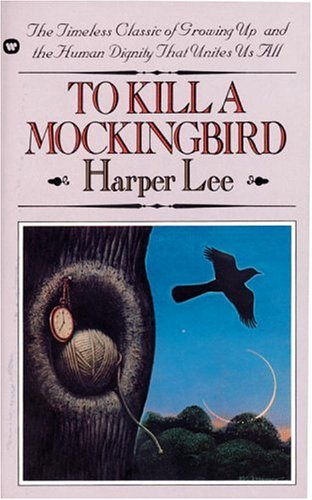
It’s pretty much a rite of passage that every teenager reads To Kill a Mockingbird at some point during their high school career. Published in 1960, Harper Lee’s only book won the Pulitzer Prize and was made into a movie starring Gregory Peck.  I love the book , but even I can see how today’s teens might struggle with it.

tkamIn case you’ve been living under a rock, To Kill a Mockingbird is the story of Jean Louise (Scout) and Jem Finch and their father, Atticus, a small-town lawyer. Narrated by Scout, the story takes place in Maycomb, Alabama in 1935. Although the action of the story takes place when Scout and her brother are children, the story is narrated from an adult’s vantage point which is how Scout is able to make some very worldly observations about society, childhood, prejudice and evil – all of which are themes in the book.

It’s an English teacher’s dream book, but it’s not without its problems – especially when you teach a generation of students who mostly read about sparkly vampires and cuddly werewolves. Still, I think it’s worthwhile.

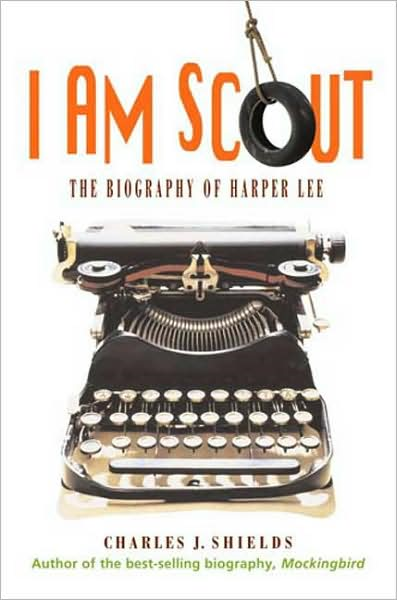
I started reading I Am Scout, Charles J. Shield’s student-friendly autobiography of Harper Lee  ( adapted by Shields from his book, Mockingbird: A Portrait of Harper Lee) just before my students and I began our discussion of To Kill a Mockingbird.  Even though I have probably read To Kill a Mockingbird a half dozen times or more, I’d never read anything about Lee’s life and I was interested.

If you ever wondered why Lee never published another book (and, really, who hasn’t wondered that?) this is the book for you. Shields traces Lee’s childhood, the youngest of four children growing up in Monroeville, Alabama. Almost from the beginning, it’s impossible not to see Scout when you read that Nelle (Ellen spelled backwards) Harper Lee:

had a reputation as a fearsome stomach-puncher, foot-stomper, and hair-puller, who “could talk mean like a boy.” Three boys had tried challenging her once. They came at her, one at a time, bravely galloping toward a dragon. Eithin minutes, each had landed face down, spitting gravel and crying “Uncle!”

Almost everything about Scout’s make-believe life is drawn from Lee’s childhood. Lee did call her father by his first name and he was a lawyer. Her childhood friend, Truman Capote, was the inspiration for the character of Dill. Lee’s mother was virtually absent from her life owing to issues with mental health. Several other characters in To Kill a Mockingbird were inspired by people in Lee’s life including Mrs. Dubose, a cranky morphine addict and Boo Radley, who is based on Alfred Boleware Jr., a Monroeville native who was rumoured to be  “a captive in his own home, tied to a bed frame by his father.”

Shields also tells how Lee helped Truman Capote research (and some say write) In Cold Blood, easily considered one of the quintessential pieces of true-crime writing of the last century. The relationship between Lee and Capote lasted thoughout their lives, but was not without its trials; Capote was, perhaps, jealous of Lee’s success –  even though he was certainly no slouch.

I am scoutSo, why didn’t Harper Lee ever write another novel?  According to Shields:

She reportedly had every intention of writing many novels, but never could have imagined the success To Kill a Mockingbird would enjoy. She became overwhelmed. Every waking hour seemed devoted to the promotion and publicity surrounding the book. Time passed, she said, and she retreated from the spotlight. She claimed to be inherently shy and was never comfortable with too much attention. Fame had never meant anything to her, and she was not prepared for what To Kill a Mockingbird achieved.

I felt after reading Shields’ biography that the reason Lee never wrote another novel was because this was the only story she had to tell. But that’s okay – if you only have one, it may as well be the one that wins the Pulitzer.

The Lost Boy – Greg Ruth

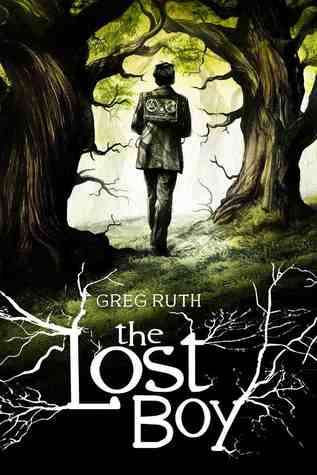
lostboyGreg Ruth has a successful career as a writer and comic book artist and has worked for Dark Horse Comics, DC/Vertigo and even illustrated Barack Obama’s picture book Our Enduring Spirit.

I saw The Lost Boy sitting on a shelf at Indigo and thought it looked and sounded interesting and as I am always on the hunt for graphic novels to add to my small but growing collection, I added it to my shopping bag.

The Lost Boy is the story of Nate who moves to a new town and a new house with his parents. His father tells him that he gets to choose any room he wants and upon a desultory inspection of the rooms upstairs Nate finds an old tape recorder under a loose floor board. Even more strange, there’s a note with his name on it which simply says: Find him.

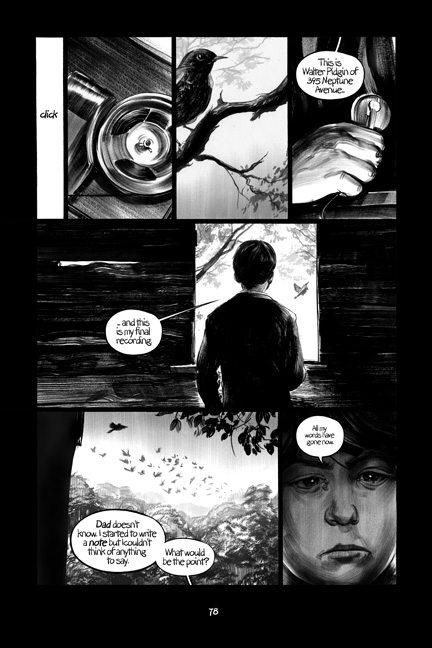
The tape recorder belongs to Walter Pidgin and when Nate presses play he hears the voice of Walter, a boy about the same age as Nate.

“These are the facts,” Walter’s voice says. “Six dogs and three cats have gone missing in the past ten weeks. The pattern is too deliberate to be coyotes.”

Walter tells his tape recorder that something ‘unnatural’ is at work in Crow’s Woods and it turns out he’s right.

lostboy2 When Nate meets Tabitha, a girl down the street, she’s able to tell him that Walter went missing many years before and when the ‘otherworld’ starts encroaching on the real worl, Nate and Tabitha decide that they need to go into the woods to find out just what happened to Walter.

I found myself getting confused by the players – and maybe that’s because there’s this complicated world which is unveiled by talking dolls and bugs. Cool, but a perhaps too convoluted for one reading. I liked the art in The Lost Boy better than I liked the story, actually – although the story had a lot of potential.

Nevertheless, a worthy and intriguing additiong to my classroom library.

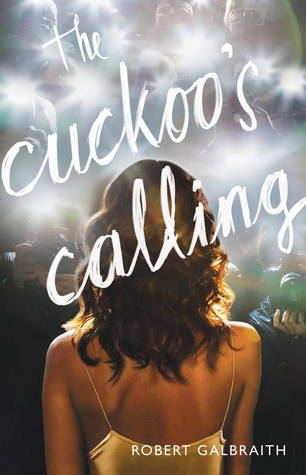
The Cuckoo’s Calling – Robert Galbraith

cuckooDespite the fact that my children, my daughter in particular, are over-the-top Harry Potter fans, I have only ever read the first book, Harry Potter and the Philosopher’s Stone. When my daughter was really little, say four or five, I had tried to read the book to her and I just couldn’t do it.  I did end up reading it out loud to a grade nine class a couple of years ago and they loved it; so did I.

That said, I wasn’t really looking forward to tackling J.K. Rowling’s massive post Potter novel, The Casual Vacancy, when it was one of last year’s book club selections. That book ended up being a really pleasant surprise, however,  and proved once and for all (as if being one of  the best-selling authors of all time wasn’t proof enough) that Ms. Rowling can write the hell out of a story.

My book club recently met to discuss Rowling’s mystery novel The Cuckoo’s Calling, which Rowling wrote using the pseudonym, Robert Galbraith. (There’s an interesting article about her decision to do so here. ) By the time we got to the book, though, the gig was up and we already knew Rowling had penned the book.

Cormoran Strike, the novel’s protagonist, is a former soldier who lost a leg below the knee to a land mine in Afghanistan. Now he lives in London where he works – although not very successfully – as a private investigator.  His relationship with Charlotte has just ended badly – again. He’s broke and living in his office. And then John Bristow arrives with a case for him.

Bristow is the brother of Strike’s childhood friend, Charlie, who had died when they were kids. He’s also the brother of Lula Landry, the most famous model on the planet. Landry recently committed suicide, but John believes something more sinister happened and wants Strike to investigate.

Of course, it’s really impossible to say much more about the story without giving away important plot points. Suffice it to say that as far as the ‘detective’ part of the novel goes – there’s lots to keep mystery-lovers in the game.

Rowling’s real strength as a writer is characterization. And as I tell the students in my writing class – character is the most important thing anyway; they are what drives your plot.

The Cuckoo’s Calling is chock-a-block with characters of all sorts, the most important of which is Cormoran Strike himself.

The reflection staring back at him was not handsome. Strike had the high, bulging forehead, broad nose and thick brows of a young Beethoven who had taken to boxing, an impression only heightened by the swelling and blackening eye. His thick curly hair, springy as carpet, had ensured that his many youthful nicknames had included “Pubehead.” He looked older than his thirty-five years.

Although the women at book club couldn’t agree on whether we found Strike attractive or not (trying to cast him in a movie version was hysterical), we all agreed that he was super-smart and that’s always the sexiest thing anyway.

Strike and his office temp, Robin (who is pretty smart herself) work their way through the list of Lula Landry associates, turning over rocks in an effort to understand the model and the world she inhabited. It makes for a pretty compelling tale.

The best endorsement I can offer for The Cuckoo’s Calling is this: I bet we’ll be seeing Cormoran again and since he’s a character I can’t seem to stop thinking about, I welcome the opportunity to join him on his next case.

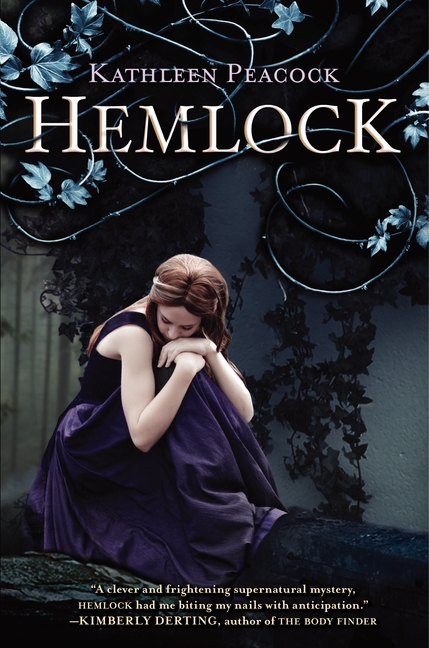
Hemlock – Kathleen Peacock

HemlockSo this rarely happens to me. The other night, after I turned my light off, I couldn’t turn my brain off and so I stared at the shapes in my room until 1 a.m.. Then I turned my light back on and raced through the final 100 or so pages of Kathleen Peacock’s debut novel, Hemlock.

Seventeen-year-old Mackenzie ‘Mac’ Dobson lives with her cousin, Tess, in the small town of Hemlock.  Her close knit circle of friends, Jason, Kyle and Amy, have recently been reduced by one: Amy was found dead in an alley, victim of a werewolf attack.

Those pesky werewolves, always maiming and eating.

Mac is suffering from very disturbing dreams brought on, she believes, by a guilty conscience. Amy had called her the night she’d died, but Mac had blown her off so she could study. But her grief and guilt are compounded by other issues: her growing feelings for her best friend, Kyle; Jason’s increasingly erratic behaviour after the death of his girlfriend, Amy, and the arrival of the Trackers, specialized werewolf hunters. On top of all this, Mac decides she is going to figure out what really happened to Amy on the night she was attacked.

There’s a lot going on in Hemlock – the town and the book. Here’s what I liked:

– I liked the fact that the whole werewolf thing just ‘is’. Werewolves exist, let’s move on. In Peacock’s version of the lore, anyone  who is scratched or bitten by a werewolf (at least those that survive the attack) become infected with lupine syndrome. Those people are captured – where it is possible to find them – and sent to rehabilitation camps. (I immediately thought of the Nazis rounding up the Jews and whether this comparison was Peacock’s intention or not, it actually works on all sorts of levels.)

– I also liked how there were werewolf supporters, sort of a ‘live and let live’ faction, which means that anyone who shares this view is also in danger of persecution, thus upping the stakes for a whole bunch of other characters. Mac is decidedly on the fence about this issue:

…I knew not all werewolves were good. Some of them did attack and kill people. And one of them had killed Amy. But Charles Manson, the kids from Columbine, that guy with the Kool-Aid – regs did horrible things to each other, too.

– I liked how propulsive the narrative was. I think Peacock really excelled at moving things along, especially when it came to fight scenes, or scenes where the wolves transformed from human to wolf.

– I liked Peacock’s sense of humour. Sometimes the dialogue made me chuckle.

But here’s my problem. Werewolves.

werewolf2I have no problem with fantasy worlds built around creatures of the night. I have a healthy imaginary life which involves virile vampires. Trust me, I get it. But I don’t get werewolves. There’s nothing sexy about them. Or particularly sympathetic, even. (Yeah, I know, they didn’t ask for this life.)

I was invested in Mac’s quest to find out the truth about Amy. I was less invested in her love triangle, a sort of Bella, Edward, Jacob thing. There was something contrived about it that just didn’t work for me. Bottom line: I didn’t care about them. Jason’s a douche. Kyle is in full-on push pull mode. Both have their reasons; all will be revealed, but I never settled into a space where I wanted her to be with either particularly and that’s a problem in a paranormal romance.

And I felt like there was perhaps a tad too much going on in the opening book of a trilogy. Love. Duplicity. Politics. Family issues. Murder and Werewolves. All the pieces click together neatly by the end though and will leave fans howling for Hemlock‘s sequel. Thornhill.

thornhillI have had the pleasure of ‘meeting’ Kathleen Peacock – virtually. She graciously agreed to speak to students at last year’s Write Stuff workshop. We linked Kathleen via the Internet and had Riel Nason, author of The Town That Drowned with us at the venue and both authors talked to the participants about the perils and rewards of writing. It was really exciting for me and for the students, too. How often do you get to talk to published writers? Kathleen is funny and smart and honest in person – well, you know what I mean. She’s also geeky, which appeals to me. I predict she has a long and successful writing career ahead of her.

Anna Dressed in Blood – Kendare Blake

Anna Dressed in Blood[1]I love the cover of Kendare Blake’s YA novel Anna Dressed in Blood. And I loved the first 200 or so pages of the book, too. And then – not so much. Of course, the first clue that things might have the potential to go south was Cassandra Clare’s ringing endorsement. But okay – I was ultimately willing to overlook that. The plot fell apart for me…and the characters…and it just felt like a hot mess by the end.

But in the beginning…

Cassio ‘Cas’ Theseus Lowood kills the dead. He’s got this cool athame (a double-edged daggar) and his dead father’s blood connection to these things that go bump in the night. Cas and his mother (who sells occult supplies on the net) travel from place to place so that Cas can put the dead to rest.  Cas is just 17 but he’s already “seen just about every variety of spook and specter you can imagine.”

Cas and his mother are en route to Thunder Bay, Ontario where the particularly vicious ghost of sixteen-year-old Anna Korlov ‘lives’ in a crumbling Victorian house. Anna’d had her throat slashed on her way to a school dance in 1958 and now she’s been known to haunt her house, wearing the white dress she’d had made for the dance only now covered in blood – hence the name ‘Anna dressed in blood’.

Cas is uneasy about this one from the start, but other things don’t go his way either. First of all – he’s usually able to fly under the radar, but not in Thunder Bay – where he quickly makes friends (and enemies) which necessitates him ‘coming out’ about his ‘calling.’ Sound familiar. Don’t worry – the one-girl-in-all-the-world ‘s name will be dropped before it’s all over.

Blake does create some creepy-crawly fun

Her feet drag horribly along like she can’t use them at all. Dark, purplish veins cut through her pale white skin. Her hair is shadowless black, and it moves through the air as though suspended in water, snaking out behind and drifting like reeds. It’s the only thing about her that looks alive.

She doesn’t wear her death wounds like other ghosts do. They say her throat was cut, and this girl’s throat is long and white. But there is the dress. It’s wet, and red, and constantly moving. It drips onto the ground.

Blake has set herself a difficult task; she has to make Anna both menacing and sympathetic and I think she manages, for the most part. That success comes, partly, from the fact that Cas is a likeable narrator: smart and  resilient. Since we see Anna through Cas’s eyes, we can empathize with her story – which is told via a brief seance-like flashback. Blake had my full attention up until then because that’s about when Cas starts to realize that his feelings for Anna aren’t strictly professional.

And then the kissing starts and – um – how do you kiss a ghost? I would have much preferred a heaping helping of angst to go along with my horror.

Blake further complicates the story with the introduction of the creature who had killed (aka eaten) his father and then the story just sort of falls apart…leading us to the inevitable sequel.

The ingredients for a terrific novel are all here. Blake’s writing is propulsive and straight forward. I think there’s just too much going on: a Dean Winchester-esque hero, wannabe Scoobies, a family friend who sounds suspiciously like Rupert Giles, ghosts aplenty, and a star-crossed love affair that isn’t quite believable.

Too bad – there was so much early potential.


Paper Towns – John Green (with a shout out to John Hughes)

If you are a person of a certain age, you probably have fond memories of John Hughes’ films. Even though I was already in my early 20’s when he started producing arguably the best teen movies ever – I was still young enough to see myself in the characters he committed to celluloid.

Sixteen Candles is my all-time favourite Hughes film, for reasons which will be apparent to anyone who has ever seen the film. I still watch it occasionally and it still makes me laugh and it breaks my heart a little now that Hughes has died.

Yes, you can argue that Jake Ryan isn’t perfect – he did let an underage, unlicensed driver take his very drunk girlfriend home in his father’s Mercedes, but it was the 80’s and, come on,  Jake Ryan is pretty damn dreamy. Also, who didn’t see some part of themselves in the other characters on the screen: Molly Ringwald’s slightly awkward Samantha Baker, Anthony Michael Hall’s loveable dork. Everyone you ever went to high school with is lovingly represented in this flick and in Hughes’ other teen masterpieces, Pretty in Pink, The Breakfast Club,  and Ferris Bueller’s Day Off. 

I would posit that John Green is this generation’s John Hughes and I hope Mr. Green will consider that a compliment because it is certainly meant as one.

Last year because everyone and their dog was reading The Fault in Our Stars I did, too. That was a reading experience I will never forget – curled in the fetal position on my bed at 2 a.m., laughing then crying, then laughing again. That is the experience I want my students to have.

PaperTowns2009_6AThe only other John Green book I have in my classroom library is Paper Towns and I just finished it yesterday. (Trust me, I’ll be rectifying the lack of Green books post-haste.) Paper Towns received rave reviews and the Edgar Award (a prize awarded by the Mystery Writers of America) and it’s totally deserving of both.

Quentin Jacobsen is just weeks away from graduating from high school when his next door neighbour Margo Roth Spiegelman shows up at his window in the middle of the night. Although Quentin and Margo had been childhood friends, they’d drifted apart as they’d gotten older and now, in Quentin’s eyes at least, Margo is this exotic and beautiful creature, but not necessarily his friend.

Margo Roth Spiegelman, whose six-syllable name was often spoken in its entirety with a kind of quiet reverence. Margo Roth Spiegelman, whose stories of epic adventures would blow through school like a summer storm: an old guy living in a broken-down house in Hot Coffee, Mississippi, taught Margo how to play guitar. Margo Roth Spiegelman, who spent three days traveling with the circus – they thought she had potential on the trapeze.

The stories, when they were shared, inevitably ended with, I mean, can you believe it? We often could not, but they always proved true.

Quentin’s best friend, Ben, describes Margo as “the kind of person who either dies tragically at twenty-seven, like Jimi Hendrix and Janis Joplin, or else grows up to win, like, the first-ever Nobel Prize for Awesome.”

Anyway, Margo needs Quentin’s help. She also assures him that this will be the best night of his life. Quentin is a guy who generally plays by the rules, so his decision to help Margo is slightly out of character for him. Nevertheless, he helps Margo carry out a list of tasks, some of them vengeful and some of them contemplative and he is indeed changed by the experience. Which is why when Margo suddenly disappears, he is compelled to follow the breadcrumb trail of clues she’s left behind.

Paper Towns is a clever mystery for sure, but that’s not the only reason to admire the heck out of it. What I love about John Green is the way he writes dialogue. His characters are smart and funny and honest-to-goodness people. In the same way that John Hughes made his characters painfully awkward or awesome or self-deprecating or ironic, Green’s teens are whole and fragile and super smart and laugh-out-loud funny.

And they think thinky-thoughts. The fact that Paper Towns is set in Orlando, Florida (John Green’s hometown) is significant. Margo says “you can see how fake it is…It’s a paper town. I mean, look at it Q: look at all those cul-de-sacs, those streets that turn in on themselves, all the houses that were built to fall apart.”

Quentin’s journey to find Margo makes him question not only everything he thought he knew about her, but also everything he believes about himself and Green does a great service to his characters (and the young adults who will be reading this book) by not giving us pat answers.

So – read John Green. Watch John Hughes. Through their eyes you’ll see teenagers at their worst…and their best. And it’s all beautiful.

Blacklands – Belinda Bauer

blacklandsTwelve-year-old Steven Lamb, the protagonist of Belinda Bauer’s debut novel Blacklands, lives with his mother, Lettie, his grandmother and his little brother, Davey,  in a small English village called Shipcott.  Steven spends his time out on the moors digging holes. He’s looking for the body of his mother’s brother, Billy, who had been killed by pedophile and serial killer, Arnold Avery, eighteen years earlier.  Avery had never given up the location of Billy’s body (or that of two of the other children he’d killed) and Steven thinks if he can find the body, it might bring closure for his perpetually grim and unhappy grandmother and his own mother, who has had to live under the weight of the tragedy her whole life.

Everything in Steven’s young life is miserable. Not only is his home life unhappy (even though he loves his family), he only has one friend at school (and it’s a relationship of convenience more than anything) and he’s constantly bullied by the “hoodies,” three lads who make it their mission to pick on him in and out of school. Even the teachers don’t know him. So Steven is a relatively solitary kid whose only goal is to find Uncle Billy so that “everything would change. [His nan] would stop standing at the window waiting for an impossible boy to come home; she would start to notice him and Davey, and not just in a mean, spiteful way, but in ways that a grandmother should notice them – with love, and secrets, and fifty pence for sweets.”

But Blacklands isn’t just Steven’s story; it’s Arnold Avery’s story, too. He’s rotting away in prison and, trust me, time spent with him isn’t so we can know his story and empathize with him. He’s reprehensible –  a cunning deviant with a predilection for sexual torture and murder. He’s been a model prisoner because “model prisoners wanted to be rehabilitated, so Avery had signed up for countless classes, workshops and courses over the years.” It had all paid off, too, because two years earlier he’d been moved from a high-security prison to Longmoor Prison, a low-security facility.

So when he receives Steven Lamb’s first letter, a plea for help in finding Billy’s body, Avery begins to dream of escape.

Blacklands was the 2010 winner of the Crime Writers’ Association Gold Dagger Award for Crime Novel of the Year.  It works on multiple levels – as a story of what grief does to a person and how that legacy trickles down to poison all who come after, as a coming-of-age tale, and finally, as a can’t-turn-the-pages-fast-enough thrill-ride. Bauer manages the tricky shift between Steven and Avery with finesse and the whole story races, with only a couple minor missteps, towards an inevitable and  thrilling denouement.