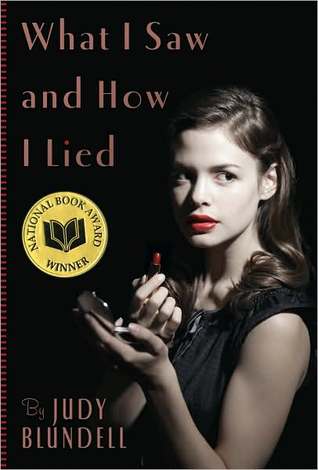
What I Saw and How I Lied – Judy Blundell

liedJudy Blundell’s YA novel What I Saw and How I Lied won the National Book Award and was named a best book by both the School Library Journal and the ALA (American Library Association). The accolades are well-deserved. This novel offers a glimpse into another time and another world and makes a nice change from reading all the dystopian and fantasy novels crowding the shelves these days.

Fifteen-year-old Evie lives with her beautiful mother, Bev, and her step-father Joe, a  veteran of World War 2,  and Joe’s mother Grandma Glad in Queens, New York. It is 1947. Things have been different since Joe returned from the war. Evie remembers a man who “made walking look like dancing…had a special greeting for everyone on the block.”  The post war Joe was different.

It was the war. You couldn’t ask him about it. You didn’t want to remind him. What every wife and daughter could give was a happy home. That was our job.

One night, out of the blue, Joe announces that he is taking Bev and Evie on vacation to Palm Beach, Florida. he makes the holiday sound so glamorous, but when they arrive it is to discover that Palm Beach is practically a ghost town, “the rest of the hotels didn’t even open until December. All of the stores on Worth Avenue, Palm Beach’s main drag, were closed. The Paramount Theatre was closed.”

Into this strangely other-worldly cotton-candy coloured world walks Peter Coleridge.

…I saw him under the moon. My breath stopped. He was not just handsome, he was movie-star handsome. Dark blond hair, a straight nose. A hunk of heaven

Peter turns Evie`s world upside down and creates a strange friction between her parents that she does not  quite understand. Not that she cares too much. Peter is older and more sophisticated and despite his mixed signals, Evie begins to take those first tentative steps towards adulthood.

As a coming-of-age story, What I Saw and How I Lied works quite well. It is definitely evocative of  another time and place. Once she realizes what is waiting for her on the other side of childhood, Evie is desperate to grow up. But there is a price to pay. This would be a great book for careful readers. It`s not action-packed, but it is well-written and thoughtful. When Evie and her parents finally return from their holiday, Evie`s life has been  altered. The line between innocence and experience has been crossed and for Evie at least, a terrible price has been paid.
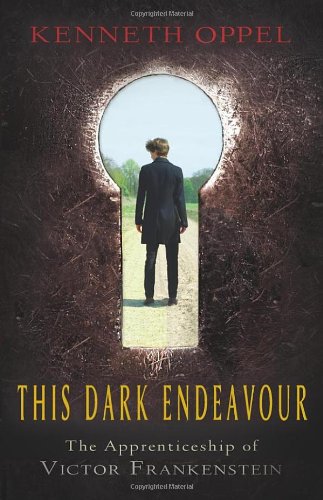
The Dark Endeavour – Kenneth Oppel

oppelKenneth Oppel’s novel This Dark Endeavour was a finalist for Canada’s Governor General’s Literary Awards and it’s no wonder. It’s a terrific book. We’ve been talking about it at school recently as several of my colleagues have read it and think it would make a great addition to the classroom. I agree. The language of the novel is almost old-fashioned, but the action will appeal to boys and the elements of romance will appeal to girls (or vice-versa) making This Dark Endeavour the perfect gateway drug to introduce students to classic novels like, well, Frankenstein.

Sixteen – year – old Victor Frankstein lives with his twin brother, Konrad, younger siblings and parents in a chateau in Bellerive on Lake Geneva. They also share their home with their cousin, Elizabeth. Their friend Henry also spends a great deal of time at the chateau. They four teenagers spend their time riding, boating, studying and exploring the centuries old chateau.

One day, the foursome discover a narrow passage behind a bookshelf and upon further investigation, a door with the greeting “enter only with a friend’s welcome.”  Upon gaining entry, they find “tables scattered with oddly shaped glassware and metal instruments – and row upon row of shelves groaning with thick tomes.”

When the young people are discovered by Konrad and Victor’s father he says, “You’ve discovered the Biblioteka Obscura I see.” Mr. Frankenstein is a local magistrate, a powerful and intelligent man who encourages his children’s intellectual pursuits but is none too happy about their discovery of this Dark Library.

You must understand that these books were written centuries ago. They are primitive attempts to explain the world. There are some shards of learning in them, but compared to our modern knowledge they are like childish dreams….This is not knowledge….It is a corruption of knowledge and these books are not to be read.

But when Konrad falls seriously ill, Victor returns to the Dark Library looking for a cure and This Dark Endeavour ramps up the fun.  Victor, Elizabeth and Henry try to  gather the ingredients for the Elixir of Life in the hopes that its mystical properties will restore Konrad’s good health and their quest is what propels the plot forward. It’s exciting and dangerous work, but Victor is a character readers will easily root for – even though he is hot-tempered and sometimes struggles to do the right thing – especially where it concerns Elizabeth.

Careful readers will spot some of the literary shout-outs embedded in the novel. For example, Victor seeks the help of Dr. Polidori who was, in fact, a real physician and writer ( 1795 – 1821), consort of Lord Byron and credited with writing the first vampire story, “The Vampyre.” Dr. Polidori lives on Wollstonekraft Alley. Fans of Mary Shelley’s novel Frankenstein might recognize Wollstonekraft as Shelley’s mother’s name. Wollstonekraft  (1759 – 1797) was a writer and feminist, well-known for her work A Vindication of the Rights of Women. It’s references like these which would make This Dark Endeavour such a great book for the classroom.

The Last Weekend – Blake Morrison

Henry Sutton wrote an interesting article for The Guardian about fiction’s most unreliable narrators but he neglected to include Ian from Blake images_list_co_uk_blake-morrison-the-last-weeken-chatto-and-windusB-LST072324Morrison’s entertaining novel The Last Weekend. Although it isn’t obvious in the beginning, Ian’s narrative soon starts to unravel as he and his wife, Em, spend a weekend with his college roommate, Ollie and Ollie’s partner, Daisy.

Ian is a primary school teacher and Em a social worker and their marriage seems solid enough, although perhaps slightly lacklustre compared to Ollie and Daisy’s relationship. Of course, as seen through a series of reminiscences, we come to understand that Ian’s relationship with Ollie has always been fraught with jealousy and a certain prickliness.

“I met Ollie in my second term at university,” Ian remembers. He admits that he was something of a loner, that  he “didn’t really have a circle – my circle was me.” Ollie, on the other hand, was hard to miss  with his “brooding intensity. ” He was, Ian admits, “smart, sporty, funny, handsome and popular – the antithesis of me.” And yet chance throws the two young men together and a strangely co-dependent relationship is forged.

It’s a lopsided relationship, a fact that Ian is only too willing point out.

The essential contrasts, all to our disadvantage, go: large Georgian house in west London vs small modern semi in Ilkeston; Range Rover and BMW vs Ford Fiesta; Mauritius (Florence, Antigua, etc.) vs Lanzarote (if we’re lucky); The Ivy vs Pizza Express; Royal Opera House vs local Odeon; Waitrose vs Morrisons; golden couple vs pair of ugly toads. I exaggerate but not much.

So, off Ian and Em go, on a hot summer weekend at the end of August to visit with Ollie and Daisy. And it’s weird from the very start. First of all, Ian had been expecting “posh” accommodations instead of a dwelling which is a “serious disappointment.”  Secondly, there is a strange undercurrent in the house. At first I suspected that Ollie wasn’t all Ian had described, but as it turns out much of what happens during that weekend is not quite as it seems.

“As to the events of August,” Ian says near the beginning of the novel, “I don’t suppose I’ll ever get over them. I’m the kind of guy who feels guilty even when he’s innocent…” It’s only after I finished reading The Last Weekend that these words revealed their menacing underbelly. And much of the novel is strangely creepy and also deeply funny. Once it is revealed that Ian is not to be trusted, The Last Weekend becomes a wonderful maze of a book.

The Things a Brother Knows – Dana Reinhardt

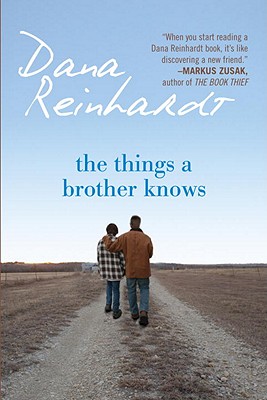
brotherWhen  17-year-old Levi Katznelson’s brother, Boaz, returns from his stint as a marine in an unnamed Middle Eastern country, he’s a changed man.  This relationship between the brothers is what propels The Things a Brother Knows by Dana Reinhardt along.

When Levi was a kid, he adored Boaz.

I used to worship him too. All little brothers worship their big brothers, I guess. It sort of goes with the job description. Think about it. Your brother’s face is one of the first you ever see. His hands are among the first to ever touch you. You crawl only to catch him. You want nothing but to walk like he does, talk like he does, draw a picture throw a ball, tell a joke like he does, let loose one of those crazy whistles with four fingers jammed in your mouth or burp the ABCs just like he does. To your mind, he’s got the whole of the world all figured out.

Levi didn’t really understand why Boaz, a popular high school athlete went off to war anyway. So  his homecoming is a complicated thing. The Boaz who returns to Levi and his parents is withdrawn, rarely speaks and won’t get in a car. He spends hours and hours in his bedroom studying maps and doing stuff on the computer. It frustrates Levi because he doesn’t understand and Bo doesn’t seem willing to explain.

Then Boaz announces that he’s going to walk the Appalachian Trail. Levi is suspicious and does a little snooping and discovers a map that reveals a different route altogether. That’s when he makes the decision to abandon his summer job and go after Boaz.

Although Levi’s figurative  journey is quite a bit different from his brother’s, that summer is pivotal on his journey to adulthood. And while it’s true that The Things a Brother Knows is a “road-trip” book of sorts, the real story here is one of understanding. Understanding each other, sure, but also understanding ourselves. What do we believe in? What matters to us? I think Reinhardt manages this without coming off too preachy.

Levi is a great character and so is his best friend, Pearl. an out-spoken Chinese girl Levi met in Hebrew school. Levi’s grandfather, Dov, is also  memorable. Spending time with these characters is no hardship.

At the end of the day, though, The Things a Brother Knows was just okay for me. The writing is fine. (There’s some swearing, for those concerned with that in a YA book.) The story moves a long, but I just felt it was sort of superficial and that, ultimately, the bow was tied a little too neatly. Still, it’s a book worth having in my classroom library.


April & Oliver – Tess Callahan

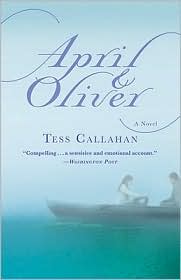
april and oliverApril Simone is the damaged character at the centre of Tess Callahan’s first novel, April & Oliver. She’s the sort of twenty-something girl you want to shake and hug because her decision-making skills have been compromised. (I was going to say  somewhere along the road to adulthood, but once you know her story – you know exactly where it happened). We meet her younger, much adored, brother Buddy, first. But we don’t get to spend much time with him because he’s killed in a car accident:

He wishes he could let her know that what’s happening now doesn’t hurt at all. He’s fine. A veil of snow shrouds the windshield. Buddy feels a growing pause between each breath, like a stride lengthening, an aperture opening by increments, until at last he slips through.

And then we meet Oliver, her cousin – although they are not linked by blood. (They sort of share a grandmother because their fathers had been step-brothers through Nana’s second marriage. I think.) April and Oliver had been best friends as children and teenagers, but they have been estranged for the last several years. Oliver moved away and they just lost touch. Buddy’s funeral brings them back together – but their reunion is anything but happy.

Every conversation between April and Oliver is barbed and sexually charged. While Oliver  certainly seems like the one who has it all together (he’s a law student, engaged to the beautiful and selfless, Bernadette), the longer he spends with April the more his carefully constructed life seems to unravel.

April tells him: “I know your problem, Oliver. In your head is a girl who doesn’t exist.”

Bernadette is all too aware of April’s magnetic pull. “Is there anything else I should know about?” she queries. “It was never like that,” Oliver answers. But it’s a lie because between April and Oliver it’s always been like that and denying it is perhaps part of the problem.

But April is a mess. She’s recently invoked a no contact order against her boyfriend, TJ – a man with a horrific past who is both scary and somehow sympathetic. She lives in a dump of an apartment, has a crap job and has so many skeletons in her closet, it’s no wonder she pushes Oliver away. He knows her too well.

They know each other too well, and their ability to peer into each other’s dark corners both antagonizes and comforts them.

April & Oliver is beautifully written; I’ll give it that. And when I finished the book I did feel satisfied  despite its ambiguous ending.  Sometimes, I admit, I did find the book frustrating – but perhaps I was meant to. I am a sucker for angst, though,  and April & Oliver has that in spades.

The Long Walk Home – Will North

long walk

Okay, The Long Walk Home is a book that I thought would be right up my alley. You know – because I am a single woman of a certain age who still kinda hopes that  the possibility of romance still exists out there, although perhaps a little closer than a mountain in Wales.

Handsome Alec Hudson has walked all the way from Heathrow to Dolgellau, which is located in North West Wales. Why didn’t he just rent a car and drive? Well, he’s on a bit of a mission. His ex-wife (and dearest friend) Gwynne has died and her final wish was that her ashes be scattered from the summit of Cadair Idis, a nearby mountain. He arrives at Tan y Gadair, a B & B run by Fiona, a petite, forty-three-year-old who “still had her looks.” Yes, people, we are going there.

Fiona is married, but her husband David lives in a converted hay barn on the property because several years previously  he’d been poisoned by the sheep dip ( a pesticide used to cure scab mite) and then suffered a heart attack. He never really recovered and his environmental sensitivities and mood swings, coupled with his penchant for whiskey make him difficult to live with. Fiona brings his food, but they no longer live as man and wife. And really, although David was a decent a guy back in the day, theirs was not a fairy tale marriage. That’s what makes Alec so immediately appealing: he’s good looking, he knows his way around the kitchen and he’s a great conversationalist. He’s the perfect man.

No surprise here – they fall in love.  It seems like I am mocking them, but I’m not really. They’re decent people. Alec pitches in around the old B & B, which is also a working sheep farm. By day two, he’s helping Owen, the farm’s hired hand, deliver lambs. By day three Fiona is crying in his arms after a particularly nasty visit with her husband. By day four Alec is confessing: “I am afraid I am very much in love with you…and I don’t know what to do about it.”

I can’t quite figure out why I didn’t like this book all that much. There are no bad guys. Everyone is witty and  kind and  good. They all make selfless decisions.  The only asshat in the book is Fiona’s daughter Meaghan’s boyfriend , Gerald, who is summarily turfed by Owen. And, yes, okay, technically Fiona shouldn’t be having sex with another man – but she hasn’t slept with her husband in years. When that big event transpires it was so treacly, my teeth ached.

So, at the end of the day…I didn’t send The Long Walk Home to the Book Graveyard and while that’s not a ringing endorsement by any stretch,  it at least lets you know that I read the whole thing. If you are interested in lambing, climbing, cooking, and listening to a middle aged woman say things like,”Yes, darling man, please,” then by all means, read Will North’s book.

A picture of Cadair Idis.

270804e

See You at Harry’s – Jo Knowles

seeyouh

I spend as much time reading about YA fiction as I do reading the books, it seems; I am always adding new titles to my list and often the same book will be recommended time and time again. That was the case with Jo Knowles’ book See You at Harry’s. It was waiting in my mailbox at school today – I’d ordered it from Scholastic before the March Break. I started reading it during my third period Grade Ten English class and just finished it a few minutes ago.

The happiest day of  Fern’s life was the day she “threw up four times and had a fever of 103 degrees.” It’s a day lodged in Fern’s (yes, she’s named after the little girl in Charlotte’s Web) memory because it’s the day she didn’t have to share her mother with her two older siblings Sarah and Holden (yes, he’s named after that Holden).

That day at home, my mom spent every minute with me. My older sister and brother were at school, and my dad was working at my parents’ restaurant. I was eight and had never been home alone with just my mom before, at least not all day and definitely not with her full attention.

Shortly after Fern’s recovery, her mom discovers she’s pregnant and instead of being the youngest, Fern suddenly has to contend with a new baby brother, Charlie.

When See You at Harry’s begins, Fern is twelve. Her sister is eighteen, Holden is fourteen and Charlie is three. Her world is chaotic because her family is chaotic…and while Fern might not always get the attention she craves, in that self-centered way all twelve-year-old’s crave attention, she is by no means neglected. She shares a close sibling bond with Holden and there is much to admire in their relationship. Things are little more complicated with Sarah and there’s Charlie.

“I wanna go to school,” he says.

“School is overrated.”

“Huh?”

“Look. All little kids want to go to school. And kindergarten is pretty great. But it just goes downhill from there.”

“Oh.”

“Enjoy your freedom, bud.”

Fern knows what she’s talking about, too. She’s just starting seventh grade and it starts to go downhill on day one. I think a lot of middle school kids will see themselves in Fern. She is, as her mother once told her, “a special soul.”

Fern’s parents run the family restaurant. Her mom is a little on the flaky side and her dad is always coming up with crazy  and embarrassing schemes to improve the business. In all the ways that matter, though,  this is a nuclear family. They aren’t perfect, but they are real. They’re distracted and selfish and  human and fragile.  It takes a  terrible  tragedy to  fill up their empty places.

While this book might not appeal to some of my  students (it is geared for middle school readers, after all), I think many of them will be quite moved by Fern’s family’s story. I was.


The World More Full of Weeping – Robert J. Wiersema

worldCanadian writer Robert J. Wiersema packs a punch with his novella, The World More Full of Weeping. On the day before going to spend a week with his mother in the city, eleven-year-old Brian disappears in the woods behind his father’s house. Wiersema manages to capture both the frantic search, and Brian’s journey in the forest in 77 short pages.

Part of the novella’s success can be attributed to Wiersema’s split narrative. Beginning in present day, Brian shares breakfast with his father who explains to him that his mother will be picking him up at four. Brian clearly doesn’t want to go, but lacks the ability, it seems, to articulate his feelings. Instead, he tells his father, Jeff, that “Carly said you wouldn’t understand.”

Carly’s true identity is just one of the mysteries of The World More Full of Weeping. Who is  Carly? At first she just seems like a girl Brian meets in the woods. But after Brian goes missing  and Jeff calls over to his neighbour John’s to see if he’s seen him, the mention of her name causes John to encourage Jeff to call “Chuck Minette at the Search and Recuse…call him right now.”

Many years ago, Jeff also went missing in the woods only to turn up the next day. When men from the community come to help look for Brian, it’s clear everyone thinks his disappearance might be a case of “like father, like son,” with the same happy outcome.

While the search for Brian continues, we see him in the woods with Carly, who is always in the same thin dress despite the uncertain March weather, her cheeks “pink and rosy.” Carly knows secret places in the woods, places Brian has not ever seen.  She asks him if he wants to “see more hidden things” and promises she can show him “a whole hidden world in the forest.”

There are no concrete answers in The World More Full of Weeping. The only certainty is that when given the opportunity Jeff and Brian made different choices. Perhaps some readers will take comfort in Brian’s decision, but for me I can’t quite get the picture of Jeff on his knees, crying for what is lost,  out of my head.

A magical and profoundly moving story.

The White Devil – Justin Evans

whitedevil

SHE WALKS IN BEAUTY

SHE walks in beauty, like the night

Of cloudless climes and starry skies;

And all that’s best of dark and bright

Meet in her aspect and her eyes:

Thus mellow’d to that tender light

Which heaven to gaudy day denies.

One shade the more, one ray the less,

Had half impair’d the nameless grace

Which waves in every raven tress,

Or softly lightens o’er her face;

Where thoughts serenely sweet express

How pure, how dear their dwelling-place.

And on that cheek, and o’er that brow,

So soft, so calm, yet eloquent,

The smiles that win, the tints that glow,

But tell of days in goodness spent,

A mind at peace with all below,

A heart whose love is innocent!

Justin Evans has written an intriguing and creepy novel inspired partly, I’m sure, by the year he spent at Harrow School. That’s right, the Harrow school in The White Devil  is a real place situated about 40  minutes from London’s West End. From the look of its website, it’s  prestigious and slightly stuffy.

The White Devil cashes in on verisimilitude of another sort: Lord Byron was once a pupil at Harrow. Byron (George Gordon Byron 1788-1824) was quite notorious, even in his own life time and not just for his Romantic poetry. He was sexually voracious and had several lovers including his half-sister. It has long been speculated, although likely not by Byron’s peers, that he was bisexual.

header-overview-11

Andrew Taylor, the novel’s 17-year-old protagonist, has been sent to Harrow in a last ditch effort to make him agreeable to American universities. He’s been turfed from his own school back home for drug-related crimes and this is his last chance to get his shit together – so to speak. From the moment he arrives at Harrow, though, Andrew feels out of place. He doesn’t understand the humour or the customs or how he’s going to survive a year in this place that is “dank, cramped and old.”

header-overview-03

When Andrew’s first friend at Harrow is found dead under somewhat suspicious circumstances, things start to go a little hairy at Harrow.  For one thing, Andrew is the person who found the dead boy. For another, he thinks he saw the person who did it. And he’s been having these dreams. Because there’s apparently a ghost at Harrow. And for some reason the ghost seems focused on Andrew. By lucky or rather unlucky (as it turns out) coincidence, Andrew is a dead ringer for the dead poet.

As the ghost at Harrow becomes more menacing, Andrew tries to figure out who it is and what it wants. He’s not alone. Helping him are Piers Fawkes, the school’s tortured poet-in-residence; Judith Kahn, a crisp librarian and Persephone, the headmaster’s daughter and the only female student at Harrow.

The White Devil is delightfully twisty and I’ll tell you one thing, it made me very curious about Byron’s life. I have read other novels featuring Byron: the YA novel  AngelMonster by Veronica Bennett and Tom Holland’s excellent Lord of the Dead, but The White Devil really brought its A game: it’s well-written, smart and a lot of gothic fun.

Evans talks about the book here.

Claws – Will Weaver

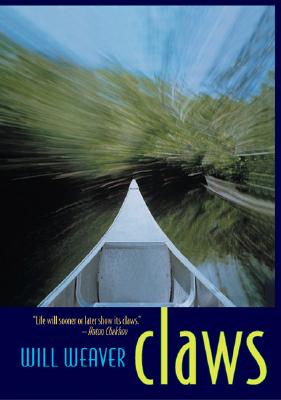
Claws-9780060094751There’s something for everyone in Will Weaver’s YA novel, Claws, but that might have been part of the reason I didn’t love this book. Is Claws a family drama, a suspense thriller, an adventure novel?

Jed Berg is sixteen. He lives with his parents, Gary and Andrea, who are successful (a freelance house designer and lawyer respectively) and according to Jed, “the most successful couple [he] can think of.” Sometimes Gary even lets Jed drive his mint 1969 Camaro. Jed is a good student, a better- than – average tennis player and goes out with Cassie, a popular and pretty senior. Life is good. Until it’s not.

Weaver admits that he “set out to write an unremittingly sad novel.” Partial to a quote by Chekhov which states that “life will sooner or later show its claws,” Weaver endeavors to unravel Jed’s surprisingly uncomplicated teenage life. He says: “I essentially wrote the novel around that idea (of life tipping upside-down).”  (from the author’s website)

And Weaver isn’t lying. Crap starts heading towards Jed at a rapid rate starting with Gertrude, a surly pink-haired girl who has evidence that Jed’s father is having an affair with her mother. Unsure of how to handle this new information, Jed tries to figure out whether or not he has a clear picture of his parent’s marriage. But then, Weaver throws the reader another twist: Gertrude isn’t being exactly honest about her identity. And then when all the infidelity cards have been played, Jed finds his own life going off the rails in ways that are both realistic and, perhaps, slightly melodramatic.

I have to give Weaver props; I kept turning the pages. Jed was likeable and intelligent. His parents and older sisters were sketched in, though,  and so it wasn’t easy to see things from a perspective other than his, but I suppose that’s the point. When you’re a kid, you want to believe that your parents will always be together. I still remember sitting at the top of the stairs with my brother, Tom,  listening to my parents talk about divorce. I was twelve. That’s 40 years ago and I have the clearest memory of it.

I wish Weaver had found another way to show his claws at the end of the book, though. It felt slightly contrived to me, but I suspect that the climax will elicit the desired result from teenage readers. It’s certainly well-written and deserving of its place in my classroom library.