Beautiful Ruins – Jess Walter

ruinsBeautiful Ruins was our last book club read before our summer hiatus. It was also the winner of ‘Best book’ or, because we don’t want to hurt anyone’s feelings when we vote, ‘book we enjoyed reading most.’ (Thus, ‘worst’ book becomes ‘book we enjoyed reading least.’) It was a close race between Beautiful Ruins and The Children Act, but Walter’s fantastic novel won out in the end.

I think I am going to have a hard time articulating how I feel about this book because it hit a lot of my sweet spots. First of all, part of the novel is set in Italy and anyone who knows me knows that Italy is my dream place. I’ve been twice and often say that some day I will live there…even if it’s just for a few months. The other part of the novel takes place in Hollywood and, okay, I admit it – I love the movie stars. Just ask anyone who was around during the David Boreanaz days…or go further back…the Robby Benson days. Ask my students how often I work Ryan Gosling into the conversation.

Beautiful Ruins follows the fortunes of Pasquale Tursi in Porto Vergogna, a tiny village near the Cinque Terre region of Italy only “it was smaller, more remote and not as picturesque.”

Port Vergogna was a tight cluster of a dozen old whitewashed houses, an abandoned chapel, and the town’s only commercial interest – the tiny hotel and café owned by Pasquale’s family – all huddled like a herd of a sleeping goats in a crease in the sheer cliffs.

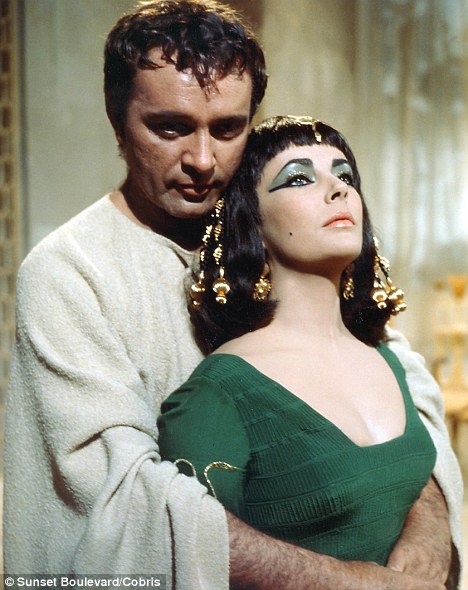
Pasquale has come back to Porto Vergogna to care for his dying mother and the Hotel Adequate View, and it is there he meets actress Dee Moray, who has come, by mistake, to the Adequate View to rest. She is in Italy to make Cleopatra, the notoriously bad film starring Richard Burton and Elizabeth Taylor.

richard and elizabeth

The title’s phony – her job’s all assisting, no developing, and she’s nobody’s chief. She tends Michael’s whims. Answers his calls and e-mails, goes for his sandwiches and coffee.

It is not the life she dreamed of when she gave up her doctoral film studies program to make movies. Now she is on the cusp of leaving her job and going to work as a curator for a private film museum.

If you’re wondering how Walter is going to dovetail these two eras, all I can say is “masterfully.” We flip back to 1960’s Italy and recent-day Hollywood and neither story (or character) gets short-shrift. In fact Claire and Pasquale aren’t the only characters who populate this story – even minor characters are fully realized including Pasquale’s elderly aunt Valeria (who provides comic relief), Shane (a screenwriter who comes to Hollywood to pitch the story of cowboy cannibals), Alvis (the failed American writer who comes to Porto Vergogna once a year to work on his novel) and even Daryl, Claire’s hunky porn-addicted boyfriend. Even Michael Deane, slimy as he is, is fun to spend time with.

And what are these Beautiful Ruins? Well, I think that’s probably the reason everyone and their dog was praising this book when it came out in 2012. This is a great story – funny and heartbreaking in equal measure – about big ideas. The people that you meet and the choices that you make are at the very center of this book. But as Alvis says to Dee, “No one gets to tell you what your life means.”

I loved this book so much.

Highly recommended.

Bird Box – Josh Malerman

birdboxIt seemed like everyone was talking about Josh Malerman’s debut novel, Bird Box, but it was still a surprise when it was chosen as our April read for book club. In the 15 years we’ve been together we’ve never read anything even resembling a horror story. I was really looking forward to this one because I love a scary book.

Malorie lives alone in a house in a Detroit suburb with two children she calls Boy and Girl. The house used to be nice but now she notices the “rusted utensils and cracked dishes. The cardboard box used as a garbage can. The chairs, some held together by twine.” Clearly, it’s not situation normal and Malorie’s musings allude to “older stains,”  for which there are “no chemicals in the house to help clean.”

Malerman doesn’t waste any time with preamble. That’s probably a good thing because Bird Box relies on a heavy dose of the unknown to make it tick. Something has happened to the world. The “Internet has blown up with a story people are calling ‘the Russia Report.'” People are behaving monstrously, attacking strangers and family members in gruesome ways (a mother buries her children alive) before ending their own lives. It’s a “the whole world’s going crazy” scenario, but it spreads from Russia to North America (and who knows where else) like wildfire. The only way to prevent doing harm to others and yourself is to prevent yourself from seeing whatever is out there. People hole up in their houses, windows covered, and if they must venture outside, they wear a blindfold.

Bird Box bounces between Malorie’s perilous journey down the river in a boat (she’s heard that there is a safe community and after four years alone, she longs for something more for herself and her children who she laments “have never seen the sky. Have never looked out a window.” ) and her time in the house with a group of strangers she discovered through an advertisement in the paper.

I can’t say I was fussy about the beginning or the ending of Bird Box, but I was seriously creeped out in the middle. There’s a scene when members of the house have to go out into the backyard to get water from the well. They have to be blindfolded, of course, and a rope is tied around their waist. The person whose job it is to go to the well must make the journey three times. On this occasion, it’s Felix’s turn. On the third and final trip from the house to the well he hears a sound.

But now he can tell where it is coming from.

It is coming from inside the well.

He releases the crank and steps back. The bucket falls, crashing against the stone, before splashing below.

Something moved. Something moved in the water.

It’s moments like these when Bird Box is at its best. Like Malerman’s characters, we are blind and we realize that the scariest thing in the world is what we can’t see.


The Gargoyle – Andrew Davidson

gargoyleI bought my copy of Andrew Davidson’s book, The Gargoyle when it was first published in 2008. I was working at Indigo at the time and this book had a lot of buzz. It actually sounded like a book I would be interested in, too – the story of lovers separated by hundreds of years. I started reading and about fifty pages in I just put the book down and never picked it up again…until last month when it was chosen for my book club.

We’ve all had the experience, I’m sure. A book doesn’t appeal to you, but a few weeks/months/years later you dive in again only to be swept away. Yeah, not so much. The impetus for finishing this book was definitely because it was a book club selection and as I said when we met a few nights ago, I can’t really decide what it was about the book that just didn’t work for me, but the sum of its parts just didn’t add up somehow.

The unnamed narrator is driving on a twisty mountain road, a bottle of bourbon wedged between his legs, when he loses control of the car, smashes through a guard rail and the car lands on its roof at the bottom of a steep embankment.

“A car crash seems to take forever, and there is always a moment in which you believe that you can correct the error,” our narrator thinks as he flies, weightless, through the air. He does survive, but he and his life are changed forever.

Our narrator is burned so badly that he “plumped up like a freshly roasted wiener, [his] skin crackling to accommodate the expanding meat.”  What follows is a graphic description of his burn injuries, perhaps too much information for the squeamish. I read a lot of horror/serial killer fiction, but even I found the catalogue of his injuries TMI at times. There’s a reason why he’s burned, though, and I get that.

Prior to his injury our narrator was a porn star. Yep – you read that right. By the time he graduated from high school, he had two skills: smoking drugs  and screwing his counselor. He didn’t figure he could make any money smoking dope, but he discovered he could earn some cash posing naked and “from there it was a short jump to $150 for photos involving sexual activity and – since you’re already for posing for stills, anyway- it makes a lot of sense to double or triple your income by acting in videos.”  Is this guy a likable character? Not particularly.

While recovering in the hospital, our narrator is visited by Marianne Engel who tells him that this is the third time he’s been burned. Thus begins their strange relationship. She visits him the hospital and tells him stories of lovers who have made great sacrifices for each other while also revealing to him, bit by bit,  how they first met – seven hundred years ago when she was a nun and he was a mercenary.

There’s a lot going on in Davidson’s book – perhaps too much. Whether you believe in Marianne’s tale or not, the book is overstuffed and could do with, I think, some judicious editing. I am all about  love that crosses time and space, but I just didn’t believe it here.

The History of Love – Nicole Krauss

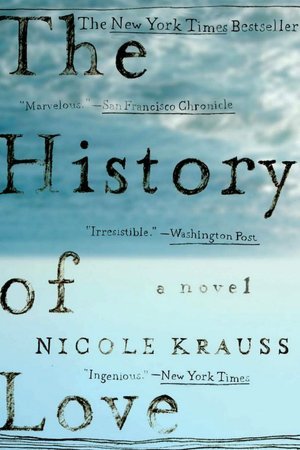
historyWhen Nicole Krauss’s novel The History of Love was published in 2005 it took the literary world by storm (though not like the storm that is raging outside as I write this, cozy in bed with my cat and my tea.) Everyone loved this book: The New York Times, The Guardian, The Globe and Mail. It was also the winner of the Edward Lewis Wallant Award for Jewish fiction and BMOC’s Best Literary Fiction. The book has been on my tbr shelf forever (emphasis on the ‘ever’) and so I chose it as my pick for book club.

The History of Love is the title of the book Leo Gursky wrote for the love of his life, Alma. Alma flees Poland just before the invasion of the Nazis and when Leo finally makes his way to America, he discovers that not only does he have a son, but that Alma has married someone else.

…he stood in her living room listening to all this. He was twenty-five years old. He had changed so much since he last saw her and now part of him wanted to laugh a hard, cold laugh….She said: You stopped writing. I thought you were dead. …At last he managed three words: Come with me….Three times he asked her. She shook her head. I can’t, she said. And so he did the hardest thing he had ever done in his life: he picked up his hat and walked away.

Now Leo is at the end of his life. “When they write my obituary,” he says, “it will say LEO GURSKY IS SURVIVED BY AN APARTMENT FULL OF SHIT.” Leo just wants to be seen. “Sometimes when I’m out, I’ll buy a juice even though I’m not thirsty. If the store is crowded I’ll even go so far as dropping my change all over the floor,” he says. His voice, one part resigned, one part hopeful is one of the novel’s greatest charms.

The other charming voice belongs to fifteen-year-old Alma – not the love of Leo’s life, but that of a teenager who lives in Brooklyn, with her widowed mother (who works as a translator) and younger brother, Bird. Her name is no coincidence: she was actually named after the character in Leo’s book The History of Love. This is where things get a bit complicated and I’m not going to bother drawing the chart required to understand it all – trust me, it’ll all sort itself out.

Alma is on a mission to find her mother a boyfriend. Her father died of pancreatic cancer when Alma was just seven and Alma feels as though her mother has been sad ever since. Alma is trying to navigate adolescence, her mother’s sadness, the fact that her brother thinks he’s the Messiah and her first love, too. Then (and I’m going to say it, girls!) by a weird twist of fate, The History of Love arrives for Alma’s mother to translate and the threads of Alma and Leo’s stories start to reach towards each other.

I really enjoyed The History of Love. There were some moments in the book that literally stopped me in my tracks. For example, Leo says: “All the times I have suddenly realized that my parents are dead, even now, it still surprises me, to exist in the world while that which made me has ceased to exist.” Those of us who have lost our parents will recognize that feeling (although perhaps never articulated) all too well.

This is one of those books, I think, which needs some time to sit in your belly. It is a book about connection – lovers, siblings, friends, parent and child. Leo, at the end of his life (which some might argue he wasted by loving someone he couldn’t have and not pursuing a relationship with his son) has all the insights of a person who has made errors in judgment, but is somehow still open to the world. Ultimately, The History of Love is about the desire we all have to be seen and understood and often the smallest gesture can have the biggest impact.

Highly recommended.

The Storied Life of A. J. Fikry – Gabrielle Zevin

zevin_firky_hcThere are  winks and nudges galore in Gabrielle Zevin’s novel The Storied Life of A. J. Fikry. This was my book club’s first read in 2015 and we gathered last night to discuss its merits. Okay, mostly everyone discussed its merits; I acted like Mr. Fikry himself before the magical arrival of Maya: grouchy.  I didn’t like the book. It was easy to read and I wanted to like it and I should have liked it, given the subject matter – bookstores and the importance of reading…but, nope, just fell flat for me.

A. J. owns a bookstore on the fictional island of Alice which is located somewhere off the coast of Hyannis. He’s a cranky guy, but I guess it’s understandable because his wife, Nic, was killed in a car accident just under two years ago and A.J. hasn’t recovered. The book store was a joint venture, dreamed up when he and Nic were in grad school. They took her trust fund money and opened Island Books, but A.J. is sort of the antithesis of everything you’d expect in a book store owner.

In fact, we meet first meet him when Amelia Loman arrives at his store to discuss Knightley Press’s winter catalogue. A.J. tells her:

I do not like postmodernism, postapocalyptic settings, postmortem narrators, or magical realism. I rarely respond to supposedly clever formal devices, multiple fonts, pictures where there shouldn’t be – basically, gimmicks of any kind. I find literary fiction about the Holocaust or any other major world tragedy to be distasteful  – non-fiction only please. I do not like genre mash-ups a la the literary detective novel or the literary fantasy. Literary should be literary and genre should be genre, and crossbreeding rarely results in anything satisfying. I do not like children’s books, especially ones with orphans, and I prefer not to clutter my shelves with young adult. I do not like anything over four hundred pages or under one hundred fifty pages. I am repulsed by ghostwritten novels by reality television stars, celebrity picture books, sports memoirs, movie tie-in editions, novelty items, and – I imagine this goes without saying – vampires. I rarely stock debuts, chick lit, poetry or translations.

Island Books sounds like an inviting place, eh? Luckily for A.J. it’s the only game in town and Alice Island is a popular summer destination, so he makes a decent living off the tourists. He’s not popular with the locals, but no wonder; he has the personality of a prickly pear.

Then, someone leaves a baby in the bookstore and A.J.’s paternal instincts kick in. In short order, much like the Grinch, A.J.’s heart grows in size and everything in his life changes. Of course it does.

The Storied Life of A.J. Fikry should have been right up my alley. Island Books inhabit a purple Victorian cottage. Be still my heart. A.J. has my dream job in my dream building. The novel is peppered with references to short stories and plays and novels, most of which I am intimately familiar (thus the nudging and winking). It celebrates the value and power of books.

Yet.

I just didn’t believe it. There was something hokey and almost to-good-to-be-true about the book, about the characters and their journeys. I won’t go so far as to say that it was a waste of time, but I have to admit to being disappointed when I finished.

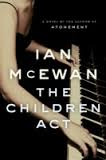
The Children Act – Ian McEwan

children's actYou can always count on Ian McEwan to bring on the controversy. This is the fourth of the prolific British novelist’s books we’ve read in my book club and it prompted a loud and lively discussion.

The main character in The Children Act is Fiona Maye, a High Court judge in London. She’s about to turn 60 when her husband, Jack, a professor, announces that he wants to have an affair (this is not a spoiler, really; the revelation comes pretty much on page one). She’s been married for thirty years and until the moment her husband tells her that he needs this because it is his “last shot” and he’s “yet to hear evidence of an afterlife” she’s been pretty smug about her life. While it is true that they don’t have children, they have had a good life together: enough money, a nice home, friendship and, Fiona admits ” she had always loved him.”  To say that Jack’s confession throws Fiona for a loop is an understatement, but she does not intend to “manage the rest of her life alone.”

Into Fiona’s fractured world comes the Henry family. Adam Henry is seventeen and he and his family are refusing the blood transfusion that may save his life because they are Jehovah’s Witnesses. According to their beliefs, “Mixing your own blood with the blood of an animal or another human being is pollution, contamination. It’s a rejection of the Creator’s wonderful gift. That’s why God specifically forbids it in Genesis and Leviticus and Acts.”

Fiona’s actually quite adept at sorting through these complicated and potentially incendiary cases, but even she is not quite sure what compels her to reserve judgment so she can visit Adam in the hospital. She calls the decision “a sentimental error,” but she goes anyway and discovers that seventeen – year – old Adam is , despite his illness, “beautiful.” It’ll be obvious to careful readers that Fiona is smitten. In fact, during the first few moments of their meeting she “caught nothing.” The visit that follows is charged – not sexually, really, although there is an element of that, too – with the kind of energy that happens when two people discover a shared passion. For Adam and Fiona it is music and poetry. Ultimately, Fiona’s decision sets Adam on a path that has profound consequences for them both.

I really liked The Children Act. McEwan is a smart writer and he’s adept at spinning a narrative that is tightly focused. Fiona isn’t a particularly likeable character, but that doesn’t mean it’s impossible to relate to her. This is a great book to get people talking.


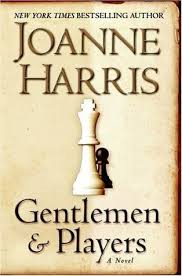
Gentlemen & Players – Joanne Harris

gentlemenGentlemen & Players is an intricate mystery by Joanne Harris, an author probably best known for her best-selling novel, Chocolat. Before she made it big in the publishing world, Harris was a school teacher which probably came in handy while writing this story of a public (in Britain this is the equivalent of our private, thus you pay a tuition)  school in England. For readers unfamiliar with the British school system, the story will likely seem extra exotic. I grew up reading Enid Blyton books and dreaming about going to boarding school in the UK, so I was all over the notion of the tuck shop (the place to buy sweets) and copious gallons of tea consumed by the teachers.

The novel gets its name from cricket, another very British enterprise. A first class cricket match pitting a team of amateurs (the Gentlemen) against the professionals (the Players) is a throw back to the class system in the 19th and 20th centuries. The Players were the working class guys and the Gentlemen from the middle and upper classes.

Harris’s novel has two narratives taking place over two different time periods. In one we follow Roy Straitley, a Classics teacher at St. Oswald’s Grammar School. He’s been in the business for over three decades and is soon to be turning 65. (I was relieved to see that Mr. Straitley still enjoys teaching since I’ll be at least that old before I will be able to afford to retire.) Straitley has dedicated his adult  life to teaching at the school and prides himself on his ability to control his class and remember all the boys he’s taught over the years.

In the other narrative, an unnamed narrator watches St Oswald’s from the gatehouse where they live with their father, the school’s porter (aka custodian).

I understood at once that they were a different race to myself; gilded not only by sunlight and their proximity to that lovely building but by something less tangible; a slick of assurance; a mysterious shine.

Later, of course, I saw it as it really was. The genteel decay behind the graceful lines. The rot.

Fifteen years later, the narrator shows up at St. Oswald’s with forged credentials and begins to teach and all hell breaks loose. At first the pranks are minor, missing registers and pens, but before long things get serious and lives are ruined and lost.

Gentlemen & Players was an easy read (despite all the wacky names I had to keep straight). Does it have something to say about the haves and the have-nots? Not really, since the second narrator just seems jealous and, quite frankly, crazy. Will I be thinking about these characters in a week? Not likely. Was I shocked by the surprise? No, I figured it out. Careful readers will. Still, I passed a pleasant few hours reading the book and if you like suspense thrillers, this is well-written (except for the over-the-top use of semi-colons!) and fun – if you don’t think too long on all the novel’s implausibilities.

The Blessings – Elise Juska

blessingsWe welcomed a new member into our book club last year and she hosted the first meeting after our summer hiatus. Elise Juska’s novel The Blessings was Margo’s selection and our discussion of the book – which I didn’t particularly enjoy while I was reading it – was certainly elevated by her superior hostessing skills. Oh, and okay, listening to the other women in my group talk about the book did soften me towards it. A bit.

The Blessings is the story of a large Irish-Catholic family in Philadelphia. You’d need a chart to untangle the siblings and cousins, the spouses and parents. There’s Gran and Pop; their children, John, Margie, Ann and Patrick and then the kids. Their story – played out over twenty years – isn’t really follow a linear narrative. Instead, Juska unfolds the story, or parts of the story, by allowing us to ‘visit’ with some of the family members.

For example, when the novel opens, eighteen-year-old Abby (daughter of Ann and Dave) is home from college for Thanksgiving. Through her eyes we see her aunts and uncles and grandparents and cousins. She reflects that “most people did not have families like hers.”  I would counter that everyone has a variation on a family like hers. Nevertheless,

If every family has a certain kind of music, Abby’s is the murmur of sympathy around a dining room table. It starts in the pause after dinner and before dessert, when the men migrate to the living room and turn on sports, and the women surround the wreckage, spilled crumbs and crumpled napkins and stained wineglasses. They pinch lids from sugar bowls and dip teabags in hot water, break cookies in half and chew slowly. They trade stories of other people’s hardships. This is the melody, the measure , of her family: the response to sad things.

The novel moves in and out of people’s lives, allowing us glimpses of failed relationships, eating disorders, love affairs, and deaths. For me, the narrative was too broken up to allow me to feel connected to any one of the characters. Just when I settled into the rhythm of their story, the chapter would end and we’d be on to the next person. Sometimes what had been happening would be alluded to later on, but we’d be hearing about the event from a completely different perspective. The Blessings was like reading a series of connected short stories.

Matriarch Helen (Gran) sums it up best:

The truth is that life in the end – even a long life – amounts to a handful of a very few things. The longer you live, the shorter the story.

The Blessings is a quiet story about family and if you’ve got one, you can probably relate to this book in some way.

Life After Life – Kate Atkinson

life-after-life-“What if we had the chance to do it again and again, until we finally did get it right? Wouldn’t that be wonderful,” says Teddy to his big sister, Ursula, the unusual main character of Kate Atkinson’s even more unusual novel Life After Life.

Ursula is born  in February, 1910. She dies and is born again. And again. Attempting to piece these multiple lives into any sort of coherent order is damn near impossible so I suggest you don’t even try. It’s far easier to just be with Ursula as she is born, grows up and then grows up again, each time encountering different possibilities based on life’s many variables. The reader is dropped into Ursula’s life at different points, just as she seems to be. Ursula hits the ground running, and eventually – with a little bit of attention paid –  so does the reader.

Ursula is a fine character with which to spend your time. She was “born with winter already in her bones” and when winter comes around again she “recognized it from the first time around.” It is through her eyes we see her parents: her perfect and beloved father, Hugh and her slightly snippy mother, Sylvie. When she is born she already has two older siblings, Maurice and Pamela, and then her arrival is followed by Teddy and James. The siblings and their parents live at Fox Corner, an English estate. Her lives and deaths flow almost seamlessly together, darkness falls and she is no more until she is again – still with the same family, still Ursula.

I don’t pretend to understand the novel’s finer points (it would take at least another reading), but I can say this: Life After Life clocks in at almost 500 pages and it was a joy to read. Sometimes Ursula makes choices which are ultimately detrimental to her well-being. One bad decision tips the balance and causes her life to spin out of control.  It’s only human to wonder how things might have been different if only… Other times her life is better, but not perfect. People suffer and die. World War I and then II upset the status quo.

There is a part of Ursula’s conscious that recognizes that her life seems to be on repeat. Her mother tells her it’s déjà vu, “a trick of the mind.” Dr. Kellet introduces her to the word “reincarnation” when she is just ten. But explanations are not necessary for Ursula or the reader. And although not every version of her life is a joy to read about, each one is as compelling as the next. Perhaps Ursula knows instinctively that ” If there’s no great glorious end to all this, if nothing we do matters… , then all that matters is what we do. ‘Cause that’s all there is. What we do. Now. Today. ” (Thanks for that quote, Joss Whedon! From the Angel episode “Epiphany.”)

It might be interesting to consider that Atkinson is also playing with the notion of novelist as God. Of course a novelist really does have the opportunity to make anything they want to happen to their characters happen. They don’t however, under normal circumstances, make every scenario occur in the same novel. If this was an experiment for Atkinson, it paid off in spades. The writing is beautiful. Ursula is everything you’d want in a protagonist; the minor characters are compelling and each and every one of Ursula’s lives offers something of value to careful readers.

Highly recommended.

The Rosie Project – Graeme Simsion

rosieIt’s easy to see why Graeme Simsion’s debut novel The Rosie Project was such a huge hit with readers all over the world. It’s one of those books with easy to like characters, a straightforward story and just enough quirk to make it stand out from the pack.

Don Tillman is a scientist in the Genetics department at an unnamed university in Melbourne, Australia. It’s clear from the book’s opening pages that while Don clearly has a super-sized brain, he also has some issues which have prevented him, thus far, from finding a suitable partner. Thus, the Wife Project.

Don’s two friends Gene and Claudia try to help with Don’s project, but Don felt their assistance was lacking. Their approach “was based on the traditional dating paradigm, which I had previously abandoned on the basis that the probability of success did not justify the effort and negative experiences.”  He eventually writes a sixteen-page questionnaire that he hopes will sort the wheat from the chaff.

Don describes everyone he meets by telling us their Body Mass Index and by the time he tells us that he is “thirty-nine years old, tall, fit and intelligent, with a relatively high status and above-average income” and that he should be “attractive to a wide variety of women. In the animal kingdom, I would succeed in reproducing” we know for sure that Don is somewhere on the Autism spectrum.

According to Autism Canada

Autism Spectrum Disorder (ASD) is a complex neurobiological condition that can affect the normal function of the gastrointestinal, immune, hepatic, endocrine and nervous systems. It impacts normal brain development leaving most individuals with communication problems, difficulty with typical social interactions and a tendency to repeat specific patterns of behaviour. There is also a markedly restricted repertoire of activity and interests. Individuals on the autism spectrum tend to have varying degrees and combinations of symptoms

All things considered, Don does pretty well in the world. Where he struggles is with human interaction. So when Rosie blows into his life, ostensibly looking for someone to help her discover the identity of her biological father, Don’s ordered world is thrown completely off-kilter. That’s when the fun really starts.

There are several laugh-out-loud moments in The Rosie Project, and it is fun to watch socially challenged Don and prickly Rosie work their way towards each other. It’ll make a great movie.