Life After Life – Kate Atkinson

life-after-life-“What if we had the chance to do it again and again, until we finally did get it right? Wouldn’t that be wonderful,” says Teddy to his big sister, Ursula, the unusual main character of Kate Atkinson’s even more unusual novel Life After Life.

Ursula is born  in February, 1910. She dies and is born again. And again. Attempting to piece these multiple lives into any sort of coherent order is damn near impossible so I suggest you don’t even try. It’s far easier to just be with Ursula as she is born, grows up and then grows up again, each time encountering different possibilities based on life’s many variables. The reader is dropped into Ursula’s life at different points, just as she seems to be. Ursula hits the ground running, and eventually – with a little bit of attention paid –  so does the reader.

Ursula is a fine character with which to spend your time. She was “born with winter already in her bones” and when winter comes around again she “recognized it from the first time around.” It is through her eyes we see her parents: her perfect and beloved father, Hugh and her slightly snippy mother, Sylvie. When she is born she already has two older siblings, Maurice and Pamela, and then her arrival is followed by Teddy and James. The siblings and their parents live at Fox Corner, an English estate. Her lives and deaths flow almost seamlessly together, darkness falls and she is no more until she is again – still with the same family, still Ursula.

I don’t pretend to understand the novel’s finer points (it would take at least another reading), but I can say this: Life After Life clocks in at almost 500 pages and it was a joy to read. Sometimes Ursula makes choices which are ultimately detrimental to her well-being. One bad decision tips the balance and causes her life to spin out of control.  It’s only human to wonder how things might have been different if only… Other times her life is better, but not perfect. People suffer and die. World War I and then II upset the status quo.

There is a part of Ursula’s conscious that recognizes that her life seems to be on repeat. Her mother tells her it’s déjà vu, “a trick of the mind.” Dr. Kellet introduces her to the word “reincarnation” when she is just ten. But explanations are not necessary for Ursula or the reader. And although not every version of her life is a joy to read about, each one is as compelling as the next. Perhaps Ursula knows instinctively that ” If there’s no great glorious end to all this, if nothing we do matters… , then all that matters is what we do. ‘Cause that’s all there is. What we do. Now. Today. ” (Thanks for that quote, Joss Whedon! From the Angel episode “Epiphany.”)

It might be interesting to consider that Atkinson is also playing with the notion of novelist as God. Of course a novelist really does have the opportunity to make anything they want to happen to their characters happen. They don’t however, under normal circumstances, make every scenario occur in the same novel. If this was an experiment for Atkinson, it paid off in spades. The writing is beautiful. Ursula is everything you’d want in a protagonist; the minor characters are compelling and each and every one of Ursula’s lives offers something of value to careful readers.

Highly recommended.
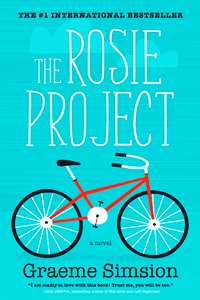
The Rosie Project – Graeme Simsion

rosieIt’s easy to see why Graeme Simsion’s debut novel The Rosie Project was such a huge hit with readers all over the world. It’s one of those books with easy to like characters, a straightforward story and just enough quirk to make it stand out from the pack.
Don Tillman is a scientist in the Genetics department at an unnamed university in Melbourne, Australia. It’s clear from the book’s opening pages that while Don clearly has a super-sized brain, he also has some issues which have prevented him, thus far, from finding a suitable partner. Thus, the Wife Project.

Don’s two friends Gene and Claudia try to help with Don’s project, but Don felt their assistance was lacking. Their approach “was based on the traditional dating paradigm, which I had previously abandoned on the basis that the probability of success did not justify the effort and negative experiences.”  He eventually writes a sixteen-page questionnaire that he hopes will sort the wheat from the chaff.

Don describes everyone he meets by telling us their Body Mass Index and by the time he tells us that he is “thirty-nine years old, tall, fit and intelligent, with a relatively high status and above-average income” and that he should be “attractive to a wide variety of women. In the animal kingdom, I would succeed in reproducing” we know for sure that Don is somewhere on the Autism spectrum.

According to Autism Canada

Autism Spectrum Disorder (ASD) is a complex neurobiological condition that can affect the normal function of the gastrointestinal, immune, hepatic, endocrine and nervous systems. It impacts normal brain development leaving most individuals with communication problems, difficulty with typical social interactions and a tendency to repeat specific patterns of behaviour. There is also a markedly restricted repertoire of activity and interests. Individuals on the autism spectrum tend to have varying degrees and combinations of symptoms

All things considered, Don does pretty well in the world. Where he struggles is with human interaction. So when Rosie blows into his life, ostensibly looking for someone to help her discover the identity of her biological father, Don’s ordered world is thrown completely off-kilter. That’s when the fun really starts.

There are several laugh-out-loud moments in The Rosie Project, and it is fun to watch socially challenged Don and prickly Rosie work their way towards each other. It’ll make a great movie.


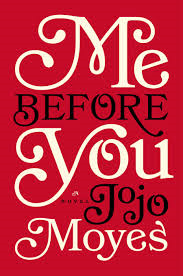
Me Before You – Jojo Moyes

mebeforeyouLast night, my book club met to discuss Jojo Moyes’ novel Me Before You.  I was the only member of the group that didn’t love the book. I liked the book a lot, but it won’t go down in my personal annals as one of the most amazing, romantic, beautiful, (insert other appropriate adjective here) books ever. Trust me, I am the gushiest romantic on the planet so it came as just as much of a shock to me when I didn’t get all weepy and heartbroken at the end.

Me Before You is the story of  26-year-old Louisa Clark, an ordinary girl from an ordinary family. Until recently, she’d been working at the local cafe in the little market village she lives in in England. She lives at home with her parents and her younger sister, Treena and Treena’s young son, Thomas. Their house is too small; they don’t have much money and so when Louisa loses her job at the cafe she is desperate to find new employment so she can continue to contribute to the family coffers.

Enter the Traynors.  They live in Granta House which is on the other side of Stortfold Castle – I presume that’s the posh side. Camilla Traynor hires Louisa as a companion to her son Will who, two years ago, had been in a serious motorcycle-meets-pedestrian accident that has left him as a quadriplegic. He’s a bit of a git.

Circumstances being what they are, Louisa doesn’t feel like she’s in a position to quit, even when Will is arrogant and unkind. Instead, Louisa is determined to make friends with Will and so, of course, that is what happens. Will softens because of Louisa’s friendship; she  flourishes because of his. They are both irrevocably changed.

Me Before You was an easy book to read. I motored through 200 pages on Saturday night. I liked Louisa and I liked Will and I liked their story. Although I didn’t agree with the stylistic choice Moyes made to interrupt the story’s predominantly first person narrative to give readers a glimpse into the heads of a few other characters, I did appreciate this observation by Will’s mother:

It’s just that the one thing you never understand about being a mother, until you are one, is that it is not the grown man – the galumphing. unshaven, stinking, opinionated offspring – you see before you, with his parking tickets and his unpolished shoes and complicated love life. You see all the people he has ever been rolled into one.

I am a mom and so I knew what she was talking about. Could I have lived without her insights?  Absolutely.

I also took issue with the epilogue. It felt cheap to me. Way, way too tidy. But no matter.

One of the questions  posed last night was whether or not Me Before You was a great book. Define great. That’s the cool thing about reading. Everyone’s definition of what makes a great book is going to be different. I am going to have to figure out how to articulate what makes a book great for me and get back to you.

As for Me Before You – it was a very enjoyable book to read. Could I niggle over a bunch of little things? Sure, but none of them really detracted from my reading experience which was totally pleasant. I didn’t shed any tears, but I did well up once or twice. So, almost, Ms. Moyes.


Bellman & Black – Diane Setterfield

bellmanWe were all pretty excited when Marianne chose Bellman & Black as this month’s book club selection. We all loved Diane Setterfield’s first novel The Thirteenth Tale when we read it a few years back. Sadly, this novel lacked that book’s  — well, everything.

As I pointed out when we met last night: “Did you notice that all the praise on the back of the book was for The Thirteenth Tale.”  And true enough – there isn’t a single endorsement for this novel on its cover or inside its pages. Okay, maybe that doesn’t mean much in the whole scheme of things and I know I’m making it sound as though Bellman & Black is horrible and I guess I wouldn’t go so far as to say that, but it isn’t very good, either.

William Bellman is just a kid playing somewhere in the English countryside  when he decides to show off in front of his friends and uses a catapult to shoot a rook (similar to a crow) out of a tree.

It took a long time for the stone to fly along its preordained trajectory. Or so it seemed. Time enough for William to hope that the bird, flapping into life, would rise upwards from the branch. The stone would fall harmlessly to earth and the rook’s granite laughter would taunt them from the sky.

Instead, William hits and kills the bird and thus leaves innocence and childhood behind him and begins  the downward slope towards death. And yes, it’s really this heavy-handed.

Will’s life is marked with great successes and tremendous tragedies. We watch him turn his uncle’s mill into a financial success. We watch him fall in love and have a family. And we watch things start to fall apart. But the thing is — and it is a thing that we talked about last night — none of it mattered all that much because Will was a character we knew or cared little about. He was driven, sure, and haunted, certainly, but not by the rooks which made strange appearances (sort of like encyclopedia entries) throughout the book.

When William suffers a tragic personal loss, he makes a deal with a mysterious stranger, Mr. Black, and he suddenly finds himself building a one-stop funeral emporium. We’re talking Victorian England here, when people mourned for years and spent money (apparently) on all manner of funereal accoutrements. So, just as we watched him build Bellman Mill, we learn all the nooks and crannies of Bellman & Black, but none of it is interesting enough to sustain a 300 plus page narrative. And trust me, the stuff about the rooks doesn’t help.

At the end of the day, Setterfield’s book is a less schmaltzy take on, say, a book like Tuesday’s With Morrie. We’re meant to understand that life must have checks and balances, and that when we care too much about things that don’t matter (wealth, success) we miss out on those things that truly do.

Bellman & Black wasn’t hard to read, but I won’t be recommending it to anyone else.

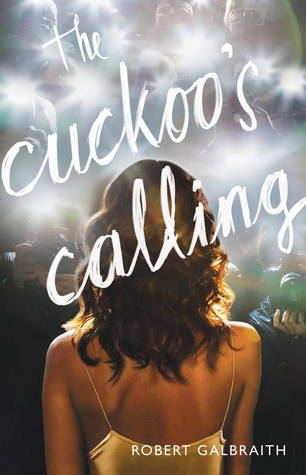
The Cuckoo’s Calling – Robert Galbraith

cuckooDespite the fact that my children, my daughter in particular, are over-the-top Harry Potter fans, I have only ever read the first book, Harry Potter and the Philosopher’s Stone. When my daughter was really little, say four or five, I had tried to read the book to her and I just couldn’t do it.  I did end up reading it out loud to a grade nine class a couple of years ago and they loved it; so did I.

That said, I wasn’t really looking forward to tackling J.K. Rowling’s massive post Potter novel, The Casual Vacancy, when it was one of last year’s book club selections. That book ended up being a really pleasant surprise, however,  and proved once and for all (as if being one of  the best-selling authors of all time wasn’t proof enough) that Ms. Rowling can write the hell out of a story.

My book club recently met to discuss Rowling’s mystery novel The Cuckoo’s Calling, which Rowling wrote using the pseudonym, Robert Galbraith. (There’s an interesting article about her decision to do so here. ) By the time we got to the book, though, the gig was up and we already knew Rowling had penned the book.

Cormoran Strike, the novel’s protagonist, is a former soldier who lost a leg below the knee to a land mine in Afghanistan. Now he lives in London where he works – although not very successfully – as a private investigator.  His relationship with Charlotte has just ended badly – again. He’s broke and living in his office. And then John Bristow arrives with a case for him.

Bristow is the brother of Strike’s childhood friend, Charlie, who had died when they were kids. He’s also the brother of Lula Landry, the most famous model on the planet. Landry recently committed suicide, but John believes something more sinister happened and wants Strike to investigate.

Of course, it’s really impossible to say much more about the story without giving away important plot points. Suffice it to say that as far as the ‘detective’ part of the novel goes – there’s lots to keep mystery-lovers in the game.

Rowling’s real strength as a writer is characterization. And as I tell the students in my writing class – character is the most important thing anyway; they are what drives your plot.

The Cuckoo’s Calling is chock-a-block with characters of all sorts, the most important of which is Cormoran Strike himself.

The reflection staring back at him was not handsome. Strike had the high, bulging forehead, broad nose and thick brows of a young Beethoven who had taken to boxing, an impression only heightened by the swelling and blackening eye. His thick curly hair, springy as carpet, had ensured that his many youthful nicknames had included “Pubehead.” He looked older than his thirty-five years.

Although the women at book club couldn’t agree on whether we found Strike attractive or not (trying to cast him in a movie version was hysterical), we all agreed that he was super-smart and that’s always the sexiest thing anyway.

Strike and his office temp, Robin (who is pretty smart herself) work their way through the list of Lula Landry associates, turning over rocks in an effort to understand the model and the world she inhabited. It makes for a pretty compelling tale.

The best endorsement I can offer for The Cuckoo’s Calling is this: I bet we’ll be seeing Cormoran again and since he’s a character I can’t seem to stop thinking about, I welcome the opportunity to join him on his next case.

Popular Music from Vittula – Mikael Niemi

popularmusicI didn’t get this book – at all. Everyone from the New York Times to Entertainment Weekly waxed poetic about its beauty and prose that “buzzes with wonder, fearlessness and ecstatic ignorance.” Um. I didn’t get it.

Translated from the Swedish, Popular Music from Vittula is a “novel” that actually seems more like a memoir  – or a series of loosely connected short stories –  because if there was a narrative thread here, I wasn’t seeing it.

The main character and narrator is Matti and we meet him as an adult “in a fix in the Thorong La Pass” (which is on Mount Annapurna, Nepal) where  he finds himself 17, 765 feet above sea level, with his lips stuck to  a Tibetan prayer plaque. I am sure what happens next is meant to be comical but, sadly, I didn’t laugh. And I didn’t laugh at any of the other crazy escapades Matti finds himself embroiled in from the age of five straight through to his teenage years.

Matti and his friend, Niila, meet at the neighbourhood playground and their friendship is cemented during a nose-picking session. The rest of this story traces their frienship, particularly their love for music, for the next decade or so.  Their otherwise straightforward lives are touched by elements of magical realism. (Did these two five year olds really manage to get on a plane and fly all the way to Frankfurt?)

Matti’s story dips in and out of his life, giving the reader a chance to experience the first time he ever heard Elvis Presley sing (in his sister’s bedroom), the first time he goes to school, his first kiss. I wish I could say that the book was more than the sum of its parts, but for me I just didn’t get it.

Wild – Cheryl Strayed

WildTP_Books-330I am of the opinion that everyone has a story to tell – that doesn’t mean everyone should tell it, though. Cheryl Strayed’s memoir should have made for a compelling read, but ended up winning “Book I Enjoyed Reading the Least” at our final book club meeting. (Although in my mind, it was neck and neck with Death Comes to Pemberley for the position.)

When I teach memoir to students in my writing class, we talk a lot about the ‘why’? Why is this the story you are telling? What have you taken away from this experience? If you want to take a reader on the journey through your life, there has to be a pretty compelling reason.

Some memoirs are more successful than others. In order for a memoir to work — for me at least — it has to combine three elements: story, character, and writing. So, for example, Elizabeth Gilbert’s best selling memoir Eat, Pray, Love both worked and didn’t work for me. The writing was terrific; I loved the idea of her journey, but I didn’t like her very much. Let’s compare Eat, Pray, Love to another best-selling memoir, Julie & Julia. I loved the story, the writing, and Julie herself.

Then there’s Wild. At twenty-six Cheryl Strayed is still mourning the death of her mother, who died when she was 22,  the dissolution of her marriage, which ended soon after, and recovering from her addiction to a guy named Joe and their shared heroin habit. Good times. Impulsively, she decides to hike the Pacific Coast Trail. That’s 4268 km of therapy. With very little preparation (or at least it seemed that way to me — she bought a book and some ill-fitting hiking books and suddenly she was walking), Strayed embarks on a journey which she hopes will clear her head and/or mend her broken heart.

Pacific-Crest-TrailWhen the book opens, Cheryl has lost a boot over the edge of a mountain:

My boot was gone. Actually gone.

I clutched its mate to my chest like a baby, though of course it was futile. What is one boot without the other boot. It is nothing. It is useless, an orphan forevermore, and I could take no mercy on it. It was a big lug of a thing, of genuine heft, a brown leather Raichle boot with a red lace and metal fasts. I lifted it high and threw it with all my might and watched it fall into the lush trees and out of my life.                                         …

I looked south, to where I’d been, to the wild land that had schooled and scorched me, and considered my options. There was only one, I knew. There was always only one.

To keep walking.

I felt like Strayed’s journey had all sorts of potential. I mean, her life was a total mess and here was her opportunity to work out her issues and reset her course. But the more I read the less I cared. I can’t quite say what it was about her, but others in book club had the same sort of feeling: we just didn’t like Strayed.

Wild felt like a missed opportunity to me.  Regardless of whether your relationship is awesome or toxic, the death of a parent is a game-changer. Strayed’s brother and sister and her beloved step-father, Eddie, sort of scatter to the wind and it made me wonder why. When my parents died — first my mom and then a couple years later, my dad — my three younger brothers and I circled the wagons and became even closer. We understood that it was just us now and ‘us’ was important. Strayed’s brother doesn’t even visit his mother when she is dying in the hospital.

So, is Strayed ‘cured’ after her long walk.  I doubt it. While on the surface it would seem that her journey to the Bridge of the Gods (and oh, those heavy-handed metaphors!) delivers her back to herself, I’m not sold.

The Painted Girls – Cathy Marie Buchanan

paintedgirlsCathy Marie Buchanan has taken French Impressionist Edgar Degas’  famous statue, Little Dancer Aged Fourteen, and spun it into a piece of historical fiction that will probably really appeal to some people, but with which I had a love/hate relationship. The Painted Girls is the story of sisters Marie and Antoinette van Goethem, who live with their widowed, absinthe addicted mother and younger sister, Charlotte, in Paris in 1878.

The novel alternates between elder sister Antoinette’s story and Marie’s as they struggle to survive extreme poverty and a mother who just doesn’t seem capable of taking care of them. The only way out of their dire situation is if Marie makes it into the Paris Opera (Antoinette tried, but didn’t have the talent) as a ballet dancer.

With the news that Maman is sending us to the dance school, Charlotte threads her fingers together, knuckles whitening as she works to hide her joy. I keep my face still, my dismay to myself. The petit rats – the scrawny, hopeful girls, vying for the quickest feet, the lightest leap, the prettiest arms – are babies, like Charlotte, some as young as six. It puts my nerves jumping, the idea of me – a thirteen-year-old –  lost among them at the barre, rats who earn their name by scurrying along the Opera corridors, hungry and dirty and sniffing out crumbs of charity.

It is here that she comes to the attention of Mr. Degas, who hires her to model for him. Marie wants something more for her life and she is willing to do whatever it takes to achieve it. That is not to say that she consistently makes wise choices, only that the desire for a better life is what drives her.

Antoinette’s journey is slightly more bumpy. She has already been turned out of the ballet as she is too old and not talented enough. She understands Marie’s talents, though, and works to ensure she has the lessons she needs to progress and food in her belly. Then she meets Emile Abadie, a shifty boy who  “is not much to look at …with that scrub-brushy hair of his creeping low on his forehead and his black eyes sinking too deep beneath the weighty ridge of his brow and his jaw looking like the sort of those on dogs it is best to steer away from in the streets.” Emile is a charmer though and even when he abuses Antoinette, she stays by his side.

The Painted Girls evokes the Belle Époque  period in Paris, a period which is, ironically, characterized by optimism. Art, music, literature and scientific discoveries all flourished during the period and Buchanan makes the most of them including bringing Zola’s masterpiece L’Assommoir to the stage.

Despite the novel’s merits (and there are many) I found the book overwritten. Not badly written, the language is often quite beautiful, just over-written. The sisters’ journey was intriguing, I am a fan of both the ballet and Degas, but at times I have to admit that it was a bit of a slog.

The Last Weekend – Blake Morrison

Henry Sutton wrote an interesting article for The Guardian about fiction’s most unreliable narrators but he neglected to include Ian from Blake images_list_co_uk_blake-morrison-the-last-weeken-chatto-and-windusB-LST072324Morrison’s entertaining novel The Last Weekend. Although it isn’t obvious in the beginning, Ian’s narrative soon starts to unravel as he and his wife, Em, spend a weekend with his college roommate, Ollie and Ollie’s partner, Daisy.

Ian is a primary school teacher and Em a social worker and their marriage seems solid enough, although perhaps slightly lacklustre compared to Ollie and Daisy’s relationship. Of course, as seen through a series of reminiscences, we come to understand that Ian’s relationship with Ollie has always been fraught with jealousy and a certain prickliness.

“I met Ollie in my second term at university,” Ian remembers. He admits that he was something of a loner, that  he “didn’t really have a circle – my circle was me.” Ollie, on the other hand, was hard to miss  with his “brooding intensity. ” He was, Ian admits, “smart, sporty, funny, handsome and popular – the antithesis of me.” And yet chance throws the two young men together and a strangely co-dependent relationship is forged.

It’s a lopsided relationship, a fact that Ian is only too willing point out.

The essential contrasts, all to our disadvantage, go: large Georgian house in west London vs small modern semi in Ilkeston; Range Rover and BMW vs Ford Fiesta; Mauritius (Florence, Antigua, etc.) vs Lanzarote (if we’re lucky); The Ivy vs Pizza Express; Royal Opera House vs local Odeon; Waitrose vs Morrisons; golden couple vs pair of ugly toads. I exaggerate but not much.

So, off Ian and Em go, on a hot summer weekend at the end of August to visit with Ollie and Daisy. And it’s weird from the very start. First of all, Ian had been expecting “posh” accommodations instead of a dwelling which is a “serious disappointment.”  Secondly, there is a strange undercurrent in the house. At first I suspected that Ollie wasn’t all Ian had described, but as it turns out much of what happens during that weekend is not quite as it seems.

“As to the events of August,” Ian says near the beginning of the novel, “I don’t suppose I’ll ever get over them. I’m the kind of guy who feels guilty even when he’s innocent…” It’s only after I finished reading The Last Weekend that these words revealed their menacing underbelly. And much of the novel is strangely creepy and also deeply funny. Once it is revealed that Ian is not to be trusted, The Last Weekend becomes a wonderful maze of a book.

See You at Harry’s – Jo Knowles

seeyouh

I spend as much time reading about YA fiction as I do reading the books, it seems; I am always adding new titles to my list and often the same book will be recommended time and time again. That was the case with Jo Knowles’ book See You at Harry’s. It was waiting in my mailbox at school today – I’d ordered it from Scholastic before the March Break. I started reading it during my third period Grade Ten English class and just finished it a few minutes ago.

The happiest day of  Fern’s life was the day she “threw up four times and had a fever of 103 degrees.” It’s a day lodged in Fern’s (yes, she’s named after the little girl in Charlotte’s Web) memory because it’s the day she didn’t have to share her mother with her two older siblings Sarah and Holden (yes, he’s named after that Holden).

That day at home, my mom spent every minute with me. My older sister and brother were at school, and my dad was working at my parents’ restaurant. I was eight and had never been home alone with just my mom before, at least not all day and definitely not with her full attention.

Shortly after Fern’s recovery, her mom discovers she’s pregnant and instead of being the youngest, Fern suddenly has to contend with a new baby brother, Charlie.

When See You at Harry’s begins, Fern is twelve. Her sister is eighteen, Holden is fourteen and Charlie is three. Her world is chaotic because her family is chaotic…and while Fern might not always get the attention she craves, in that self-centered way all twelve-year-old’s crave attention, she is by no means neglected. She shares a close sibling bond with Holden and there is much to admire in their relationship. Things are little more complicated with Sarah and there’s Charlie.

“I wanna go to school,” he says.

“School is overrated.”

“Huh?”

“Look. All little kids want to go to school. And kindergarten is pretty great. But it just goes downhill from there.”

“Oh.”

“Enjoy your freedom, bud.”

Fern knows what she’s talking about, too. She’s just starting seventh grade and it starts to go downhill on day one. I think a lot of middle school kids will see themselves in Fern. She is, as her mother once told her, “a special soul.”

Fern’s parents run the family restaurant. Her mom is a little on the flaky side and her dad is always coming up with crazy  and embarrassing schemes to improve the business. In all the ways that matter, though,  this is a nuclear family. They aren’t perfect, but they are real. They’re distracted and selfish and  human and fragile.  It takes a  terrible  tragedy to  fill up their empty places.

While this book might not appeal to some of my  students (it is geared for middle school readers, after all), I think many of them will be quite moved by Fern’s family’s story. I was.