
We Could Be Beautiful – Swan Huntley

beautifulCatherine West wants a family — which is sort of funny once you get to know her. The narrator of Swan Huntley’s novel We Could Be Beautiful is vain, spoiled, and selfish. It’s hard to imagine  she’d ever be selfless enough to have kids. Plus, she’s pushing the biological envelope: Catherine’s 43.

She thinks she has everything it would take to be a mother, but when she categorizes her success, it feels like having a baby would be just one more accessory.

I was rich, I owned a small business,  I had a wardrobe I replaced all the time. I was tones enough and pretty enough. I moisturized,  I worked out. I looked younger than my age. I had been to all the countries I wanted to see. I collected art and filled my West  Village apartment with it. My home was bright and tastefully bare and worthy of a spread in a magazine.

The only problem is that Catherine’s single. She’s had lots of boyfriends (and a girlfriend), and two broken engagements, but now she’s alone. Her most significant relationship is with Dan, the massage therapist who comes to her house to rub her neurosis away.

Then she meets William Stockton, a “stunning, square-jawed man with gentle eyes and elegant gray hair, full and parted to the side.” There’s something familiar about him, and as it turns out William’s parents and Catherine’s parents used to be great friends. Catherine is several years younger than William, so her memories of him are vague.

Almost immediately, Catherine is smitten and too-good-to-be-true William is moving in. On paper, he seems like a great guy (he’s educated, has a good job in banking, he’s charming and attentive), but readers will clue in that there’s something not quite right. Catherine isn’t so swift on the uptake.

We Could Be Beautiful is billed as a thriller, and it certainly reads like one.  I mean, you’ll certainly figure out pretty quickly that William is up to something, even if you’re not sure what it is. When Catherine mentions William to her mother, who is suffering from dementia, Mrs. West’s reaction is visceral. Then Catherine finds a box of old ephemera, including a letter from a long-ago nanny which alludes to some event that she hadn’t protected Catherine from.

Probably the more interesting aspect of this book, though,  is Catherine’s journey. I found her vapid at the beginning of the book. She doesn’t need to work because her father left her and her sister a pile of money. She owns the West Village house she lives in. She owns a little store called Leaf, which sells — tellingly — beautiful art cards, with nothing printed inside. Her one friend, Susan, is as superficial as she is. She has a strained relationship with her only sibling, Caroline. On the surface it’s a beautiful life, sure, but it’s style over substance. Her relationship with William forces Catherine to do some recalibrating, and that’s interesting to watch.

I enjoyed this book. It’s well-written, the pages turn themselves, and even if it’s less ‘thriller’ and more ‘drama’, it’s still entertaining.

The Visitors – Catherine Burns

Marion Zetland lives with her older brother, John, in a house that’s seen better days in a visitorscoastal town in Northern England. The siblings, now in their 50s,  have never been especially close, but now that both their parents have died, they have to rely on each other and their relationship is a sort of co-dependent nightmare. There is something very odd going on in their house, a house filled with the bric-a-brac of a childhood spent in some luxury (the Zetlands owned a textile mill), and now the domain of a couple hoarders.
Catherine Burns’s debut novel The Visitors focuses the story on Marion. She is mostly friendless, surrounds herself with stuffed animals, and spends her days watching sappy television movies, remembering events from her past, and imagining a future which she surely never had access to. She’d learned at a young age that she was plain, and spent most of her life living in John’s considerable shadow. He, after all, had gone off the Oxford, and she had limped through school, barely able to understand the most basic things.

When the novel opens, Marion has just been awakened by a scream, a sound that “flapped its wings against the inside of her skull.” She knows where the scream is coming from, and she even knows, although perhaps only subconsciously, why someone might be screaming inside her house, but she tamps down the feeling by calling forth her mother’s voice, which she knows would tell her that “John is doing the very best for them; you have to trust him – he is your brother and a very clever person.”

Slipping easily between the past and the present, we learn about the extremely dysfunctional Zetland family, about how Marion was bullied by her peers, and John’s own perverse personality, which is alluded to many times.  The only time we aren’t closely watching Marion, we are reading emails to someone called Adrian. The first time they appeared, I thought there’d been some sort of printing error, but it’ll all make sense in the end.

I really enjoyed The Visitors. I found Marion to be quite a sympathetic character, someone who clearly had been dealt a crappy hand in the family department, but was also dealing with some mental illness, too. Turns out, though, the lens through which the story is told is just a tad unreliable. Although this story is not told in the first person, we are really only privy to Marion’s thoughts, and there’s no question – she’s an odd duck.

Although I wasn’t 100% sold on the ending, I still recommend giving this one a go. It’s well written and you’ll totally keep turning the pages.


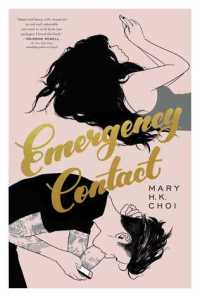
Emergency Contact – Mary H.K. Choi

Penny Lee can’t wait to get away from her mom, Celeste. Not because she’s overbearing, emergencybut because Penny has always felt like she’s the parent and her mom’s the kid. Sometimes Penny wanted to “shake Celeste until her fillings came loose.” Now it’s time for Penny to go off to college –  University of Texas in Austin, only an hour or so away, but away nonetheless.

Her dorm mate Jude, and Jude’s bestie, Mallory, seem like every mean girl Penny has ever encountered, but like everyone else in Mary H.K. Choi’s debut novel Emergency Contact appearances can be deceiving. Penny isn’t anything like them, she’s like the “tiny Asian girl from the Japanese horror movie The Grudge.” (Penny is, in fact, Korean.) Although her friendship with Jude and Mallory isn’t immediate, it turns out, once she lets them in, they’re tremendous allies.

Then there’s Sam. Sam is related (sort of) to Jude through some complicated family tree consisting of defunct marriages. At twenty-one, he works at a local coffee shop where he cooks scrumptious pastries, and lives in a room overhead. He’s skinny, floppy-haired and tattooed, and Penny is almost immediately smitten when she joins Jude and Mallory  for iced coffees. Sam is “different. Sleek. Brooding and angular.”

A chance encounter one afternoon, causes Sam and Penny to become each other’s emergency contacts,  and thus begins a series of light-hearted, and then increasingly more personal texts. Such is romance in the 21st century, I guess. The thing is, Penny has a boyfriend back home and Sam is still in love with his ex, the obnoxiously self-centered Lorraine. But since Penny and Sam never meet in person and only rarely speak on the phone, they manage to keep their relationship superficial, even if neither of them actually feels that way about each other.

I read my fair share of YA romance, and I have to say that Emergency Contact  is definitely one of the better ones I’ve read. Both Sam and Penny are delightfully drawn. Penny is closed off, but clearly as smart as a whip. Sam, too, has had his problems, and things get more complicated for him as he tries to navigate his feelings for Lorraine and his growing feelings for Penny. The thing about these two people is that they are genuinely nice and Choi doesn’t resort to any ridiculous tactics to keep them apart…or push them together, either. There’s certainly lots of potential for misunderstandings and crossed wires, but the little snags in their journey seem realistic rather than ridiculous.

And even though you know where all this is headed and you’ll want these guys to get together, too, it’s the journey, not the destination.

The Dutch House – Ann Patchett

dutchI think some authors could write about paint drying and it would be worth reading. Ann Patchett is one of those authors. The Dutch House  is the third book I’ve read by Patchett (Bel Canto, Commonwealth),  and it did not disappoint.
Danny and Maeve grow up in the Dutch House, a gorgeous jewel-box of a house in Elkins Park, a suburb of Philadelphia. The house seems to “float several inches above the hill it sat on.”  Danny and Maeve’s father, Cyril,  had bought the house as a surprise for their mother, Elna, but she didn’t like the house – or so the story goes – and left the family for parts unknown. When the novel opens, Danny and Maeve are 8 and 15 respectively, and being introduced to their father’s ‘friend’, Andrea and her two young daughters Norma and Bright. The arrival of Andrea into their lives changes everything for the siblings.

The Dutch House is not a linear story. It bounces back and forth through time, covering roughly fifty years. Not every writer could manage this sort of narrative as easily as Patchett does. Although the perspective is Danny’s, readers will come to know and love (or hate) many other characters, most notably Maeve, who is the centre of Danny’s world.

She taught me the proper way to hold a fork. She attended my basketball games and knew all my friends and oversaw my homework  and kissed me every morning before we went our separate  ways to school and again at night  before I went to bed regardless of whether or not I wanted to be kissed. She told me repeatedly, relentlessly, that I was kind and smart and fast, that I could be as great a man as I made up my mind to be. She was so good at all that, despite the fact that no one had done it for her.

When Andrea turfs them from their house, their lives are thrown into chaos. They find themselves parking in front of the Dutch House over the years, reminiscing about and redacting their past, never quite able to let go. In some ways, their lives are halted by this connection to a place.

Not much happens in the novel, but at the same time everything happens. Danny and Maeve’s  lives and relationship are the story,  which makes sense, really. As we’re waiting for our own plots to unfold, life is actually happening all around us. The bitter feelings Maeve clings to derail her life, but we don’t really understand that until her mother turns up out of the blue. Or we see what ends up happening to Andrea.

Patchett has written characters you will absolutely come to care about and given them lives which should remind us to care more deeply about our own, and the people we share them with.

Highly recommended.

A Lite Too Bright – Samuel Miller

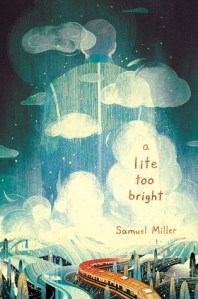
A Lite Too Bright  is a crazy good debut YA novel by Samuel Miller.  I bought the book alitetoobrightbecause I loved the cover and it had lots of praise from media outlets, not other YA writers (I never trust those, really). I wish that I had read the novel in one or two sittings because it deserves that kind of attention, but I enjoyed the book anyway.

Arthur Louis Pullman III is the grandson of legendary author Arthur Louis Pullman I, whose novel A World Away, is a literary classic and required reading in most high schools, even though Arthur III never got around to finishing it.

Arthur has recently suffered some sort of crisis which requires him to come stay with his Uncle Tim and Aunt Karen in Truckee, “one of those places you go when you’ve thrown in the towel on doing anything extraordinary in your life.”  Arthur’s life has fallen apart, the details of which are only alluded too in visions of him crashing his Camaro into a body of water and feeling himself “floating, untethered by gravity.” Whatever has happened, he’s been removed from the scene of the crime in Palo Alto, perhaps in the hope that he can get himself sorted out.

There’s clearly some family dysfunction. Aunt Karen wants to send him off to some Christian wilderness camp. His father and brother are trying to figure out out to handle what is left of their father’s estate –  which has sustained the brothers but is now beginning to run out.

Arthur Louis Pullman III was something of a literary legend, a sort of Harper Lee-like character who only ever wrote one book, albeit a famous one. At the end of his life, he suffered from Alzheimer’s and he died a week after he disappeared from his home.  A Lite Too Bright follows Arthur I as he attempts to recreate his grandfather’s final week after he discovers what he believes is a clue left specifically for him.

Miller’s novel is an ode to writing, to family, and to living a full and complete life. It’s also a road trip novel, with a complex mystery at its core. Young Arthur is an engaging narrator, desperate to find his grandfather, not in the literal sense, of course, but to understand him, and as he embarks on this journey he discovers that other people are intent on getting close to Pullman Sr., too. As Arthur retraces his grandfather’s last steps, he also comes to terms with his own trauma.

Arthur’s  journey is well worth taking.

Don’t You Forget About Me – Mhairi McFarlane

Fans of Simple Minds (or the John Hughes film The Breakfast Club) will likely recognize the title of Mhairi McFarlane’s latest novel Don’t You Forget About Meat a glance. The comparison pretty much stops there, though.

Georgina Horspool meets Lucas McCarthy in school. He’s a transplant from Ireland and forgetabout methe two bond over an English project about Wuthering Heights. Soon the pair are inseparable and Georgina admits that “I didn’t know what falling in love felt like, I’d never done it before. I discovered you recognize it easily when it arrives.”

But then something happens at the pair’s ‘leaving party’ (the book takes place in the U.K., so let’s say prom party) and whatever was between them is suddenly over.

The book fast forwards 12 years at this point and we catch up with Georgina just as her life is falling apart. She’s fired from her job at a crappy Italian restaurant and then she walks in on her boyfriend Robin, a minor-celebrity comic, in a compromising position with his assistant. Her relationship with her older sister, Esther, and her mother is prickly. She has good friends, sure, but most everything else in her life is shite. A last minute bar tending job brings her back into Lucas McCarthy’s orbit. The thing is, he doesn’t seem to remember her. Like, at all.

McFarlane’s book depends on the assumption that readers’ patience will last through  400 plus pages. Truthfully, I almost abandoned the book around page 50 because it felt like it was trying so hard to be a British rom com in the vein of Richard Curtis (and, trust me, no one loves Love Actually  more than me!) It just felt disingenuous. But a friend whose reading proclivities are similar to my own said she liked it, so I picked it back up and settled into the book. I’m not going to say that it 100% won me over, but I didn’t find the book as irksome as I did when I first started it.

Georgina, as it turns out, has a lot of baggage. Her life is stuck. Her beloved father died when she was in her first year of university. Her mother’s new husband is a loathsome bully. And then there’s the thing that happened at the prom that  ended Georgina’s relationship with Lucas. When Lucas’s brother, Devlin, offers Georgina a job at the brothers’ new pub, it puts the pair in close proximity. Lucas is “at turns standoffish, slyly funny, dour, mischievous, helpful, haughty. It’s behaviour borne of beauty privilege….”

For me, some of the novel’s moving parts seemed slightly contrived and some of the resulting patch-ups are sort of deflated by that. I also felt like Lucas was, although certainly attractive, not a fully realized character. Georgina is transformed by a beautiful adult coat. Familial relationships are repaired almost by magic.

I don’t read a lot of romance novels. I think Don’t You Forget About Me  is trying for something slightly more complicated than straight-up romance and I liked that about it.  It takes a LONG time for these two to find their way back to each other, but most readers will likely find the journey worthwhile.

Mortal Memory – Thomas H. Cook

cook-e1564403930383.jpgIf you are regular reader of this blog, then you know that I am a huge fan of American mystery/crime writer Thomas H. Cook. I found his book Breakheart Hill by chance well over a decade ago and I look for his books whenever I am in a book store. The problem is, he’s very rarely to be found on the shelves even though he is an Edgar Award winner (The Chatham School Affair) and a much-lauded writer. The Los Angeles Times Book Review  said that “Cook is an important talent, not simply a plotter but a prose stylist with a sensitivity to character and relationships…A storytelling writer of poetic narrative power. His crime fiction extends the boundaries of the form.” (This is why I hoard the books I find and don’t read them all at once; I have to pace myself so I don’t run out.) Besides the two books I’ve already named, I also really loved Master of the Delta and Instruments of the Night which might be my favourite of Cook’s books.  But really, you can’t go wrong reading anything this guy writes.

This much I remembered from the beginning: the floral curtains in their second- floor bedroom pulled tightly together; Jamie’s new basketball at the edge of the yard, glistening in the rain; Laura’s plain white bra lying haphazardly in the grass behind the house, the rest of our clothes, drenched and motionless as they hung from the line above it.

Thus begins Mortal Memory, a story that begins when narrator Stevie Farris discovers, mortalat age 9, that his father has shot and killed his mother, Marie, older brother, Jamie and sister, Laura. The knowledge of this horrific act tortures Stevie, mostly because he doesn’t understand why his father committed such a horrible crime. Wasn’t his family happy?

Flash forward 30 plus years and Steve is married with a son of his own. That’s when he meets Rebecca Soltero. She’s a writer who’s “writing a book about men who have killed their families.” Rebecca’s arrival and her penetrating questions bring all sorts of memories back for Steven. The story seamlessly weaves between past and present as Steve recalls the cracks in the family veneer, which ultimately causes him to examine the fault lines in his own family.

That’s one of the things I most admire about Cook. His books always operate on more than one level. Yes, there’s a mystery – that’s what will keep you feverishly turning the pages, but there is always some sort of family drama, often between fathers and sons, which is carefully and thoughtfully crafted. Another thing Cook does extremely well, is to turn your expectations upside down. Trying to figure out what’s happened is half of the fun of reading Cook, but I’ve never been right once. And I wasn’t this time, either.

So where does Mortal Memory fit in the Cook continuum? Probably somewhere in the middle. Not my favourite – mostly because I didn’t love the resolution – but any time spent with this author is time well spent.


The Silent Patient – Alex Michaelides

silentI guess I can see why The Silent Patient, Alex Michaelides’ debut novel, seemed to be on everyone’s radar over the past few months. It’s definitely one of those page-turners, the kind you stuff in your beach bag or read on the deck (which is where I read mine). But does it actually have a “twist that will make even the most seasoned suspense reader break out in a cold sweat” (Booklist)? Not so much.

Theo Faber became a psychotherapist because he was “fucked up.”

I was on a quest to help myself. I believe the same is true for most people who go into mental health. We are drawn to this profession because we are damaged – we study psychology to heal ourselves. Whether we are prepared to admit this or not is another question.

What is Theo’s childhood trauma, you might well ask? His father was/is an abusive dick; his mother a mostly mute witness to her husband’s shenanigans. So, from early on, readers know that Theo is damaged goods. Why he thought the psychiatry business was a good fit we’ll never know, but his choice of profession should give readers pause. Holy unreliable narrator, Batman!

Theo has taken a new job as a forensic psychotherapist at the Grove because Alicia Berenson is there. Alicia, an up and coming painter, killed her husband, Gabriel, a well-known photographer six years ago. She hasn’t spoken a word since. Theo is convinced that he can help her.

The Silent Patient follows Theo’s determined quest to free Alicia from her self-imposed silent prison. That would probably get pretty boring, though, so we’re also privy to Alicia’s journal entries. (How else would we get to know anything about what really happened?)

The problem with all of this, though, is there is nothing much to see in either case. Theo chases around London talking to the people from Alicia’s life: her cousin, Paul; her art dealer, Jean-Felix; her brother-in-law, Max. These conversations don’t really yield anything interesting; readers will have to rely on Alicia’s journal to fill in the blanks. (Her journal often quotes entire conversations verbatim, which is just odd. It’s a diary, not a court transcript.)

So, while The Silent Patient was certainly easy (easy really is the operative word here; the prose is straight-forward and unembellished) to read, did it add anything new to the thriller genre? Not really. The characters, virtually all of them,  are one-dimensional. I didn’t particularly like or care for any of them, meaning I didn’t really have any skin in the game. They seemed more like chess pieces Michaelides moved around the board to suit the plot. This is a story that is trying to be more than the sum of its parts, but its parts are just not that interesting.


A Velocity of Being – M. Popova & C. Bedrick

Marie Kondo says that your possessions should spark joy.  She also says that about 30 books is the magic number. She and I would not get along. At all. Books are talismans and touchstones and time machines. I wish that I still had every book I ever owned, but we moved a lot when I was growing up and I’ve moved a lot as an adult and it’s just not possible to save everything. Still, like Stephen King, I believe in the “portable magic”of books.

So do the people in Maria Popova and Claudia Bedrick’s beautiful book A Velocity ofvelocity of being Being. They’ve gathered letters from a variety of well-known (and less well-known) artists, writers, thinkers, scientists, musicians and philosophers. These letters are addressed to young readers and each letter is accompanied by bookish art. It’s a win-win book for me.

Popova begins the book’s introduction this way

When asked in a famous questionnaire devised by the great French writer Marcel Proust about his idea of perfect happiness, David Bowie answered simple: “Reading.”

I couldn’t agree more. I have whiled away many wonderful hours with books. My love affair began early. Both my parents were readers and there were always books in my house. My mother read to my brothers and me from the time we were babies and I have very specific memories of her not being able to get through O. Henry’s story  “The Ransom of Red Chief” without breaking down in uncontrollable giggles. She loved Uncle Wiggly, too and Robert Louis Stevenson’s A Child’s Garden of Verse.

When I started reading on my own, I fell in love with the Bobbsey Twins and Trixie Beldon and Cherry Aames. I was really an equal opportunity reader. So reading A Velocity of Being is like being with my tribe. These are people who, like me, understand the particular joys of words words on a page. Their stories and recollections made me smile, laugh, tear up and nod my ahead in agreement.

For example, poet, essayist and naturalist Diane Ackerman writes “No matter where life takes you, you’re never alone with a book, which becomes a tutor, a wit, a mind-sharpener, a soulmate, a performer, a sage, a verbal bouquet for a loved one. Books are borrowed minds, and because they capture the soul of a people, they explore and celebrate all it means to be human. Long live their indelible magic.”

Rebecca Solnit, writer, historian and activist, reminds us that although “Nearly every book has the same architecture – cover, spine, pages – […] you open them onto worlds and gifts far beyond what paper and ink are, and on the inside they are every shape and power.”

And Helen Fagin, born in 1918, reminds us that “To read a book and surrender to a story is to keep our very humanity alive.”

All proceeds from the sale of A Velocity of Being will benefit the New York public library system. Really, everyone should have a copy. I can’t wait to share some of these letters with my students in the fall…and perhaps even have them write their own odes to reading.


Out of Sight – Isabelle Grey

Out of Sight, by British writer Isabelle Grey, is the story of  Patrickoutofsight Hinde, a homeopath who, when the novel opens, lives with his wife, Belinda, and young son, Daniel, in Brighton. He has a happy life, for the most part, except for the stress brought on when his parents visit. He seems to be a bottled up sort of fellow and although he is capable of offering impartial advice to his patients, I wonder if he wouldn’t benefit from his own advice. As the novel goes on, readers will become aware of Patrick’s own emotional trauma, a condition he describes as “An inherited predisposition…something that leaves a residue which has a negative impact on the vital force.”

Flash forward five years and meet Patrice (aka Patrick) who is now living in the house his grandmother Josette left him in France. Leonie, another Brit who is working in the same small town as a letting agent for holiday properties, meets Patrice and is immediately smitten. Patrice proves to be a bit cagey, but despite his reticence to share feelings or disclose too much about his life, Leonie sets her romantic sights on him.

Leonie, for her part, is still recovering from a recent break-up. You’d think she’d know better than to put all her romantic eggs into Patrice’s clearly flawed basket, but she’s keen on him. The heart wants what it wants, that sort of thing, even though Patrice tells her he doesn’t “want [her] thinking he’s a good bet when [he’s] not.”

Patrice’s reluctance to get too involved with Leonie is legitimate. There’s nothing sinister about it, though, although you might be mislead by the novel’s tagline “A moment of madness. A family changed forever.” For some reason I was under the impression that Out of Sight  was going to be sort of a thriller and it’s really not.

I didn’t dislike Out of Sight, but I didn’t love it either. I found Leonie tiresome and although I don’t dispute the fact that Patrick’s trauma is worthy of sympathy, at the end of the day the book lacked any real emotional heft for me.