White Rabbit – Caleb Roehrig

white rabbitRufus Holt is having a really fucking bad day. I use the expletive because, well, there’s a lot of F-bombs in Caleb Roehrig’s YA mystery White Rabbit. I’m not a prude by any stretch, but I have to admit that by the end of the novel I was getting a little tired of all the swearing. Surely teenagers as smart as the ones who populate Roehrig’s world would have the vocabularies to match.

But, really, that’s just a niggle. Overall, Roehrig has written a tightly plotted and well-written (I know what I said, it’s still a well-written book!) mystery.

Sixteen-year-old Rufus has just received a call from his half-sister April. He’s pissed because his ex-boyfriend, the handsome and thoughtful Sebastian, has just hauled him out of the 4th of July party they were attending to “talk.” But then, April tells Rufus that she’s in trouble and needs his help.

Rufus’s relationship with April is somewhat contentious. Her father is his father, but Rufus is the black sheep. His father is never anything but cruel to Rufus. His relationship with his older brother, Hayden, is downright abusive. But when April calls, Rufus feels obligated to help. What he discovers is his sister, whacked out of it,  sitting in a puddle of her boyfriend Fox Whitney’s blood surrounded by White Rabbits, “a designer drug known to cause euphoria, heightened sensory perception, and hallucinations.” But “the pills have also been linked, notoriously, to acts of extreme violence.”  April swears she didn’t kill Fox and begs Rufus to help her.

Rufus and Sebastian spend the rest of the book trying to prove April’s innocence by visiting the other people who’d attended the same party. Rufus has never been a part of the “IT” crowd, but one of the party attendees is Lia, Sebastian’s ex-girlfriend. Sebastian insists that he’s not leaving Rufus, and besides he has the car.

White Rabbit  is a carefully plotted mystery. The characters are, generally speaking, awful people – with the exception of Rufus (despite his potty mouth) and Sebastian. As the boys try to get answers to clear April’s name (and there is a financial incentive for Rufus to take on this mostly thankless task), they are lied to, shot at, chased with cars. While they try to figure out whodunit, Rufus and Sebastian also try to navigate their feelings for one another. There are red herrings galore and people with nefarious motives, but all of it makes for page-turning fun.

They Both Die at the End – Adam Silvera

theybothdieIn a not-too-distant future universe- or I don’t know, maybe it’s way in the distance – Mateo Torrez gets the call everyone dreads:
…I regret to inform you that sometime in the next twenty-four hours you’ll be meeting an untimely death. And while there isn’t anything we can do to suspend that, you still have a chance to live.

Mateo is only seventeen and he certainly doesn’t want to die.

Neither does eighteen-year-old Rufus Emeterio. He gets the call as he’s beating the snot out of Peck, his ex-girlfriend’s new boyfriend.

Death-Cast makes the call, but they can’t tell you anything more than sometime in the next twenty-four hours your number is up. That’s the premise of Adam Silvera’s philosophically astute and heart-breaking YA novel, They Both Die at the End.

Mateo and Rufus came from vastly different worlds. Mateo is introverted and lives his life from the safety of his apartment. His father in in the hospital in a coma; his best friend, Lidia and her infant daughter, Penny, are his closest friends. Rufus lives in a group home. His family had received the Death-Cast call and perished. He has a new family, now, a rag-tag group of foster kids and the foster parents who love them. Despite the fact that he was beating someone up when we meet him, he is a sweet and thoughtful kid.

Mateo and Rufus meet via the Last Friend App, an app “designed for lonely Deckers and for any good soul who wants to keep a Decker company in their final hours.” (Decker meaning those on deck to die). Although the boys come from vastly different worlds, their one night together opens them up to life’s possibilities in ways neither could have imagined.

“To live is the rarest thing in the world. Mot people exist, that’s all.” Oscar Wilde

That’s the quote that opens this much-lauded novel. It’s so true, isn’t it? We hide behind our phones, we curate our lives for social media (just look at pictures of people at concerts; everyone is holding up a phone to video the performance rather than enjoying it in the moment.) We collect stuff, not memories. We don’t really talk to each other anymore. With the specter of the end hanging over their heads, Mateo and Rufus spend the day criss-crossing NYC, having meaningful moments with their loved ones and moments of introspection with themselves.

Thornton Wilder warned audiences back in the 1930s that life was “too wonderful for anybody to realize.” In his play, Our Town, Emily asks the Stage Manager if “any human beings ever realize life while they live it? – every, every minute.” I think Mateo and Rufus would have appreciated Wilder’s sentiment.

I truly fell in love with these characters, and I kept thinking “surely they’re not going to die” but the book’s title is not misleading. Silvera’s novel is outstanding and I highly recommend it.

Paperback Crush – Gabrielle Moss

paperbackI couldn’t resist picking up Paperback Crush,  a colourful, sometimes snarky look at the Young Adult fiction published in the 1980s and 90s. Author Gabrielle Moss say that the book is “here to honor the young adult lit published after Judy Blume but before J.K. Rowling.” Those decades produced more YA than the previous decades, but the quality, I suspect, wasn’t what we’ve come to expect from modern YA. And I read a lot of YA.
It’s a hotly debated subject (okay, maybe not hotly): what’s the first YA book?

…experts don’t agree on exactly when [YA] dawned. Books from the original 1930s Nancy Drew stories to Laura Ingalls Wilder’s 1932 book Little House in the Big Woods  to the 1936 novel Sue Barton, Student Nurse by Helen Dore Boylston have all been held up as the first-ever YA novel

I like to think that S.E. Hinton’s The Outsiders  is the first true example of YA, a story written expressly for young people, but according to Young Adult Library Services Association president Michael Cart YA “all started with Maureen Daly’s Seventeenth Summer.” I actually have vague memories of reading that book, but my memories of reading The Outsiders and Hinton’s follow-up That Was Then, This is Now  are seared into my adolescent memory.

Moss tracks the trends in YA, everything from first love and love-gone-wrong to sick lit and paranormal romance. She examines teenage jobs (babysitters and camp counselors); friendships (bffs and frenemies); family (siblings and cousins and evil step-parents).  She looks at specific books and authors, flagging the more famous titles with passive-aggressive admiration (Wakefield twins!)

I wasn’t reading a lot of YA lit in the 80s and 90s, but I am a reader, so I was at least familiar with 80% of the literature Moss mentioned. I mean, you would have had to be living on another planet not to know Sweet Valley High  or The Baby-Sitters Club [sic]. I enjoyed reading about these books, and often found Moss’s commentary laugh-out-loud funny.

Literature from this time period was not without its issues. As Moss points out “a lot of these books centered on the stories of white rich thin heterosexual women with naturally straight hair.” But no matter. For better or worse “They validated girls’ stories by putting them to paper….”

I came of age in the 1970s, but as a teacher I enjoyed Paperback Crush.  It is pure nostalgia. Although I am just a bit older than the book’s target demographic, I too remember the joys of the Scholastic flyer, and the thrill of choosing my own books to read. Many of the titles mentioned caused a flood of memories. If books were a part of your life, this one will give you all the feels.

We Were Liars – E. Lockhart

liarsCadence Sinclair, the narrator of E. Lockhart’s riveting YA novel We Were Liars, lives a seemingly charmed life. The eldest of the Sinclair grandchildren, she summers with her cousins Johnny, Mirren, Liberty, Bonnie, Will and Taft on Beechwood Island, a private island off the coast of Massachusetts, somewhere near Martha’s Vineyard. Her grandparents, Harris and Tipper, have a created a sort of kingdom on Beechwood. Each of their three daughters has their own house on the island, but everything revolves around the patriarch. There is a lot of drinking and in-fighting, all of it held together by Tipper. When she dies, the daughters and their children, who are used as pawns to secure Harris’s favour, go a little off the rails.
The summer that Cadence is eight, Johnny brings his friend Gat to the island.

His nose was dramatic, his mouth sweet. Skin deep brown, hair black and waving. Body wired with energy. Gat seemed spring-loaded. Like he was searching for something. He was contemplation and enthusiasm. Ambition and strong coffee. I could have looked at him forever.

Cadence, Johnny, Mirren and Gat, the Liars,  become an inseparable foursome. Gat is invited back every summer and by the time they are fourteen, Cadence and Gat have begun tentative steps towards crossing the friendship line. Cadence feels “the love rush from me to Gat and from Gat to me.”

But then summer fifteen happens. That’s the summer Tipper dies. It’s also the summer that Cadence goes swimming alone at the little beach. She doesn’t remember much of what happened

“I only remember this: I plunged down into this ocean,                                                          down to rocky rocky bottom, and                                                                                                      I could see the base of Beechwood Island and                                                                            my arms and legs felt numb but my fingers were cold.                                                        Slices of seaweed went past as I fell.”

It’s a summer that changes everything. Cadence is taken home to Vermont to recover and she doesn’t return to Beechwood until summer seventeen. Her memory is suspect, making her a terrifically unreliable narrator. She suffers from debilitating migraines; she starts to give away her possession. Her island has changed and so have the Liars. One thing remains unchanged though: the way she and Gat feel about each other.

I loved pretty much everything about We Were Liars. I loved the jagged edges of Cadence’s memory as she tries to piece together the mystery of her accident. I loved the dysfunctional nature of the Sinclair family. As Cadence admits in the beginning, “I am the eldest Sinclair grandchild. Heiress to the island, the fortune, and the expectations.”  And I loved the Liars.

Lockhart’s book has a big plot twist. Some might see it coming; I did not. I am not a teenage reader so while the twist wasn’t exactly shocking to me, that doesn’t mean it wasn’t effective. We Were Liars is a page-turning puzzle of a book. I read it in one breathless gulp.

Highly recommended.


This Is How It Always Is – Laurie Frankel

Laurie Frankel tackles some compelling and timely questions in her widely-praised novel This is How It Always Is. It’s one of those “issues” novels that makes it, as the Globe and Mail suggests, “a must for your next book club discussion.”

Penn and Rosie live a somewhat charmed life in rural Wisconsin. Rosie is an ER doctor; this is how Penn is a writer-cum-stay-at-home- dad. They have five sons: Roo, Ben, the unfortunately named twins, Rigel and Orion, and finally, Claude. In almost every way the Walsh-Adamses seem to have life figured out.

As almost everyone with children knows, parenting is hard. Harder still when life throws you a curve ball and the curve ball for this family comes when, at three, Claude announces that along with being

a chef, a cat, a vet, a dinosaur, a train, a farmer, a record player, a scientist, an ice-cream cone, a first baseman, or maybe the inventor of a new kind of food that tasted like chocolate ice cream but nourished like something his mother would say yes to for breakfast. When he grew up, he said, he wanted to be a girl.

Rosie tries to put Claude’s proclamation into context. He is, after all, only three; precocious, sure, but still only three. As time goes on, though,  Rosie and Penn discover that his playing ‘dress-up’ is not a passing phase. Claude tells his parents “I’m not usually.”

Like any good parents, Rosie and Penn want their son to be happy and it turns out that what would make Claude happy is not to be Claude, but to be Poppy. Eventually that necessitates a move (to Seattle), some secret-keeping and the first real bump in the matrimonial road for the couple.

I had a few little issues with this book. Not with Claude/Poppy’s story, really. And not with the writing, which was excellent, (although I did find that the book was over-written and often bogged the story down).

I really wished that Frankel had spent a little bit more time demonstrating how Poppy’s reality impacted her brothers. Clearly, Roo struggled a little, but somehow it seemed as though we were expected to believe that all his issues were resolved…by magic? good parenting? I dunno.

I also took issue with the end of the book. Rosie runs away with Poppy to a place where ladymen are no big deal, and somehow this experience rights everyone’s ship. By the time they return to the States, people who had been mean to Poppy have seen the error of their ways in a manner far beyond what might be expected of ten-year-olds.

It’s all a little too happily-ever-after for me.

All of this aside, though, I think This Is How It Always Is  is a big-hearted book about a topic that is both timely and important. It’s worth a look.


Starry Eyes – Jenn Bennett

Although it took the story a little while to get going, Jenn Bennett’s YA romance 94B71DCC-2A46-44E4-90BF-CABC55A86A33Starry Eyes ended up being a sweet love story with believable main characters.
Seventeen-year-old Zorie lives with her father and stepmother in Melita Hills, California. Her parents own a health clinic, acupuncture and massage and the like. Sharing the building with them is Toys in the Attic, a sex shop owned by Sunny and Jane, married mothers to Lennon. Lennon and Zorie used to be besties. Childhood friends whose feelings for each other had crossed the line into something more complicated before Lennon ditched Zorie, without explanation, Before the homecoming dance. Now the two are barely speaking to each other. And Zorie’s father seems to have a total hate-on for Lennon and his moms now, too.

It’s the summer before senior year and Zorie is in hard-core planning mode. She’s a planner because “Spontaneity is overrated.” When she is invited on a glamping trip (high end camping) with her “kind of, sort of friend” Reagan, she really doesn’t want to go. Her mother thinks it would be good for Zorie to go, though, and when Zorie finds out that Brett, “a minor celebrity in our school” will be going, Zorie agrees to go with.  Zorie has been “nursing a crush on him since elementary school” and the two had exchanged one kiss at a party. There’s also the problem that Zorie has recently discovered that her father has been cheating on her mom and she needs some time to decide how to handle the discovery.

Things get complicated when it turns out that Lennon is also going on the trip.

The first third of the book sets up this premise, and it’s the part of the book that moved the most slowly for me. When I was done reading, I did understand why some of this set up was important, but for the me, the best part of the book was when Zorie and Lennon suddenly find themselves on their own in the woods.

Being alone gives them a chance to talk, something the two hadn’t really done for a long time. There’s real energy between the pair, sexual energy, for sure, but also something more powerful: Zorie and Lennon clearly care very deeply for each other. As they walk through the woods, they talk. They are not distracted by the outside world and the solitude gives them time to reveal long-held wounds.

Readers will root for Zorie and Lennon. These are imperfect teens, but they also felt real to me. There’s a beating heart at the centre of this romance.


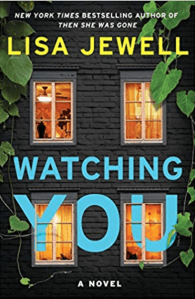
Watching You – Lisa Jewell

01B345DC-2890-42FE-9E54-71D514747137The current flavour-of-the-month in book stores these days seems to be duplicitous nannies or wives, unreliable narrators of all stripes, characters and plots that simply can’t be trusted. In my experience, books like this come with varying degrees of pedigree. But then there’s Lisa Jewell.

Watching You is my third novel by this British writer. My first experience with Jewell was The Girls in the Gardenand then I read I Found You. I always have another of her books waiting for me because I know I can depend on Jewell to deliver a cracking story, believable characters and a few unexpected twists.

Watching You takes place in Melville Heights, a tony neighbourhood in Bristol. The cast of characters is varied. There’s screw-up Josephine (Joey), newly married to gorgeous lug, Alfie. The two have recently returned to Melville Heights and are living with Joey’s older brother, Jack, a heart surgeon and his wife, Rebecca, who is pregnant. Then there’s Tom Fitzwilliam and his wife, Nicola, and their son, Freddie. Tom’s the new headmaster at the local school. Then there’s Jenna Tripp and her mother.

Everyone is watching everyone else in Melville Heights. Freddie spies on people from his bedroom window, keeping tabs on their comings and goings because “In the absence of any friends or any real desire to have friends, Freddie had spent the past year or so compiling a dossier called The Melville Papers.” Down below, Mrs. Tripp is doing the same and while Freddie’s surveillance seems a bit creepy, Mrs. Tripp is clearly paranoid. And Joey watches Tom Fitzwilliam. She can’t help it.

Joey watched him walking back to his table. He wore a blue suit with a subtle check. The bottom buttons, she noticed, strained very gently against a slight softness and Joey felt a strange wave of pleasure, a sense of excitement about the unapologetic contours of his body, the suggestion of meals enjoyed and worries forgotten about over a bottle of decent wine. She found herself wanting to slide her fingers between those tensed buttons, to touch, just for a moment, the soft flesh beneath.

The story opens with a murder, a gory stabbing, and as the stories of this disparate cast of characters unravels, we watch (through a series of police interviews) the clues start to build a case. But of course, this is Lisa Jewell – so nothing is ever as it seems. They say you can never really know someone, and I think Jewell uses that premise to her advantage here. Who are these people? What are there motives? Where are their loyalties?

I had zero problem turning the pages. Ultimately, at the end of a book like this, you want to feel satisfied with the resolution. The red herrings have to be plausible at least. I like to try to figure things out along the way, and I don’t like it when the plot drives off the cliff of ridiculous. No chance of that here. Jewell masterfully manages all the players, even those with only a minor role to play.

Watching You is a great book to curl up with on these cold winter nights.

My Absolute Darling – Gabriel Tallent

Gabriel Tallent’s debut (DEBUT!) novel, My Absolute Darling, is going to be difficult tomyabsolutedarling write about – not only because the subject matter is contentious, but because I don’t have an adequate vocabulary to express just how truly astounding this novel is. (I guess he gets the extra ‘l’ in his last name because when they were handing out talent, he got more than his share. Seriously.)

Julia (though everyone calls her Turtle) Alveston is fourteen. She lives with her father, Martin, in Northern California. Her mother is dead. Although her father sometimes works as a carpenter, the two of them are isolated and live pretty much off-the-grid. The only other adult in her life is her grandfather, Martin’s dad, who lives in a trailer on their property. Turtle goes to school, but she is friendless; she is more comfortable roaming the woods and shooting guns, than she is talking to kids her own age.

Turtle’s relationship with Martin is complicated. Martin is an imposing figure, both physically and intellectually. But he is also a seriously damaged man and it won’t take long for readers to see that the relationship between father and daughter is, among other things, abusive. But then, even that doesn’t adequately explain things.

After a meeting at school, where Turtle’s teacher expresses concern with her progress, Martin says “Is this the sum of your ambition? To be an illiterate little slit?”

His meaning comes to her all at once like something lodged up in a can glopping free. She leaves parts of herself unnamed and unexamined, and then he will name them, and she will see herself clearly in his words and hate herself.

There is always simmering violence in Turtle’s home, a house tellingly “overgrown with climbing roses and poison oak.” There are guns and knives inside, both of which Turtle knows how to use with startling proficiency.  Martin is a survivalist who fervently believes that “Humanity is killing itself – slowly, ruinously, collectively shitting in its bathwater….”

Turtle has learned to read her father, to anticipate what’s coming. It’s hard – very hard – to watch her negotiate with herself, or justify Martin’s abuse, particularly the sexual abuse. Tallent wisely chooses a limited third person point of view to tell Turtle’s story; I don’t know how readers could bear it otherwise.

She thinks, do it, I want you to do it. She lies expecting it at any moment, looking out the window at the small, green, new-forming alder cones and thinking this is me, her thoughts gelled and bloody marrow within the piping of her hollow thighbones and the coupled, gently curving bones of her forearms. He crouches over her and in husky tones of awe, he says, “Goddamn, kibble, goddamn.”

When Turtle meets Jacob and Brett, her world starts to crack open a little bit, but it’s not until Martin arrives home, after a protracted absence, with ten-year-old Cayenne in tow, that Turtle starts to reconsider her life. She knows she has to “really goddamn look at it without lying….”

Tallent said in a 2017 interview for Mashable that ” “…good books ask us to be courageous readers.” I think he’s right, of course, but I don’t think everyone will be able to stomach the violence in My Absolute Darling. That said,  this book is worth the effort.

First of all, Tallent’s a gifted writer. His descriptions of the natural world – almost a character in and of itself – are masterful. This is Turtle’s domain and it’s important. She can survive in the wild, and those survival instincts serve her well. Secondly, Turtle is a character you will not soon – if ever –  forget. She is tough because she has to be, but there is a tenderness about her, too. Her friendship with Jacob is unexpected and impossible, but also essential because it gives Turtle a glimpse into a normal world that has been denied to her. Finally, Martin is not a one-note villain. Although my feelings about him didn’t really waver, I still found some sympathy in my heart for him. That’s a tribute to Tallent because, mostly, Martin is a narcissistic monster. I believe Martin loves Turtle, but in a twisted, possessive, controlling way.

I highly recommend this book, although I understand that it won’t be palatable for many readers. It was on my short list as a potential selection for my book club, but I knew – even before I read it – that most of the women in my group would have a very difficult time with its subject matter. After reading it, I can say with certainty that I was right: they would have hated it. But I would argue that it’s compelling, intelligent and  worthy of the copious praise it has received.

Highly recommended.

Ruthless – Carolyn Lee Adams

2E11B418-C156-499C-B40A-C90F9802D4A7Seventeen-year-old Ruth Carver has a nickname on the show-riding circuit: Ruthless. She earned the name by being single-minded  when it comes to competitions, but it’s more than that. At the ranch, it’s “sink or swim” and Ruth lives by that motto. Ruth also understands that her success in the ring will benefit her parents’ struggling ranch. She’ll do whatever it takes to win, even if that means pushing other people away from her. That includes Caleb, the boy who loves her.

Carolyn Lee Adams’ YA novel Ruthless is a thrill-ride of a novel. It starts when Ruth wakes up in the back of a pickup truck, buried in a mound of manure, hay and shavings. She’s hurt and she soon realizes that she is in trouble, serious trouble.

The trouble comes in the shape of a man Ruth nicknames Wolfman.

He is tall and big, with a large, black beard and bushy eyebrows. He has strange hazel-orange eyes. He reminds me of a wolf.

Ruth remembers him from the ranch. “I kept seeing that wolf-looking guy, and that wolf-looking guy kept seeing me,” Ruth recalls. So “I told Dad to fire him.” Seems like Wolfman is the kind of guy to carry a grudge.

Wolfman aka Jerry Balls, is a smart and dogged  psychopath.  He punishes girls who he feels are deserving and Ruth can see that “He hates me in a way that I didn’t know was possible.”

So here is Ruth, trapped with a psycho in the middle of the Blue Ridge Mountains. Left alone when Wolfman is called in to work, she discovers that she is not his first victim, but she is determined that she will be his last. Her breathless escape from his cabin is just the start of 200+ pages of pulse-pounding reading.

If you’re wondering how Ruth is going to manage getting and staying away from Wolfman in the middle of nowhere, in terrain she doesn’t know, without supplies…well, that’s part of what makes Lee’s novel so compelling. Failing is not an option here and readers soon discover that Ruth is every bit as tenacious as Wolfman.

There is nothing graphic about this book, although the threat is imminent. Wolfman is also not a one-dimensional character; his story is told through a series of flashbacks. Doesn’t make him any more sympathetic, but you still get a glimpse into how he might have ended up the way he did.

We also see a bit of Ruth’s story from pre her abduction. One surprisingly prescient snippet recalls a conversation she has with her family. Her grandfather, once a sheriff, is offering advice should she ever be taken. He tells her “Don’t ever let them take you to a second location.” Her father offers “May God have mercy on the soul of the poor bastard who ever dared try.” Truer words.

Ruthless is terrific.

One Day in December – Josie Silver

I expect to be in the minority here, but I really didn’t see the charm of Josie Silver’s B697342F-E7EB-45CA-8ED5-439900BCD1C2novel One Day in December. It’s a book that depends on the chemistry of the central characters, Laurie and Jack, and our willingness to believe that a fleeting eye-lock might actually change the trajectory of someone’s life.

Laurie and her bestie, Sarah, live in London, working post-college jobs and bemoaning their love lives (or lack thereof) over weird little sandwiches made with chicken, blue cheese, mayo and cranberry.

One day on the bus, Laurie locks eyes with a stranger waiting at a bus stop.

We are staring straight at each other and I can’t look away. I feel my lips move as if I’m going to say something, God knows what, and all of a sudden and out of nowhere I need to get off this bus. I’m gripped with the overwhelming urge to go outside, to get to him. But I don’t.

Laurie spends the next year boo-hooing about the boy, looking for him everywhere she goes, determined that he’s the one. And then, there he is. It’s a Christmas miracle. Except maybe not so much because it turns out that the love of Laurie’s life is Sarah’s new boyfriend.

Silver toggles the narrative between Laurie and Jack, so that we get to see just how tortured and two-sided these star-crossed lovers are. Because — of course — Jack remembers Laurie from the bus and — of course —  he hopes she doesn’t realize who he is because he is trying “to establish her place in [his] head as Sarah’s friend rather than the girl I saw once and have thought of often since.” Even though Sarah is smoking hot he worries that if he and Sarah break up she’ll “spirit Laurie away with her.”

Ah, the tangled web.

Jack and Laurie’s relationship morphs over the ten years of the novel. That’s a lot of time to be pining for someone else. Laurie runs away to Thailand for a time and there she meets Oscar, a London banker, “but not a wanker”, who is “funny, self-deprecating, and when he looks at [her] there’s a kindness in his eyes that warms [her].” Truthfully, he’s an altogether nicer bloke than Jack.

But the heart wants what it wants, I guess. At least that’s the premise of Silver’s confection. You’ll need to believe in Jack and Laurie to fall in love with the book. I didn’t care about either of them.