The Girl in the Park – Mariah Fredericks

parkRain, the compelling narrator if Mariah Fredericks’ YA mystery, The Girl in the Park, attends the prestigious Alcott School in Manhattan’s Upper West Side. “At our school,” she says. “everybody is the child of a somebody.” Rain’s somebody is her mom, an opera singer and “if you’re into opera, you probably know her.”

Rain is a watcher, a listener. Mostly it’s because she was born with a cleft palate, and although speech therapy has smoothed out some of the T’s and S’s, Rain’s still self-conscious. She hates how she sounds, “mushmouthed and nasal.”  That is, until Wendy starts school and tells her “Big deal. Okay, maybe you sound a little funny. But you need to forget about that and speak up girl.”

Wendy is larger than life. Although she’s rich, she comes from Long Island and doesn’t have the right kind of money or pedigree. The students at Alcott are snobbish and clique-ish, but that doesn’t stop Wendy from trying to make inroads. It’s when Rain tells her that she’s approaching it all wrong that the two girls become friends.

We only ever really see Wendy through Rain’s eyes because when the novel begins, Rain discovers that her friend has been found dead in Central Park. At this point, Rain and Wendy were friendly but no longer really friends. Wendy’s blatant disregard for the prep school rules and her reputation as a “skank” have caused Rain to distance herself from the girl who once told her that “You. Other the other hand. Listen. And you think. So when you do speak? You’re brilliant. So, give up the silence, okay”

Rain can’t stand the thought that something so horrible has happened to Wendy. Worse, the night it happened Rain was at the same party as Wendy and she feels she may have seen something that could help the police — she just doesn’t know what it is.

The Girl in the Park is a fast-paced mystery with enough suspects to keep readers engaged and guessing whodunit. It’s also a story that peers into the nasty, and sometimes heartbreaking, world of teenagers. I couldn’t put it down.

Try Not to Breathe – Jennifer R. Hubbard

breatheI think I am starting to suffer from YA fatigue. Or maybe it’s just that, despite its accolades, Jennifer Hubbard’s novel Try Not to Breathe, didn’t quite work for me. I don’t mean to imply that the novel isn’t decent or that it isn’t well-written, either. I can’t say for sure why it was that when  I got to the novel’s tidy ending,  I just felt sort of meh.

Ryan is 16 and has recently returned home from a stint at Patterson, a psychiatric hospital. Ryan attempted suicide and now “everyone snuck looks at me in the halls…Sometimes I was tempted to foam at the mouth and babble to invisible people, because the other kids seemed so disappointed that I didn’t. But I couldn’t be sure they would realize it was a joke. The few times I’d tried to make anyone laugh, all I got were nervous glances and squirming.”

Ryan’s circle is pretty small. He’s an only child; his father travels a lot and his mother works from home – to keep an eye on him. Everyone is pretty much on tenterhooks. His only freedom comes at the waterfall, where he stands under the punishing water “because [he] needed it.”

Into his world comes Nicki. She’s the younger sister of a guy he sort of knows from school. She shows up at the waterfall and the two form a friendship that soon becomes necessary to them both. Nicki isn’t afraid to ask Ryan questions, and soon Ryan discovers that he isn’t afraid to answer them. She has an agenda, as it turns out; her father committed suicide and she thinks, given the circumstances, Ryan might have some insider information.

The other important people in Ryan’s life are Val and Jake, two other teens he met during his stay at Patterson. He thinks he has feelings for Val, but a road trip orchestrated by Nicki (who is too young to drive, but does it anyway) delivers the heart-crushing news that Val is not as willing to take a chance on Ryan. It’s just one of the post-suicide-attempt blows Ryan is dealt, but he manages to rally.

Try Not to Breathe does a good job describing a teenager’s depression. Ryan had “lived behind what felt like a pane of glass, separated from the world.” Ryan is a likeable character, too, and so is Nicki. I found his parents less successful, sort of hovering non-entities. Despite my own reservations, I think the book will likely speak to teenagers who have ever considered suicide because, ultimately, Ryan’s is a story of survival.

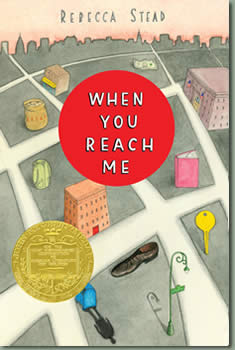
When You Reach Me – Rebecca Stead

book-whenyoureachmeRebecca Stead’s Newberry Award winning novel, When You Reach Me, is a puzzle of a book. And I should note that the Newberry isn’t the only prize this book received – there’s a list of twenty other prizes and distinctions this book has received. This book has some serious pedigree. It’s a middle grade book, but I’m telling you – those middle grade kids better be on their toes because this book is a puzzle.

Twelve-year-old Miranda lives in a New York City apartment with her legal secretary mom. Sometimes her mom’s boyfriend, Richard, is there. That’s okay because “Richard looks the way I picture guys on sailboats – tall, blonde and very tucked-in, even on weekends.”

Miranda’s best friend, Sal, lives one floor below Miranda. For as long as Miranda can remember it’s been Sal and Miranda, Miranda and Sal. Until it wasn’t.

It happened in the fall, when Sal and I still walked home from school together every single day: one block from West End Avenue to Broadway, one block from Broadway to Amsterdam, past the laughing man on our corner, and then half a block to our lobby door.

Miranda has been receiving mysterious notes, notes that seem to predict the future. The notes seem to know an awful lot about Miranda and her life. And then the spare key to the apartment goes missing. And while all this is happening Miranda has to manage her estranged relationship with Sal and all the other pre-teen drama a twelve-year-old must face.

When You Reach Me is a delightful hybrid. It’s one part coming-of-age novel, one part science fiction, one part homage to Madeline L’Engle’s A Wrinkle in Time and all parts fabulous.

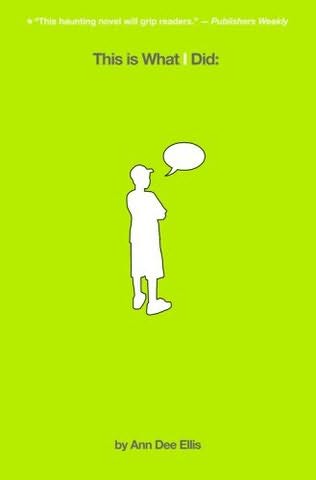
This is What I Did: by Ann Dee Ellis

whatI didLast week Bruce kicked me in the balls at Scouts and all his buddies were there laughing and I started crying.

That’s Logan, the thirteen-year-old narrator of Ann Dee Ellis’s compelling and unusual YA novel This is What I Did:. Logan is a target for bullies for a variety of reasons: he’s the new kid and he’s mostly silent. There’s a reason, of course. His family has recently moved to the new school because of something horrific that happened concerning Logan and his best friend Zyler. Logan doesn’t want to talk about it, so the details of the event is unspooled in the kind of painful way that makes you read faster.

I also loved the way Logan shared his story.

A year ago I was fine. That’s when there was nothing wrong.

A year ago, in seventh grade, I was fine.

We were living on Mulholand with the hills and the lake and the freeway and the Minute Man Gas Stop and my best friend, Zyler, ate Twinkies and coke and hated girls, except one.

Dialogue looks like this:

Ryan: Why do you sit down here all the time?

Me: Where’s Mack?

Ryan: Helping Dad with something.

Me:

Ryan:

Me:

Ryan: Okay, I think I’m going to go back upstairs.

And then he left.

Logan has parents who desperately want to help him, but aren’t sure how. Given that we see them only through Logan’s eyes, they are believable and sympathetic, but by no means perfect.

It is only when Logan meets Laurel that he starts opening up. One day she hands him a note that says “Nascar=Racecar, Racecar=Palindrome.”  Soon, he and Laurel are sending each other palindromes regularly and before he knows it, Logan has made a friend.

I really liked This is What I Did:. It tackles some weighty issues without shying away from them and allows the reader to share Logan’s journey from broken to healing in  way that was both satisfying and hopeful.

Highly recommended.

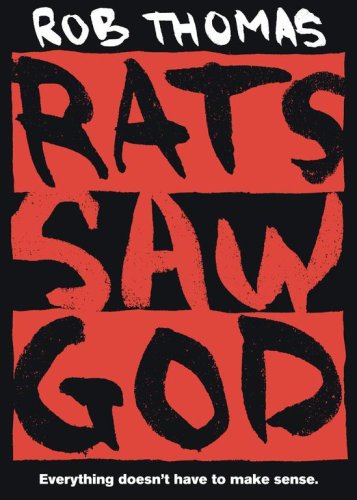
Rats Saw God – Rob Thomas

ratsRob Thomas shares his name with the lead singer of Matchbox 20, and although they are both writers, this Rob Thomas is better known for his television show Veronica Mars than his hit songs.

Rats Saw God is a Catcher in the Rye-esque coming of age novel about Steve York, a high school senior who ends up in his guidance counselor’s office trying to explain why he’s flunking out when his SAT scores are through the roof. The fact that he’s regularly stoned might also be a contributing factor, but in any case, Steve finds himself sitting with Mr. DeMouy being offered a cup of tea. DeMouy tells him that at the end of the semester he’ll be one English credit short.  DeMouy makes him an offer: write 100 typed pages – about anything. If he does that, DeMouy will make sure Steve graduates.

When Mom and the astronaut called Sarah and me into our Cocoa Beach, Florida (see I Dream of Jeanie) dining room to tell us they were getting a divorce, I admit I was shocked. I suppose I should have seen it coming, but the warning signs had been such a part of the status quo.

Thus begins Steve’s paper. It’s the story of his junior year. After the divorce, he moves with his dad, “that barely animate statue,” to Houston and his sister, Sarah, twelve at the time, moves to San Diego with her mom. In the summer, they swapped. Steve and his father have an estranged relationship:

He would leave for work before I woke but would provide a list of chores by the sink, paper clipped to a ten-dollar bill, which was to provide me both lunch and dinner.

At school, Steve befriends Doug, a skateboarder, and that friendship leads him to Dub, and the people who eventually become GOD, the Grace Order of Dadaists.  Dadaists, Steve explains ” were painters, writers, sculptors in the twenties who believed in art without coherent meaning. Nothing they did had to be justified. The more abstract, the weirder something was, the better.”

Rats Saw God is funny and smart  and it is a delight to watch Steve try to figure out the world, even when he has to face the truth that sometimes people will disappoint you. Of course, sometimes they’ll surprise you, too.

The Storied Life of A. J. Fikry – Gabrielle Zevin

zevin_firky_hcThere are  winks and nudges galore in Gabrielle Zevin’s novel The Storied Life of A. J. Fikry. This was my book club’s first read in 2015 and we gathered last night to discuss its merits. Okay, mostly everyone discussed its merits; I acted like Mr. Fikry himself before the magical arrival of Maya: grouchy.  I didn’t like the book. It was easy to read and I wanted to like it and I should have liked it, given the subject matter – bookstores and the importance of reading…but, nope, just fell flat for me.

A. J. owns a bookstore on the fictional island of Alice which is located somewhere off the coast of Hyannis. He’s a cranky guy, but I guess it’s understandable because his wife, Nic, was killed in a car accident just under two years ago and A.J. hasn’t recovered. The book store was a joint venture, dreamed up when he and Nic were in grad school. They took her trust fund money and opened Island Books, but A.J. is sort of the antithesis of everything you’d expect in a book store owner.

In fact, we meet first meet him when Amelia Loman arrives at his store to discuss Knightley Press’s winter catalogue. A.J. tells her:

I do not like postmodernism, postapocalyptic settings, postmortem narrators, or magical realism. I rarely respond to supposedly clever formal devices, multiple fonts, pictures where there shouldn’t be – basically, gimmicks of any kind. I find literary fiction about the Holocaust or any other major world tragedy to be distasteful  – non-fiction only please. I do not like genre mash-ups a la the literary detective novel or the literary fantasy. Literary should be literary and genre should be genre, and crossbreeding rarely results in anything satisfying. I do not like children’s books, especially ones with orphans, and I prefer not to clutter my shelves with young adult. I do not like anything over four hundred pages or under one hundred fifty pages. I am repulsed by ghostwritten novels by reality television stars, celebrity picture books, sports memoirs, movie tie-in editions, novelty items, and – I imagine this goes without saying – vampires. I rarely stock debuts, chick lit, poetry or translations.

Island Books sounds like an inviting place, eh? Luckily for A.J. it’s the only game in town and Alice Island is a popular summer destination, so he makes a decent living off the tourists. He’s not popular with the locals, but no wonder; he has the personality of a prickly pear.

Then, someone leaves a baby in the bookstore and A.J.’s paternal instincts kick in. In short order, much like the Grinch, A.J.’s heart grows in size and everything in his life changes. Of course it does.

The Storied Life of A.J. Fikry should have been right up my alley. Island Books inhabit a purple Victorian cottage. Be still my heart. A.J. has my dream job in my dream building. The novel is peppered with references to short stories and plays and novels, most of which I am intimately familiar (thus the nudging and winking). It celebrates the value and power of books.

Yet.

I just didn’t believe it. There was something hokey and almost to-good-to-be-true about the book, about the characters and their journeys. I won’t go so far as to say that it was a waste of time, but I have to admit to being disappointed when I finished.

Heading Out to Wonderful – Robert Goolrick

wonderfulI was a big fan of Robert Goolrick’s novel, A Reliable Wife, but I turned the last page of his second novel, Heading Out to Wonderful, this morning with le sigh. And not a good sigh.

Brownsburg, Virginia, 1948 is the setting of Goolrick’s novel. It was

the kind of town that existed in the years right after the war, where the terrible American wanting hadn’t touched yet, where most people lived a simple life without yearning for things they couldn’t have

Into this town comes Charlie Beale. He arrived in “a beat-up old pickup truck. On the seat beside him were two suitcases. One was thin cardboard and had seen a lot of wear and in it were all of Charlie Beale’s clothes and a set of butcher knives as sharp as razors.” The other suitcase is full of money.

Turns out that Charlie is not as dicey as he sounds, though. He quickly gets a job at the town butcher shop and soon ingratiated himself with the people of Brownsburg.

He cut the meat and charmed the ladies, one by one, but, more than charm, he treated every one, black and white, from the richest to the shoeless poorest, from dollars and dimes, with the same deference and shy kindness, and he won their hearts…

He makes good friends with Will, the man who owns the butcher shop, and Will’s wife, Alma, a school teacher. He becomes especially close to Will and Alma’s five-year-old son, Sam.

Charlie tells Will that he is ready to settle down, that he has been looking for “something wonderful.” Brownsburg, apparently, is it.

Or maybe the something wonderful is Sylvan. She’s the young wife of the town’s richest man, Boaty Glass. Sylvan is an uneducated girl who comes from the country (the reader will eventually find out how the repulsive Boaty landed such a beautiful wife) and dreams of being a movie star.

…she looked as though she had stepped into the shop from another part of the world…Her lips were a crimson slash, her hair pulled up in gleaming blonde waves on top of her head, held with tortoise-shell combs studded with rhinestones. Se wore dark sunglasses, a thing no other woman in town even thought to own, and espadrilles, tied with grosgrain ribbons around her ankles…

None of the other women speak to her, but Charlie can’t take her eyes off her and “she went off in his head and his heart like a firecracker.”

It is Charlie’s illicit relationship with Sylvan that makes up the bulk of the story. Sam, although only a child, plays a pivotal role.

Heading Out to Wonderful should work. I can’t quite figure out why it doesn’t. Perhaps it is because I never really felt like I understood either Charlie or Sylvan. The reader is never privy to Charlie’s past and so never clearly understands what motivates him. Where did all his money come from, for example? Why does he prefer to sleep outside on the ground?

Sylvan is, I think, something of a cold fish. Her only friend is Claudie, a black seamstress in town. Sure, I could chalk up her behavior to youth, but I just didn’t  like her and so it was hard to root for the relationship between her and Charlie.

Goolrick is a great writer and for that reason, Heading Out to Wonderful was easy enough to read, but lots of things about this book irked me (Charlie’s younger brother turning up out of the blue, for example)  and so I can’t wholeheartedly recommend it. Loads of other people/critics loved it, though.

Kiss Crush Collide – Christina Meredith

kisscrushcollideJust once I’d like to see a girl go on a journey of self-discovery that isn’t instigated by the boy she meets. But essentially that’s what happens to Leah Johnson, youngest of a trio of golden girls in Christina Meredith’s YA novel Kiss Crush Collide. These are girls whose futures have all been mapped out by a cliché of a mother and a doting but passive father. Yorke, the eldest, is in college and planning a wedding to her boyfriend, Roger; Freddie is graduating from high school and heading off for a year in France; Leah is about to start her last high school summer before she, too, becomes (like her sisters before her) valedictorian and then on to bigger and better things.
But that all changes when Leah meets Porter at her family’s country club (yes, they’re that kind of family; they go to the country club on Friday night).

When he wrapped his fingers around mine, a warm current of electricity flowed through me. I felt suddenly solid, as if my world had been rolling past me and it had stopped right now, amazingly sharp and in focus as if I had just taken off my roller skates. I didn’t want to let go.

That’s the boy: green eyes, beautiful brown hair, penchant for stealing cars. He pushes/pulls Leah in ways that Shane (her perfect high school boyfriend) never has, so of course she wants him. She sneaks off with him on the very night she meets him and then can’t stop thinking about him.

I suspect that lots of girls in my class will like Kiss Crush Collide and that’s okay.  There are lots of girl meets boy books out there, and this one sits pretty much in the middle of the pack. What has Leah learned from her seventeenth summer? How to drive her car (finally) and her life. Too bad it was a boy who taught her how to do both.

Silent to the Bone – e.l.konigsburg

silentWhen thirteen-year-old Branwell’s baby sister ends up in a coma, Branwell stops talking and it’s up to his best friend, Connor, to figure out what really happened the day Nikki was hurt. That’s pretty much the plot of e.l. konigsburg’s YA novel, Silent to the Bone. Luckily, in konigsburg’s skillful hands, this story ends up being so much more than the sum of its parts.

I cannot explain why Branwell and I became friends. I don’t think there is a why for friendship, and if I try to come up with reasons why we should be friends, I can come up with as many reasons why we should not be. …Friendship depends on interlocking time, place and state of mind.

Connor is, in fact, a true-blue friend to Branwell. After Nikki is hurt, Branwell is sent to the Behavioral Center for observation. Connor visits him frequently and despite Branwell’s silence, Connor knows in his heart of hearts that Branwell did not hurt his baby sister.

Connor devises a genius way of communicating with Branwell based, in part, on Jean-Dominique Bauby’s The Diving Bell and the Butterfly. In that book, a paralyzed man dictates his life story by blinking his left eye. Connor creates a series of flash cards using words he thinks might trigger a reaction. Slowly the true story of what happened to Nikki is revealed.

Silent to the Bone ended up on just about everyone’s “best” list including the ALA, New York Times and School Library Journal. One of the reasons, I think, is that the book is layered. There’s the central mystery of what happened to Nikki; there’s the complicated blended family relationships, there’s the love and petty jealousies that mark any solid friendship.

Branwell and Connor are believable characters. Connor’s older sister (from his father’s first marriage) helps Connor disseminate all the information he gathers from his visits with Connor. Connor is only a kid, sure, but he’s tenacious and smart and he is determined to figure out what really happened.

This is a great book for thoughtful readers.

The Children Act – Ian McEwan

children's actYou can always count on Ian McEwan to bring on the controversy. This is the fourth of the prolific British novelist’s books we’ve read in my book club and it prompted a loud and lively discussion.

The main character in The Children Act is Fiona Maye, a High Court judge in London. She’s about to turn 60 when her husband, Jack, a professor, announces that he wants to have an affair (this is not a spoiler, really; the revelation comes pretty much on page one). She’s been married for thirty years and until the moment her husband tells her that he needs this because it is his “last shot” and he’s “yet to hear evidence of an afterlife” she’s been pretty smug about her life. While it is true that they don’t have children, they have had a good life together: enough money, a nice home, friendship and, Fiona admits ” she had always loved him.”  To say that Jack’s confession throws Fiona for a loop is an understatement, but she does not intend to “manage the rest of her life alone.”

Into Fiona’s fractured world comes the Henry family. Adam Henry is seventeen and he and his family are refusing the blood transfusion that may save his life because they are Jehovah’s Witnesses. According to their beliefs, “Mixing your own blood with the blood of an animal or another human being is pollution, contamination. It’s a rejection of the Creator’s wonderful gift. That’s why God specifically forbids it in Genesis and Leviticus and Acts.”

Fiona’s actually quite adept at sorting through these complicated and potentially incendiary cases, but even she is not quite sure what compels her to reserve judgment so she can visit Adam in the hospital. She calls the decision “a sentimental error,” but she goes anyway and discovers that seventeen – year – old Adam is , despite his illness, “beautiful.” It’ll be obvious to careful readers that Fiona is smitten. In fact, during the first few moments of their meeting she “caught nothing.” The visit that follows is charged – not sexually, really, although there is an element of that, too – with the kind of energy that happens when two people discover a shared passion. For Adam and Fiona it is music and poetry. Ultimately, Fiona’s decision sets Adam on a path that has profound consequences for them both.

I really liked The Children Act. McEwan is a smart writer and he’s adept at spinning a narrative that is tightly focused. Fiona isn’t a particularly likeable character, but that doesn’t mean it’s impossible to relate to her. This is a great book to get people talking.