The Shining Girls – Lauren Beukes

shininggirlsFull disclosure: I like Criminal Minds. And no, it’s not just because FBI profiler Derek Morgan is sometimes shirtless and also often kicks down doors or flies through the air to take down the perps. I have to admit that I have a sick fascination with serial killers and their creepy-crawly minds. So Lauren Beukes novel The Shining Girls  seemed like it might totally be up my dark alley (with the crazy person waiting at the end in the shadows.) This book was a recent purchase, never a guarantee that I am going to read it imminently, but  – as it turns out – I did read it in short order. Was it a wholly satisfying experience? Um, no. However, I was still turning the pages way past my bedtime last night, so that’s saying something.

Harper Curtis is a nondescript sort of guy, remarkable only for his limp. Oh, plus he’s a time-traveling serial killer. Why he is able to skip through time is never really explained, but how is a different story. There’s this House (yes, with a capital ‘H’) and Harper has the key.

Kirby Mazrachi is almost seven when she meets Harper. Harper doesn’t like the “unpredictability of children” but he assures Kirby that he will be back for her. He tells her:

I’ll see you when you’re all grown up. Look out for me, okay, sweetheart? I’ll come back for you.

Harper does come back for Kirby; he comes back for all his “shining girls.” Beukes gives us just enough of their stories to make us care about their awful, violent deaths. One by one, he picks them off, leaving mementos of another time with their ruined bodies.

Harper doesn’t count on Kirby surviving, but she does. Now,  years after her attempted murder, she’s determined to find the man who almost did her in. The thing is, since he’s able to move through time, he’s almost impossible to catch.

The Shining Girls might be the sort of book that readers give up on because it’s too confusing or they don’t buy the time travel element of it. I was happy to go along for the ride, especially for the first three-quarters of the book or so. Harper wasn’t especially scary – we don’t really learn anything about him until about two-thirds of the way through the book – he’s pretty much a garden variety psychopath with a penchant for knives and intestines. What really kept me turning the pages was Kirby. She’s smart and resilient and determined. I liked her and I wanted her to be safe.

Something happened, though, near the end of the book. The carefully sustained tension was somehow deflated. Kirby became that girl. You know, the one who chases after the killer all on her own and then goes into the House all on her own…without a weapon. It was more than that, though. (Seriously, I knew she had to chase after Harper and go into the house – what kind of ending would we have had if she hadn’t?)  I think it was just that when all the pieces of Beukus’ intricate jigsaw puzzle were exposed it somehow seemed silly.

Time heals all wounds. Wounds clot, eventually. The seams knit together.

You had me, Ms. Beukes, until the very end. But even still – I’d highly recommend this book as  genre-bending, well-written, page-turning fun. (If serial killers are your thing, that is.)


Love Remains – Glen Duncan

loveremains Despite the fact that Glen Duncan’s novel Love Remains is only 277 pages long, it took me about a month to finish because I could never read any more than a few pages at a time before my head started to swim. But I mean that as a compliment rather than a criticism.  Duncan is a well-known and much-praised British author who was new to me when I purchased the book. Love Remains, Duncan’s second novel, is almost relentlessly grim. Again – it’s a compliment, honest. There’s no way you could tackle the topic Duncan does in this book without being a skillful craftsman, and Duncan really is an amazing writer.

Nick and Chloe meet in university.

The possibility of love revealed itself to Chloe immediately, in a shock. When they sat opposite each other that first Wednesday, with rain streaking the steamed windows and the delicious reek of frying bacon in the air, she felt (thinking, stunned, of the billions who had felt it, down the long bloodied canvas of history) the first murderous utterance of romance: It’s him.

Nick’s feelings for Chloe are slightly more ambivalent, although he does concede that “he was so curious about what was going on inside her that lust only followed along afterwards, like an obligatory bit of luggage.”

The trajectory of Chloe and Nick’s love story is mostly straightforward. They get married, start jobs,  eventually move into “their first proper home” in Clapham and then, as with many marriages, the romantic impetus drains from their lives as they deal with life’s mundane and often inane decisions: “Do you think we should get a futon, Nick.”  As their marriage closes in around them, “They suffered, periodically, the ache of familiarity.” Chloe feels “suffocated by the sound of his breath escaping through his nostrils” and Nick “hated her for having finished the shape of him.”

Duncan masterfully builds a marriage from the ground up and then, just as masterfully, wrenches it apart in the most violent way possible.  In some ways, it’s almost as though Duncan has written two different, but equally compelling, novels.

When the novel opens, Nick has already left London because that’s what you do “when the future ended.” He is on a journey, it seems, of self-destruction comprised of smoking, drinking and having sadomasochistic sex. None of it makes sense until we learn what has happened to Chloe and, even then, it’d difficult to wrap your head around. Is Nick reprehensible for having abandoned his wife? That’s just one of the moral questions Duncan asks you to consider in this book.

Chloe is on a journey of her own. It is equally compelling, although perhaps more heartbreaking. The random and horrific experience she has endured has sharpened her: “Her face in the mirror, barely recognizable, rewritten.”

What was once a path traveled together, has now been cleaved. I commend Duncan for resisting the urge to offer a tidy ending, but the ending, nonetheless, is remarkable.

Highly recommended.

Living Dead Girl – Elizabeth Scott

living

Elizabeth Scott’s 2008 YA novel Living Dead Girl garnered a lot of praise when it was published. Voted Best Book by the American Library Association, Voya Editor’s Choice and Teen Reads Best book in 2008, among others, Living Dead Girl seemed to be on everyone’s radar when it came out. In 2008 I was just returning to teaching after many years doing other stuff. I wasn’t reading a lot of teen fiction and I’d never heard of the book. Now that I am back in the classroom I spend a lot of time researching YA fiction in an effort to stock my classroom library with books that will appeal to my students. At just 170 pages, this riveting novel will certainly appeal to mature readers.

Alice was abducted by Ray just before her tenth birthday. For five years he has held her captive, physically, sexually and mentally abusing her.

Once upon a time, I did not live in Shady Pines.

Once upon a time, my name was not Alice. Once upon a time, I did not know how lucky I was.

Alice is fifteen now. She has been Ray’s prisoner for so long she no longer even dreams of escape even though she is left alone all day while Ray goes to work. She has been taught from a young age that if she does run away, Ray will return to Alice’s home and kill her parents. Even though Alice can barely remember the girl she was before, she know that she has no choice but to protect her parents. She knows what happened to the Alice before her.

…I keep waiting for Ray to tire of me. I am no longer short with dimpled knees and frightened eyes…I am 15 and stretched out, no more than 100 pounds. I can never weigh more than that. It keeps my breasts tiny, my hips narrow, my thighs the size Ray likes.

Half starved (she seems to live on yogurt), Alice’s days consist cleaning and watching soap operas as she waits for Ray to get home. Although the abuse is not described in detail, enough is alluded that readers will be left feeling very uncomfortable.

The thing is, you can get used to anything. You think you can’t, you want to die, but you don’t. You won’t. You just are.

Living Dead Girl is almost relentlessly grim, but it’s the kind of book that you just can’t put down. I doubt I will forget Alice anytime soon.

The Coldest Girl in Coldtown – Holly Black

Thank goodness for Holly Black — she’s put the bite back into vampire fiction.coldest  If you’ve been playing the home game, you’ll know that Stephenie Meyer pretty much took fangs and sex out of the vampire equation with her hugely popular Twilight series.  I didn’t hate the first book, but it went downhill fast afterwards. I loved The Coldest Girl in Coldtown. The prose sparkles, but the vampires don’t, so it’s win-win for lovers of vampire fiction.

Tana woke lying in a bathtub.

It doesn’t take very long for Tana and the reader to realize that something just isn’t right. Tana had been attending a sundown party and had locked herself in the bathroom to avoid her ex boyfriend, Aidan. Exiting the bathroom the morning after, Tana is aware of the quiet.

She’d been to plenty [of sundown parties], and the mornings were always full of shouting and showers, boiling coffee and trying to hack together breakfast from a couple of eggs and scraps of toast.

What Tana finds instead, as she moves through the house which smells of spilled beer and “something metallic and charnel-sweet,” are the bodies of her classmates “their bodies pale and cold, their eyes staring like rows of dolls in a shop window.”  And we’re only on page five, people!

The Coldest Girl in Coldtown takes the best parts of standard vampire mythology and ups the ante. The vampires in this book are rock stars, revered and coveted.  Black builds a mythology that is believable. Patient zero in Black’s world is Caspar Morales, a vampire who decided that he wouldn’t kill his victims, he’d infect them instead. Essentially, you’re bitten by a vampire, you’re infected, or Cold.

If one of the people who’d gone Cold drank human blood, the infection mutated. It killed the host and then raised them back up again, Colder than before. Cold through and through, forever and ever.

Pretty soon, the government has no choice but to barricade the infected people (and the wannabes) in places called Coldtowns. People who suspect that they are infected must,  by law, turn themselves in. And once you’re in a Coldtown, there’s no getting out.

As Tana comes to terms with the fact that her friends are dead, she discovers that Aidan is, in fact, not. He’s been bungee corded to a bed and chained beside him is a vampire boy, a boy who “must have been handsome when he was alive and was handsome still, although made monstrous by his pallor and her awareness of what he was.”

This is Gavriel. He is everything a vampire should be: dangerous, cunning, tortured and impossible to resist. (Okay, maybe I am just a little bit fixated on my personal notion of a vampire here, but Gavriel ticks all the vampire ticky boxes for me. )

The Coldest Girl in Coldtown is so good. Tana is smart and resourceful and brave. The book builds a world that is believable and terrifying. It is a world that just is. The book isn’t scary, but it is definitely a page-turner. The descriptions of vampirism are bloody and sensual (without being over-the-top, so there’s nothing sexually graphic).

I raced to the end, concerned for all the characters and their fates.  Should there be a sequel?  Black had this to say on her website:

Coldest Girl in Coldtown was written as a stand-alone. That said, I know what happens next, and maybe someday you will too. Right now, as with Curse Workers, I’m happy with where I left everyone. I’m sure they’ll be fine. Right?

I’m good with that.

Highly recommended.

Through the Woods – Emily Carroll

throughwoodsJust in time for Hallowe’en comes Canadian author Emily Carroll’s book, Through the Woods, a collection of chilling short stories. The stories would be quite enough on their own, but Carroll ups the ante with amazing art work. As far as graphic literature goes, Through the Woods goes to eleven. (Yes, yes I did just use a Spinal Tap reference.)

There are five stories in Carroll’s collection and each one of the stories feels vaguely old-fashioned. The monsters that live on these pages have been around for a very long time.

In the first story “Our Neighbor’s House,” Mary is left in charge of her two younger sisters, Beth and Hannah, while her father goes off to hunt. Their father tells them “I’ll be gone for three days…but if I’m not back by sunset on the third day, pack some food, dress up warm, and travel to our neighbor’s house.” When their father fails to return, things go from bad to worse in short order.

In the final story, “The Nesting Place, ” Bell, short for Mabel,  spends her school holidays with her older brother, Clarence, and his wife, Rebecca, at their isolated country house. Bell is a solitary child and she takes little interest in socializing with her brother. The only other person at the house is the housekeeper who warns Bell not to venture into the woods because she could easily become lost as Rebecca once had, “found three days later at the bottom of a cave…three days all alone in the dark drinking water out of a fetid pool to stay alive.” Rebecca, as Bell is soon to find out, has been deeply changed by that experience. And not in a good way.

woods

The stories between the first and last are every bit as unsettling. Dreams and teeth and blood and beasts loom large in this collection.Carroll’s illustrations are saturated with primary colours: blood-red moons and sapphire blue rivers. I don’t know much about art, but Through the Woods is a beautiful book to look at – if slightly macabre.

See more of Carroll’s work at her website.


Gentlemen & Players – Joanne Harris

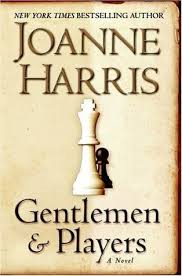
gentlemenGentlemen & Players is an intricate mystery by Joanne Harris, an author probably best known for her best-selling novel, Chocolat. Before she made it big in the publishing world, Harris was a school teacher which probably came in handy while writing this story of a public (in Britain this is the equivalent of our private, thus you pay a tuition)  school in England. For readers unfamiliar with the British school system, the story will likely seem extra exotic. I grew up reading Enid Blyton books and dreaming about going to boarding school in the UK, so I was all over the notion of the tuck shop (the place to buy sweets) and copious gallons of tea consumed by the teachers.

The novel gets its name from cricket, another very British enterprise. A first class cricket match pitting a team of amateurs (the Gentlemen) against the professionals (the Players) is a throw back to the class system in the 19th and 20th centuries. The Players were the working class guys and the Gentlemen from the middle and upper classes.

Harris’s novel has two narratives taking place over two different time periods. In one we follow Roy Straitley, a Classics teacher at St. Oswald’s Grammar School. He’s been in the business for over three decades and is soon to be turning 65. (I was relieved to see that Mr. Straitley still enjoys teaching since I’ll be at least that old before I will be able to afford to retire.) Straitley has dedicated his adult  life to teaching at the school and prides himself on his ability to control his class and remember all the boys he’s taught over the years.

In the other narrative, an unnamed narrator watches St Oswald’s from the gatehouse where they live with their father, the school’s porter (aka custodian).

I understood at once that they were a different race to myself; gilded not only by sunlight and their proximity to that lovely building but by something less tangible; a slick of assurance; a mysterious shine.

Later, of course, I saw it as it really was. The genteel decay behind the graceful lines. The rot.

Fifteen years later, the narrator shows up at St. Oswald’s with forged credentials and begins to teach and all hell breaks loose. At first the pranks are minor, missing registers and pens, but before long things get serious and lives are ruined and lost.

Gentlemen & Players was an easy read (despite all the wacky names I had to keep straight). Does it have something to say about the haves and the have-nots? Not really, since the second narrator just seems jealous and, quite frankly, crazy. Will I be thinking about these characters in a week? Not likely. Was I shocked by the surprise? No, I figured it out. Careful readers will. Still, I passed a pleasant few hours reading the book and if you like suspense thrillers, this is well-written (except for the over-the-top use of semi-colons!) and fun – if you don’t think too long on all the novel’s implausibilities.

The Splendor Falls – Rosemary Clement-Moore

splendorClement-Moore’s novel, The Splendor Falls, contains several recognizable gothic characteristics including an atmosphere of mystery and suspense, an ancient prophecy, a heroine who experiences visions, and supernatural events (there’s ghosts galore). Sadly, the book is too long and too slow to add up to much that would be considered frightening.

Seventeen-year-old Sylvie Davis is the “youngest-ever principal dancer for the American ballet” when she suffers a freak accident which ends her dancing career forever. Dancing is all Sylvie has ever known and the fact that she no longer can sends her into a tailspin of depression which is completely understandable. What is not understandable, however, is the fact that she starts to see things that she can’t explain. She starts to doubt her sanity and her mother, who has recently married a psychiatrist, decides to send her to her deceased father’s ancestral home in Alabama.

Sylvie and her purse dog, Gigi, arrive at Bluestone Hill, a plantation house which is currently being restored by her father’s cousin, Paula. It won’t take long for the reader to recognize the bit-players: the snotty daughter of Paula’s business partner, Clara; the golden-boy president of the Teen Council, Shawn; the mysterious and handsome, Rhys.

Sylvie is petulant about her circumstances. She doesn’t really know, Paula, and knows even less about her father’s childhood. It seems, though, that everyone in the small town knows her family. To make matters worse – she starts seeing things and hearing things.  The reader, by rights, should be creeped out right along with her. I can’t quite figure out why I wasn’t.

The Splendor Falls‘ biggest problem is, I think, with pacing. At just over 500 pages, there just weren’t enough thrills and chills to keep the pages turning. The novel’s denouement, when it comes, doesn’t really live up to its potential.

I’d been really looking forward to this book. I loved the title and the cover and the promise of things that go bump in the night, but at the end of the day the book was more whimper than bang.

Dare Me – Megan Abbott

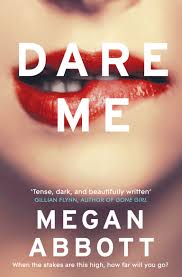
daremeWe have cheerleaders at the high school where I teach, but they’re sure as hell not like the cheerleaders in Megan Abbott’s compelling YA novel, Dare Me. These girls are vicious.

Addy Hanlon is the  narrator of this sordid tale.

There I am, Addy Hanlon, sixteen years old, hair like a long taffy pull and skin tight as a rubber band. I am on the gym floor, my girl Beth beside me, our cherried smiles and spray-tanned legs, ponytails bobbing in sync.

Her ‘girl’ is Beth Cassidy, an acerbic teen who spits out insults like bullets. Beth and Addy have been besties since they were young enough to “hang on the monkey bars, hooking [their] legs round each other.” Now they rule their school, part of a cheer squad that makes boys go weak in the knees and girls run for cover when they swagger down the hall, an impenetrable mass of venom.

Ages fourteen to eighteen, a girl needs something to kill all that time, that endless itchy waiting, every hour, every day for something – anything – to happen.

The social order of things is thrown into disarray, though, when the squad gets a new coach.

The New Coach. Did she look at us that first week and see past the glossed hair and shiny legs, our glittered brow bones and girl bravado? See past all the that to everything beneath, all our miseries, the way we all hated ourselves but much more everyone else? Could she see past all that to something else, something quivering and real, something poised to be transformed, turned out, made? See that she could make us, stick her hands in our glitter-gritted insides and build us into magnificent teen gladiators.

Colette French is demanding. On the second day she “takes a piece of Emily’s flab in her fingers” and tells her to “fix it.” The girls discover they can’t fluster her, that she is already bored with their nonsense. Then, Coach dismisses Beth as captain, saying that she doesn’t “see any need for a captain.”

Addy knows Beth’s response, when it comes, will change everything, and it does.

Dare Me is a riveting look at the world of girls on the cusp of adulthood and the woman who allows them a glimpse of what waits for them on the other side. There are no parents here, no sane adults to pull back the reins. Even Coach, who seems dazzling and perfect to the cheerleaders, is soon revealed as damaged and flawed. Addy is particularly taken with Coach and as their relationship morphs into something more intimate, Addy realizes she’s been “waiting forever, my palm raised. Waiting for someone to take my girl body and turn it out.”

I can’t express how  terrific this book is. The writing is dazzling; it was like a mouth full of pop-rocks, you know that candy that fizzes in your mouth? Watching Addy try to navigate her sixteenth year, despite the fact that the world of cheer-leading is totally alien to me, was a thing of horrible beauty.

Highly recommended.

The Reading Promise – Alice Ozma

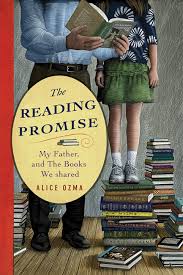
readingpromiseAlice Ozma’s dad, Jim,  made a promise to his daughter: he’d read to her every single night for 1000 consecutive nights. When they reached that pretty impressive goal they extended “The Steak” which, ultimately,  lasted for nine years. Nine years! Ozma shares their  story in her memoir, The Reading Promise.

“Our rules were always clear and firm: we had to read at least ten minutes (but almost always much more) per night, before midnight, with no exceptions. It should come from whatever book we were reading at the time, but if we were out of the house when midnight approached, anything from magazines to baseball programs would do. The reading should be done in person, but if the opportunity wasn’t there, over the phone would suffice. Well, just barely.”

Reading is something that Alice’s dad clearly values and is passionate about. As a librarian/teacher at an elementary school, he believes in the research that clearly shows that reading aloud is  “the single most important activity for building the knowledge required for eventual success in reading.”   But this nine-year reading “Streak” serves another very important purpose: as a single father, Jim is doing his best to spend quality time with Alice. His older daughter, Kathy, had announced when she was in grade four that she no longer wished to be read to. Alice is different.

The Reading Promise isn’t all about the books Jim and Alice shared. I found the book more interesting when Alice talked about the books, though. I laughed when Jim read Dicey’s Song to fifteen-year-old Alice, skipping over the parts he felt too embarrassed to read aloud. I admired Jim and Alice when they patched up small squabbles through reading together. Not even teenage hormones or adult frustration stymied their reading. I was as incensed as Alice was when the principals at both schools where Jim worked decided he should read no more than five minutes a day to his students, that he should, instead, teach them how to use a computer.

Ozma clearly had no notion that she’d be committing the story of “The Streak” to paper when she started her reading journey with her father. If her memoir suffers a little because of it, so what? Their commitment to reading and to each other makes for a lovely story.

Ten Tiny Breaths – K.A. Tucker

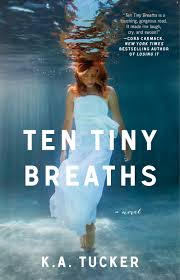
tentinybreaths“New Adult (NA) fiction is a developing genre of fiction with protagonists in the 18-25 age bracket. The term was first coined by St. Martin’s Press in 2009 when they held a special call for “…fiction similar to YA that can be published and marketed as adult—a sort of an ‘older YA’ or ‘new adult’.”[1] New Adult fiction tends to focus on issues such as leaving home, developing sexuality, and negotiating education and career choices,” says Wikipedia.

K.A. Tucker’s novel Ten Tiny Breaths ticks all the New Adult boxes. Protagonist Kacey Cleary’s life is irrevocably  altered at sixteen when her parents, best friend and boyfriend are all killed in a drunk driving accident. Kacey is spared and so is her younger sister, Livie. Flash forward four years and Kacey and her younger sister, who is now fifteen, have left their aunt and uncle’s home in Michigan and headed for Florida. They had to go: Kacey had seen the looks Uncle Raymond had been giving her sister.

So now Kacey and Livie are in Miami. They’ve got enough money to pay for a skanky apartment they found online (luckily their superintendent has a heart of gold). They move in and meet the stripper and her daughter who live next door (luckily the stripper has a heart of gold and also gets Kacey a good gig bar-tending at the club where the owner and all the bouncers have hearts of gold). Then Kacey meets the too-hot-to-be-believed guy who lives in the complex (also with a heart of gold…and a big ol’ secret).  So, yeah, New Adult, sure since there’s a teensy bit of not-very-graphic sex, some swearing and a main character in the 18-25 range…but none of her story is plausible. None. Of. It.

Okay – it’s completely believable that Kacey would be messed up after losing her parents.  Kacey had “spent a year in physical rehabilitation to repair her shattered body, only to be released with a shattered soul…sank into a world of drugs and alcohol for a year to cope…doesn’t cry, not a single tear.”  I get that. Kacey doesn’t like physical touch, that Livie’s hand is the only one she can hold because it “doesn’t feel dead.”

The problem with Ten Tiny Breaths isn’t the writing; it’s the plot and the characters – all of whom seem to have completely altruistic motives. Kacey’s messed up, no question. And sure, Post Traumatic Stress can do some wonky stuff…but the last third of the book is just overwrought and unbelievable and saccharine.

If you want to give the New Adult genre a try, I recommend you check out  Easy. That’s a New Adult novel with some meat on its bones.