The Long Walk Home – Will North

long walk

Okay, The Long Walk Home is a book that I thought would be right up my alley. You know – because I am a single woman of a certain age who still kinda hopes that  the possibility of romance still exists out there, although perhaps a little closer than a mountain in Wales.

Handsome Alec Hudson has walked all the way from Heathrow to Dolgellau, which is located in North West Wales. Why didn’t he just rent a car and drive? Well, he’s on a bit of a mission. His ex-wife (and dearest friend) Gwynne has died and her final wish was that her ashes be scattered from the summit of Cadair Idis, a nearby mountain. He arrives at Tan y Gadair, a B & B run by Fiona, a petite, forty-three-year-old who “still had her looks.” Yes, people, we are going there.

Fiona is married, but her husband David lives in a converted hay barn on the property because several years previously  he’d been poisoned by the sheep dip ( a pesticide used to cure scab mite) and then suffered a heart attack. He never really recovered and his environmental sensitivities and mood swings, coupled with his penchant for whiskey make him difficult to live with. Fiona brings his food, but they no longer live as man and wife. And really, although David was a decent a guy back in the day, theirs was not a fairy tale marriage. That’s what makes Alec so immediately appealing: he’s good looking, he knows his way around the kitchen and he’s a great conversationalist. He’s the perfect man.

No surprise here – they fall in love.  It seems like I am mocking them, but I’m not really. They’re decent people. Alec pitches in around the old B & B, which is also a working sheep farm. By day two, he’s helping Owen, the farm’s hired hand, deliver lambs. By day three Fiona is crying in his arms after a particularly nasty visit with her husband. By day four Alec is confessing: “I am afraid I am very much in love with you…and I don’t know what to do about it.”

I can’t quite figure out why I didn’t like this book all that much. There are no bad guys. Everyone is witty and  kind and  good. They all make selfless decisions.  The only asshat in the book is Fiona’s daughter Meaghan’s boyfriend , Gerald, who is summarily turfed by Owen. And, yes, okay, technically Fiona shouldn’t be having sex with another man – but she hasn’t slept with her husband in years. When that big event transpires it was so treacly, my teeth ached.

So, at the end of the day…I didn’t send The Long Walk Home to the Book Graveyard and while that’s not a ringing endorsement by any stretch,  it at least lets you know that I read the whole thing. If you are interested in lambing, climbing, cooking, and listening to a middle aged woman say things like,”Yes, darling man, please,” then by all means, read Will North’s book.

A picture of Cadair Idis.

270804e

See You at Harry’s – Jo Knowles

seeyouh

I spend as much time reading about YA fiction as I do reading the books, it seems; I am always adding new titles to my list and often the same book will be recommended time and time again. That was the case with Jo Knowles’ book See You at Harry’s. It was waiting in my mailbox at school today – I’d ordered it from Scholastic before the March Break. I started reading it during my third period Grade Ten English class and just finished it a few minutes ago.

The happiest day of  Fern’s life was the day she “threw up four times and had a fever of 103 degrees.” It’s a day lodged in Fern’s (yes, she’s named after the little girl in Charlotte’s Web) memory because it’s the day she didn’t have to share her mother with her two older siblings Sarah and Holden (yes, he’s named after that Holden).

That day at home, my mom spent every minute with me. My older sister and brother were at school, and my dad was working at my parents’ restaurant. I was eight and had never been home alone with just my mom before, at least not all day and definitely not with her full attention.

Shortly after Fern’s recovery, her mom discovers she’s pregnant and instead of being the youngest, Fern suddenly has to contend with a new baby brother, Charlie.

When See You at Harry’s begins, Fern is twelve. Her sister is eighteen, Holden is fourteen and Charlie is three. Her world is chaotic because her family is chaotic…and while Fern might not always get the attention she craves, in that self-centered way all twelve-year-old’s crave attention, she is by no means neglected. She shares a close sibling bond with Holden and there is much to admire in their relationship. Things are little more complicated with Sarah and there’s Charlie.

“I wanna go to school,” he says.

“School is overrated.”

“Huh?”

“Look. All little kids want to go to school. And kindergarten is pretty great. But it just goes downhill from there.”

“Oh.”

“Enjoy your freedom, bud.”

Fern knows what she’s talking about, too. She’s just starting seventh grade and it starts to go downhill on day one. I think a lot of middle school kids will see themselves in Fern. She is, as her mother once told her, “a special soul.”

Fern’s parents run the family restaurant. Her mom is a little on the flaky side and her dad is always coming up with crazy  and embarrassing schemes to improve the business. In all the ways that matter, though,  this is a nuclear family. They aren’t perfect, but they are real. They’re distracted and selfish and  human and fragile.  It takes a  terrible  tragedy to  fill up their empty places.

While this book might not appeal to some of my  students (it is geared for middle school readers, after all), I think many of them will be quite moved by Fern’s family’s story. I was.


Our Daily Bread – Lauren B. Davis

ourdailybread

Picking a book for my book club  is serious business. The way our group works, we have one opportunity to pick and host per year and so you don’t want to choose a dud. The women in our group our merciless [cough] The White Iris [/cough] and it sucks to be on the receiving end of a book choice gone bad.  Usually I spend a lot of time choosing my book. This year I thought I would choose something from my own massive tbr  pile, but the problem was that every book I selected from my shelf was unavailable at local stores. In the end, I headed over to Indigo to peruse the shelves. The only criteria at that point was that there were enough copies on the shelf for the members of my club.

In the end, I chose a book I’d never heard of but which was plastered with accolades and a bright red sticker proclaiming that it had been longlisted for the Giller in 2012. Feeling confident of its pedigree, I brought home Lauren B. Davis’s novel Our Daily Bread.

Davis’s novel owes some of its gripping story to the real-life Golers from South Mountain, Nova Scotia. But Davis is quick to point out that Our Daily Bread is not ABOUT the Golers. While it’s true that Davis’s fictional Erskine family shares some similarities with the real-life family, that is only one small part of this mesmerizing and beautifully-written tale.

Albert Erskine is not like the rest of his violent, drug and alcohol addicted, sexually deviant family. He has already separated himself from the pack by building himself a small shack away from the main buildings on his family’s “compound”  on North Mountain.  His uncle Lloyd comments on Albert’s ‘otherness’ by saying: “You don’t act like the family at all now, do you? Don’t come visiting. Live in your little shack. Course maybe you have your own parties. That it? You have kids come to see you?”

It’s near impossible to trace the branches of  Albert’s family tree. Suffice it to say, there are a lot of younger kids with questionable DNA and Albert regards them with a mixture of annoyance and helplessness.  When ten-year-old Toots stops by his shack looking for food,  Albert ponders the sticky question: “What would she be like, if she’d been raised in some other place?” Albert often wonders how he might be different if his circumstances had been different. It’s a painful road for both Albert and the reader to travel.

Down in Gideon is another family with their own struggles: Tom and Patty Evans and their children Ivy and Bobby.  Tom is a good man. He grew up in Gideon and is well-liked and well-known. His wife, Patty, is another story. For starters, she’s from away. And although Tom seems desperately in love with her, she seems detached and unhappy. No matter what Tom does, it’s not good enough. As the tension in the household escalates, Ivy and Bobby seek shelter elsewhere. For Ivy, it is with the benign widow Dorothy Carlisle; Bobby’s new friend and confidant turns out to be  Albert Erskine. The intersection of these lives makes up the bulk of the narrative of Our Daily Bread.

I am guessing that some of the women in my group will have difficulty with the graphic (but never, imo, gratuitous) nature of the subject matter. As a mother, it’s certainly upsetting to see children in peril. The interesting thing about this book is that peril means different things to different people. Is Ivy’s falling-apart life any less horrible because she has a warm bed to sleep in? The impact Bobby and Albert have on each other’s lives is astounding and heart-breaking, too. Bobby is filled with a fifteen year old’s rage and angst and it isn’t until the novel’s powerful climax that he understands the value of his father’s love.

It truly is the mark of a great novel when you can empathize with so many of the characters. I loved Ivy’s resolute determination and Albert’s jaded hope and Dorothy’s refusal to bend to the will of small-town politics. And I loved Tom. A lot. As he copes with his unraveling marriage, as he asked himself the question, “How can I ever trust myself again?” I just saw so much of myself in him. But, ultimately, it all comes back to Albert. I so desperately wanted him to get in his truck and just go. I will be thinking about him for a long time.

Our Daily Breadisn’t ‘light’ reading, but this is a book that will stay with you long after the final page is turned.

As expected, our discussion of this book was lively and we were SO excited to be able to Tweet with Ms. Davis about her book. Here is some of our conversation:

Lauren B. Davis:  Oh, that’s wonderful, Christie!  If you have any questions, just send me a tweet! Thanks so much. #Ilovebookclubs

The Ludic Reader: Lively discussion about Our Daily Bread. @Laurenbdavis girls want to know if you think Albert ever contemplated a sexual advance towards Bobby?

Lauren B. Davis‏:  Not consciously, altho I do think the conditioned response of his childhood arose (pardon the pun) a few times, including that moment in the cabin the night Bobby came up to the compound with him.

@bitebymichelle wants to know where the wife went.

Lauren B. Davis‏: At the very end of the book?  Ah, who knows.  She is a lost soul, I fear.  I wonder if she’ll  ever come back and finally make that long walk up to the door.  What do you all think?

The Ludic Reader: Nobody is going to love her like Tom did, but we don’t think she’ll come back until her life is shit.

The Ludic Reader:  We all loved Albert so much – why did he have to die? (Altho we do know the answer.)

Lauren B. Davis‏: Can’t tell you how I tried not to kill him.  In the first draft he survived, but it just didn’t work.  I suppose it’s the symbolic sacrifice, but to be honest, I still grieve him. I found the final scene difficult to write.

The Ludic Reader: Some feel the trial was not necessary. Why did you decide to include it?

Lauren B. Davis:  It is rough, isn’t it?  But I felt readers would want to know what happened to the abusers, and since the courtroom  dialogue was taken from trial transcripts, I felt I was bearing witness to the children whose story inspired me. There was so much more of the Goler case which I did not include, because it was simply too horrible. But the response of the townspeople was important to the meaning of the book  I understand the squeamishness.  I felt I, too.  But yes, I think it’s important to be fearless in our gaze and to speak  truth to power even if our voice shakes.
Girl in Translation – Jean Kwok

girlintranslation“I was born with a talent. Not for dance, or comedy, or anything so delightful. I’ve always had a knack for school.”

Kimberly is just eleven when she and her ‘Ma’ emigrate to the States from Hong Kong. It has long been a dream of theirs to live in America and chase that American dream. They arrive in New York with little more than the clothes on their backs and the promise of a new life.

Ma’s older sister, Paula, has been living in New York with Uncle Bob for several years and it is because of her sponsorship that Kimberly and Ma are able to come. But don’t get the idea that Paula is a benevolent soul; she’s not. She puts Ma to work in the clothing factory Bob manages – a sweat shop – and sets her sister and niece up in an apartment so filthy, cold,  and vermin infested that the building has all but been condemned. In fact, every other tenant has moved out in anticipation of the building’s eventual demolition.

Girl in Translation is the story of Kimberly’s adolescence. It’s about her tenacity. If she weren’t so intelligent, her story might have had a different conclusion, but she’s really smart and it’s those smarts that propel her past many of the obstacles poverty throws in her way.

Those of us who live a comfortable existence likely have very little notion of how incredibly difficult it must be for people who come to, let’s say, North America and try to start a new life. Immigrants often don’t speak the language. They don’t understand how anything works. They have no way of advocating for themselves. Kimberly and her mother also have to contend with Aunt Paula who is petty and stingy and jealous of Kimberly’s smarts.

There are moments of kindness in Kimberly’s story. She makes a true friend early on. She finds success academically. She makes her way. But there are significant sacrifices, too.

Like Kimberly, Kwok was born in Hong Kong and immigrated to New York City. She, too, worked at a sweat shop. She, too, was smart. At about the two third mark in the novel I started to feel a bit…I don’t know…disappointed. Kimberly’s story remained interesting, but I really felt as though this was a memoir dressed in a novel’s cloak. I can’t quite explain why, but I didn’t feel like I was living the story anymore, I felt like I was being told the story. And then…that thing I HATE. Flash forward twelve years and let’s see where all the characters are. Nothing about that epilogue – over-wrought and schmaltzy as it was – seemed to fit the rest of the novel.

That’s my own personal niggle, though. The novel has been praised all over the place and I suspect the vast majority of readers will really enjoy it.

Why We Broke Up – Daniel Handler

whywebrokeup_cover-220x300__span

Daniel Handler has written a book that will resonate with just about anyone – young or old – who has ever had their heart stomped on. Which means YOU will love this book. Yes you.

Why We Broke Up is Min Green’s farewell letter to Ed Slaterton, a boy she met at her best friend Al’s Bitter Sweet Sixteenth birthday. As she recounts her brief but meaningful relationship with Ed, hunky co-captain of the basketball team, she also returns to him all the detritus of that relationship.

I’m telling you why we broke up, Ed. I’m writing it in this letter, the whole truth of why it happened. And the truth is that I goddamn loved you so much.

You don’t have to be sixteen to appreciate what’s in Min’s box: the bottle caps and ticket stubs and note on a napkin. Every relationship has its stuff. Min’s relationship with Ed lasted only a few weeks, but as is often the case with the very young, they pronounced their feelings (Ed first) very early on.  They might have seemed, at first glance, totally mismatched. Min, the Jewish girl and movie aficionado and Ed the cool jock with a string of past-girlfriends. But, as Min says: “…the thing with your heart’s desire is that your heart doesn’t even know what it desires until it turns up.”

When I was in grade nine I was madly in love with a boy called Dana. I loved him as only an awkward fourteen-year-old girl can possibly love a much cooler fourteen-year-old boy: from afar. I still have a picture of us taken on our grade nine trip to Prince Edward Island. Me in my Indian cotton shirt and really unfortunate flared jeans, a Bay City Rollers haircut; him in the uniform of the day (and also, perhaps, a Bay City Rollers haircut. Come on, it was the 70s). Anyway. He drank from my coke bottle and I saved that bottle and the inch of pop left at the bottom for years! And I never even got a kiss.

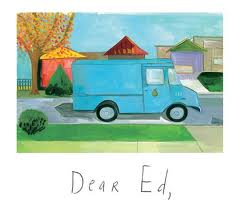
Why We Broke Up is a good bye letter, but it’s also love letter. It’s quirky for sure. (Daniel Handler is perhaps better known as Lemony Snicket, author of the very popular Series of Unfortunate Events books. My 13 year old son is almost through the series and he is constantly reading me bits because he finds them so funny.) The book is illustrated by Maira Kalman and it’s a lovely book – glossy papered and heavy.  brokeupIt’s a clever way to tell an often told story – boy meets girl. Etc.

It’s hard not to feel for Min, though, as she sifts through the mementos, calling up the events associated with them. There’s a story for every artifact and even though she’s giving them all back, the reader understands that her heart will not easily be mended. That’s love for you.

Visit The Why We Broke Up Project


Gone Girl – Gillian Flynn

gonegirl

That I read Gone Girl so soon after finishing Dark Places is a tribute to Gillian Flynn’s talent. With so many books on my tbr shelf, I don’t generally read books by the same author back-to-back. Gone Girl had a few extra things going for it, though. Virtually everyone has been talking about it and I just couldn’t resist its lure any longer.

Nick Dunne and Amy Elliott Dunne are just about to celebrate their fifth wedding anniversary when Amy goes missing. There are signs of a struggle in their rented Missouri home and Nick can’t really account for his whereabouts that morning, so it doesn’t take too long for the police to start treating him like the prime suspect.

Flynn uses a dual narrative approach to tell the story of their courtship and life in New York where Nick was a magazine writer and Amy wrote quizzes for a variety of publications. Life was pretty good for them. They were beautiful, smart and rich. Well, Amy was rich because her parents – Rand and Mary Beth – had written a series of books called Amazing Amy which had, until recently, been a bit of a cash cow. Then Nick and Amy’s fortunes take a turn for the worse and suddenly they find themselves back in Nick’s hometown.

From the start we know that the golden lives of these two protagonists is slightly tarnished. On the morning of the anniversary, Nick’s reaction to his wife’s greeting of “Well, hello, handsome” is one of “bile and dread” inching up his throat. Then: Amy’s missing.

Gone Girl is a supremely entertaining game of cat and mouse. Their married lives had been marked with anniversary treasure hunts and this year is no different. Amy has left the first in a series of clues for her husband. The clues, and the letters which accompany them, seem to indicate Amy’s  awareness of her husband’s unhappiness and her own part in it. But Amy wants to patch things up. The treasure hunt also seems to point to Nick as the person responsible for Amy’s disappearance and slowly the media, Amy’s parents and even his twin sister, Go, start to regard him with suspicion.

But there is more to Gone Girl than a suspenseful mystery. There’s actually quite a damning indictment of the fakery of  relationships; the  potential for infidelity, boredom, entitlement. We want the fairy tale until we don’t. Marriage is hard work. Nick and Amy’s story is extreme, but recognizable nonetheless.

Flynn is a terrific writer. I mean – gifted. She inhabits Nick’s brain as easily as she inhabits Amy’s. They are sympathetic and reprehensible and downright scary in equal measure. To say much more about the plot would be to spoil the novel’s twists. Suffice to say, this is one married couple I wouldn’t be inviting over for dinner any time soon!

The Blue Notebook – James A. Levine

blue notebookIt’s easy to become complacent when you live in Canada. I live in a nice house; I have a car; I have a job; my children are healthy and go to school wearing the clothes they want, with full bellies. They sleep in warm beds. They are safe and loved.  So when I read a novel like James Levine’s The Blue Notebook it sticks with me. Not because it’s beautifully written literature — which I have to say, it’s not — but because it tells a story so compelling and upsetting and alien to my everyday life, I can’t quite wrap my head around it.

Batuk is just nine when her beloved father sells her to Master Gahil. I got the sense that he was strapped for cash and Batuk was his only asset. Thus begins her life of sexual slavery, a life she learns first at the hands of a variety of men in “the orphanage” and then under the watchful eye of Mamaki Briila. She is one of six children housed in “nests” on Common Street in Mumbai. Here she makes “sweet-cake” all day long.

It’s a ghastly life, but Batuk is somehow able to separate herself from the act of sex by retreating into a world of stories. She is literate because she spent several weeks in a TB hospital as a child and a kind nurse taught her to read and write. She commits her story to the pages of a blue notebook and this is how the reader comes to know her story.

And so I look within myself and assemble myself in words. I take the words that are my thoughts and dreams and hide them behind the dark shadow of my kidney. I compress my need for love into words and hide that as a drop of blackness next to my liver (it will be safe there until I need it.)

James Levine, the author of The Blue Notebook, is actually a  professor of medicine and a respected scientist and researcher. He was compelled to write Batuk’s story after seeing a young girl on the Street of Cages in Mumbai. He says, “The image of the girl in the pink sari haunted me so that I was compelled to write The Blue Notebook, a work of fiction based on field-workers’ reports and observation of the conditions that such children survive.” There is an interesting article about Dr. Levine and the book here.

Batuk’s story is a dark one. There is really no reprieve for her or the reader but to be fair — why should we come out of this experience unscathed? The truth is horrific. According to Child and Women Abuse Studies Unit (CWASU) there are an estimated 10 million prostitutes in India. A February 2012 UN report indicated that India was the most dangerous place in the world to be born a girl. Not only are girls less desirable to their families, extreme poverty often leads them to a life of prostitution.(http://www.telegraph.co.uk/news/worldnews/asia/india/9054429/India-most-dangerous-place-in-world-to-be-born-a-girl.html)

If you are interested in helping the children of India there are several charitable organizations, including HOPE.


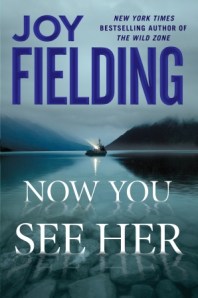
Now You See Her – Joy Fielding

now you see her

Well, there’s a few hours I’m never getting back.

I am not a book snob. I like a fast-paced, plot-driven suspense thriller as much as the next girl. Now You See Her, on the surface at least, seems like a book that would be right down my dark alley. Marcy Taggert is on holiday in Ireland. It was supposed to be a second honeymoon, but her husband, Peter, has run off with the golf pro from his country club and so Marcy has gone solo. While enjoying a cup of tea with a man she’s met on her day-trip to Cork, Marcy sees her daughter, Devon. Which isn’t possible because Devon is dead. (cue music)

I really wanted to like Now You See Her. For one thing it’s written by Canadian Joy Fielding (who has had a great deal of success in this genre). For another, I felt like I should be able to relate to Marcy. We’re of the same vintage, at any rate. But nothing about this book spoke to me.

So Marcy sees Devon and tears off looking for her. Of course, she doesn’t find her. But she returns to Cork and sets up camp and becomes more and more convinced that Devon is not dead. Marcy’s supposition might, in fact, be possible because Devon’s body was never found. She meets various characters along the way, some of whom have nefarious motives, some who want to help her. Some who think she’s crazy and as the book plods along it’s possible that crazy is exactly what Marcy is.

Here’s why the book didn’t work for me:

1. Marcy is stoo-pid. She actually meets a man in a pub and goes off with him after he tells her that, yes, miraculously, he knows her daughter. Really? Really?

2. The writing is clun-ky. Sometimes,  apropos of nothing, we get a little history lesson.  No one sounds Irish. The transitions are often confusing.

3. There are characters who just appear — out of nowhere — conveniently. Fresh baked muffins, anyone? Also, the characters are not believable. Seriously, wait until the lackluster denouement, see who plays a part in it and then see how you’ve been mislead all along.  But not in a plausible way. Peripheral characters, Marcy’s son, for example, are footnotes.

4. If you are going to weave a tangled web, the spider at the center wants to be believable. Um. Just no.

I don’t know where Now You See Her comes in Fielding’s canon, but I won’t be rushing to read any more of her work.

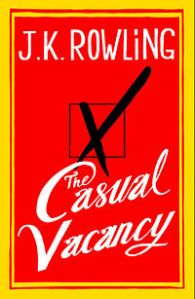
The Casual Vacancy – J.K. Rowling

200px-The_Casual_Vacancy

I’m not sure I would have ever read J.K. Rowling’s adult novel The Casual Vacancy if it hadn’t been chosen by a member of my book club. For starters, the book didn’t sound all that appealing to me – Barry Fairbrother dies and leaves a vacant seat on the  parish council. Small town politics? Ugh. I wouldn’t have been motivated to read it because I’m a fan of her other books either. You know, the ones about the wizard and his friends and he who shall not be named.  Yeah. I’ve only read the first one. Loved the movies, though.

So, I started this novel not really expecting very much of anything. I mean, c’mon, it’s 503 pages long. It’s about a small British town. There are a zillion characters. And I loved it. Okay, maybe love is too strong a word. (My kids say I never love any book, but that’s not true.) I really liked The Casual Vacancy. A lot.

First of all, I lived in England for a couple years and so Pagford, the fictional setting of this novel, seemed familiar to me. I knew the shops and the narrow streets, the school  and the council flats. I could hear the characters (I kept imagining Coronation Street although I know that’s probably the wrong accent.) Once I got settled, the characters and their stories (all of which intersect due to their relationship with Mr. Fairbrother) felt very much like I was watching a British soap opera marathon. Every character was brought brilliantly to life. Fathers and mothers, teenage children, doctors, addicts, rich and poor – no one is left out.  I really think that writing character is Ms. Rowling’s true gift as a writer. Characters drive story and that is certainly the case in this book. Nothing much happens. And everything happens and all of it because Barry Fairbrother dies.

Some of The Casual Vacancy is laugh-out-loud funny. For example, middle-aged Samantha’s growing preoccupation with the hunky lead singer of a British boy band. (I may know a thing or two about this, as I find myself staring at pictures of Zayn Malik from One Direction just a teensy bit longer than is necessary.) Some of the characters are so heart-breaking you just want to hug them: Krystal and her little brother, Robbie. Some characters are reprehensible, yes, Simon, I’m looking at you! All of them are so…human…though. Flawed and brave and cowardly and pretentious and blind and you’ll see yourself or someone you know in every single one of them. This isn’t a book where something happens. The plot is pretty much incidental to the novel. Spending time with these people is time well spent, though.

I do have one niggle with the book. Rowling took such care building up these people in this place and time, I did find the ending a little rushed. I would have been happier, perhaps, with a little less in the middle in exchange for a little more at the end. I didn’t feel cheated, exactly, I guess I just wanted more. I don’t need to know the fate of everyone, but some pretty dramatic things happen near the end and I just felt pushed along.

I’d recommend this book, though. If you weren’t a fan before, The Casual Vacancy could very well win you over. I am definitely going to read those Harry Potter books.


Things Change – Patrick Jones

When sixteen-year-old Johanna accepts a ride home from a meeting with Paul, even she is surprised when she boldly asks him to kiss her. Paul is sort of a well-known figure at their high school, not because he’s an athlete or a particularly good student, but because he is funny and good-looking. People want to be around him. Johanna, on the other hand, is studious and  not very popular. Her one and only friend, Pam, calls her “Books” and the two girls have a standing date at the local bookstore on Saturday.

Patrick Jones’ debut novel Things Change will appeal to fans of realistic fiction. Johanna will be immediately recognizable to young girls; they will either see themselves or someone they know in her. Like many teenage girls, Johanna tries to please her parents, tries to balance school and life and falls head over heels in love with a boy who is fighting his own demons. Because one thing Things Change is not is a straight up love story.

Paul and Johanna eventually hook up and it’s all sunshine and roses – except for when it’s not. Paul is possessive and jealous and has a temper that causes him to lash out at Johanna, inflicting physical and emotional pain for which he is almost immediately contrite. But that’s the pattern, right? And Johanna – young and inexperienced – does what many much older women in her situation might do: she makes excuses, tries to be perfect, forgives.

Although the third person narration is mostly limited to Johanna’s point of view, Jones does something smart,  giving the reader a glimpse of Paul’s psyche by letting us read letters he writes to his dead father. I say it’s smart because it prevents Paul from being a one dimensional monster and the book from being a one-note cautionary tale. Paul’s demons in no way excuse his deplorable behaviour, but it does make him human and somewhat sympathetic.

Patrick Jones used to be a Young Adult librarian and Things Change certainly demonstrates that he’s listened to and observed teens carefully. This book doesn’t preach nor talk down to his target audience. It’s not overly graphic, but there is some sexual content and bad language. That said, I will happily be recommending it to readers in my classroom – both those students who claim they don’t like to read and those who want to read compelling and realistic fiction.