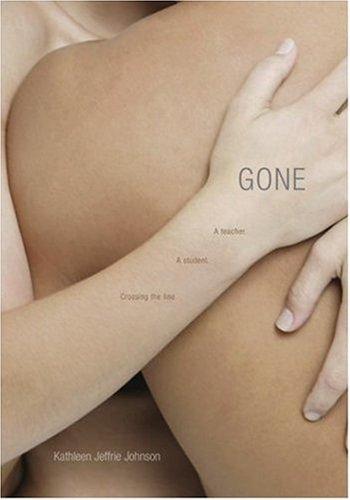
Gone – Kathleen Jeffrie Johnson

Connor, the 17-year-old protagonist of Kathleen Jeffrie Johnson’s YA novel, Gone, is straddling the  fence between innocence and experience. He has just graduated from high school, lives with his Aunt Syl, and visits his father in a nursing home where he has been living ever since he crashed his car while driving drunk. His mother is also a recovering alcoholic.  He is certainly vulnerable to the advances of Corinna Timms.

Ms. Timms was one of Connor’s high school teachers.

Zach…called Ms. Timms serious babe material – too bad she was their teacher. Connor called her, just to himself, beautiful. Half the time in her class had been spent trying not to stare at her, then failing his resolve, ducking his head when she turned around from the blackboard and caught him.

For the nanosecond that their eyes locked – what?

It’s this what that drives the narrative of Gone. As Connor moves through his days, avoiding his mother, working at Chow Line, hanging with his friend, Zach – he does his best to avoid thinking about his growing feelings for Ms. Timms. But it is clear to the reader (and Connor’s closest friends) that something is happening. And make no mistake – the fuel for Connor’s growing obsession is hormones.

Connor’s feelings for Ms. Timms are, in part, exacerbated by his parental issues. When his father dies and his mother, newly sober, comes to town, Connor is forced to confront some of his painful family problems. By then, though, things with Ms. Timms have crossed the platonic line and his world spins off its axis.

Gone is not a love story. Ms. Timms has her own demons. In the end, she comes across more as predator than genuine friend. And while Connor’s world does shift dangerously off track, he is a smart kid and I suspect that he’ll be okay in the end.

This book won’t be everyone’s cup of YA tea. But it’s intelligent and well-written, although there is some strong language. Obviously.

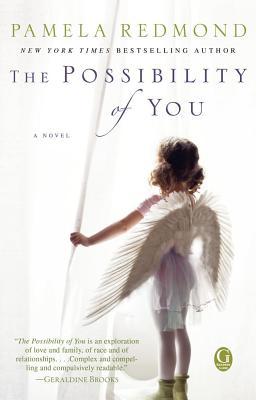
The Possibility of You – Pamela Redmond

Pamela Redmond admits in the  introduction to her novel The Possibility of You that she “had bookclubs in mind” when she wrote the book. And that’s exactly how this novel reads – like a book written to get women talking.

The novel tells the story of three women: Bridget, Billie and Cait and spans several decades. Cait’s present-day  story begins when she falls into bed with another journalist while they are on assignment to cover the story of a missing boy. Later, Cait discovers that she is pregnant and she decides she needs to locate her birth mother.

Bille’s story takes place in the 1970s. Orphaned after the death of her drug-addicted father, she heads to New York City with her best friend, Jupe. There she meets, for the first time, her eccentric and wealthy grandmother, Maude.

Going back even further is the story of Bridget, an Irish immigrant who works in Maude’s house caring for Maude’s young son, Floyd.

That these three women’s stories should be intertwined will come as no surprise to the reader. There isn’t actually anything surprising about that – or even all that original about their stories at all, actually. And I understand that that makes me sound sort of heartless. I think Redmond’s intent was that women of all stripes should find at least one of these women, and their stories of birth and death, to be compelling and relateable. The idea that women make sacrifices and mistakes isn’t riveting in and of itself, unless the characters are somehow sympathetic.

Maude was the most modern of the characters, a famous singer in her day, she married a much older man, had affairs which she openly bragged about and sent her maid, Bridget, to get birth control so she could sleep with her boyfriend without the complications of getting pregnant or having to get married. While she seems thoroughly forward thinking in 1915, at the end of the day, she is reprehensible and selfish.

The Possibility of You seemed like it should have added up to a lot more than the sum of its parts, but for me it just seemed like a cobbled-together story with all the talking points necessary for a good book club evening over a glass of wine.

My book club discussed the book last night and none of us were all that enamoured with it. In fact once we dispensed with the book’s central idea – how do women cope with giving up a child – we veered into a much more lively discussion of local politics. Despite the book’s positive reviews, we just weren’t moved by the novel or its characters.

Fifty Shades of Grey – E L James

E L James’s novel Fifty Shades of Grey has caused something of a stir in the literary world. First published as fanfiction called “Master of the Universe” under James’s pseudonym Snowqueen’s Icedragon (and, really, fanfiction writers need to give their pen names a lot more consideration before they choose them!), the original story was set in Stephenie Meyer’s Twilight universe. Yeah – there’s your first problem.

For those of you  unfamiliar with fanfiction, writers (of varying degrees of proficiency) pen stories based on characters and situations created by other writers.  Wikipedia has a competent explanation of its origins here. Really good fanfic writers can make their stories seem almost like canon. And really good fanfic is out there; but so is really, really bad fanfic. Back in the day I read (and wrote) a lot of it, so I can actually say this with some degree of authority.

Anyway, E L James publishes this wicked long Twilight-based fic – which I suspect is long gone from places where it was originally posted…although fans of the series can still be found gushing about it online. Someone (many someones, probably) suggested that she change the names of the characters and publish it — which James did, in eBook format and print on demand in June 2011 using  The Writers’ Coffee Shop. Word of mouth (ahem) fanned the flames and the rights to the book were purchased by Vintage. Suddenly, everyone was talking about Fifty Shades of Grey and weighing in on its subject matter. I talked a little bit about that here.

If you are a fic reader, I suspect that you’ll find Fifty Shades of Grey relatively tame.  Seriously. I’ve never read Twilight fic, but I’ve read the first two and a half books (and could barely manage that) and I’ve seen the movies (I have a 14- year-old daughter, although her literary tastes are, thankfully, more advanced than Twilight). Despite the name changes, there’s enough of Bella/Edward in Anastasia/Christian that even a casual reader will recognize them. They are, at the very least, completely derivative characters: she the winsome, beautiful-but-doesn’t-know-it, feisty yet innocent virgin and he is the over-the-top rich, fantastically beautiful (and like Meyer’s Edward, the reader has to be reminded of his beauty virtually every time he appears) control freak with a sad/complicated — or, as Christian himself says “fifty shades of fucked up”– past.

Bella Ana does her roommate a favour by going to interview the reclusive Christian for the university paper. She  literally falls into his office — she’s kinda klutzy — and we are to believe that Christian is instantly smitten. He tries to stay away– unsuccessfully. But does he really like her, or does he just recognize in her a submissive personality?  Because one of Edward’s Christian’s dark secrets is that he likes to tie women up. And other stuff. Stuff that requires a contract and a safe word.

If you’ve read fanfic, you’ve read this scenario a bazillion times. If you’re going to pay for it, it wants to be good. So, is Fifty Shades of Grey good? For me, it was okay. The writing is okay. The sex is okay. The characters are okay. It didn’t particularly shock me, nor did it, you know, rev my engine.

Ana is prone to saying: Holy fuck! and Holy shit! and Holy crap! a whole lot. A whole lot! She also channels her inner goddess in what I suspect is her way of trying to decide whether or not the amazingly mind-blowing orgasms make up for the occasional spanking. Ana and Christian say, “Laters, baby” to each other.  It’s weird. Noticing this stuff is always a sign that I am not really invested in the story. Oh come on, who reads a book like this for the story anyway?

I suspect that lots of people will find Fifty Shades of Grey shocking. I suspect a lot of the soccer moms who were reading it were clutching their pearls as they perspired daintily.  But, truly, it’s pretty tame. If you want the really good stuff, you can read it online. For free.
Nevermore – Linda Newbery

This is the kind of book I would have loved as a young reader. Plucky heroine, manor house in the English countryside, an intriguing mystery. The problem for me, of course, was that I solved the mystery early on – but that doesn’t mean the book wasn’t fun to read.

Twelve-year-old Tizzie and her mother, Morag,  have moved to Roven Mere, where Morag has taken a job as a cook. The huge estate is a constant source of intrigue, especially for Tizzie, who hopes that for once Morag will give up the wanderlust that has driven them from town-to-town most of her life.

Owned by Sir Rupert Evershall, but run by the crusty Finnigan, Roven Mere is always at the ready for the return of Sir Rupert and his young daughter, Greta.

“Is he very grand, Lord Rupert?” Tizzie asks Mrs. Crump, the housekeeper.

“Oh, I’ve never actually met him,” said Mrs. Crump. None of us have. Only Finnigan. We’re expecting him home in a week or two. Him and his family. Very exciting it’ll be, meeting them at last.”

Tizzie spends her early days exploring the house – which does seem to be in a constant state of readiness for Sir Rupert and Greta’s homecoming – making friends with Davy, Mrs. Crump’s grandson, and trying to manage her mother’s moodiness.

The book is intended for younger readers whom I am sure would be charmed by Tizzie, the novel’s mystery and Roven Mere itself. I certainly was.

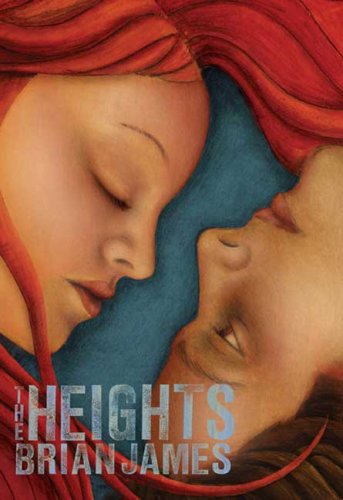
The Heights – Brian James

Ask anyone, I am a sucker for stories about star-crossed lovers. I love angst with a capital A. So the premise of Brian James’s YA novel The Heights would seem like a perfect fit for me. I mean the tagline was “theirs was a love that would last forever.”

Sadly, for me, this book was a pale cousin to its predecessor, Wuthering Heights. James sets his novel in foggy San Francisco where Catherine Earnshaw and her older brother, Hindley, live with their widowed father. Henry lives there too. He’s the orphaned Mexican boy Catherine’s father scooped off the mean streets and raised as his own. Now, years later, Mr. Earnshaw is dead and Hindley, a big shot lawyer, has come home to make sure Henry doesn’t get anything he’s rightfully entitled to (as Mr. Earnshaw preferred Henry to Hindley – and no wonder, Hindley is a misogynistic asshat.)

Hindley is also intent on splitting up Catherine and Henry, siblings on the cusp of admitting that their feelings for each other might be just a teensy bit more complicated than they should be. Of course, they never get around to admitting their feelings to each other before Hindley throws his oar in and muddies the waters.

Told in alternating view points, we see Catherine mooning over Henry and Henry mooning over Catherine – but nothing much comes of it, especially once Hindley banishes Henry to the basement of their huge house in The Heights (a tony neighbourhood in San Francisco) and sends him to a rough school way across town where Henry is constantly in danger of being beat up. Make no mistake, he’s tough and can handle himself – and without Catherine’s calming influence, he’s more likely to swing than swoon.

James tries at Bronte’s themes: obsession, class, revenge – but the problem with The Heights, for me at least, is that the novel’s contemporary setting makes the characters seem sort of inert. I never wanted them to be together because neither of them seemed all that sympathetic. And yes, you could make the same case for Catherine and Heathcliff – but Bronte’s sweeping tale somehow elevates those characters to mythic, romantic heights in a way James never quite manages.

I will be happy to encourage my students to read The Heights, but even happier if they go on to read Wuthering Heights.

The Slap – Christos Tsiolkas

If you are not easily offended, The Slap is one hell of a book. I just now randomly opened it and counted half a dozen raunchy references to sex and another half dozen expletives. Tsiolkas throws around the ‘c’ word like he’s talking about making a cup of tea. Yet, The Slap is a very human story, albeit one filled with polarizing characters.

At our book club discussion, our moderator (that’s the person who chooses the book) asked us to write the name of the most reprehensible character on a slip of paper. Then she asked us to name the most sympathetic character. She wanted our thoughts on paper before we began talking and were swayed by opposing opinions. Then we began to discuss the book, the premise of which is simple enough. A group of disparate characters gather at the Melbourne home of Hector and Aisha for a barbeque. Hector is a gorgeous Greek man and Aisha is from India and owns her own veterinary clinic. They have a couple young kids. There are cousins and parents and friends and co-workers in attendance. One of the guests slaps the face of four-year-old, Hugo, who was going to — so the slapper thought — bash his son with a cricket bat. Hugo’s parents press charges.

But The Slap isn’t really a book about what becomes of Hugo and his parents or how the trial plays out. Tsiolkas drops in and out of the lives of various characters (one at a time a la Jodi Picoult only WAY more sophisticated and profane), giving us snapshots of their lives and insight into their feelings about the slap. We don’t hear from every character at the bbq and, interestingly enough, some of the characters we do hear from seem like unusual choices. The beauty of the book, though, is that we do get to know the characters well, feeling empathy, admiration and repulsion in equal measure – sometimes all at once for the same character.

The Slap, as another member of our group pointed out, is quite unlike anything else our group has ever read…and that’s saying something considering we’ve been meeting for 13 years. It isn’t just the language — which takes some getting used to even for someone like me who has been known to drop the occasional ‘f-bomb.’ Several of us agreed that we had a visceral reaction to the book and the characters: hard drinking, racist, violent, irreverent and funny drug users – the whole lot.  The Slap is thrumming with energy. It is almost impossible to put down.

Tsiolkas has important things to say about love, though – not just the love between a man and a woman, but the love between friends,  and parents and children.

This, finally, was love. This was its shape and essence, once the lust and ecstasy and danger and adventure had gone. Love, at its core, was negotiation, the surrender of two individuals to the messy, banal, domestic realities of sharing a life together. In this way, in love, she could secure a familiar happiness.

The Slap is an excellent novel.

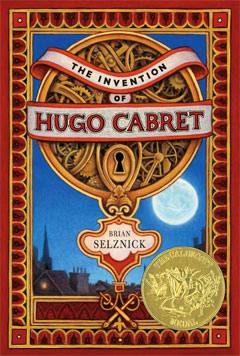
The Invention of Hugo Cabret – Brian Selznick

I bought this book for my 12 year old son for Christmas. He started reading it and then, as boys of his age often are – got distracted and left it on the table in the livingroom – where I picked it up and read it from start to finish.

The Invention of Hugo Cabret is  a straightforward tale, elevated because of its narrative style. Selznick tells the story in words and full page illustrations – 284 pages of them.

Twelve-year-old Hugo lives in the attic of the Paris train station. He lives there because his father has died and an elderly uncle has claimed him. The uncle is responsible for keeping all the clocks in the station running perfectly and he teaches Hugo to do the same. But when the uncle disappears, Hugo is left to fend for himself.

The Invention of Hugo Cabret is a book that perfectly marries text and images. Selznick stops his written narration, often several pages at a time, and lets his black and white drawings take over. The pictures tell the story, not just supplement the words. It’s brilliant really.

The story revolves around an automaton – a self-operating  machine with human actions- a mysterious man who operates a toy store in the train station, a young girl and a famous French film director.  The joy of how these things connect is for the reader to discover. It’s quite magical.

You can read more about the book here.

31/365

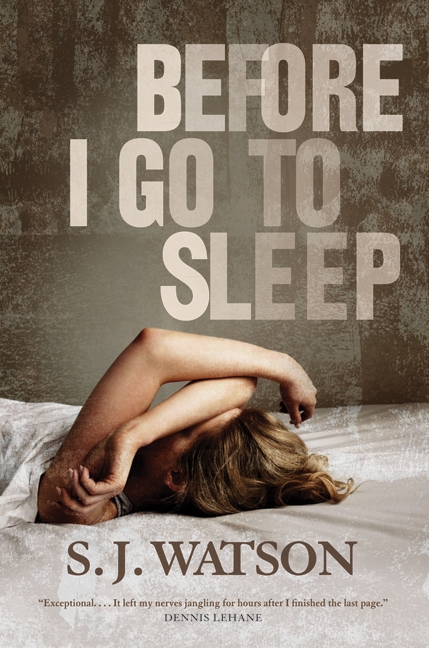
Before I Go To Sleep – SJ Watson

What are we, if not an accumulation of our memories?

Memories are a bit of a problem for the protagonist of SJ Watson’s debut novel Before I Go To Sleep. Twenty years ago, Christine was in a serious accident that left her without the ability to retain memories. That means every morning she wakes up in a room she doesn’t recognize, with a husband she doesn’t remember and in a body she’s troubled to discover is twenty years older than it should be. She muddles through the day, trying to piece her fractured life back together – with the knowledge that she’s going to have to do it all over again the next day. That’s right: she goes to sleep and her brain erases all the memories of the day.

Before I Go To Sleep was my book club’s first read for 2012 and was also my pick. We had a lively discussion about the book’s merits and I am happy to say that with a few minor caveats, the women in my group (except for one) generally enjoyed the book.

The general concensus was that Watson did an admirable job of writing a convincing female – not an easy task, I don’t think. We had a little bit of a debate about the novel’s structure. At least one person was put off by constantly having to re-read the story, rediscovering memories as Christine did. I actually think that it was deftly handled. If I am feeling frustrated by having to hear stuff over and over, imagine how trapped by her circumstances Christine must be feeling. 🙂

I alo think Watson was striving to write something more than just a thriller – although he did that quite handily. I think he was trying to say something about memory and how our memories shape us. It’s a fear of mine, really, to be old and not know my children or the other people who have been important to me. Christine’s situation means that she is forced to learn painful information over and over again – and it’s heartbreaking.

The book had me in its iron grip until the last 50 or so pages- when I have to say that it fell apart for me. It wasn’t that I didn’t buy a certain part of it (and, really, it’s  almost impossible to talk about without giving anything away), let me just say this: too much convenient exposition. Too neat.

That said, Before I Go To Sleep was a great way to kick off our 12th reading year.

SJ Watson talks about the book and his writing here.

21/365


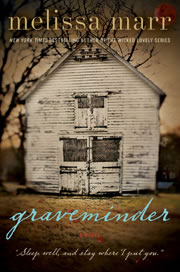
Graveminder – Melissa Marr

Melissa Marr’s first novel for adults (she’s better known for her YA novel series Wicked Lovely) was my first read in 2012. Actually I started Graveminder  in 2011 and was hoping to get it finished but I just couldn’t manage it. Graveminder was recently voted Best Horror novel at Goodreads, but it’s been on my radar for a few months and I was really looking forward to reading it.

So, so disappointed.

The premise of Graveminder is actually quite intriguing. When Rebekkah Barrow’s grandmother, Maylene, is murdered, Rebekkah comes back to the town where she grew up. Claysville is not like other towns; it has strange traditions, particularly where the dead are concerned.

Matlene was a graveminder.

If anything happens to me, you mind her grave and mine the first three months. Just like when you go with me, you take care of the graves. …Promise me.

Rebekkah, as it turns out, is a graveminder, too. Her job – which she knows nothing about until she returns to Claysville, is to guard the graves of the dead.

Her return to Claysville is complicated by her on again off again relationship with Byron,  the town’s undertaker.  (Graveminder, undertaker – sounds like a couple wresters,eh?) Byron was Rebekkah’s sister’s high school sweetheart until tragedy struck and now Rebekkah just can’t seem to get it together where Byron’s concerned. These unresolved feelings make up a large part of the novel’s energy – but not in a good way.

None of Graveminder actually lives up to the promise of the plot.  The writing is generally clunky, the characters vacillate between annoying and insipid and many promising plot threads are never satisfactorily resolved.  Rebekkah continually pushes Byron away and they have the same conversation over and over – like they are 12 – drove me c-r-a-z-y.  Their interaction was not adult in any way.

Graveminder wasn’t scary, either. The premise was: the dead must be tended or maybe they’ll come back and if they do – watch out. Also, Marr has created an intriguing ‘other’ world, a place where the dead go and live. The thing is, it feels like she’s dropping the reader into the middle of a story – where questions are asked but never answered.

If there’s a sequel coming, I won’t be reading.

11/365

The Last Night I Spent With You by Mayra Montero

The Last Night I Spent With You is a slim volume, only 115 pages. Translated from the Spanish, Montero’s novel tells the story of Celia and Fernando – a middle-aged couple on a cruise. Their only daughter has just been married and Fernando’s friend, Bermudez, has sagely offered this advice: “women lose their inhibitions on ships.”

Actually, it seems as though everyone does.

Both Fernando and Celia are trying to come to terms with suddenly being cut loose from the strings that tied them to their daughter and each other. Fernando, too, seems to be experiencing a bit of a midlife crisis: death is looming. As their ship sails and docks, Fernando falls into an affair with Julieta, a middle-aged passenger.  For her part, Celia reminisces about an affair she’d had several years ago, when she’d been taking care of her ailing father.

Everything about this voyage is sexually charged in a way, one gathers, things haven’t been for several years between this married couple.

At last we were alone, it was true, after almost twenty-three years of winters and vacations, springs and birthdays, when Elena had been the axis of our lives. Elena growing up, becoming pretty, becoming taller than Celia, much more slender, infinitely more flirtatious. Our daughter Elena.

The Last Night I Spent With You is graphic and the writing is – despite it being a translation – good. The characters are selfish and often  behave inappropriately. It’s hard to say what they are searching for. It’s even harder to say whether, by the novel’s end, they’ve found it.