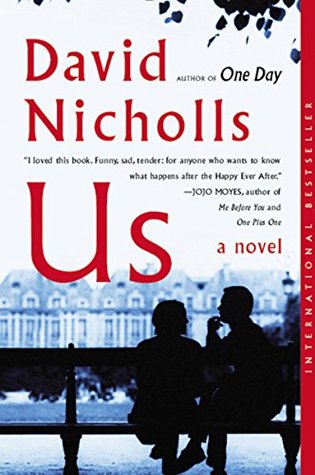
Us – David Nicholls

David Nicholls (One Day, Such Sweet Sorrow) is a master at peering into all the hidden corners of relationships. In Us, he tells the story of Douglas and Connie and their seventeen-year-old son, Albie. One night, Connie wakes Douglas up and drops a bombshell: “I think I want to leave you.”

Douglas and Connie have been married for two decades, a happy marriage, Douglas (our narrator) tells us, but certainly not without its problems. Connie’s news comes just as the family is about to set off on a “Grand Tour” of Europe in advance of Albie heading off to university. They decide to go anyway, and Douglas takes this as a hopeful sign; perhaps he will be able to win back his wife’s affection and repair his slightly wobbly relationship with Albie.

The fact was I loved my wife to a degree I found impossible to express, and so rarely did. While I didn’t dwell on the notion, I had presumed that we would end our lives together.

Douglas, a scientist, and Connie, an artist, seem like an unlikely pair, really. Douglas’s narrative mines their origin story (they met at a dinner party thrown by his younger sister) for all the details which will help the reader understand their relationship and Douglas, wisely, doesn’t gloss over the fact that he is often pedantic and, perhaps, less empathetic than others. Maybe it is the scientist in him, but Douglas doesn’t always see the value in throwing caution to the wind. For him, everything is a teachable moment, and it’s caused some friction with his family over the years. I could certainly see how living with him, especially given that Connie is much more free-spirited, could wear one down.

So the family go off on their tour of the great museums of Europe and it’s a bit of a bust from the get go. Douglas has the whole thing planned down to the minute, but of course it’s impossible to plan for every contingency. Still, he tries.

1. Energy! Never be ‘too tired’ or ‘not in the mood.’

2. Avoid conflict with Albie. Accept light-hearted joshing and do not retaliate with malice or bitter recriminations. Good humour at all times.

3. It is not necessary to be seen to be right about everything, even when that is the case.

Poor Douglas. He really can’t help himself. But he’s not a jack ass. He’s actually quite a lovely guy and he really does try, but it doesn’t take long before the trip goes sideways. His willingness to do whatever it takes to fix things, including his marriage, (often leading to quite comical incidents) is one of the great joys of Us.

The other joy is watching this family – all of whom love each other deeply but imperfectly – try to figure things out. The potential dissolution of a family – all that history – isn’t easy, and watching Douglas bare his scientific soul to the idea of being without Connie and having damaged his relationship with Albie beyond repair is really quite magnificent. I read one review that suggested that Douglas was too reticent about sharing personal details, often times the scene fades to black before too much is revealed, but I think this is exactly the reason Connie felt she had to leave him.

Us is funny (although there were instances when I felt it was trying just a tad too hard to get a laugh), and well-written. I loved visiting these European cities. The characters felt like real people. The ending was – well, you decide.
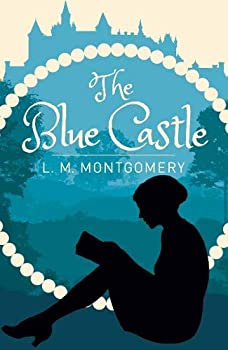
The Blue Castle – L.M. Montgomery

I haven’t read a Lucy Maud Montgomery book for probably 50 years – and, sadly, that’s not an exaggeration. Of course, like many Canadian women, I read and fell in love with Anne of Green Gables when I was a kid, but I haven’t ever revisited Anne’s island. The Blue Castle is the only novel Montgomery wrote which is not set in her beloved Prince Edward Island, and it’s only one of two adult novels she wrote.

Valancy Stirling lives with her widowed mother and Cousin Stickles in Deerwood, Ontario. Her life is joyless, and her mother, cousin and extended family are overbearing and critical. Every day is like the day before, and there is no hope that anything will ever change. What stings most of all is that “she had never had a chance to be anything but an old maid. No man had ever desired her.”

There is one bright spot in Valancy’s life and that is her “Blue Castle”.

Valancy had lived spiritually in the Blue Castle ever since she could remember. She had been a very tiny child when she found herself possessed of it. Always, when she shut her eyes, she could see it plainly, with its turrets and banners on the pine-clad mountain height, wrapped in its faint, blue loveliness, against the skies of a fair and unknown land. Everything wonderful and beautiful was in that castle.

A trip to the doctor changes everything for Valancy. Suddenly she stops allowing her family to bully her and their reaction to her spirited responses is quite comical. She packs her bags and moves out to Old Abel Gay’s, the local handyman and town drunk, whose daughter, Cissy, a former classmate of Valancy’s, is dying. No one can quote believe it. They think she’s gone quite mad. But Abel is kind to her and Valancy finds a friend in Cissy. Suddenly the whole world opens up to Valancy, and truthfully, almost 100 years after The Blue Castle was published, her journey to independence is a delight.

If, like me, you haven’t read Montgomery in forever, I highly recommend this one. It’s charming, it’s funny, it’s sweet and, in many ways, Valancy is a modern heroine. I loved my time with her.

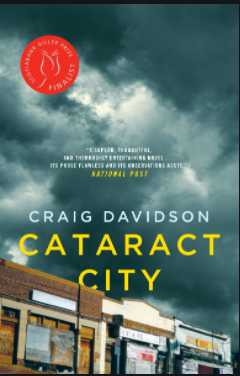
Cataract City – Craig Davidson

Although I can’t say the subject matter of Canadian writer Craig Davidson’s Giller-nominated novel Cataract City was necessarily my thing (boys lost in the woods, greyhound racing, dog fights, bare knuckled fist fighting, etc), I found myself sinking whole heartedly into this story of two best friends: Owen Stucky and Duncan Digs. I think it’s because Davidson (who also writes horror novels under the name Nick Cutter, the only one of which I’ve read is The Troop) is such an excellent writer and his stories are so filled with nostalgia and melancholy and hope that it’s impossible not to really care about his characters even though their shenanigans might not be the usual fare for a woman in her late middle age.

Craig and Duncan live in Cataract City (aka Niagara Falls), a city which they seem to love and loathe in equal measure. When the novel opens, Duncan is just getting out of the Kingston Penitentiary after serving 2912 nights. Of those nights, Duncan tells us, “two were the longest: the first and the last.” When he gets back to his parents’ house, he pries up a loose floorboard in his bedroom closet and from the cavity under the floor, takes out an old cigar box, filled with the treasures of his youth. The mementos spark his memories and the novel begins its meandering narrative, told in the voices of both Duncan and his childhood friend, Owen.

As described by the boys, Cataract City is a place where dreams go to die. Owen says “If you grew up in Cataract City and earned a university degree, chances are you left town. If you grew up in Cataract City and managed to finish high school, chances are you took a job at the dry docks, Redpath Sugar, the General Motors plant in St. Catherines or the Bisk.” Both the boys’ fathers work at the Bisk, the Nabisco plant, and their “dads carried the smell of their lines home with them.”

The city of your birth was the softest trap imaginable. So soft you didn’t even feel how badly you were snared – how could it be a trap when you knew its every spring and tooth?

Duncan and Owen meet when they are ten; even though they “both lived on Rickard Street and went to the same school” they had never spoken to each other. When another boy tackles Owen one day in the playground, Duncan comes to his rescue and the two boys bond over their shared love of wrestling. It’s wrestling that gets the boys into their first scrape.

Cataract City bounces back and forth between then and now, changing narrators effortlessly. Although the boys take different roads in life (Owen becomes a cop after a knee injury squashes his chances to play professional basketball and Duncan, well, he ends up in jail), the two never stop caring for each other. The melancholic nostalgic seeps into Davidson’s story and it’s hard not to be reminded of days gone by when even the characters long to

be kids again, just for a while. Revoke for just one day our breaking bodies and tortured minds. I would have given anything to spend one more day as we once had, even if it was one of those piss-away afternoons reading comic books in Owen’s basement while the rain clicked in the downspout like marbles.

I loved the journey these two take, some of it literal, some figurative. I loved the insights into friendship and family and love and memory. I loved all the references to Canadian things (The Beachcombers and Rowdy Roddy Piper). I loved the struggle to figure out what it all means in the end.

An instant in time, measurable in seconds, that acts as the hinge for everything you’ve ever done. Everything feeds into that moment: your backlog of experience and behaviours determine how you enter that moment and how you’ll walk away from it afterwards. Every way you’ve ever been hurt, every grievance nursed, every secret fear, those moments where you’ve stood up or stepped down and all the love in your body – it all matters when you reach the Point. It is all brought to bear.

The only other Davidson novel I’ve read is The Saturday Night Ghost Club and I really loved it. I will make a concerted effort to read his other work, for sure. Highly recommended.

A Rip in Heaven – Jeanine Cummins

It was only a few months ago that I read Jeanine Cummins’s American Dirt, a novel that, though not without controversy, I could not put down. I had the same experience with her memoir/true crime A Rip in Heaven. I was about 40 pages along when I settled in to read the other night and I finally had to turn off my light at 2 a.m. It was a school night and that’s way past light’s out for me, but I just couldn’t stop reading it.

In 1991, 16-year-old Cummins, her younger sister, Kathy, 14, and older brother, Tom, 18, are vacationing in St. Louis with their parents. Both sides of the family are there, so the siblings have lots of cousins to hang with and it’s a happy time. Tom, in particular, has developed a close bond with his cousins, Julie and Robin, and on his last night in town, he sneaks out to visit the Old Chain of Rocks Bridge, where Julie, an aspiring poet, has left some of her poetry by way of graffiti. Mostly the cousins don’t want their time together to end.

Although it was never officially accredited as a landmark, the Old Chain of Rocks Bridge was widely recognized as one, and the city of Madison was loathe to have it torn down. A couple of decades came and went while the old bridge stood silently straddling the Mississippi and gathering rust. […] Local affection for the bridge, combined with the enormous price tag of demolishing it, kept it standing. By 1991 the bridge, though structurally sound, was in a terrible state of disrepair, and it had become a favorite local hangout for teenagers and graffiti artists from both banks.

It is on this bridge, sometime after midnight, that the trio encounter 23-year-old Marlin Gray, a smooth-talking, good looking, layabout; Daniel Winfrey, “an awkward scrawny kid,”; Reginald Clemons, “a shy, and quiet man of nineteen” and Antonio Richardson, Clemons’s cousin, who was “just plain bad news.” At first these four seem relatively benign to the cousins, but it doesn’t take long for things to take an horrific turn. Tom and his cousins end up in the Mississippi; Tom is the only survivor.

The actual crime is so mindless and so awful, it’s almost hard to believe. It turns out, that’s part of the problem for Tom. When he is finally able to get help, the cops don’t believe his story. The cops employee ever dirty tactic in the book to get him to admit to their version of events and he is finally arrested and charged with two counts of first degree murder.

Cummins writes A Rip in Heaven in the third person, adopting her childhood nickname, Tink, as a way to somewhat distance herself from this story, which is both devastating, and riveting. Like I said, I couldn’t put the book down and had to force myself to turn the light out so I wouldn’t be a hot mess at school the next day. The book follows Tom’s time in police custody and the subsequent trials, which Cummins has pieced together from court documents, police records and interviews. It is also a plea that we not forget the victims in cases such as these. Cummins acknowledges that “As a society, we have a certain fascination with murder and violence. […] We want to know why atrocities happen; we want to understand the causes of wickedness.” But as Cummins points out, “The dead can’t tell their own stories,” so often the perpetrators of the crimes find themselves at the center of attention. This was also the case for the four young men involved in this case.

By all accounts, Julie and Robin were amazing young women, and their deaths left a hole in the lives of all those who loved them: a rip in heaven. Cummins has managed to capture the trauma, the drama, and the way this family banded together to survive it. It makes for compelling reading.

My Name is Lucy Barton – Elizabeth Strout

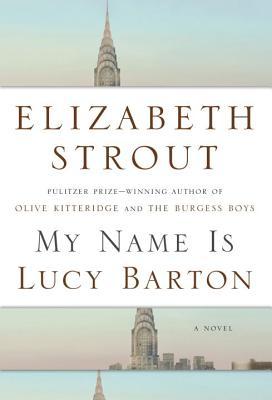
Lucy Barton is recovering from surgery in a New York City hospital with a view of the Chrysler Building. She’d gone into the hospital to have her appendix removed and ended up staying for nine weeks, fighting an infection that nobody seemed able to identify. During her time in the hospital, her mother comes to stay for a few days and as the two women sit together, parts of Lucy’s childhood float to the surface. This is the premise of Elizabeth Strout’s novel My Name if Lucy Barton. Last year I read Olive Kitteridge, a book which had been languishing on my tbr shelf for years. I loved it. I really enjoyed this book, too. It’s a quiet book and as the story moved along, it seemed to build in intensity.

Lucy and her mother have a strained relationship; in fact, they have not spoken in several years, but when she shows up at Lucy’s bedside “using my pet name, which I had not heard in ages, [it] made me feel warm and liquid-filled, as though all my tension had been a solid thing, and now was not.”

For five days, Lucy’s mother sits with her and the two talk of the past, a past which hadn’t been necessarily kind to them.

We were oddities, our family, even in that tiny rural town of Amgash, Illinois, where there were other homes that were run-down and lacking fresh paint or shutters or gardens, no beauty for the eye to rest on. […] We were told on the playground by other children, “Your family stinks,” and they’d run off pinching their noses with their fingers; my sister was told by her second-grade teacher – in front of the class – that being poor was no excuse for having dirt behind the ears, no one was too poor to buy a bar of soap.

Lucy gets out, though. A teacher recognizes Lucy’s love of reading and provides her with lots of books to read. The books make Lucy feel “less alone. This is my point. And I thought: I will write and people will not feel so alone!” Despite her insecurities, Lucy takes herself, her studies and her writing very seriously and earns herself a full-ride scholarship to college. This is the beginning of Lucy’s journey of self-discovery and also the beginning of her exile from her family. It is only her mother’s arrival at her bedside which makes her re-examine her roots and she is telling this story from many years in the future when she actually has the perspective necessary to understand.

As Lucy and her mother share stories about the people of Amgash, Lucy also looks more closely at her memories of her family and her own strengths and weaknesses as a person. These observations are the heart and soul of Strout’s novel.

It interests me how we find ways to feel superior to another person, another group of people. It happens everywhere, and all the time. Whatever we call it, I think it’s the lowest part of who we are, this need to find someone else to put down.

I think My Name is Lucy Barton is a book that would benefit from a second read. It really asks the reader to look closely at their own lives, their harsh judgments of others, their estrangements, the second-chances we’re offered and often stupidly refuse. When Lucy and her husband divorce, Lucy’s adult daughter tells her “when you write a novel you get to rewrite it, but when you live with someone for twenty years, that is the novel, and you can never write that novel with anyone again!”

I think this is a novel that is deceptive, now that I’ve tried to capture my thoughts about it here. Quiet, yes, but powerful in the way that it examines one woman’s story. And that’s what we all have, our own stories.

The Girls Are All So Nice Here – Laurie Elizabeth Flynn

So. Much. Fun.

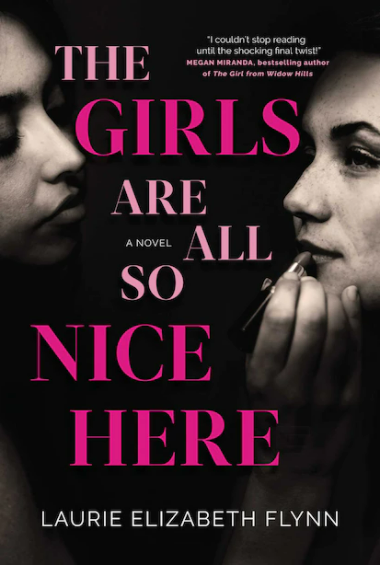
Ambrosia (Amb) Wellington has just received an invitation to attend the tenth reunion of her Wesleyan graduating class. When the email arrives, Ambrosia deletes it immediately. As she does the second email. Then she gets a note in the mail: “You need to come. We need to talk about what we did that night.” The who and what implied in this message is at the centre of Laurie Elizabeth Flynn’s thriller The Girls Are All So Nice Here. Flynn’s first novel for adults (she has written three novels for young adults) is pretty much un-put-down-able. I started it one night when the book I was reading just wasn’t floating my boat. I read 100 pages and only stopped because it was a school night and I needed to turn off my light.

The novel flips back and forth between now, Amb in the present day, an executive at a NYC PR firm and then, when Amb was an awkward college freshman looking for a way to fit in. She arrives at her college dorm, Butterfields, and meets her new roommate, Flora, and although they’d been emailing back and forth over the summer, Amb seems to bristle when she meets Flora in person. She thinks about what she’ll say about her when she texts her high school bestie, Billie, recalling how they’d studied the pretty girls in high school, peeling “them like overripe fruit in marathon gossip sessions to lessen the sting of not being invited to their parties.”

Flora isn’t a mean girl, though. She’s kind and thoughtful and leaves cheerful, positive post-its on the doors of the other girls in their dorm. Her life at home, despite her wealth, isn’t perfect. Her long-term boyfriend, son of her mother’s best friend, is attending Dartmouth, three hours away. So the friction isn’t instigated or perpetuated by Flora; Amb’s insecurities are the problem. The low-key cool she’d cultivated back home seems misplaced here where “the girls seemed casually beautiful in a way that felt unachievable.” Then she meets Sloane (Sully) Sullivan, a girl with “a face that instantly held everybody’s attention.”

To timid, trying-too-hard Amb, Sully seems fearless. And she is, I guess, if your idea of fearless is someone who drinks, does drugs, and sleeps with just about anyone she crosses paths with. For whatever reason, Amb finds that she will do pretty much anything to get herself on Sully’s radar because when Sully “fixed her gaze on me. It was like being anointed.” Sully’s roommate, Lauren, warns Amb that Sully has “zero attention span”, but Amb is intrigued. Sully isn’t nice though, far from it, and she warps Amb’s insecurities and deep-seated desire to fit in into something toxic.

The Girls Are All So Nice Here, beyond being a page-turning thriller, has lots to say about female relationships. If you were ever on the outside looking in, you’ll relate to these girls. Even when Amb realizes that she’s being manipulated, Sully’s approval means more to her than doing the right thing. And the right thing might have prevented a tragedy which destroys more than one life. The book also has lots to say about a culture that still seems to pit women against each other. Instead of looking out for each other, these girls look for ways to undermine each other. It’s like Mean Girls on steroids.

“Our reign was short and bloody,” Amb recalls. She’s not lying.

Highly recommended.

Sing, Unburied, Sing – Jesmyn Ward

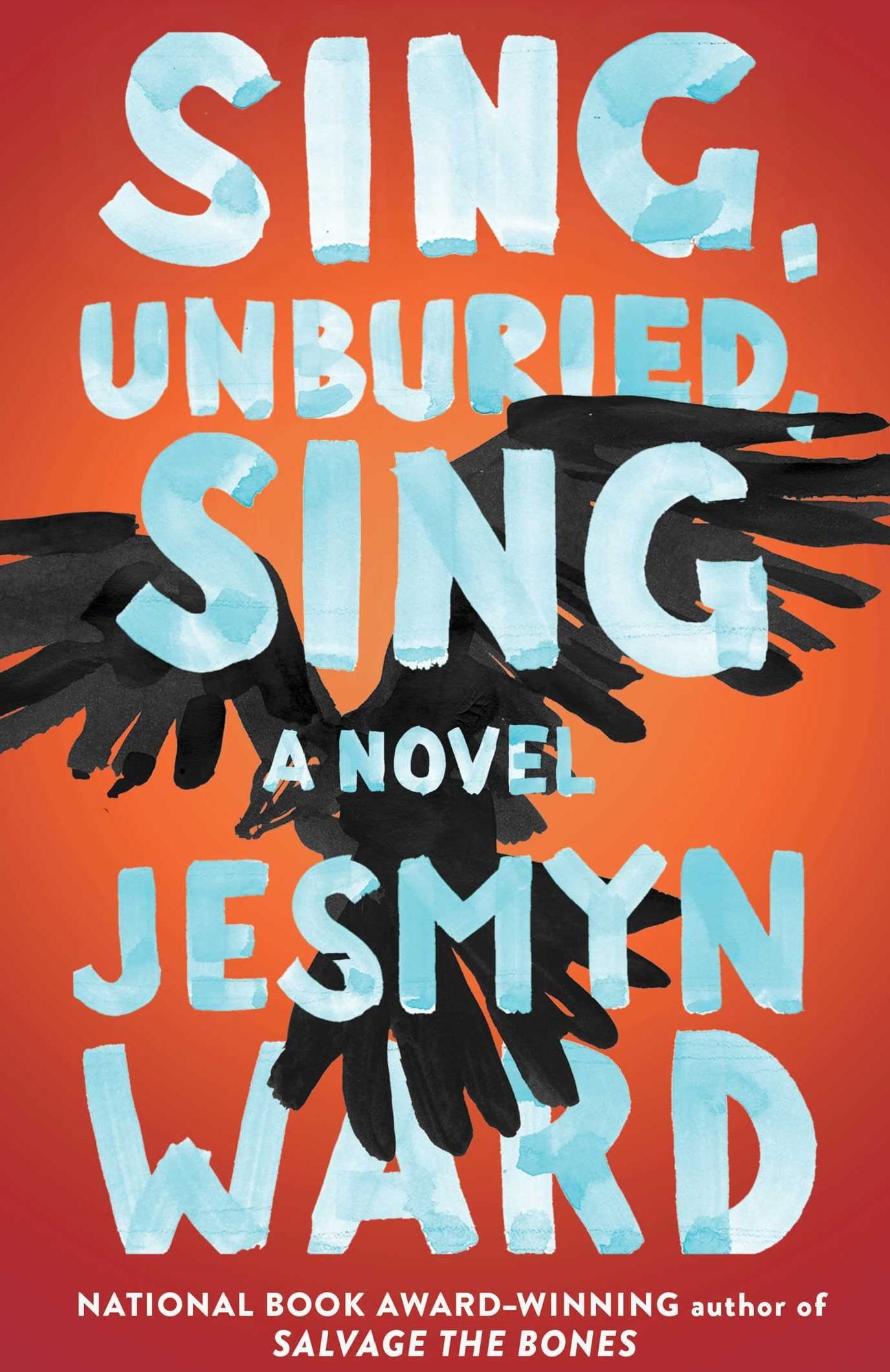
Jesmyn Ward’s 2017 award-winning novel Sing, Unburied, Sing is the kind of book you can’t really put down once you pick it up. Partly it’s because the real action takes place over a very short amount of time and is so nerve-wracking I just couldn’t bear to stop reading, and partly it’s because the narrators in the book, Jojo and his mother, Leonie, and Richie, a boy who died years before the action of the story, are just too compelling to turn away from.

Jojo lives with his mother, his little sister, Kayla, and his maternal grandparents, Pop and Mam, in rural Mississippi. It’s Jojo’s thirteenth birthday when the novel begins, and Jojo’s first task of the day is to help his grandfather slaughter a goat for his birthday barbecue. Jojo says “I like to think I know what death is. I like to think that it’s something I could look at straight.” Oh, he’ll be looking at it straight, all right, and so will the reader. Ward doesn’t shy away of any of the details and so you’ll know pretty much from that opening scene that violence is part of the deal in this book.

This family has its share of troubles. Mam is currently bedridden, ravaged by cancer; Leonie is addicted to drugs; Michael, Jojo’s white father is currently in prison. Jojo depends on himself and his grandfather, who is loving albeit taciturn. Pop demonstrates his affection for Jojo by telling him stories, stories about his childhood and stories about his own incarceration.

Sometimes he’ll tell me the same story three, even four times. Hearing him tell them makes me feel like his voice is a hand he’s reached out to me, like he’s rubbing my back and I can duck whatever makes me feel like I’ll never be able to stand as tall as Pop, never be as sure.

Jojo’s main concern is Kayla, who is only three. He no longer depends on his mother and, in fact, thinks of her as Leonie. “It was a new thing, to look at her rubbing hands and her crooked teeth in her chattering mouth and not hear Mama in my head….”

When Michael is due to be released from prison, Leonie decides that she should make the journey to the prison to pick him up. She also thinks it would be a great idea to bring Jojo and Kayla, and her co-worker, a white woman named Misty whose boyfriend, Bishop, is also serving time. It’s hot, Kayla is almost immediately car sick, and the whole journey just seems fraught with danger.

Both Leonie and Jojo see ghosts. Literally. Leonie sees the ghost of her brother, Given, who was killed in a hunting accident fifteen years ago. Given was, by all accounts, destined for greatness: a talented athlete, popular and well-liked. Jojo sees Richie, a young boy who was incarcerated with Pop. In some ways Richie and Given are a manifestation of the guilt carried by those still living, but at the very least they are indicative of the way we are shaped by our pasts. Can we blame Leonie’s vices on the loss of her brother? Can we, at least, empathize with her? I’m not sure I did, she was just so negligent, but I was wholly invested in Jojo and found it impossible not to worry about him the entire time.

Sing, Unburied, Sing tackles the prickly topic of racism, too. Michael’s parents are make-no-bones-about-it racists. Leonie has talked to them exactly four times and is well aware that Michael’s father, Big Joseph (after whom Jojo is named) would rather “hang up in my face […] than speak to me, the nigger his son had babies with.” When a white cop pulls them over, my heart was in my throat the whole time. This is a story that carries the weight of hundreds of years of racism on its shoulders. My white privilege, I know, makes me blind to it.

This is a must-read book.

We Begin at the End – Chris Whitaker

Chris Whitaker’s novel We Begin at the End was all over my Twitter feed and the praise was copious, so I did what any booklover does, I ordered the book. Regular readers will know that having possession of a book doesn’t necessarily mean it’s going to land on my bedside table (which is where my currently-reading books live), but this one called to me. I needed to know what all the fuss was about. I needed to know if it was deserving of the fuss.

Hell, yeah.

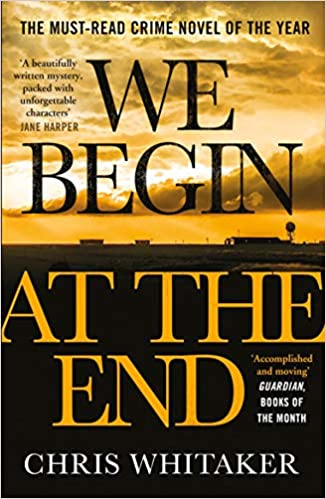
Whitaker’s mystery/coming-of-age/noir novel concerns the fates of a whole cast of characters. It starts in the past as the town of Cape Haven, California, including Walk and his best friend Vincent King, are out looking for the body of Sissy Radley, younger sister of Vincent’s girlfriend, Star. Flash forward thirty years: Vincent’s been languishing in prison, Walk is now the town sheriff, and Star’s the messed-up mom of 13-year-old Duchess and 5-year-old, Robin.

Walk has made it his mission to look out for Star and her kids. Star’s a bit of a hot mess. She and her kids live in poverty, and Star spends a lot of time self-medicating with booze and pills. Duchess thinks part of her mom’s difficulty stems from what happened to Sissy all those years ago. “Duchess had got the bones of the story over the years, from Star when she slurred it, from the archive at the library in Salinas.”

When Vincent is released from jail he returns to Cape Haven and sets about restoring his family home, which just happens to be on a prime piece of waterfront. Dickie Darke, the local badass and sometime consort of Star, wants Vincent’s land badly, but Vincent isn’t interested in selling. He mostly just wants to be left alone. Vincent’s freedom is short lived though, and he’s soon back in jail for another crime, and this crime is the mystery which threads itself through the novel. Vincent insists on Martha May, another childhood friend and Walk’s old girlfriend, to represent him even though she’s not a criminal lawyer. That brings Martha back into Walk’s orbit after a long absence.

There are lots of surprises in Whitaker’s novel and some of the best ones are saved for the end, but it isn’t really the mystery that kept me turning the pages, it’s the characters.

Walk is loyal and dogged, and he’s spent his whole life in Cape Haven, where he knows everyone, Cape Haven is a quiet coastal town and he’s never even really had occasion to draw his gun. Vincent is taciturn and patient. Star is a hot mess. Even Dickie Dark is complicated. Minor characters, Milton, the town butcher and head of the local neighbourhood watch, Cuddy, the guard at the prison where Vincent has spent the last thirty years of his life, and Hal, the children’s grandfather, are compelling. But it’s Duchess who draws you in

If Duchess is perhaps a tad too precocious, she’s to be forgiven. She’s been dealt a rotten hand. And when circumstances land her and Robin in Montana with the grandfather they don’t know, her life is upended again. It takes every ounce of energy she has to rein herself in, and she’s really only willing to do that for her little brother. She doesn’t let people get close; it takes patience and perseverance to get past her defenses. Luckily, there are people in her life willing to keep trying. I loved her. She reminded me of Turtle, the protagonist of Gabriel Tallent’s stellar debut My Absolute Darling. This is a compliment, trust me.

There are a lot of moving pieces in Whitaker’s novel, and a lot of characters, too. There has been some criticism of his prose and the short hand he uses. I don’t read westerns and while much of this novel feels like a western, I chalked Duchess’s odd vernacular up to bravado: “I am the outlaw Duchess Day Radley” she tells more than one adversary. Perhaps odd coming from a kid from California, but not necessarily from a smart kid looking to build a protective shield around herself and those she loves. As for the novel’s prose, once I settled into Whitaker’s world, the writing just seemed spare. I think it suited the story, laid it bare.

This is a great book on so many levels. Read it for the mystery. Read it for the characters. Read it for the gut punch at the end. But read it!

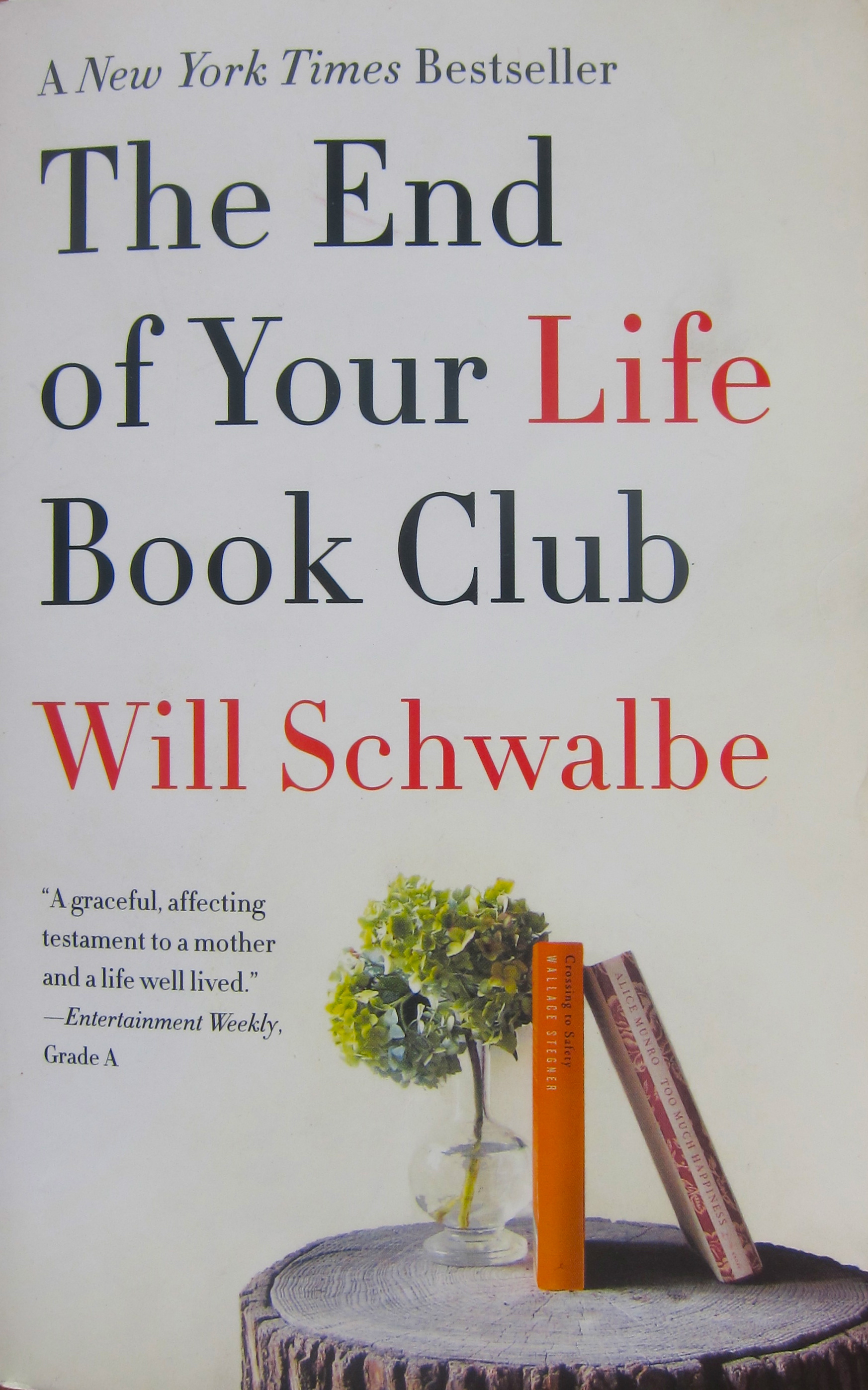
The End of Your Life Book Club – Will Schwalbe

Will Schwalbe’s memoir, The End of Your Life Book Club, is about the last couple of years before his mother’s death from pancreatic cancer and it is a beautiful tribute to family, faith, hope, and books. Always books. This book has been languishing on my tbr shelf for ages and it’s one of those books that when I finished, with a satisfied sigh and perhaps a tear or two, I thought I wish I’d picked you up sooner. I guess Schwalbe and his mom, Mary Anne, might say that the book found me at the right time.

I imagine Schwalbe’s family as sort of East Coast aristocracy, without the snobbish bits. His parents both worked in academia, and then his father got into concert management. Schwalbe describes his mother as “the hub” of the family.

Mom didn’t confine herself to coordinating our lives. She was also helping to coordinate, almost always at their request, the lives of hundreds of others: at her church at The Woman’s Commission for Refugee Women and Children (she’d been the founding director), at the International Rescue Committee (she’d been board staff liaison and founded the IRC’s UK branch), and at all the other myriad organizations where she’d worked or served on boards.

Mary Anne is clearly a force to be reckoned with and her cancer diagnosis is a setback not a death sentence. She’s diagnosed in 2007, first with hepatitis, and then eventually with pancreatic cancer. Mary Anne’s oncologist calls her cancer “treatable but not curable”, and these words offer Mary Anne and her family (her husband, and Schwalbe’s brother and sister) hope.

The Schwalbe family have always been readers and soon Will and his mother have formed a book club of two, reading and discussing a variety of books over the long hours at Memorial Sloan-Kettering in NYC, where Mary Anne gets her hope by way of chemotherapy.

Our book club got its formal start with the mocha and one of the most casual questions two people can ask each other: What are you reading?

Beginning with Wallace Stegner’s 1987 novel Crossing to Safety, a book which I read many years ago, the mother and son read their way through classics, non-fiction, popular fiction and do what any book lovers do — debate, deconstruct and discuss. They don’t always agree, but they appreciate each other’s choices, and as any reader knows many a great discussion can be had even if you didn’t necessarily love the book. These discussions also allow them to share their lives with each other in a meaningful way. Schwalbe is hyper aware that he knows his mother as ‘mom’, the person who kept his world on its axis, but perhaps he doesn’t know her quite so well as Mary Anne, the woman. This is his opportunity.

Mary Anne’s faith is the constant in her journey, and although Schwalbe doesn’t share her certainty about God and the afterlife, he is buoyed by hers. Mary Anne constantly sees the upside. When hearing of a friend’s Alzheimer’s diagnosis she says “I feel so lucky […] I can’t imagine what it would be like not to be able to know the people I love, or to read, or to remember books I’ve read or to visit my favorite places and remember everything that happened there, all the wonderful times. “

The End of Your Life Book Club is not as maudlin as it might sound. It’s a beautiful book that reminds us of the value and irreplaceable nature of family, and reminds us how important it is to cultivate relations with the people in our lives. Mary Anne struck me as the kind of woman who looked you in the eye when she talked to you. As Schwalbe reminds us “we’re all in the end-of-our-life book club, whether we acknowledge it or not; each book we read may well be our last, each conversation the final one.”

Highly recommended.

Hamnet & Judith – Maggie O’Farrell

Very little is actually known about William Shakespeare, the man (I believe is) responsible for writing some of the most beautiful poetry ever committed to paper. His plays are still produced some 400 years after his death. He is a mainstay of English Language Arts curriculums the world over. In fact, I am just beginning to look at Romeo and Juliet with my Grade 10 classes. It is a play I love to talk about and I can totally trace my love of angst back to my first exposure to it in 1977.

Maggie O’Farrell’s novel Hamnet & Judith tells the story of an unnamed man (clearly Shakespeare) and his wife, Agnes (more commonly known to us as Anne) from their first meeting, through the birth of their first daughter, Susanna, followed by the arrival of their twins, Hamnet and Judith. The novel bounces forwards and backwards in time, but somehow still manages to move forward to its perfect (yet heartbreaking) conclusion.

Agnes is really the central character in O’Farrell’s novel. She and her brother Bartholomew (loved him!), have been orphaned by the death of first their mother, and then years later their father. Now they live with their unkind stepmother, Joan, and a gaggle of step siblings. The tutor who is teaching Agnes’s younger brothers, becomes enamoured with Agnes when he sees a figure out walking in the fields with a hawk on her arm.

She has a certain notoriety in these parts. It is said that she is strange, touched, peculiar, perhaps mad. He has heard that she wanders the back roads and forests at will, unaccompanied, collecting plants to make dubious potions.

It is said that the stepmother lives in terror of the girl putting hexes on her, especially now the yeoman is dead. Her father must have loved her, though, because he left her a sizable dowry in his will. Not that anyone, of course, would want to wed her. She is said to be too wild for any man.

Hamnet & Judith concerns the relationship between Agnes and the tutor, a relationship that seems quite modern, actually. Agnes soon learns that the tutor needs out from under his father’s controlling hand and she finds a way to give him his freedom, although I think it does come at great personal cost to her. The way they are portrayed in this novel, one could never doubt their love for one another.

It also concerns the relationship between Judith and Hamnet. The novel actually begins when Hamnet, 11, discovers his sister very ill. It is plague times, of course, and O’Farrell even includes a chapter in the book that explains how Judith came to be ill – from a flea that traveled in a container of glass beads all the way from Murano, Italy. Of course, it is not Judith who dies – I hope that’s not a spoiler – and four years after Hamnet’s death, his father writes, perhaps, his most famous play, Hamlet.

Ultimately, this is a novel about family. It’s about grief, and watching Agnes mourn the loss of her son is absolutely heart-wrenching. It is about the minutiae of daily life. Given that we are experiencing a global pandemic, it’s difficult not to see the parallels despite the 400 years that separate our story from this one. Let’s not forget, although O’Farrell’s story is fiction, Shakespeare and his family were very real.

I loved this book. It’s more than worthy of the praise.