The Storied Life of A. J. Fikry – Gabrielle Zevin

zevin_firky_hcThere are  winks and nudges galore in Gabrielle Zevin’s novel The Storied Life of A. J. Fikry. This was my book club’s first read in 2015 and we gathered last night to discuss its merits. Okay, mostly everyone discussed its merits; I acted like Mr. Fikry himself before the magical arrival of Maya: grouchy.  I didn’t like the book. It was easy to read and I wanted to like it and I should have liked it, given the subject matter – bookstores and the importance of reading…but, nope, just fell flat for me.

A. J. owns a bookstore on the fictional island of Alice which is located somewhere off the coast of Hyannis. He’s a cranky guy, but I guess it’s understandable because his wife, Nic, was killed in a car accident just under two years ago and A.J. hasn’t recovered. The book store was a joint venture, dreamed up when he and Nic were in grad school. They took her trust fund money and opened Island Books, but A.J. is sort of the antithesis of everything you’d expect in a book store owner.

In fact, we meet first meet him when Amelia Loman arrives at his store to discuss Knightley Press’s winter catalogue. A.J. tells her:

I do not like postmodernism, postapocalyptic settings, postmortem narrators, or magical realism. I rarely respond to supposedly clever formal devices, multiple fonts, pictures where there shouldn’t be – basically, gimmicks of any kind. I find literary fiction about the Holocaust or any other major world tragedy to be distasteful  – non-fiction only please. I do not like genre mash-ups a la the literary detective novel or the literary fantasy. Literary should be literary and genre should be genre, and crossbreeding rarely results in anything satisfying. I do not like children’s books, especially ones with orphans, and I prefer not to clutter my shelves with young adult. I do not like anything over four hundred pages or under one hundred fifty pages. I am repulsed by ghostwritten novels by reality television stars, celebrity picture books, sports memoirs, movie tie-in editions, novelty items, and – I imagine this goes without saying – vampires. I rarely stock debuts, chick lit, poetry or translations.

Island Books sounds like an inviting place, eh? Luckily for A.J. it’s the only game in town and Alice Island is a popular summer destination, so he makes a decent living off the tourists. He’s not popular with the locals, but no wonder; he has the personality of a prickly pear.

Then, someone leaves a baby in the bookstore and A.J.’s paternal instincts kick in. In short order, much like the Grinch, A.J.’s heart grows in size and everything in his life changes. Of course it does.

The Storied Life of A.J. Fikry should have been right up my alley. Island Books inhabit a purple Victorian cottage. Be still my heart. A.J. has my dream job in my dream building. The novel is peppered with references to short stories and plays and novels, most of which I am intimately familiar (thus the nudging and winking). It celebrates the value and power of books.

Yet.

I just didn’t believe it. There was something hokey and almost to-good-to-be-true about the book, about the characters and their journeys. I won’t go so far as to say that it was a waste of time, but I have to admit to being disappointed when I finished.

Heading Out to Wonderful – Robert Goolrick

wonderfulI was a big fan of Robert Goolrick’s novel, A Reliable Wife, but I turned the last page of his second novel, Heading Out to Wonderful, this morning with le sigh. And not a good sigh.

Brownsburg, Virginia, 1948 is the setting of Goolrick’s novel. It was

the kind of town that existed in the years right after the war, where the terrible American wanting hadn’t touched yet, where most people lived a simple life without yearning for things they couldn’t have

Into this town comes Charlie Beale. He arrived in “a beat-up old pickup truck. On the seat beside him were two suitcases. One was thin cardboard and had seen a lot of wear and in it were all of Charlie Beale’s clothes and a set of butcher knives as sharp as razors.” The other suitcase is full of money.

Turns out that Charlie is not as dicey as he sounds, though. He quickly gets a job at the town butcher shop and soon ingratiated himself with the people of Brownsburg.

He cut the meat and charmed the ladies, one by one, but, more than charm, he treated every one, black and white, from the richest to the shoeless poorest, from dollars and dimes, with the same deference and shy kindness, and he won their hearts…

He makes good friends with Will, the man who owns the butcher shop, and Will’s wife, Alma, a school teacher. He becomes especially close to Will and Alma’s five-year-old son, Sam.

Charlie tells Will that he is ready to settle down, that he has been looking for “something wonderful.” Brownsburg, apparently, is it.

Or maybe the something wonderful is Sylvan. She’s the young wife of the town’s richest man, Boaty Glass. Sylvan is an uneducated girl who comes from the country (the reader will eventually find out how the repulsive Boaty landed such a beautiful wife) and dreams of being a movie star.

…she looked as though she had stepped into the shop from another part of the world…Her lips were a crimson slash, her hair pulled up in gleaming blonde waves on top of her head, held with tortoise-shell combs studded with rhinestones. Se wore dark sunglasses, a thing no other woman in town even thought to own, and espadrilles, tied with grosgrain ribbons around her ankles…

None of the other women speak to her, but Charlie can’t take her eyes off her and “she went off in his head and his heart like a firecracker.”

It is Charlie’s illicit relationship with Sylvan that makes up the bulk of the story. Sam, although only a child, plays a pivotal role.

Heading Out to Wonderful should work. I can’t quite figure out why it doesn’t. Perhaps it is because I never really felt like I understood either Charlie or Sylvan. The reader is never privy to Charlie’s past and so never clearly understands what motivates him. Where did all his money come from, for example? Why does he prefer to sleep outside on the ground?

Sylvan is, I think, something of a cold fish. Her only friend is Claudie, a black seamstress in town. Sure, I could chalk up her behavior to youth, but I just didn’t  like her and so it was hard to root for the relationship between her and Charlie.

Goolrick is a great writer and for that reason, Heading Out to Wonderful was easy enough to read, but lots of things about this book irked me (Charlie’s younger brother turning up out of the blue, for example)  and so I can’t wholeheartedly recommend it. Loads of other people/critics loved it, though.

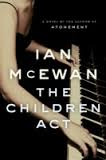
The Children Act – Ian McEwan

children's actYou can always count on Ian McEwan to bring on the controversy. This is the fourth of the prolific British novelist’s books we’ve read in my book club and it prompted a loud and lively discussion.

The main character in The Children Act is Fiona Maye, a High Court judge in London. She’s about to turn 60 when her husband, Jack, a professor, announces that he wants to have an affair (this is not a spoiler, really; the revelation comes pretty much on page one). She’s been married for thirty years and until the moment her husband tells her that he needs this because it is his “last shot” and he’s “yet to hear evidence of an afterlife” she’s been pretty smug about her life. While it is true that they don’t have children, they have had a good life together: enough money, a nice home, friendship and, Fiona admits ” she had always loved him.”  To say that Jack’s confession throws Fiona for a loop is an understatement, but she does not intend to “manage the rest of her life alone.”

Into Fiona’s fractured world comes the Henry family. Adam Henry is seventeen and he and his family are refusing the blood transfusion that may save his life because they are Jehovah’s Witnesses. According to their beliefs, “Mixing your own blood with the blood of an animal or another human being is pollution, contamination. It’s a rejection of the Creator’s wonderful gift. That’s why God specifically forbids it in Genesis and Leviticus and Acts.”

Fiona’s actually quite adept at sorting through these complicated and potentially incendiary cases, but even she is not quite sure what compels her to reserve judgment so she can visit Adam in the hospital. She calls the decision “a sentimental error,” but she goes anyway and discovers that seventeen – year – old Adam is , despite his illness, “beautiful.” It’ll be obvious to careful readers that Fiona is smitten. In fact, during the first few moments of their meeting she “caught nothing.” The visit that follows is charged – not sexually, really, although there is an element of that, too – with the kind of energy that happens when two people discover a shared passion. For Adam and Fiona it is music and poetry. Ultimately, Fiona’s decision sets Adam on a path that has profound consequences for them both.

I really liked The Children Act. McEwan is a smart writer and he’s adept at spinning a narrative that is tightly focused. Fiona isn’t a particularly likeable character, but that doesn’t mean it’s impossible to relate to her. This is a great book to get people talking.


Love Remains – Glen Duncan

loveremains Despite the fact that Glen Duncan’s novel Love Remains is only 277 pages long, it took me about a month to finish because I could never read any more than a few pages at a time before my head started to swim. But I mean that as a compliment rather than a criticism.  Duncan is a well-known and much-praised British author who was new to me when I purchased the book. Love Remains, Duncan’s second novel, is almost relentlessly grim. Again – it’s a compliment, honest. There’s no way you could tackle the topic Duncan does in this book without being a skillful craftsman, and Duncan really is an amazing writer.

Nick and Chloe meet in university.

The possibility of love revealed itself to Chloe immediately, in a shock. When they sat opposite each other that first Wednesday, with rain streaking the steamed windows and the delicious reek of frying bacon in the air, she felt (thinking, stunned, of the billions who had felt it, down the long bloodied canvas of history) the first murderous utterance of romance: It’s him.

Nick’s feelings for Chloe are slightly more ambivalent, although he does concede that “he was so curious about what was going on inside her that lust only followed along afterwards, like an obligatory bit of luggage.”

The trajectory of Chloe and Nick’s love story is mostly straightforward. They get married, start jobs,  eventually move into “their first proper home” in Clapham and then, as with many marriages, the romantic impetus drains from their lives as they deal with life’s mundane and often inane decisions: “Do you think we should get a futon, Nick.”  As their marriage closes in around them, “They suffered, periodically, the ache of familiarity.” Chloe feels “suffocated by the sound of his breath escaping through his nostrils” and Nick “hated her for having finished the shape of him.”

Duncan masterfully builds a marriage from the ground up and then, just as masterfully, wrenches it apart in the most violent way possible.  In some ways, it’s almost as though Duncan has written two different, but equally compelling, novels.

When the novel opens, Nick has already left London because that’s what you do “when the future ended.” He is on a journey, it seems, of self-destruction comprised of smoking, drinking and having sadomasochistic sex. None of it makes sense until we learn what has happened to Chloe and, even then, it’d difficult to wrap your head around. Is Nick reprehensible for having abandoned his wife? That’s just one of the moral questions Duncan asks you to consider in this book.

Chloe is on a journey of her own. It is equally compelling, although perhaps more heartbreaking. The random and horrific experience she has endured has sharpened her: “Her face in the mirror, barely recognizable, rewritten.”

What was once a path traveled together, has now been cleaved. I commend Duncan for resisting the urge to offer a tidy ending, but the ending, nonetheless, is remarkable.

Highly recommended.

The Blessings – Elise Juska

blessingsWe welcomed a new member into our book club last year and she hosted the first meeting after our summer hiatus. Elise Juska’s novel The Blessings was Margo’s selection and our discussion of the book – which I didn’t particularly enjoy while I was reading it – was certainly elevated by her superior hostessing skills. Oh, and okay, listening to the other women in my group talk about the book did soften me towards it. A bit.

The Blessings is the story of a large Irish-Catholic family in Philadelphia. You’d need a chart to untangle the siblings and cousins, the spouses and parents. There’s Gran and Pop; their children, John, Margie, Ann and Patrick and then the kids. Their story – played out over twenty years – isn’t really follow a linear narrative. Instead, Juska unfolds the story, or parts of the story, by allowing us to ‘visit’ with some of the family members.

For example, when the novel opens, eighteen-year-old Abby (daughter of Ann and Dave) is home from college for Thanksgiving. Through her eyes we see her aunts and uncles and grandparents and cousins. She reflects that “most people did not have families like hers.”  I would counter that everyone has a variation on a family like hers. Nevertheless,

If every family has a certain kind of music, Abby’s is the murmur of sympathy around a dining room table. It starts in the pause after dinner and before dessert, when the men migrate to the living room and turn on sports, and the women surround the wreckage, spilled crumbs and crumpled napkins and stained wineglasses. They pinch lids from sugar bowls and dip teabags in hot water, break cookies in half and chew slowly. They trade stories of other people’s hardships. This is the melody, the measure , of her family: the response to sad things.

The novel moves in and out of people’s lives, allowing us glimpses of failed relationships, eating disorders, love affairs, and deaths. For me, the narrative was too broken up to allow me to feel connected to any one of the characters. Just when I settled into the rhythm of their story, the chapter would end and we’d be on to the next person. Sometimes what had been happening would be alluded to later on, but we’d be hearing about the event from a completely different perspective. The Blessings was like reading a series of connected short stories.

Matriarch Helen (Gran) sums it up best:

The truth is that life in the end – even a long life – amounts to a handful of a very few things. The longer you live, the shorter the story.

The Blessings is a quiet story about family and if you’ve got one, you can probably relate to this book in some way.

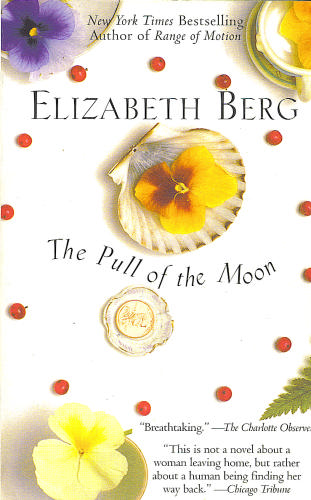
The Pull of the Moon – Elizabeth Berg

pullofthemoon Nan is fifty. One day she wakes up and just decides to leave. Her daughter, Ruthie, is grown and gone; her husband, Martin, remains at home receiving the letters Nan writes to him from the road. In the first she tells him

I just wanted you to know I was safe. But I shouldn’t have said I’d be back in a day or two. I won’t be back for awhile. I’m on a trip. I needed all of a sudden to go, without saying where, because I don’t know where. I know this is not like me. I know that. But please believe me, I am safe and I am not crazy, I felt like if I didn’t do this I wouldn’t be safe and I would be crazy.

Elizabeth Berg’s novel The Pull of the Moon is one of those novels that book clubs (whose members are of a certain age) will have a field day over. And I would be the dissenting voice. (I usually am.) It’s not because I don’t get it, it’s just because I didn’t wholly believe it.

So Nan (who has enough money at her disposal that she can just take the car and wander off and stop whenever and wherever she wants – and there’s the first fly in this self-discovery ointment; it’s Eat, Pray, Love for the middle-aged set) has had it with her suburban life. But it’s not even that so much as that she no longer recognizes the woman she’s become. All her dreams and aspirations have buckled under the weight of being a mother and wife and now she wonders “who in the hell am I?”

This question is likely something most women of a certain age can understand because many of us chuck our own desires under the bus when the kids come along. Nan takes this opportunity to examine who she was and who she is and what she wants going forward. She writes letters to Martin and also writes in a journal, something she hasn’t done since she was eleven.

She meanders along back roads, stopping for food and rest and pondering the sorry state of her life. She also randomly befriends people: the waiter in the diner where she gets breakfast, a hitchhiker she picks up, a man mourning the loss of his wife, an old woman shelling peas. These interactions weren’t all that believable to me because Berg expects the reader to believe that a simple question will open everyone’s floodgates. Suspicion quickly gives way to confession.

Strangely, despite the fact that I didn’t really buy the characters Nan meets (or the short time she spends with them) I did empathize with Nan.  Maybe that’s because, although my kids aren’t yet grown and gone and I no longer have a ‘Martin’, I am 53. I am way past the mid-way point of my life and although I try not to spend my life wallowing in regret, I do wish I had done some things a little differently. I also desperately wish I could call someone up and say, “I want and new house and this is what it’s going to look like. As soon as I get back from this roadtrip, we’re building that puppy. You got that buster?” (Seriously, Nan writes to Martin that she wants a new house!)

Nan writes in her journal that when she was twelve her life “was like a wild, beating thing, exotic, capable of unfolding and enlarging itself, pulling itself higher and higher like a kite loved by the wind.”  The best thing about The Pull of the Moon is Nan’s attempt to recapture the essence of that feeling, life’s enormous possibilities which have long been buried under the weight of the expectations of others. When she does that, Nan’s journey is one worth taking.


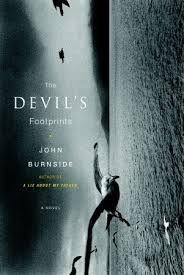
The Devil’s Footprints – John Burnside

devilAlthough John Burnside is a prolific and award-winning writer (he is one of only two poets to have been awarded both the T.S. Eliot and Forward Poetry prizes for his collection, Black Cat Bone and in addition to over a dozen volumes of poetry he has written non-fiction, novels and a screenplay), The Devil’s Footprints is my first encounter with him.

Michael Gardiner has lived in Coldhaven, a seaside town in northern Scotland, his whole life. His parents were distant, creative people: his father a well-known photographer, his mother a painter. They were outsiders when they came to the village, but it’s the only home Michael has ever known and he lives in the house where he grew up with his wife, Amanda.

When The Devil’s Footprints begins, Michael is considering the deaths of Moira Birnie and her two young sons. Michael had a brief relationship with Moira back when he was nineteen and the circumstances of their deaths troubles Michael. He also wonders why Moira’s 14-year-old daughter, Hazel, was spared. But The Devil’s Footprints is not a mystery.

Burnside effortlessly weaves past and present, illuminating his solitary childhood and the fact that he was mercilessly bullied by Moira’s older brother, Malcolm.

“I always walked to and from school alone. I didn’t have a best friend, I didn’t really have friends at all,” Michael recalls.

As an adult, Michael doesn’t appear to have any friends, either. The reader learns little about his relationship with Amanda, a woman to whom he’s been married for about a decade. Michael doesn’t have to work because his father’s death has left him financially independent. Amanda “liked her job and insisted on going every day, full-time, even though we didn’t need the money.” Michael’s view of his marriage from a strangely impassive perspective. He notes “We had quickly passed the stage in a marriage when being together counts for much” and he knew what Amanda wanted from him was “stability.”

The thing of it is, Michael seems decidedly unstable, especially after he becomes  fixated on Hazel. There are all sorts of Nabokov comparisons to be made in their relationship; Michael makes them himself. But it isn’t until he packs his bags and spirits young Hazel away that the reader starts to understand the huge knot of grief Michael has been carrying around with him.

Did I like The Devil’s Footprints?  I think it’s a book that does an admirable job of reaching into the dark heart of one character. The writing is, understandably, poetic. I am glad that I read it.

The Lantern – Deborah Lawrenson

lantern If you’ve ever been to Provence, I suspect you’ll recognize the lush and aromatic landscape Deborah Lawrenson describes in her novel The Lantern. I’ve never been, but after reading this gothic romance, I’d love to go.

…the lavender fields, sugar-dusted biscuits, wild-flowers in meadows, the wind’s plainsong in the trees, the cloisters of silver-flicking olives, the garden still warm at midnight

The Lantern is two stories in one, stories that share Les Genevriers, an abandoned house in southern France. In one story we meet Benedicte, the youngest of three children who grows up in the house back when it was a working farm. In the other we meet Dom and an unnamed narrator, who is affectionately called ‘Eve,’ who have recently purchased Les Genevries with a view to restoring it to its former glory.

Eve is a twenty-something translator who meets Dom, a forty-something composer, in Switzerland, in a maze – which is prescient, as her life suddenly becomes a tangle of wrong turns and dead ends. She is instantly smitten with him and he seems to return the affection. When they return to London, Eve says “I tried to play it cool. So did he. But we both knew.” Their whirlwind romance eventually takes them to France and Les Genevries.

That summer, the house and its surroundings became ours. Or, rather, his house; our life there together, a time reduced in my memory to separate images and impressions: mirabelles – the tart ornage plums like incandescent bulbs strung in forest-green leaves; a zinc-topped table under a vine canopy; the budding grapes; the basket on the table, a large bowl; tomatoes ribbed and plump as harem cushions; thick sheets and lace secondhand from the market, and expensive new bed covers that look as old as the rest; lemon sun in the morning pouring through open windows; our scent in the linen sheets. Stars, the great sweep of the Milky Way making a dome overhead. I have never seen such bright stars, before or since.

Sounds romantic, eh? But it’s also isolated and when Dom starts to behave strangely and Eve starts to smell things and see things that aren’t actually there, The Lantern  crosses over into gothic territory. There’s also, as it turns out, an ex-wife whom Dom doesn’t want to talk about and a real estate agent in the local town who does. The plot thickens.

Then there’s Benedicte. She lives her whole life at Les Genevries. Her story, and that of her blind sister Marthe and malevolent brother, Pierre, weave throughout Eve’s narrative and make up some of the “many stories about the place.” As an old woman living in Les Genevries, Benedicte becomes convinced that she is being haunted. She sees her brother, Pierre, “standing, waiting expectantly in front of the hearth, silent, as if his intention was perfectly clear.” And then he is gone. Benedicte has never believed in ghosts, but it is hard to deny that Les Genevries is full of spirits.

Lawrenson does a fabulous job of weaving together the stories of Eve and Benedicte, their connection to Les Genevries and of making Provence jump off the page. The novel is creepy, clever and compelling and a lot of fun to read.

Highly recommended.

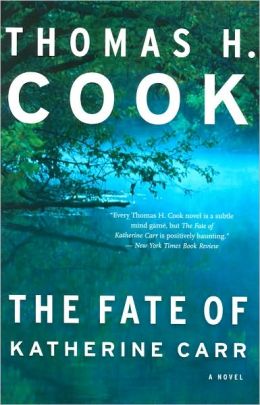
The Fate of Katherine Carr – Thomas H. Cook

katherine carrThe Fate of Katherine Carr is the story of things lost and found. George Gates is a former travel writer who now writes features for the local paper and spends his evenings drinking scotch at his neighbourhood bar. He’s a broken man, but no wonder: his eight year old son, Teddy, had been taken off the street on his way home from school, murdered and the murderer had never been caught. That was seven years ago, but George hasn’t recovered. He was supposed to pick Teddy up at the bus stop and hadn’t because he’d been trying to write the perfect sentence. He’s consumed with guilt.

One night at the bar, George runs into Arlo McBride, a retired police detective. Over drinks, Arlo tells George about the one missing person’s story which has stayed with him because it was never solved.  She vanished, Arlo tells George,  “like she cut a slit in the world and stepped through it into another one.”

George is intrigued. Before he’d retired from travel writing, he’d spent the bulk of his career writing about places where people had disappeared. Creepy places like Saipan, where Japanese parents – fearing American soldiers – had hurled their children and then themselves from the cliffs. He suddenly finds himself investigating what might have happened to Katherine. As it turns out, Katherine was also a writer and she left behind a handful of poems and a story which Arlo provides to George.

During the course of his ‘investigation’ George meets Alice Barrows, a twelve-year-old with progeria, a disease which causes premature aging. At first, Alice is just a potential subject for a story, but their relationship quickly becomes more profound. Alice is alone in the world and so is George. She is interested in mysteries and George is soon sharing  Katherine’s story with Alice.

Thomas H. Cook is one of my favourite writers. I’ve said it before and I’ll say it again – he writes literary mysteries. They’re page-turners, to be sure, but they are beautifully written, too. The characters are complicated and, more often than not, damaged. George is particularly sympathetic. As a parent, I can only imagine how horrific it must be to lose a child to a monster, but to live daily with the guilt of not being where you said you would. Cook ups the ante every single time.

The Fate of Katherine Carr works on many levels. Narratively, it’s a story within a story within a story. Emotionally, it’s hard not to be moved by George’s never-ending grief or Alice’s own sad fate. Some might argue that nothing much happens, but I respectfully disagree. While Cook might not write blood and guts thrillers, and while his endings might not leave all the loose ends tied in a neat bow – I think he writes fantastic books for careful and thoughtful readers.


Life After Life – Kate Atkinson

life-after-life-“What if we had the chance to do it again and again, until we finally did get it right? Wouldn’t that be wonderful,” says Teddy to his big sister, Ursula, the unusual main character of Kate Atkinson’s even more unusual novel Life After Life.

Ursula is born  in February, 1910. She dies and is born again. And again. Attempting to piece these multiple lives into any sort of coherent order is damn near impossible so I suggest you don’t even try. It’s far easier to just be with Ursula as she is born, grows up and then grows up again, each time encountering different possibilities based on life’s many variables. The reader is dropped into Ursula’s life at different points, just as she seems to be. Ursula hits the ground running, and eventually – with a little bit of attention paid –  so does the reader.

Ursula is a fine character with which to spend your time. She was “born with winter already in her bones” and when winter comes around again she “recognized it from the first time around.” It is through her eyes we see her parents: her perfect and beloved father, Hugh and her slightly snippy mother, Sylvie. When she is born she already has two older siblings, Maurice and Pamela, and then her arrival is followed by Teddy and James. The siblings and their parents live at Fox Corner, an English estate. Her lives and deaths flow almost seamlessly together, darkness falls and she is no more until she is again – still with the same family, still Ursula.

I don’t pretend to understand the novel’s finer points (it would take at least another reading), but I can say this: Life After Life clocks in at almost 500 pages and it was a joy to read. Sometimes Ursula makes choices which are ultimately detrimental to her well-being. One bad decision tips the balance and causes her life to spin out of control.  It’s only human to wonder how things might have been different if only… Other times her life is better, but not perfect. People suffer and die. World War I and then II upset the status quo.

There is a part of Ursula’s conscious that recognizes that her life seems to be on repeat. Her mother tells her it’s déjà vu, “a trick of the mind.” Dr. Kellet introduces her to the word “reincarnation” when she is just ten. But explanations are not necessary for Ursula or the reader. And although not every version of her life is a joy to read about, each one is as compelling as the next. Perhaps Ursula knows instinctively that ” If there’s no great glorious end to all this, if nothing we do matters… , then all that matters is what we do. ‘Cause that’s all there is. What we do. Now. Today. ” (Thanks for that quote, Joss Whedon! From the Angel episode “Epiphany.”)

It might be interesting to consider that Atkinson is also playing with the notion of novelist as God. Of course a novelist really does have the opportunity to make anything they want to happen to their characters happen. They don’t however, under normal circumstances, make every scenario occur in the same novel. If this was an experiment for Atkinson, it paid off in spades. The writing is beautiful. Ursula is everything you’d want in a protagonist; the minor characters are compelling and each and every one of Ursula’s lives offers something of value to careful readers.

Highly recommended.