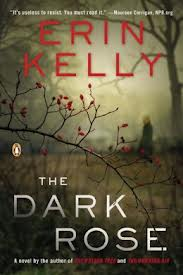
The Dark Rose – Erin Kelly

darkroseSO ANNOYED! I had an awesome review of this book written and when I posted it all that posted was what is below between the **…and I am tired and never going to be able to recreate what I had written and I could SCREAM.

So, briefly:

39-year-old Louisa and 19-year-old Paul are both working on the restoration of a ruined Elizabethan garden in Kelstice, a small town northwest of London. She’s hiding out – as she has done for the past twenty years or so – because she’s still obsessed with the guy she was in love with when she was 18. Paul’s hiding out because his best friend, Daniel, will soon be on trial for murder and he’s the star witness for the prosecution.

Paul’s had a traumatic childhood. He lost his father in a rather traumatic and gory accident which he witnessed. Then he started to get picked on in school and Daniel became his saviour.  He’s really a decent guy who just made some stupid choices because of his loyalty to Daniel.

**It’s also impossible not to relate to Louisa – at least I could relate to her. She falls madly in love with Adam Glasslake, lead singer of the band Glasslake and the more distant and unattainable he is, the more she wants him. What 18-year-old hasn’t been on that roller coaster ride?

After they make love for the first time and after Adam falls asleep, Louisa

…inhaled the thick oily skin between his shoulder blades where he smelled most like himself. If you could distill and bottle the essence of a human being, if you could crush skin like petals , then she would do this with Adam Glasslake. The vetiver scent was faint now, but his neck still bore the visible traces of the oil he had anointed himself with earlier. It was a faint dark green. Below this, on his clavicle, she had marked him for herself, a vivid red circle, half kiss, half bite. She felt intensely female and powerful, like a witch.

Louisa and Adam’s relationship is rocky at best and ends badly and years later she still gives in to a ritual that requires liquor and a few tatty mementos.   The first time she sees Paul she is so overcome that she felt that “the strength of her longing had finally called him [Adam] into being, that she had conjured his spirit.” She is so overcome she “would have smashed through the glass walls of the greenhouse to get away from him.”

When Louisa and Adam’s separate but equally compelling lives intersect, things don’t turn out at all like you might expect. And I mean that in a good way. Kelly does an admirable job making both Louisa and Paul into characters that you actually kind of root for thus elevating The Dark Rose  from run-of-the-mill thriller to literary page-turner.

The Dark Rose is my first encounter with Erin Kelly, but I will certainly be reading more of her work.**
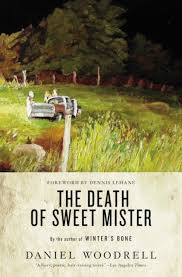
The Death of Sweet Mister – Daniel Woodrell

sweetmisterThe Death of Sweet Mister is grim and virtually unputdownable.

Woodrell’s novel is set in 1960s Ozarks. I don’t know anything about the Ozarks but Wikipedia tells me that “It covers much of the southern half of  Missouri and an extensive portion of northwestern and north central Arkansas. The region also extends westward into northeastern Oklahoma and extreme southeastern  Kansas.”

Morris “Shug” Atkins is thirteen and lives with his mother Glenda and her boyfriend, Red. “The idea that Red was my dad,” says Shug “was the official idea we all lived behind, but I wouldn’t guess that any of us believed it to be an idea you could show proof of or wanted to.”

Red is an ex-con, a mean snake of a man who drinks and does drugs and abuses both Shug and his mother.

…Red was near only the height I was at that age, but a man. He had the muscles of a man and all those prowling hungers and meanesses…

Their lives are just about as miserable as you might imagine them to be.

The three of them live in a house that “looked like it had been painted with jumbo crayons by a kid with wild hands who enjoyed bright colours but lost interest fast”  in the middle of a graveyard. In exchange for their dwelling, Shug maintains the cemetery – mowing and the like.  Red contributes to the family’s meagre existence by sending Shug off to break into houses and steal pharmaceuticals. You know it’s only going to be a matter of time before Shug gets caught.

Shug’s mother, Glenda, is the sort of woman who will never “get too plain or too heavy. Her eyes were of that awful blue blueness that generally attaches to things seen at a distance.” She copes with Red’s nastiness by drinking rum and cola, her special “tea”.

None of the characters in The Death of Sweet Mister seem to hold out much hope for a brighter future, but then into the narrative drives Jimmy Vin Pearce. His shiny green T-Bird and his flashy clothes seem to signal hope, like maybe Glenda and Shug might be able to escape the smallness and meaness of their lives. But one day Shug comes home to find blood had “whirled and whirled in the kitchen.”

I loved the language of Woodrell’s book. I loved Shug’s voice. I felt tremendous sympathy for him. He is a product of his environment and so it’s not particularly surprising how his story concludes. Doesn’t make it any less sad, though.

Highly recommended.


The Boy – Lara Santoro

theboyAnna is 42. The boy is 20. And yes, he has a name. His name is Jack. The Boy is the story of Anna and Jack’s brief but catastrophic affair and as tragic love affairs go, this one has its strengths and its weaknesses.

Anna meets Jack at a party her neighbour, Richard, is throwing.

The boy wore dark, baggy clothes so there was no discerning the profile of his body, yet Anna could tell, simply by the way he sat, that it must be a good one. She raised her eyes to his with calculated slowness and found to her surprise that they were free of fear, free of pretense, free of the myriad layers stretched by age over the human eye.

Okay, I’m not really sure what the last bit means but I’m just going to paraphrase here and say that Jack had it goin’ on and Anna was eventually unable to resist. He is pretty cocky.

There are some obstacles to their forbidden love. For one thing, Anna has an eight-year-old-daughter, Eva, who often seems like more of an adult than her mother. For another Anna has a slightly checkered past. (There were/are some issues with alcohol/drugs.) Then there’s her ex back in England. And okay, yes, there’s a huge age gap between Anna and Jack but Jack isn’t a witless sex toy.  (And there’s no graphic sex in this book anyway.) It’s all complicated and fraught, as lives often are.

When Eva goes to spend a few weeks of the summer with her dad, Anna gives in to the boy’s siren call and before you can say MILF, Jack’s moved his stuff into Anna’s house. Partly, Anna is looking for a way to reclaim her own lost youth. Partly, she seems to genuinely care for Jack. But they are living in a bubble that bursts when Eva returns from England.

Driving Eva to school one morning Anna loses her temper:

“Is this a joke?” she said. “After everything I have done for you? After all the sacrifices I’ve made for you, suddenly I have the audacity to tell you to stop ordering me around and you’re not talking to me. I have given you everything, Eva. Everything. I have traded my own life for yours. In fact, I haven’t had a life. You have. I haven’t. And this is what I get.”

This is, I think, the impetus for Anna’s affair with Jack. He’s this beautiful, motherless boy who wants her and she wants to forget, just for a little while that she has responsibilities that make it impossible for her to have whatever she wants. “We have children,” she says. “We have children, and they’re nothing we’re prepared for.”

Ain’t that the truth.


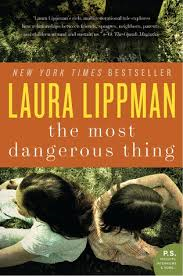
The Most Dangerous Thing – Laura Lippman

mostdangerousIt took me forever (it seems) to finish Laura Lippman’s novel The Most Dangerous Thing, a book that the Wall Street Journal called “a creepy, genre-bending, stand-alone novel.”

Lippman’s novel is the overly long story of five childhood friends, Gwen, Mickey, Tim, Sean and Go-Go who are reunited as adults after Go-Go is killed in a car accident that may or may not have been deliberate.  The real story, though, is about what happened to these five when they were kids – a bit of nasty business that is alluded to and then covered up. It’s the seventies, after all.

The story bounces between then and now and the big reveal  – which comes in the novel’s final pages – doesn’t really equal the sum of its parts. My problem with the book is that it took forever to get anywhere and when I finally arrived I was just sort of meh about the whole affair. As a novel of “psychological suspense,” as the Globe and Mail purports it to be, it was lacking the actual suspense.

Actually, I think the real mystery in The Most Dangerous Thing is  who is telling the story because Go-Go is dead and the remaining four are all referred to in the third person. In the author’s notes at the back of the book Ms. Lippman says: “I don’t want to tell you.”

As another kind of story, The Most Dangerous Thing is quite compelling.  The children are children only in flashback; we are actually dealing with them as adults and their lives are messy and complicated – as lives tend to be. We also spend time with their parents and those lives aren’t much better. But the thing is – is The Most Dangerous Thing a family drama  times three or is it a mystery, or a thriller, Maybe it’s social commentary?

Ms. Lippman says it’s her most autobiographical novel – geographically speaking. She says “I have been circling the unusual neighbourhood in which I grew up, determined to write about it, but wanting to wait for the right time and story.”

If I hadn’t been itching for the book to move along already, I would probably have enjoyed it more. Ms. Lippman is a wonderful writer, no question…but this book was only just okay for me. Maybe if I hadn’t been expecting something different, I would have been less disappointed.

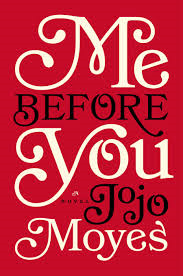
Me Before You – Jojo Moyes

mebeforeyouLast night, my book club met to discuss Jojo Moyes’ novel Me Before You.  I was the only member of the group that didn’t love the book. I liked the book a lot, but it won’t go down in my personal annals as one of the most amazing, romantic, beautiful, (insert other appropriate adjective here) books ever. Trust me, I am the gushiest romantic on the planet so it came as just as much of a shock to me when I didn’t get all weepy and heartbroken at the end.

Me Before You is the story of  26-year-old Louisa Clark, an ordinary girl from an ordinary family. Until recently, she’d been working at the local cafe in the little market village she lives in in England. She lives at home with her parents and her younger sister, Treena and Treena’s young son, Thomas. Their house is too small; they don’t have much money and so when Louisa loses her job at the cafe she is desperate to find new employment so she can continue to contribute to the family coffers.

Enter the Traynors.  They live in Granta House which is on the other side of Stortfold Castle – I presume that’s the posh side. Camilla Traynor hires Louisa as a companion to her son Will who, two years ago, had been in a serious motorcycle-meets-pedestrian accident that has left him as a quadriplegic. He’s a bit of a git.

Circumstances being what they are, Louisa doesn’t feel like she’s in a position to quit, even when Will is arrogant and unkind. Instead, Louisa is determined to make friends with Will and so, of course, that is what happens. Will softens because of Louisa’s friendship; she  flourishes because of his. They are both irrevocably changed.

Me Before You was an easy book to read. I motored through 200 pages on Saturday night. I liked Louisa and I liked Will and I liked their story. Although I didn’t agree with the stylistic choice Moyes made to interrupt the story’s predominantly first person narrative to give readers a glimpse into the heads of a few other characters, I did appreciate this observation by Will’s mother:

It’s just that the one thing you never understand about being a mother, until you are one, is that it is not the grown man – the galumphing. unshaven, stinking, opinionated offspring – you see before you, with his parking tickets and his unpolished shoes and complicated love life. You see all the people he has ever been rolled into one.

I am a mom and so I knew what she was talking about. Could I have lived without her insights?  Absolutely.

I also took issue with the epilogue. It felt cheap to me. Way, way too tidy. But no matter.

One of the questions  posed last night was whether or not Me Before You was a great book. Define great. That’s the cool thing about reading. Everyone’s definition of what makes a great book is going to be different. I am going to have to figure out how to articulate what makes a book great for me and get back to you.

As for Me Before You – it was a very enjoyable book to read. Could I niggle over a bunch of little things? Sure, but none of them really detracted from my reading experience which was totally pleasant. I didn’t shed any tears, but I did well up once or twice. So, almost, Ms. Moyes.


I Take You – Nikki Gemmell

tlc tour hostThanks to the folks at TLC, I’m back with another book by Nikki Gemmell. You’ll recall that I took a look at her novel With My Body last month and today I am going to talk about her book I Take You. Beginning with The Bride Stripped Bare, With My Body and I Take You form a trilogy of sorts, although the characters and plots don’t really overlap so each book could be read independently of the others. I Take You

I Take You is the story of Connie Carven, wife to Clifford, a banker who has been seriously injured in a skiing accident and can no longer – erm – perform certain husbandly duties. No matter, Cliff has found other ways to satisfy his wife, most of them involving his Mont Blanc pen and a wicked imagination. At first Connie seems like a willing participant in her husband’s increasingly perverse sexual games, but one night Cliff takes things a teensy bit  (okay, a lot) too far and something in Connie–I don’t want to say snaps–changes.

Truthfully, I didn’t get Connie’s relationship with Cliff. Like, at all. Pre-accident he was  “her American…someone to be laughed at and admired and feared in equal measure.” Cliff is over-the-top rich and Connie “grew quickly addicted to this way of living — loved the sparkly, unthinking splash of it.”

When she tries to explain her relationship with Cliff to her father she says:

“We’re happy , Dad. As we are. I’m his wife and I have a job to do. A very important one. Now more than ever. Only I can help him, only me. I’ve become crucial to him in a way that’s impossible to explain.”

We are meant to believe that Cliff’s accident was the impetus for her to fall in love with her husband because “it tipped their sex life into something else. Because Cliff gouged out — patiently, gently, beseechingly — the very marrow of his impenetrable wife. It had been the trigger that now tipped him into something else.”  But the thing is, I don’t see these two as having very much of anything at all except perhaps for a co-dependent relationship and a penchant for kinky sex. And I never saw Cliff as a nurturing, kind man and he can’t kiss worth a damn, apparently.

Then, matters get more complicated when Connie meets Mel — he’s the gardener who takes care of the private communal garden that belongs to the houses on their square. It was at this point that I had a ‘wait a minute’ moment. I Take You was starting to sound suspiciously like another book: D.H. Lawrence’s novel Lady Chatterly’s Lover.  According to the blurb on the back (which I hadn’t bothered to read) Gemmell was indeed inspired by Lawrence’s infamous book.

Everything you think is going to happen, happens. Mel and Connie start an illicit affair; Cliff gets all bent out of shape about it; Connie chooses personal happiness over marital responsibility.

So how does I Take You compare with the other erotica out there? Well, Gemmel’s writing is still lovely (although I think I might have appreciated this book a bit more if I’d had more of a breather between this one and With My Body.) It’s often quite graphic, so if that’s not your cup of titillation tea — perhaps this isn’t the book for you.

I can’t say I was quite as enamoured with I Take You as I was with With My Body. I may need a little while longer to figure out why Connie’s journey just didn’t resonate with me the way the narrator in With My Body did.

A Peculiar Grace – Jeffrey Lent

peculiargraceIt took me forever to finish Jeffrey Lent’s highly praised novel A Peculiar Grace. Forever. Just under 400 pages, it felt twice as long because Lent’s prose is just shy of purple and nothing happens. Nothing. Well, okay, that’s not exactly true. Stuff happens.

Forty-something Hewitt Pearce is leading a solitary life in the Vermont house he inherited from his father. Hewitt’s a blacksmith, a prickly artistic type who “had to sit there a while to see if  it was a day for iron or not. This was the essence of what his customers perceived as a great problem – the fact he refused to state a deadline however vague.”  A sign near his forge’s door states: “If you want it done your way learn how to do it & make it yourself. Your commission is not my vision.”

Well, okay then.

Into Hewitt’s insular life comes 20-something Jessica. Her VW breaks down on Hewitt’s property and he offers her something to eat and a place to clean up. So she pretty much moves in. Jessica isn’t 100% emotionally secure, and Hewitt is 100% emotionally closed off so anything that’s going to happen between them is going to be a long time coming. (No pun intended.)

There are complications. Hewitt’s still hung up on Emily, a girl he met and loved many years ago. She’d married someone else and Hewitt has worshipped and brooded from afar ever since. There are also some family skeletons including  a famous painter father, and  an older sister Hewitt’s on the outs with.  Then Emily’s husband dies and Hewitt decides it’s time to make his feelings known to her once more, but really — can these two crazy middle-aged kids overcome their past and make it? And what about Jessica?

I kept reading. I don’t know why. When Hewitt’s mother, sister and niece arrived for a visit and these family members started talking to each other it was bizarre. People don’t actually talk to each other like this, do they?

“Jesus mother. Don’t you flush?”

“I certainly do. …And haven’t you heard about conserving water? Speaking of which you need to change the gaskets in the faucets of the tub and sink upstairs. At Broad Oakes they sent around a pamphlet about the unnecessary use of water. And not just because of the drought but because there’s long-term stress on the aquifers all over the U.S. and people still want green lawns in August”

“I don’t think so, girlie. Whatever nonsense you’re up to here I want to be able to watch your face when it comes out.”

By the time Hewitt and Jessica (and Emily and Hewitt’s sister)  finally work out their messy and strangely overwrought lives,  I had reader’s fatigue. Partly it had to so with the stylistic nature of Lent’s prose — weirdly fragmented and dense — and partly it had to do with not really caring very much about any of these people.

Paper Covers Rock – Jenny Hubbard

paper-covers-rockJenny Hubbard, the author of Paper Covers Rock, was a high school and college English teacher for seventeen years and I am guessing she was a good one. Her debut novel is filled with  references to poetry and literature and how they make us have “the feels” and allow us to connect with the world etc.

Sixteen-year-old Alex Stromm attends Birch Academy, a boarding school in North Carolina. He is, by his own admission, a good solid kid. When the story opens, Alex is writing in a journal his father had given him to write his impressions in when he’d started at Birch two years previously. Although the book has remained blank, now has something to write about: his friend Thomas is dead. He writes:

What I carry in my backpack down to the river, I carry not knowing that in less than an hour Thomas Broughton will be dead. That is not a knowledge I carry yet, but I will carry it soon – the knowledge of my darkest self – and I will carry it forever.

The reader learns about what happened that fateful day when Alex, Thomas, Clay and Glenn were at the rock by the river in fits and starts. Alex’s feelings of grief and guilt are only part of what compels him to scribble in his journal. He is also in love with his English teacher, Miss Dovecott, a recent Princeton graduate who is only a few years older than the boys she teaches. When she takes an interest in Alex’s writing he becomes even more conflicted about what happened that day on the rock.

Sounds sinister, eh? It’s not really, but I have to say that I did keep turning the pages and read the book in one sitting. Alex’s feelings for Miss Dovecott are complicated by his feelings of loyalty for Glenn. (Clay has taken the blame and left school; I’ll leave you to discover the reason why on your own.) Turns out that just after Thomas drowned, drawn by the screams, Miss Dovecott arrived on the scene and Glenn is convinced that she knows more than she is letting on. Oh what a tangled web.

And I have to say, the writing is stellar. The poetry Alex writes is lovely and it’s easy to see why Miss Dovecott takes an interest in him. Ms. Hubbard captures the male voices beautifully (not as crass as they might be now because, after all, the story is set in 1982) and also manages to make Alex both sympathetic and self-serving on his journey to manhood.


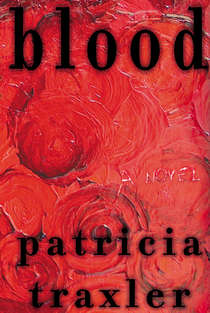
Blood – Patricia Traxler

BloodNorrie Blume, the protagonist of Patricia Traxler’s debut novel, Blood, is a thirty-five-year-old painter who has taken a leave of absence from her job as a graphic artist to focus on her art. To do that, she has accepted a Larkin fellowship at Radcliffe in Boston and has moved into one of the residences. It is there that she meets two other Larkin fellows, Clara, a journalist from Chile and Devi, a poet from London. Norrie doesn’t make friends easily and she is used to a certain degree of isolation — partly because of her vocation and partly because of her relationship with Michael Sullivan, a best-selling novelist who just happens to be married. It’s not like they can hang out in public. Nevertheless, she likes Devi immediately and sees all Clara’s character flaws just as quickly.

I have mixed feelings about Blood. Generally speaking, I liked it. The writing was decent and the story moved along. My problem had to do with a certain degree of uneveness.

Norrie tells the reader, “Though it’s true there’s a killing in my story, its principal violence is, I think I’d have to say, the violence of love.”

True enough: Norrie and Michael can’t keep their hands off each other and in one respect, Blood is a relatively explicit examination of infidelity. Of course, while  there’s no real honour in adultery, Michael does genuinely seem to love Norrie and wants a future with her. On the other hand, he can’t quite seem to get his shit together enough to leave his wife of 25 years. And why should he when he can have his cake and eat it, too.

Much of Blood is given over to the push/pull of Norrie’s top-secret relationship with Michael (no one, not even her best friend Liz, knows about him even though they’ve been together for two years.) And that might have been quite enough for one novel, but Traxler also delves into the mysterious world of female relationships and that’s where Clara and Devi come in.

Clara is clearly passive-aggressive and Norrie alternates between feeling sorry for and irritated by her. When she meets Devi, however, her feelings are immediately of the warm and fuzzy variety. This strangely dysfunctional threesome makes up the other third of the novel’s narrative. It’s also what, apparently, drives the book’s suspense – not to say that I didn’t turn the pages, but towards the end it did get a little, um, silly.

Not content with all those relationships, Traxler also dips a brush into the whole world of creativity. Traxler herself is an award-winning poet and so she likely knows a thing or two about the creative process, I’m just not sure that as it was written here is added any value to this story.

I guess that’s why when I came to the end of Blood I couldn’t really say I loved the book. I might have liked it a whole lot better if it had been about just Norrie and Michael, or just Norrie and Clara and Devi or even just about Norrie and her struggles to create art. As it was, the canvas was just a little too crowded for me.

Master of the Delta – Thomas H. Cook

masterofthedeltaI always say Thomas H. Cook is a mystery writer and he is…but I think he is also so much more than that. Master of the Delta is my 8th outing with Cook and it didn’t disappoint, even though some of the themes were familiar. The novel has the propulsive energy of a mystery, a book with a thread of whodunit twined with a ribbon of ‘is this going to end like I think it’s going to end?’ And of course – nothing is ever quite what it seems. But Cook operates on another level and this is where I think he excels.

Master of the Delta is Jack Branch’s story. Branch is a twenty-three year old teacher who has returned to his hometown to teach at Lakeland High School. Branch has had a priviledged upbringing: he grew up at Great Oaks, one of the town’s massive plantation homes.  It is 1954.

As a boy I’d sat with my father on just such a veranda, evenings that despite all that has happened since still hold a storied beauty for me. There was something calm and sure about them, and it would never have occurred to me that anything might shatter the sheer stability of it all, a father much admired, a son who seemed to please him, a family name everywhere revered and to which no act of dishonour had ever been ascribed.

Branch is a fussy young man – no, fussy isn’t the right word. He’s cocky. He believes his own hype. I don’t mean to say that he is without merit, but his youthful arrogance is partly to blame for events that haunt him for the rest of his life.

And that’s one of the cool things about Master of the Delta (and Cook’s novels in general). Cook always manages to weave past and present together seamlessly so Branch’s story is told as it unfolds, but also from the vantage point of Branch as a much older man – someone who is, from this vantage point at least, able to see his own character flaws.

Branch is teaching a course on evil through the ages and he discovers that one of his students, Eddie Miller, is the son of Luke Miller, the Coed Killer – a man who had killed a local girl and subsequently been killed in jail. Branch encourages Eddie to write a paper about his father. He feels it will help Eddie get out from under the weight of his awful heritage. So Eddie starts to research the father he barely remembers, but when this research reaches into his own life, Branch’s age and inexperience begin to show.

Really, Master of the Delta is a book about fathers and sons, about the part luck plays in how our lives turn out, about kindness and cruelty.  It is a book that has something to say about teachers and books and as a teacher who loves books, I enjoyed that. I truly believe Cook is a masterful observor of human life – our weaknesses and our strengths.  He might wrap it all up in a mystery, but I can’t think of anyone who does it better than he does.