Your Blue-Eyed Boy by Helen Dunmore

Your Blue-Eyed Boy is my second novel by Helen Dunmore. I read her book With Your Crooked Heart a couple years back. Dunmore is a poet and although it’s not always the case, her skill with language translates beautifully to prose. She creates captivating and complicated characters, with interior lives that are filled with wreckage and hope.

Your Blue-Eyed Boy is, I think,  about ghosts. Simone is a District Judge, married to an unemployed architect, mother to two young sons. Her story is told by layering all the bits of her life: her childhood, her young adulthood and her married life. When the story starts Simone describes herself as being “in that stage of youngishness which seems as if it’ll go on forever”.

And then, out of the blue, Simone receives a letter from someone from her past. If you were to take the novel’s prologue at face value, you would think that this book was about blackmail. “There are things you should know about blackmail…” Simone says.

But Your Blue-Eyed Boy is not as simple as that. This is a novel about reconciling who you are now with who you were when. It’s easy enough to pretend that each section of your life is complete and separate, but this is a novel that asks us to question our past choices, our past loves and our place in the here and now.

It’s a gorgeous book that reads like a thriller.

The Way the Family Got Away by Michael Kimball

Critics loved this book. For example, Angus Wolfe Murray from ‘The Scotsman’ said: ‘Occasionally a novel by a new writer will cause critics to choke with excitement. This is one.’

For me, though, the style got in the way of the story which is too bad because the story was kinda sad.

A family (mother, father, boy and girl) set off in their car from Mineola, Texas to Gaylord. They have all their worldly possessions in that car, including the body of the infant they lost to yellow fever. As they travel they sell/exchange their things in exchange for gas. They are going to Bompa’s house (one can assume this is a grandparent).

What makes this story odd (and I guess critics would say amazing) is that the story’s narrators are the two remaining children,  both of them very young.

“My brother’s fever wouldn’t leave him or our house,” the little boy says.

His sister says: “The sun-color got too bright and too inside and under my little brother’s skin until it burned his insides out inside his crib.”

What follows is a strange narration which flips between the brother and sister as their parents navigate their way from town to town in an effort to escape their grief.

I think your enjoyment of the novel will depend on your willingness to fall into the strange rhythm of their language.

For me, it just didn’t work. And I hate it when a book makes me feel as though I didn’t get it. Like- if I was smarter this would make sense and I could jump on the bandwagon with all the smart critics…one of whom actually said “you can’t read if you can’t read this book.”

I can read the words, thanks. They just didn’t move me.

The Boy on the Bus by Deborah Schupack

Meg Landry is an unreliable narrator. She’s the central character of Deborah Schupack’s novel, The Boy on the Bus. Meg lives in rural Vermont with her asthmatic son, Charlie, and her partner, Jeff (who is mostly away working as an architect) and her 13 year old daughter, Katie, who attends boarding school.

As the novel opens, Meg is waiting for Charlie’s school bus (and Charlie’s school bus driver, Sandy, for whom Meg has ‘feelings’)But when the school bus arrives, Charlie won’t get off the bus and when Meg goes to get him she discovers that this boy is not, in fact, her son.

“Meg sat in the row in front of him, facing forward. He seemed to be a good boy – whoever he was- and eager to please.”

It is from this intriguing start that we learn the story of this family as seen through Meg’s eyes. And I would advise reading this book in as close to one sitting as you can manage because the effect of Meg’s estrangement from her partner, her ongoing battles with Katie and the emotional toll of caring for Charlie’s illness has a cumulative effect that I’m not sure would be apparent if you read the book in fits and starts.

It is only when we see Meg through the eyes of others (the town sherriff, Charlie’s doctor) that we begin to understand what is actually happening and while some reader’s might find Meg unsympathetic- I felt quite sorry for her and hopeful at the book’s end.

Fingersmith by Sarah Waters

There are always novels that you envy people for not yet having read, for the pleasure they still have to come. Well, this is one. Long, dark, twisted and satisfying, it’s a fabulous piece of writing…and unforgettable experience.” Julie Myerson, Guardian

Fingersmith
was my choice for book club. As always, I deliberated endlessly over what to choose and wanted to pick something off my ‘to read’ shelf. Despite the book’s length, reviews had promised a page-turner and they were right.

Fingersmith
is a difficult book to talk about without giving anything away – there are more plot twists and deceptions packed into its 500 plus pages than any other book in recent memory.

Set in Victorian England, it concerns the life of Sue Trinder, who was orphaned at birth and  raised by Mrs Sucksby and her ‘family’ of fingersmiths or petty thieves. At 17, Sue is drawn into a plot to bilk Maud Lilly, another orphan who lives in a remote estate with her Uncle, out of her fortune. This plot and the effect it has on Sue’s life (and Maud’s as well) is told first from Sue’s point of view and then from Maud’s and it is intricate and filled with intrigue.

There are some Dickensian elements – Waters makes some social commentary, although not overtly, and there is melodrama galore- but, ultimately, Fingersmith is a highly satisfying read populated with intriguing characters and more chilling dips than a roller coaster.

Highly recommended!

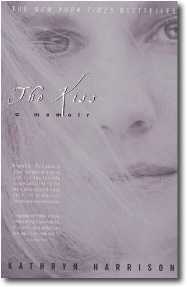
The Kiss by Kathryn Harrison

Appalling but beautifully written…jumping back and forth in time yet drawing you irresistibly toward the heart if a great evil. – Christopher Lehmann Haupt, The New York Times

Memoirs are all the rage these days and I have read a few– but I’ve never read anything like The Kiss by Kathryn Harrison. I’ve read a couple other books by Harrison and I now more fully understand some of the recurring themes in her novels (dysfunctional families, issues of love and the withholding of it, estrangement, emotional blackmail) after finishing The Kiss.

This is a well-known book, I think, despite having been published ten years ago. It received copious praise and, despite its difficult subject matter, I can see why. In fandom, we often write incest fic and consider it to be hot– but Harrison’s story of her affair with her father is never titillating. Instead, it’s a breathtaking and gut-clenching examination of how her seemingly unrequited love for her mother manifested itself into an all consuming and ultimately devastating sexual affair with her estranged father.

Harrison’s father left the family (at his in-law’s request) when the author was six months old. Until she was twenty she only saw him twice. Her father, a well-educated preacher, drew her into an affair with a kiss.

The book is frighteningly honest – Harrison doesn’t spare herself or her part in the relationship. She turns a keen, intelligent (but very emotional) eye on her life, the important relationships she had (or desperately wanted to have) and her father– who is one of the vilest characters I have ever met.

I couldn’t put this book down and when I was done I felt such a great sadness for her.

Shiver by Nikki Gemmell

The first book I read by Australian author Nikki Gemmell was The Bride Stripped Bare. I fell in love with the way she writes and so I found myself looking for other novels by her. Shiver is her first novel and it’s worthy of praise.

I can catalogue Antarctica by touch.

The touch of air sucked dry on my cheek, the fur of a day-old seal pup, the touch of an iceberg, a blizzard, a lover, the touch of sweat at minus twenty-three, of a camera stuck to the skin on my face, of cold like glass cutting into my skin, of a snowflake, of a dead man, of a doctor’s fingers on my inner thigh, of a tongue on my eye.

Fin is a twenty-six year old Sydney-based radio journalist who gets the opportunity to travel to Antarctica to “capture noises.” The trip down and her subsequent stay at the Australian station would be a compelling enough read all on its own  because of how alien the landscape is and the weird subculture of scientists and others who  make the journey. But Fin does something she isn’t supposed to do– she falls in love.

Her relationship with 38-year-old biologist, Max, is – of course- intense because of where they are, their lack of privacy, the rules surrounding fraternization. Fin is buoyed by her feelings– not the first relationship of her adult life, but certainly the most important. She and Max share an unquenchable thirst for each other physically and are, in other ways, perfectly suited.

Of course, something tragic happens and even though you know it’s coming, it’s still horrible.

Gemmell herself spent time in Antarctica and says that this is her most autobiographical novel. Knowing the circumstances of her inspiration adds an extra layer of meaning to the book– but I suggest you wait to read about her real-life experiences until after you’ve finished the novel.

The Story of My Face by Kathy Page

An elegantly compelling story of how a young girl’s obsession forever changes the lives of those around her…a disciplined exploration of the complexity of human motivation and our need for redemption. – Lynne Van Luven, Vancouver Sun

Kathy Page’s The Story of My Face is at once compelling and confounding. Page is a skilled enough writer that you are pulled into the mysterious events surrounding Natalie’s disfigurement– the cause and extent of which you learn little about until the book’s final pages– from the beginning. But the central event of Natalie’s life is buried in adult-Natalie’s search for meaning and understanding.

We meet Natalie Baron as an adult on her way to Finland to research Tuomas Envall, the leader of a strict religious sect. Natalie’s own connection to the cult comes in the form of Barbara Hern, her husband, John, and son, Mark. These three people have important roles to play, particularly Barbara for whom Natalie has a possessive affection.

Page weaves past and present together, but for me– the story was at its most compelling during the time Natalie is with the Herns on a retreat with other members of this religious sect.

The story of what happens to her face is actually not as startling as how she impacts the lives of the Hern family, most specifically Barbara.

Taming the Beast by Emily Maguire

A thought-provoking and searing first novel. -The Age

Sarah Clark is a smart kid. That’s what we’re told, anyway. By the time she turns fourteen she’s read every one of Shakespeare’s plays and sonnets, and then the works of Donne, Marlowe, Pope and Marvell. At fourteen she meets the English teacher, Daniel Carr, who will change her life.

“For the entire forty minutes of his first class he spoke about why Yeats was relevant to Australian teenagers in the year 1995. In the second class, Sarah put up her hand to make a comment on something he said about ‘Hamlet’. When he called on her to speak, she started and could not stop. She stayed in the classroom all through lunch, and when she re-emerged into the sunlight and the condescending stares of the schoolyard cliques, she was utterly changed.”

It’s not a huge leap to believe that a meeting of the minds turns to a meeting of the flesh. But their sexual affair is not quite the same as the poetry they’ve discussed– it’s raw, aggressive often brutal. The obvious questions to ask would be: is this abuse? (Clearly he’s breaking the law based on his position and the difference in their ages.) But Sarah has a penchant for this sort of sex, it seems.

And when Carr is forced to choose between Sarah and his wife and children, he chooses the latter– leaving Sarah to drift through the next eight years of her life in a haze of alcohol, drugs, and sex with hundreds of men.

Until Carr re-enters her life.

This is not a love story. Watching Sarah move through her days (and nights) is like peering through the windows of a car wreck. The characters are almost despicable– and so as I was reading, even when things were particularly horrible, I kept thinking –you know what, you guys deserve each other.

Saturday by Ian McEwan

I am not a McEwan newbie. Saturday is the 4th of his books I have read and, thus far, my least favourite. But even though I didn’t love this book, I would still have to praise McEwan’s ability to write. If I have a criticism of Saturday it’s that it’s over-written. That may be the fault of McEwan’s decision to set the novel in one day in the life of neurosurgeon, Henry Perowne.

Saturday is Henry’s favourite day. He plays squash, does some shopping and on this particular Saturday– anticipates the homecoming of his daughter, Daisy. But, of course, this Saturday isn’t going to be like all the others. He awakens in the middle of the night and watches from his bedroom window as a plane– streaming fire, cuts across the sky to (crash, he assumes) land at Heathrow.

This event wouldn’t be the cause of so much concern if this story wasn’t set post 9/11 and on the very day when hundreds of thousands on people are set to march in London’s streets to protest the war against Iraq.

As Henry sets out to accomplish his long list of things to do before his daughter arrives he gets into a minor fender bender that will propel (although not quickly) the book towards its denouement. Whether or not you find the ending, or the book for that matter, satisfying, will depend on how much you care for Henry and the minutia of his Saturday.

Sweetness in the Belly by Camilla Gibb

British born, Canadian-raised writer Camilla Gibb’s stunning new novel Sweetness in the Belly divided my book club. I was among those who loved it. The book tells the story of Lilly, born to hippie parents and brought up as a Muslim, after their death, in the city of Harar. Her story is told by layering her young years in a politically charged Ethiopia with her life as a nurse in London. It’s a fascinating picture of a world torn apart by poverty and prejudice and by Lilly’s own beliefs. It is also a love story as we wait with Lilly to learn the fate of her lover, Aziz.

I know nothing of the politics of Ethiopia under Emperor Haile Selassie. I know very little about the Muslim religion, but Gibb’s beautiful prose and attention to detail (she conducted fieldwork in Ethiopia for her PhD in social anthropology) makes this book a page-turner. The characters are complex and interesting and the day-to-day struggles of the women, in particular, are riveting. I was both gutted and elated by book’s end.