The Reunion by Alan Lightman

Alan Lightman is an adjunct Professor of Humanities, Creative Writing, and Physics at MIT. Of his novel Reunion the New York Times Book Review said: “Elegant…spare, economical and charged with meaning.”

I’m going to be honest: I am a sucker for this kind of book – lost love, longing, a trip to the past. So I would have thought that Reunion would be right up my alley because it has all the ingredients necessary to punch me in the gut.

Charles is professor at a small college. He’s divorced and the father of a grown daughter. We meet him as he is about to return to his Alma Mater for his 30th reunion. It is here that Charles is catapulted back into his past to relive his first love-affair, with a ballerina named Juliana. His past doesn’t rise up to meet him in the flesh. Instead, while gazing into a model of the college campus as it once was, Charles has a sort of complicated hallucination where he relives the whole affair and struggles to reconcile the memory with the reality of it.

On some levels the book really worked for me.

Young people explode with their discovery of the world and the newness of life…What young people don’t realize is that so much is happening for the last time as well. The world is both opening and closing at once.

I understood this. I felt tremendous empathy for Charles as he came to terms with the knowledge that he couldn’t go back and recapture those first, fleeting moments of love or be the person that he was then.

And while Lightman is a gifted writer, I think it’s the scientist in him that kept me from fully engaging in the book. There were sections of the book that bored me – a lot of the first 50 pages or so- but when Charles was fully sucked into his past, reliving his love affair with the enigmatic, Juliana, I went with him gladly, even though I knew it would not end well.

The End of Alice by A.M. Homes


I haven’t read a book this creepy, violent, or disturbing in a long time. A.M. Homes is, quite possibly, the most fearless writer I have ever read and The End of Alice is a book that is both horrifying and beautiful. Beautifully written, that is, because there isn’t a character in this novel that is particularly sympathetic.

The novel is narrated by an unnamed incarcerated pedophile. He begins a correspondence with a nineteen year old girl- also unnamed- who writes him the details of her growing obsession with a twelve year old boy.

That’s the book in a nutshell. The old pedophile and the pedophile-to-be exchange letters (although not in the traditional sense) and reveal their dirty deeds bit by bit, culminating in a retelling of the old guy’s crime: the end of Alice.

All the characters are reprehensible: the pedophile’s mother, the young boy’s father. Even the so-called victims are less innocent than you might think they are. As each crime is revealed you think it will help you understand how it shaped the person…but really it just adds to the feeling of itchy voyeurism. And since one guy is in jail, there’s a lot of graphic male/male sex.

So- do I recommend this book? It’s not for the faint of heart, that’s for sure. Is it well-written? Certainly. Could I stop reading despite the high gross-out factor? No. Whether it says something valuable or useful about the state-of-the-world, I don’t know.

Bel Canto by Ann Patchett


I wasn’t sure I was going to like Ann Patchett’s novel Bel Canto when I started reading it. I mean – it didn’t seem like a book that would either grab my interest or hold it. But a funny thing happened to me about 75 pages in…I started to care about these characters.

Bel Canto is actually based loosely on something that happened in Lima, Peru. On December 17, 1996, the terrorist organization Tupac Amaru took over the Japanese embassy there. From this nugget of truth, Patchett unspools the story. It’s Mr. Hosokawa’s birthday and the government of  an unnamed South American country are hoping he will open an electronics plant there. They have hired Roxane Coss to sing and the only reason Mr. Hosokawa has agreed to attend the party is because she will be there; he is an opera fan and she is the best soprano in the world. The party is being held at the home of the country’s Vice-President; the President had to attend to ‘matters in Israel’. In the middle of the festivities, the house is taken over by a group of terrorists.

What happens when a group of wildly different people are forced to share close quarters? The book forces the characters- a wonderful, eccentric group- to be both more and less than they are. A priest, for example, finally has the opportunity to hear confession; Mr. Hosokawa’s translator, a central character named Gen Wantanabe, gets to converse in Spanish, German, French, English, and Russian and because of it- is privy to people’s most private thoughts and Roxane Coss uses the power of her voice to tame the savage beast- so to speak.

The terrorists themselves are also central to the story and we learn much about them…and I dare say, we come to care for them every bit as much as we care for the privileged party-goers. There is a message to be had in this book and Patchett’s fine prose illustrates that without hitting the reader over the head. This was a book club selection and, truthfully, not everyone loved this book.

For me, though, this is a book about love- how it shapes us and changes us, how beauty transforms and transports and how you just might take a risk if you thought it might be your last opportunity to do so.

The Deadly Space Between by Patricia Duncker

Here’s a funny thing: I liked this book, but I don’t have a freakin’ clue what it’s about. Well, I sort of know that it’s about a well-regarded artist Isobel (Iso) and her 18 year old son, Toby. When Iso takes a lover, the enigmatic Roehm, Toby’s life is thrown into a tailspin. But The Deadly Space Between is not a straight forward tale by any stretch.

First of all, only 15 years separate Iso and her son and their relationship is complicated and sexually charged. The story is narrated by Toby and it’s difficult to know how reliable his observations are: Are his memories exaggerated? Is Roehm as other-worldly as he seems?

Roehm is a mysterious character, that’s for sure. Seen through Toby’s eyes he is huge, white and powerful; much like the monolithic winterscapes his mother is currently painting. Roehm’s arrival unbalances Toby’s relationship with his mother- which is clearly too insular- and even though the only information we get about Roehm is skewed through Toby’s eyes, his mysterious presence is what propels the novel through to its strangely unsettling conclusion.

Innocents by Cathy Coote

Cathy Coote’s debut novel, Innocents, garnered some good press with its tale of a precocious 16 year old girl who pursues her 34 year old teacher.

My darling, the book begins, All of this is my fault. I  know you think your to blame for what happened. You’re wrong, my love. I’ve been guilty all along.

Coote’s wrote this book when she was 19, so I’m gonna take a wild guess and say that this book hits close to home. That’s not to say that it wasn’t without its merits- but likable characters isn’t one of them.

The story’s narrator is never identified and the novel takes the form of a long letter to her lover –  a letter which supposedly reveals all the ways in which she tricked him and bent him to her will, finally provoking an act which causes our ‘innocent’ narrator great distress.

Ultimately, it’s hard to believe that the man was so easily manipulated and that the girl was as devoid of genuine feeling as she claims to be.

Your Blue-Eyed Boy by Helen Dunmore

Your Blue-Eyed Boy is my second novel by Helen Dunmore. I read her book With Your Crooked Heart a couple years back. Dunmore is a poet and although it’s not always the case, her skill with language translates beautifully to prose. She creates captivating and complicated characters, with interior lives that are filled with wreckage and hope.

Your Blue-Eyed Boy is, I think,  about ghosts. Simone is a District Judge, married to an unemployed architect, mother to two young sons. Her story is told by layering all the bits of her life: her childhood, her young adulthood and her married life. When the story starts, Simone describes herself as being “in that stage of youngishness which seems as if it’ll go on forever”.

And then, out of the blue, Simone receives a letter from someone from her past. If you were to take the novel’s prologue at face value, you would think that this book was about blackmail. “There are things you should know about blackmail…” Simone says.

But Your Blue-Eyed Boy is not as simple as that. This is a novel about reconciling who you are now with who you were when. It’s easy enough to pretend that each section of your life is complete and separate, but this is a novel that asks us to question our past choices, our past loves and our place in the here and now.

It’s a gorgeous book that reads like a thriller.

The Way the Family Got Away by Michael Kimball

Critics loved this book. For example, Angus Wolfe Murray from ‘The Scotsman’ said: ‘Occasionally a novel by a new writer will cause critics to choke with excitement. This is one.’

For me, though, the style got in the way of the story which is too bad because the story was kinda sad.

A family (mother, father, boy and girl) set off in their car from Mineola, Texas to Gaylord. They have all their worldly possessions in that car, including the body of the infant they lost to yellow fever. As they travel they sell/exchange their things in exchange for gas. They are going to Bompa’s house (one can assume this is a grandparent).

What makes this story odd (and I guess critics would say amazing) is that the story’s narrators are the two remaining children,  both of them very young.

“My brother’s fever wouldn’t leave him or our house,” the little boy says.

His sister says: “The sun-color got too bright and too inside and under my little brother’s skin until it burned his insides out inside his crib.”

What follows is a strange narration which flips between the brother and sister as their parents navigate their way from town to town in an effort to escape their grief.

I think your enjoyment of the novel will depend on your willingness to fall into the strange rhythm of their language.

For me, it just didn’t work. And I hate it when a book makes me feel as though I didn’t get it. Like- if I was smarter this would make sense and I could jump on the bandwagon with all the smart critics…one of whom actually said “you can’t read if you can’t read this book.”

I can read the words, thanks. They just didn’t move me.

The Boy on the Bus by Deborah Schupack

Meg Landry is an unreliable narrator. She’s the central character of Deborah Schupack’s novel, The Boy on the Bus. Meg lives in rural Vermont with her asthmatic son, Charlie, and her partner, Jeff (who is mostly away working as an architect) and her 13 year old daughter, Katie, who attends boarding school.

As the novel opens, Meg is waiting for Charlie’s school bus (and Charlie’s school bus driver, Sandy, for whom Meg has ‘feelings’)But when the school bus arrives, Charlie won’t get off the bus and when Meg goes to get him she discovers that this boy is not, in fact, her son.

“Meg sat in the row in front of him, facing forward. He seemed to be a good boy – whoever he was- and eager to please.”

It is from this intriguing start that we learn the story of this family as seen through Meg’s eyes. And I would advise reading this book in as close to one sitting as you can manage because the effect of Meg’s estrangement from her partner, her ongoing battles with Katie and the emotional toll of caring for Charlie’s illness has a cumulative effect that I’m not sure would be apparent if you read the book in fits and starts.

It is only when we see Meg through the eyes of others (the town sherriff, Charlie’s doctor) that we begin to understand what is actually happening and while some reader’s might find Meg unsympathetic- I felt quite sorry for her and hopeful at the book’s end.

Fingersmith by Sarah Waters

There are always novels that you envy people for not yet having read, for the pleasure they still have to come. Well, this is one. Long, dark, twisted and satisfying, it’s a fabulous piece of writing…and unforgettable experience.” Julie Myerson, Guardian

Fingersmith
was my choice for book club. As always, I deliberated endlessly over what to choose and wanted to pick something off my ‘to read’ shelf. Despite the book’s length, reviews had promised a page-turner and they were right.

Fingersmith
is a difficult book to talk about without giving anything away – there are more plot twists and deceptions packed into its 500 plus pages than any other book in recent memory.

Set in Victorian England, it concerns the life of Sue Trinder, who was orphaned at birth and  raised by Mrs Sucksby and her ‘family’ of fingersmiths or petty thieves. At 17, Sue is drawn into a plot to bilk Maud Lilly, another orphan who lives in a remote estate with her Uncle, out of her fortune. This plot and the effect it has on Sue’s life (and Maud’s as well) is told first from Sue’s point of view and then from Maud’s and it is intricate and filled with intrigue.

There are some Dickensian elements – Waters makes some social commentary, although not overtly, and there is melodrama galore- but, ultimately, Fingersmith is a highly satisfying read populated with intriguing characters and more chilling dips than a roller coaster.

Highly recommended!

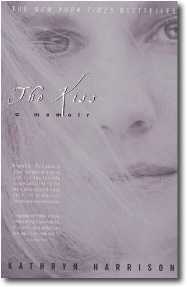
The Kiss by Kathryn Harrison

Appalling but beautifully written…jumping back and forth in time yet drawing you irresistibly toward the heart if a great evil. – Christopher Lehmann Haupt, The New York Times

Memoirs are all the rage these days and I have read a few– but I’ve never read anything like The Kiss by Kathryn Harrison. I’ve read a couple other books by Harrison and I now more fully understand some of the recurring themes in her novels (dysfunctional families, issues of love and the withholding of it, estrangement, emotional blackmail) after finishing The Kiss.

This is a well-known book, I think, despite having been published ten years ago. It received copious praise and, despite its difficult subject matter, I can see why. In fandom, we often write incest fic and consider it to be hot– but Harrison’s story of her affair with her father is never titillating. Instead, it’s a breathtaking and gut-clenching examination of how her seemingly unrequited love for her mother manifested itself into an all consuming and ultimately devastating sexual affair with her estranged father.

Harrison’s father left the family (at his in-law’s request) when the author was six months old. Until she was twenty she only saw him twice. Her father, a well-educated preacher, drew her into an affair with a kiss.

The book is frighteningly honest – Harrison doesn’t spare herself or her part in the relationship. She turns a keen, intelligent (but very emotional) eye on her life, the important relationships she had (or desperately wanted to have) and her father– who is one of the vilest characters I have ever met.

I couldn’t put this book down and when I was done I felt such a great sadness for her.